Best Surrey UCO Prices: 2026 Commercial Kitchen Guide
The highest quoted rate may not deliver the best return for your kitchen. If you're trying to get the best price for UCO Surrey, the value of the oil matters, but so do collection terms, any charges and the paperwork you receive.
It’s reasonable to want a clear offer and a collection that doesn’t disrupt service. Used cooking oil value can be affected by factors such as quantity and condition, so compare what you’ll actually receive, not just a headline rate. Look for clear payment terms and the right waste documentation alongside any payment offered.
This guide explains what can affect the value of commercial UCO, how to assess a collection offer and how to organise a practical collection in Surrey. Cash 4 Waste Oil provides free commercial collections, pays cash on the spot for collected used cooking oil and supplies a Waste Transfer Note. Use the guidance below to compare arrangements, prepare your kitchen team and understand how collected oil is put to use as biodiesel.
Key Takeaways
- To get the best price for UCO Surrey, look beyond the headline offer and compare the complete collection arrangement.
- Oil quantity, condition and collection practicality can affect its value, so share clear details about your commercial kitchen’s used oil.
- Compare payment method, any collection charge, the collection arrangement and the documentation supplied.
- Prepare your team by identifying the food-grade cooking oil, sharing collection details, arranging collection and retaining the Waste Transfer Note.
- Cash 4 Waste Oil offers Surrey commercial kitchens free collection and cash payment on the spot, with a Waste Transfer Note provided.
Getting the best price for UCO in Surrey starts with the right kind of oil
You want to recover value from used oil without disrupting a busy kitchen. Start by identifying what you need: commercial used cooking oil collection, not a purchase of heating oil. These are different services, with different purposes and collection arrangements.
Used cooking oil collection is the recovery of spent, food-grade cooking oil from commercial kitchens; heating-oil delivery supplies fuel for heating systems. That distinction matters when searching online. Heating-oil comparison pages focus on buying fuel, often using postcode and order quantity to show delivery options. They don’t explain how a restaurant or pub can arrange collection of used fryer oil or assess what a collection offer includes.
Used cooking oil (UCO) is also known as waste cooking oil and can be recycled for uses such as biodiesel production. For a Surrey business, describe the material clearly so the collection arrangement fits the waste your kitchen actually produces.
What counts as commercial used cooking oil?
Think about the oil your team sets aside after food preparation. A restaurant may have used vegetable oil from its fryers; a pub, hotel or contract catering kitchen may produce similar oil during regular service. This section concerns used food-grade vegetable and cooking oils. It does not include engine oil from vehicles or industrial mineral oils, which are different materials and are not part of a commercial cooking-oil collection.
Keeping those categories separate avoids confusion when arranging collection. If your kitchen handles more than one type of oil, identify which containers hold used food-grade cooking oil. This gives the collector a clearer picture of what needs to be collected and keeps the arrangement focused on the right material.
Why Surrey businesses search for a better UCO return
For a commercial kitchen, used oil is an operational by-product, not a household heating purchase. The aim is to recover value while making collection manageable around food preparation, service and staff routines. To get the best price for UCO Surrey businesses should understand the full terms of an offer rather than focus on a headline payment alone.
Before arranging collection, establish how payment is made, whether collection carries a charge and what documentation is provided. These details affect the practical value of an offer and help you compare arrangements fairly. A straightforward process should fit the way your kitchen works without creating avoidable extra steps for staff.
Correctly identifying the oil is a useful first move. Once you know it is used food-grade cooking oil, you can describe the collection need accurately and assess an offer in context. Next, consider the factors that may affect the oil’s value and compare payment and collection terms like for like.
What can affect the value of used cooking oil collected in Surrey?
There isn’t a single rate that applies to every kitchen’s used cooking oil. A collector may consider the amount available, its condition and how practical it is to arrange collection. These are general valuation considerations, not a formula or a guaranteed payment for an individual business.
A UCO valuation reflects the details of the oil and collection arrangement; it does not guarantee a particular payment. A headline rate without clear terms can therefore be misleading. It may not tell you what your kitchen will receive or whether collection costs affect the overall return.
Oil quantity, condition and handling
The quantity available helps a collector understand the scale of the collection, while the condition can affect how suitable the oil is for recovery. For example, oil kept separate from unrelated waste may be easier to assess than oil mixed with other materials. These are practical considerations, not a published pricing formula or a promise of a specific rate.
Describe the oil accurately. Share a realistic estimate of the amount and mention anything that could affect its condition or handling. Clear information helps establish whether the proposed collection arrangement fits the oil you have, rather than an assumption based on a headline offer.
Compare the full collection offer, not just the payment
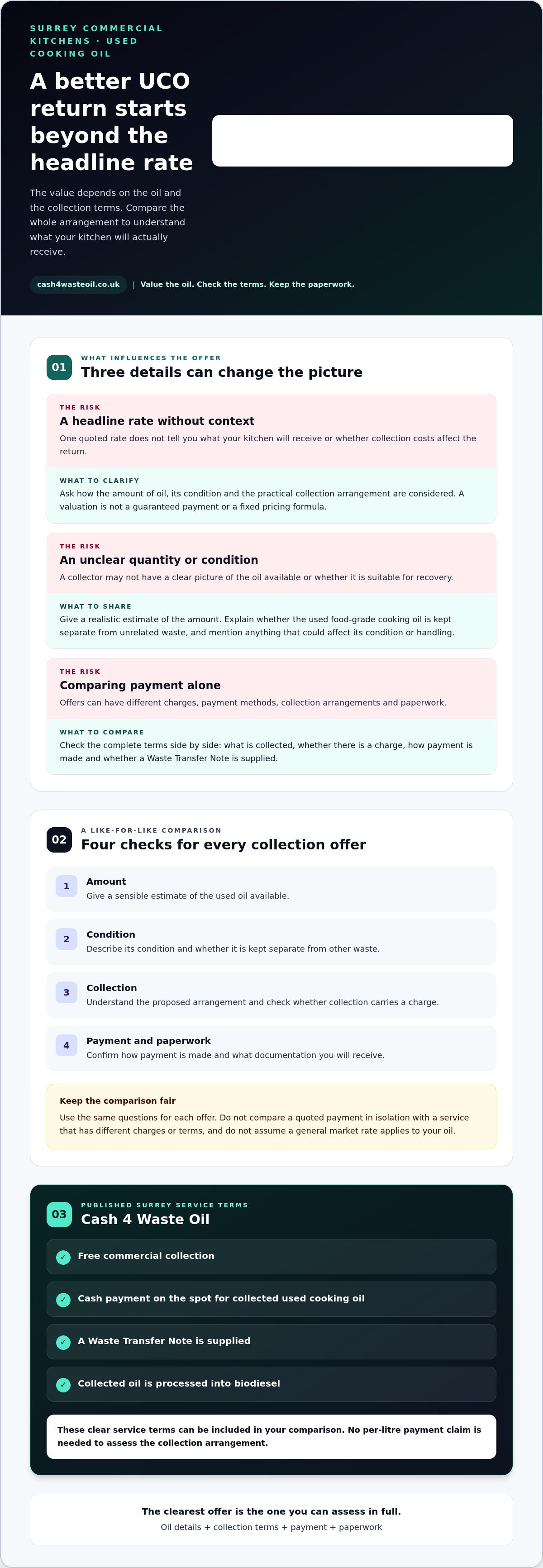
Consider the complete arrangement before deciding what represents good value. Is collection free, and how is payment made? What collection arrangement is proposed, and will you receive a Waste Transfer Note? These details help you understand the practical return and what your kitchen team needs to plan for.
Use the same questions for each offer. Don’t compare a quoted payment in isolation with a service that has different charges or terms, and don’t assume a general market rate applies to your oil. A fair comparison relies on clearly stated details: what is collected, any charge, the payment method and the paperwork supplied.
For Cash 4 Waste Oil collections in Surrey, commercial kitchens receive free collection, cash payment on the spot for collected used cooking oil and a Waste Transfer Note. The oil is processed into biodiesel. Include these clear service terms in your comparison without relying on an unsupported per-litre claim.
- Amount: Give a sensible estimate of the oil available.
- Condition: Explain whether it’s kept separate from other waste.
- Collection: Understand the arrangement and whether there’s a charge.
- Payment and paperwork: Check how payment is made and what documentation is supplied.
To assess the value in context, compare the stated terms with your kitchen’s needs, not an assumed rate. When considering a straightforward commercial UCO collection in Surrey, weigh up payment, collection and documentation together. That gives you a clearer basis for deciding whether the arrangement works for your business.
How to compare UCO collection offers and identify genuine value
A payment offer is only useful if you understand the terms behind it. A headline rate may look attractive, but unclear charges, payment arrangements or paperwork can create extra cost and work for your kitchen. Compare the full service, not just the amount quoted.
To get the best price for UCO Surrey businesses should compare offers on the same basis: the oil being collected, any collection charge, how payment is made, the collection arrangement and the documentation supplied. Don’t assume an advertised rate is a guaranteed return for your kitchen. Look for stated terms you can assess and keep a record of what’s agreed.
A practical checklist for assessing a collection offer
Use the same checks for each offer. Note the answers in a simple comparison sheet so you can see where the terms differ without relying on assumptions or general market rates.
- Collection charge: Is collection free, or is a charge stated? Record any cost that affects the overall return.
- Payment: How and when will payment be made? Write down the stated method and timing.
- Collection arrangement: Is the proposed arrangement practical for your kitchen’s operations? Record the agreed approach rather than assuming it will suit your schedule.
- Documentation: What paperwork is supplied? Check that a Waste Transfer Note is provided and retain it with relevant business records.
Headline payment versus the complete service
A quoted payment doesn’t show the whole picture if the collection also brings a charge or requires extra handling by your staff. Consider the likely return alongside the costs and operating effort involved. For example, an offer that appears higher at first glance may be less useful if its collection terms are unclear or leave your team with additional steps.
A clear, documented arrangement is easier to plan around. You can see how payment works, what the collection involves and what records you’ll receive. That clarity helps you make a fair comparison, even when offers use different wording. Don’t treat an unexplained rate as proof of the best value, and don’t assume a rate quoted elsewhere applies to your oil or collection.
| Comparison point | What to record |
|---|---|
| Payment method | How and when payment is made |
| Collection charge | Whether collection is free or a charge applies |
| Collection arrangement | The stated plan and practical requirements |
| Documentation | Whether a Waste Transfer Note is supplied |
Cash 4 Waste Oil provides free commercial UCO collection in Surrey, pays cash on the spot for collected used cooking oil and supplies a Waste Transfer Note. Compare those terms with your kitchen’s needs. If you’re also reviewing arrangements in another area, the related guide to getting paid for used cooking oil in London covers the same practical considerations for London businesses.
Prepare your Surrey kitchen for a straightforward UCO collection
A little preparation makes it easier to organise collection around a commercial kitchen’s day-to-day work. Identify the used cooking oil, share clear details about what’s available and where it’s kept, agree the collection arrangement, then file the paperwork afterwards. These steps help avoid confusion and give the collector useful information from the outset.
There’s no need to overcomplicate the process. Give an accurate picture of the oil and collection location, and make the arrangement clear to the staff involved. To get the best price for UCO Surrey businesses can start by sharing the right details and understanding the collection terms before arranging the service.
Share useful details before arranging collection
Start with the essentials: explain what kind of commercial kitchen you operate and describe the used food-grade cooking oil you have. Give a realistic estimate of the amount and explain where the oil is located on site. Clear information helps shape a practical arrangement without relying on assumptions about volume, access or timing.
Then agree how the collection will fit your operations. Keep relevant staff informed so they know which oil is being collected and where to direct the collector. Avoid making plans around an assumed arrival time or collection frequency. Follow the arrangement agreed for your kitchen.
A simple preparation sequence
- Identify the oil. Separate commercial used cooking oil from other materials, including engine or industrial oils.
- Share the details. Describe your business, the oil available, an approximate amount and its collection location.
- Arrange the collection. Agree practical details so the process fits your kitchen’s operations.
- Retain the paperwork. Keep the Waste Transfer Note supplied with the collection alongside your relevant business records.
Keep the information straightforward and accurate. If the amount changes or the collection location needs clarification, make sure the people coordinating the collection have the latest details. Clear communication can prevent avoidable back-and-forth and make the handover easier for your team.
Keep collection records organised
A Waste Transfer Note records key information about a waste collection. Cash 4 Waste Oil provides a Waste Transfer Note with its commercial used cooking oil collection service. After collection, retain the document with your business records so it’s easy to locate if your team needs to refer to the transaction later.
Choose a consistent place to file collection paperwork, whether that’s with other waste records or in your business’s established record-keeping system. Make sure the staff member responsible for the collection knows where the note will be stored. A tidy process reduces the chance of paperwork being misplaced during a busy shift.
With the oil identified, collection details shared and documentation accounted for, your team has a clear process to follow. Arrange a commercial UCO collection in Surrey with Cash 4 Waste Oil and receive free collection, cash payment on the spot and a Waste Transfer Note.
Get a clear UCO collection arrangement from Cash 4 Waste Oil in Surrey
Cash 4 Waste Oil collects used food-grade cooking oil from commercial kitchens in Surrey. This service helps businesses recover value from used kitchen oil; it is not a supply of heating oil. The terms are straightforward: collection is free, payment is made in cash on the spot for the oil collected, and a Waste Transfer Note is provided.
Clear terms make it easier to plan for collection, understand how payment is made and keep the paperwork together. Rather than basing a decision on an unverified headline rate, consider the actual arrangement and how it fits your kitchen.
What Surrey commercial kitchens can expect
The service is for restaurants, pubs, hotels and other commercial kitchens with used food-grade cooking oil. Cash 4 Waste Oil offers scheduled or on-call commercial collections, giving businesses a way to arrange collection in line with their operational needs. The collection arrangement is made around the details of the business and its oil.
Collections are fully licensed and Environment Agency registered. The Waste Transfer Note supplied with the collection provides a record for your business. This is commercial UCO collection, not domestic oil collection for householders, and it does not cover engine or industrial mineral oils.
Cash 4 Waste Oil collects commercial used cooking oil across London, Greater London, Kent, Surrey, Birmingham, Coventry, Leicester, Wolverhampton, Leicestershire, Derbyshire, Staffordshire, Warwickshire, Northamptonshire, Oxfordshire and Worcestershire.
Arrange a collection and turn used oil into value
To get started, provide your business details and information about the used cooking oil and its collection location through the Cash 4 Waste Oil website. Clear details help establish a practical arrangement for your kitchen. Your team can then plan the handover and retain the Waste Transfer Note with its relevant business records.
Collected oil is processed into biodiesel. This gives used cooking oil a further purpose as a resource, while keeping the decision straightforward: organise collection, receive cash payment on the spot and retain the paperwork supplied with the service.
If you want to get the best price for UCO Surrey, weigh the complete arrangement rather than chasing a rate without clear terms. Cash 4 Waste Oil offers free collection for commercial kitchens in Surrey, on-the-spot cash payment and a Waste Transfer Note, backed by fully licensed, Environment Agency registered collections.
Arrange your Surrey commercial UCO collection with Cash 4 Waste Oil and turn used cooking oil into a practical return for your business.
Make used oil part of a smoother kitchen routine
Turn used cooking oil from an afterthought into a simple part of your kitchen’s operating routine. Decide who shares collection details, who coordinates the handover and where the paperwork is kept. A clear process helps your team manage the next collection with less last-minute organising.
If you’re ready to get the best price for UCO Surrey, focus on an arrangement that makes the return and collection terms clear. Cash 4 Waste Oil provides free scheduled or on-call commercial collection, cash payment on the spot and a Waste Transfer Note. Collections are fully licensed and Environment Agency registered.
Arrange a commercial used cooking oil collection for your Surrey kitchen and take the next practical step towards a more organised oil collection routine.
Frequently Asked Questions
Is used cooking oil collection free for Surrey businesses?
Yes, Cash 4 Waste Oil provides free used cooking oil collection for commercial kitchens in Surrey. There is no collection charge reducing the return. If you’re comparing options to get the best price for UCO Surrey, consider the full terms as well as any payment offered. The service is for commercial food businesses, not household cooking oil.
How is payment made for collected used cooking oil?
Cash 4 Waste Oil pays businesses in cash on the spot for the used cooking oil collected. This gives the kitchen a clear payment method at collection, rather than a voucher or a later payment arrangement. Make sure the staff member overseeing the handover knows the agreed process and can coordinate with the collector. The amount paid depends on the oil collected; no fixed rate is stated here.
Can a household in Surrey arrange used cooking oil collection?
No. Cash 4 Waste Oil’s collection service is for commercial kitchens, such as restaurants, pubs and hotels, rather than domestic households. A household’s leftover frying oil is not the same collection arrangement as a business’s commercial oil stream. The service is intended for used food-grade cooking oil generated by a food business operating from a commercial kitchen.
What paperwork is provided after a commercial UCO collection?
Cash 4 Waste Oil provides a Waste Transfer Note with its commercial collection. Keep the note with your business’s waste records so it can be found if you need to refer to a particular collection. Make sure the person receiving the paperwork passes it to whoever manages your kitchen’s records. This helps keep collection documentation together instead of mixed in with day-to-day service paperwork.
Does Cash 4 Waste Oil collect engine oil as well as cooking oil?
No. Cash 4 Waste Oil collects used food-grade vegetable and cooking oils from commercial kitchens. Engine oil and industrial mineral oils are different materials and are not accepted as cooking-oil collections. Keep those materials separate and describe the oil accurately when organising a commercial kitchen collection. For example, used fryer oil belongs in the cooking-oil category, while oil drained from a vehicle does not.
What happens to used cooking oil after collection?
Collected used cooking oil is processed into biodiesel. This gives spent kitchen oil a further use as a feedstock for biodiesel production, rather than treating it as a material with no value after cooking. For a business, the practical point is simple: used food-grade oil can be collected and directed into processing that turns it into a useful resource.
Can a Surrey pub or hotel use the collection service?
Yes. Pubs and hotels with commercial kitchens can arrange collection of their used food-grade cooking oil. The service also serves restaurants and other commercial kitchens. A pub might have fryer oil from its food service, while a hotel could produce used cooking oil through its kitchen operations. Share the business type and collection details when arranging service so the collection can be planned around the oil available.