Catering Waste Oil Documentation: The 2026 UK Compliance Guide
Could a single missing piece of paper really cost your kitchen over £5,000 this year? With the Environment Agency now charging £118 per hour for non-compliance investigations, the stakes for your catering waste oil documentation have never been higher. You've probably felt the frustration of trying to keep physical records clean in a greasy kitchen environment or felt confused by the shift to mandatory Digital Waste Tracking in October 2026. It's a lot to manage whilst you're trying to run a profitable service.
We understand that you want a kitchen that's both efficient and legally bulletproof. This guide provides the clarity you need to master the 2026 UK compliance landscape, ensuring you avoid heavy fines and pass every inspection with confidence. We'll break down the specific legal requirements for Waste Transfer Notes, show you how to organise a foolproof filing system, and explain how your used oil is transformed into sustainable biodiesel. By the end, you'll have a clear roadmap to keep your business compliant, your records digital, and your kitchen stress-free.
Key Takeaways
- Understand your legal "Duty of Care" to avoid fixed penalty notices and costly Environment Agency investigations.
- Identify the six essential components required for compliant catering waste oil documentation to ensure every collection passes inspection.
- Prepare for the mandatory transition to the Digital Waste Tracking (DWT) service coming into force in October 2026.
- Protect your business from liability by verifying a collector’s upper-tier waste carrier licence before any oil leaves your premises.
- Master the "Two-Year Rule" for document retention to keep your commercial kitchen audit-ready at all times.
The Legal Framework: Why Catering Waste Oil Documentation Matters
The Environmental Protection Act 1990 dictates how your kitchen manages its by-products. Under this legislation, every commercial food business has a "Duty of Care." This means you're legally responsible for your waste from the moment it's produced until it's safely disposed of or recycled. Waste oil management falls squarely under this remit. If your oil is fly-tipped by an unlicensed collector, the Environment Agency (EA) will hold you accountable, not just the person who dumped it.
Duty of Care Regulations and Your Responsibility
Your legal obligation doesn't end when the collection van pulls away. You must prove that you've handed your waste to a registered carrier. During a local authority audit, claiming you didn't know the rules won't protect you. Inspectors look for a clear paper trail. Whether you operate in London, Birmingham, or Coventry, you must have valid catering waste oil documentation for every single litre that leaves your site. Failure to produce these records can lead to fixed penalty notices or even criminal prosecution.
Food Safety Act 1990: More Than Just Hygiene
Environmental Health Officers (EHOs) often use waste records as a barometer for your overall kitchen management. Poor oil disposal often leads to "statutory nuisance" issues, such as foul odours or severe drain blockages. These blockages cost the UK economy millions annually and are a primary cause of fatbergs. If an inspector finds evidence of oil entering the drainage system, they'll likely trigger a full Food Standards Agency (FSA) inspection. Proper catering waste oil documentation proves you aren't the source of the problem.
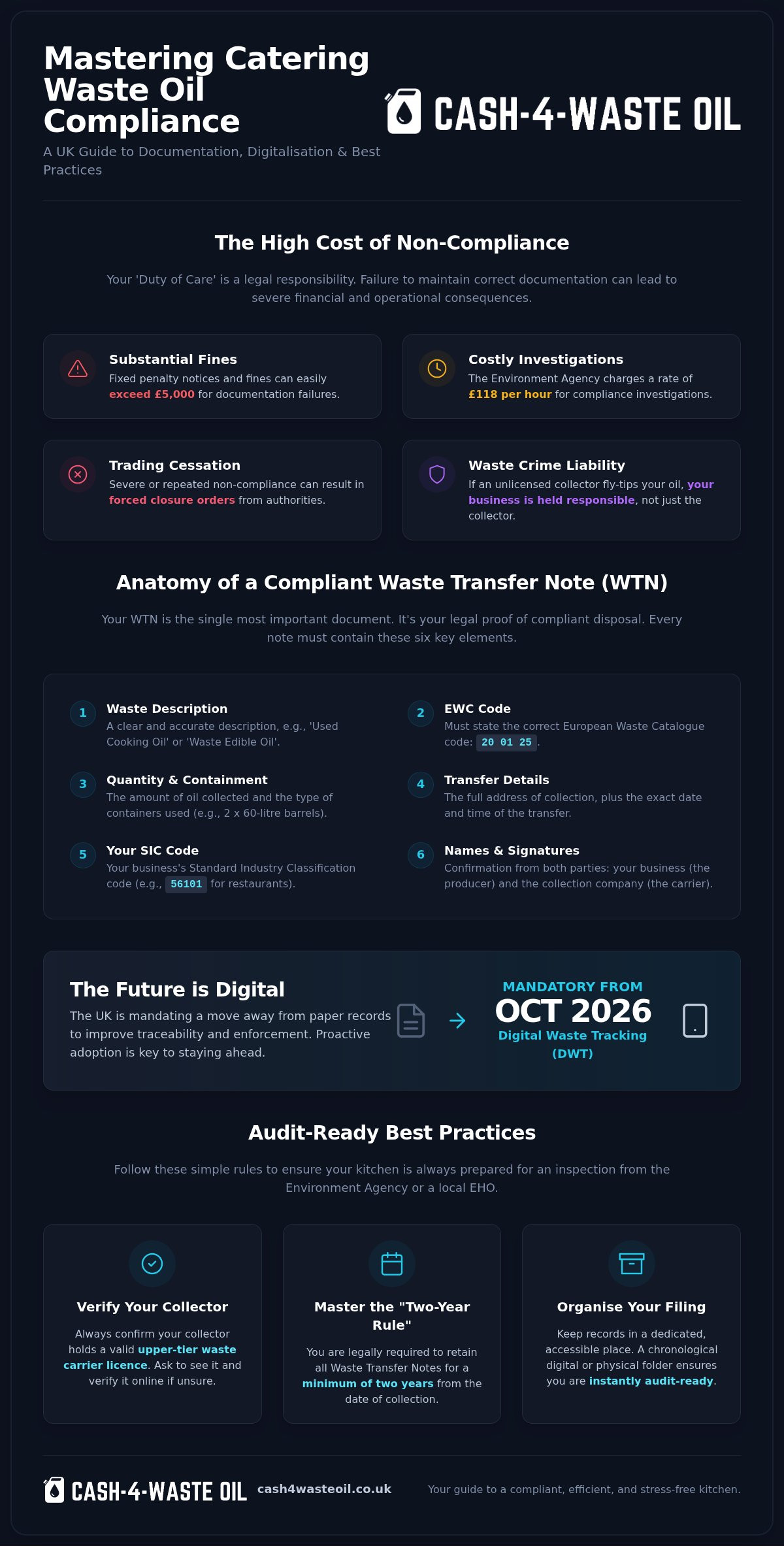
The consequences of ignoring these regulations are severe. The Environment Agency has strengthened its enforcement approach for 2026. Consider these risks to your business:
- Immediate fixed penalty notices and fines that can exceed £5,000.
- Environment Agency investigation charges, currently billed at £118 per hour.
- Potential trading cessation orders that force your doors to close.
- Legal liability for "waste crime," which costs the UK economy £1 billion each year.
Documentation is your legal shield. It prevents the drainage issues that attract pests and proves your environmental responsibility. EHOs typically ask for your disposal records at the start of a visit. Having them organised shows you run a professional, compliant operation. Don't leave your business vulnerable to avoidable fines or closure.
The Waste Transfer Note (WTN): Anatomy of a Compliant Document
A Waste Transfer Note (WTN) is more than a receipt; it's a legal requirement that tracks waste from your kitchen to its final disposal point. According to UK government guidelines, you cannot move waste without one. It's the primary piece of catering waste oil documentation that proves you've met your Duty of Care. Without this document, you have no proof that your oil didn't end up in a local river or sewer.
Every compliant WTN must contain six specific data points:
- A clear description of the waste (Used Cooking Oil).
- The correct EWC code (20 01 25).
- The quantity and type of containers used (e.g., 20-litre drums).
- The date, time, and full address of the transfer.
- Your business’s Standard Industry Classification (SIC) code.
- The names and signatures of both the producer and the carrier.
Most UK restaurants use SIC code 56101. This helps the Environment Agency track waste streams across different sectors. You should also decide if a "Season Ticket" suits your business. Whilst a single-load WTN covers one-off collections, a Season Ticket allows for multiple transfers of the same waste over 12 months. This is ideal for kitchens with regular, weekly collections and simplifies your filing process.
Mandatory Information for Your Oil Collection Records
Accuracy is non-negotiable. Your records must explicitly list the EWC code 20 01 25. This identifies the material as edible oil rather than hazardous mineral oil. Having the correct catering waste oil documentation ensures that you aren't held liable for improper disposal later. If you want a service that manages these details for you, you can book a collection today and receive your paperwork instantly on-site.
Digital vs. Physical Waste Transfer Notes
The mandatory Digital Waste Tracking (DWT) service launched in October 2026 has changed the landscape. Digital WTNs are now the legal standard and are preferred for their superior traceability. They won't get stained by kitchen grease or lost in a cluttered drawer. However, some local inspectors still appreciate seeing a physical "Compliance Folder" for quick reference. If you choose to go digital, make sure your staff can access the files immediately on a mobile device during an unannounced visit. Digital signatures are perfectly valid, provided they're captured at the point of transfer and include a secure, verifiable timestamp.
Licensed Carriers vs. Unregulated Collectors: Protecting Your Business
Many "cowboy" collectors operate across the UK, offering tempting cash payments for used oil whilst providing zero paperwork. This is a trap. If a collector doesn't provide a Waste Transfer Note, they aren't operating legally. Under UK government guidance on waste cooking oil, businesses must ensure their waste is handled by an authorised carrier. Choosing an unregulated collector isn't just a minor oversight; it's a breach of your Duty of Care that leaves your business exposed to severe legal action. If that oil is later fly-tipped, the Environment Agency will trace it back to you, not the person who collected it.
Verifying Your Collector in London and the Midlands
Checking a company’s credentials takes less than a minute. You can visit the Environment Agency public register online and search by the business name or registration number. Look specifically for an "upper tier" waste carrier licence. Legitimate collectors in London, Surrey, and Kent will also display their branding and licensing badges clearly on their vehicles. Cash 4 Waste Oil maintains full transparency with our Environment Agency registration. This protects your business reputation and ensures your catering waste oil documentation is always audit-ready. If a collector becomes defensive when you ask for their licence number, turn them away immediately. Professionalism starts at the back door.
The Financial Risk of Unlicensed Disposal
The true cost of an unlicensed collection far outweighs any small cash incentive. If your oil is found fly-tipped, you could face immediate spot fines of £300 or more; larger non-compliance cases often lead to fines exceeding £5,000. Perhaps more critically, using an unregulated carrier can void your business insurance policies. Most commercial insurers require proof of legal waste disposal to maintain coverage. Without valid catering waste oil documentation, you might find yourself footing the bill for a kitchen fire or flood without any insurance support. The risk to your livelihood is simply too high.
Regional authorities in London and the Midlands are increasingly active in conducting spot checks on commercial premises. They don't just look for the oil; they look for the paper trail. A "cash on the spot" model is perfectly legal and beneficial for your cash flow, but only if it's accompanied by a valid legal note. By partnering with a licensed carrier, you ensure your oil is recycled into sustainable biodiesel whilst keeping your business on the right side of the law. It's a smart business decision that balances financial gain with total regulatory peace of mind.
Best Practices for Record Keeping and Inspections
Legally, you must retain every Waste Transfer Note for a minimum of two years. This "Two-Year Rule" ensures that authorities can trace waste patterns over time to identify potential environmental risks. If an Environmental Health Officer (EHO) visits your premises in London or Birmingham, they won't just look at today's collection. They often request a retrospective look at your catering waste oil documentation to ensure consistency. Gaps in your records suggest improper disposal, which triggers deeper investigations.
Organising Your Kitchen Paperwork
Kitchens are notoriously difficult environments for physical paperwork. Heat, steam, and grease can quickly ruin essential legal documents. We recommend maintaining a dedicated "Compliance Folder" stored in a dry office area or a sealed plastic box. Organise your notes chronologically; auditors prefer a clear timeline that matches your business activity. To make your records truly bulletproof, try linking your fresh oil purchase receipts with your waste oil disposal notes. This proves that the volume of oil entering your kitchen roughly matches the volume being recycled or consumed in food, leaving no room for accusations of illegal dumping.
Don't let your compliance rely solely on one person. Train your senior staff to collect and file WTNs whenever a collection occurs. If you're off-site during a delivery or collection, your team must be able to produce the necessary catering waste oil documentation immediately. A "we'll find it later" response rarely satisfies a busy inspector.
Preparing for a Local Authority Spot Check
When an EHO arrives, they'll likely ask where your oil is stored and who handles the removal. They're looking for evidence of a "closed-loop" process. By showing a stack of valid WTNs, you demonstrate that your waste isn't just "gone," it's being converted into sustainable biodiesel. This contributes to the circular economy and shows your business is environmentally responsible. If you want to simplify this process, you can book a professional waste oil collection and receive your legal documentation on the spot.
Being prepared turns a high-stress inspection into a routine check. When you can present a tidy, chronological folder of licences and transfer notes, the inspection usually concludes much faster. It signals to the officer that you take your regulatory duties seriously, which often leads to a more favourable overall hygiene rating.
Hassle-Free Compliance with Cash 4 Waste Oil
Managing catering waste oil documentation shouldn't feel like a second job. We've built our service to handle the administrative burden so you don't have to. By choosing a partner that automates the paperwork, you ensure your kitchen remains compliant whilst focusing on your customers. Our Environment Agency registered collection network provides the legitimacy required to pass any local authority audit with total confidence.
We believe compliance should be a reward, not just a requirement. That's why we pay cash per litre for your used cooking oil on the spot. You receive the financial benefit of your waste whilst obtaining the mandatory Waste Transfer Note (WTN) immediately. It's a pragmatic solution for busy commercial kitchens that values both your time and your bottom line. We take the stress out of logistics so you can get back to what you do best.
Our Seamless Collection and Documentation Process
Our process is designed for speed and reliability. It follows a logical sequence that ensures you're never left waiting:
- Initial Booking: Schedule a collection that fits your kitchen's quiet periods.
- On-Site Collection: Our licensed carriers arrive at your site in London, Kent, Surrey, or the Midlands.
- Immediate Documentation: We issue your compliant WTN on the spot.
- Instant Payment: You receive cash per litre for your food-grade vegetable oil.
We handle the heavy lifting, pumping your used vegetable oil into our secure vehicles. Your oil is then transported to our processing facilities where it's refined into sustainable biodiesel. This ensures your waste helps power the UK's transport network instead of clogging our sewers. We serve a wide area, including Birmingham, Coventry, and the Warwickshire region, providing a local service you can depend on.
Join the Circular Economy Today
Professional kitchens are moving away from unregulated collectors who offer no protection. They're switching to partners who provide transparency, licensing, and financial incentives. By joining our network, you're doing more than just ticking a compliance box. You're participating in a modern circular economy that treats waste as a valuable resource. It's a smart business decision that benefits your kitchen and the planet simultaneously.
Our service fits around your kitchen’s schedule. We understand the fast-paced nature of the hospitality sector and aim to provide a stress-free experience. There's no need to worry about missing records or greasy paperwork when you have a digital-ready partner. Take the first step toward a cleaner, more profitable kitchen today. Our team is ready to help you streamline your waste management.
Get a quote and book your compliant collection today.
Secure Your Kitchen’s Future with Compliant Waste Management
Maintaining accurate catering waste oil documentation isn't just about ticking boxes; it's about protecting your business from the £118-per-hour investigation fees and heavy fines that follow non-compliance. You've learned that your Duty of Care is a permanent responsibility, and the upcoming shift to mandatory Digital Waste Tracking in October 2026 makes professional record-keeping more critical than ever. By choosing a licensed carrier, you ensure your oil is recycled into sustainable biodiesel whilst keeping your kitchen audit-ready and your drains clear.
Don't let greasy paperwork or unregulated collectors put your livelihood at risk. We provide a seamless solution that handles every legal requirement for you. As an Environment Agency registered partner, we offer instant cash payments on-site and provide full Waste Transfer Notes for every collection. This allows you to focus on your service with total peace of mind that your environmental duties are met.
Ready to streamline your compliance? Get Cash for Your Waste Oil & Stay Compliant Today. We're here to help you turn your waste into a reliable revenue stream whilst keeping you on the right side of the law.
Frequently Asked Questions
How long must I keep my waste transfer notes for cooking oil?
You must legally retain all waste transfer notes for a minimum of two years from the date of the transfer. This is a mandatory requirement under the Environmental Protection Act 1990. During this period, you must be able to produce these records immediately if requested by a local authority or the Environment Agency. Storing your records in a dry, chronological folder ensures you remain audit-ready and avoids the risk of non-compliance penalties.
Can I get a fine if I don’t have a waste transfer note?
Yes, failing to produce a valid waste transfer note can result in significant financial penalties. Local authorities often issue immediate fixed penalty notices for missing records. If the case proceeds to court, fines can exceed £5,000. Additionally, the Environment Agency may charge an investigation fee, currently billed at £118 per hour. Proper catering waste oil documentation is your only legal protection against these avoidable costs and potential criminal prosecutions.
What is the EWC code for used cooking oil in the UK?
The correct European Waste Catalogue (EWC) code for used cooking oil is 20 01 25. This specific code identifies the material as edible oil and fat, distinguishing it from hazardous mineral oils. It's essential that this code appears on every piece of catering waste oil documentation you receive. Using the wrong code or leaving it blank can invalidate your transfer note, leading to compliance issues during a professional Environmental Health Officer audit.
Do I need a waste transfer note if the collection is free?
You absolutely need a waste transfer note, even if the collection is free or if you're being paid for the oil. The legal requirement for a WTN is based on the movement of waste, not the financial transaction involved. Your Duty of Care requires a documented trail for every litre of oil that leaves your premises. Without this paperwork, you have no proof that the waste was handled by a licensed carrier.
Is a digital waste transfer note legally acceptable for a kitchen inspection?
Digital waste transfer notes are legally acceptable and have become the standard following the launch of the mandatory Digital Waste Tracking (DWT) service in October 2026. These digital records are often preferred because they're easier to store and harder to lose than physical paper. Ensure your staff know how to access these files on a tablet or smartphone so they can present them to an inspector immediately during any surprise visit.
What happens if I lose my waste oil documentation?
If you lose your records, you should contact your waste carrier immediately to request copies. Most professional collectors maintain digital backups of all issued transfer notes. Since you're legally required to keep these for two years, it's vital to replace missing documents as soon as possible. Keeping a secondary digital backup in a secure cloud folder is a smart way to ensure your kitchen remains compliant even if physical copies are damaged.
Who is authorised to ask for my catering waste records?
Several authorities are legally authorised to inspect your waste records. These include Environmental Health Officers (EHOs) from your local council, officers from the Environment Agency, and representatives from the water board investigating drain blockages. These professionals can request to see your records at any reasonable time. Having your folder organised and accessible demonstrates that you take your legal and environmental responsibilities seriously, often leading to a much smoother inspection process.
Does a waste transfer note prove my oil was recycled into biodiesel?
A waste transfer note proves that your oil was handed to a licensed carrier for legal disposal or recycling. Whilst it doesn't track the exact chemical transformation, using a registered carrier like Cash 4 Waste Oil ensures the oil enters a legitimate recycling stream. We process collected oil into sustainable biodiesel, and your WTN provides the legal link in that chain. This documentation confirms your kitchen's active contribution to the circular economy.