Commercial Cooking Oil Waste Regulations UK 2026: The Essential Compliance Guide
Could a single missing document be the difference between a profitable week and a heavy Environment Agency fine? For UK hospitality owners, staying ahead of commercial cooking oil waste regulations is no longer just a box-ticking exercise; it is a critical business strategy. We understand the pressure of managing a high-pressure kitchen where storage space is at a premium and the paperwork feels endless. It is easy to feel overwhelmed by the legalities of waste disposal when you would rather focus on serving your customers.
This guide will help you master the 2026 compliance landscape so you can stop fearing inspections and start seeing your waste as a legal asset. We promise to simplify the complex rules into a repeatable process that protects your business and your bottom line. You will learn exactly how to handle Waste Transfer Notes, meet new storage standards, and secure a financial return for your used oil. We are moving beyond the jargon to give you a clear, pragmatic roadmap for total peace of mind and professional compliance.
Key Takeaways
- Understand how the 2026 legislative framework defines your "Duty of Care" and why it applies to every business producing used oil.
- Navigate the latest commercial cooking oil waste regulations to ensure your waste carriers are fully licensed and Environment Agency registered.
- Master the Waste Transfer Note (WTN) process to ensure you have a legal defence ready for any health and safety inspection.
- Implement practical storage and drainage solutions to prevent leaks and avoid heavy fines under current "Fatberg" legislation.
- Learn how to turn a logistical burden into a profit centre by securing cash payments for your used cooking oil.
The Legal Landscape of Commercial Cooking Oil Waste in 2026
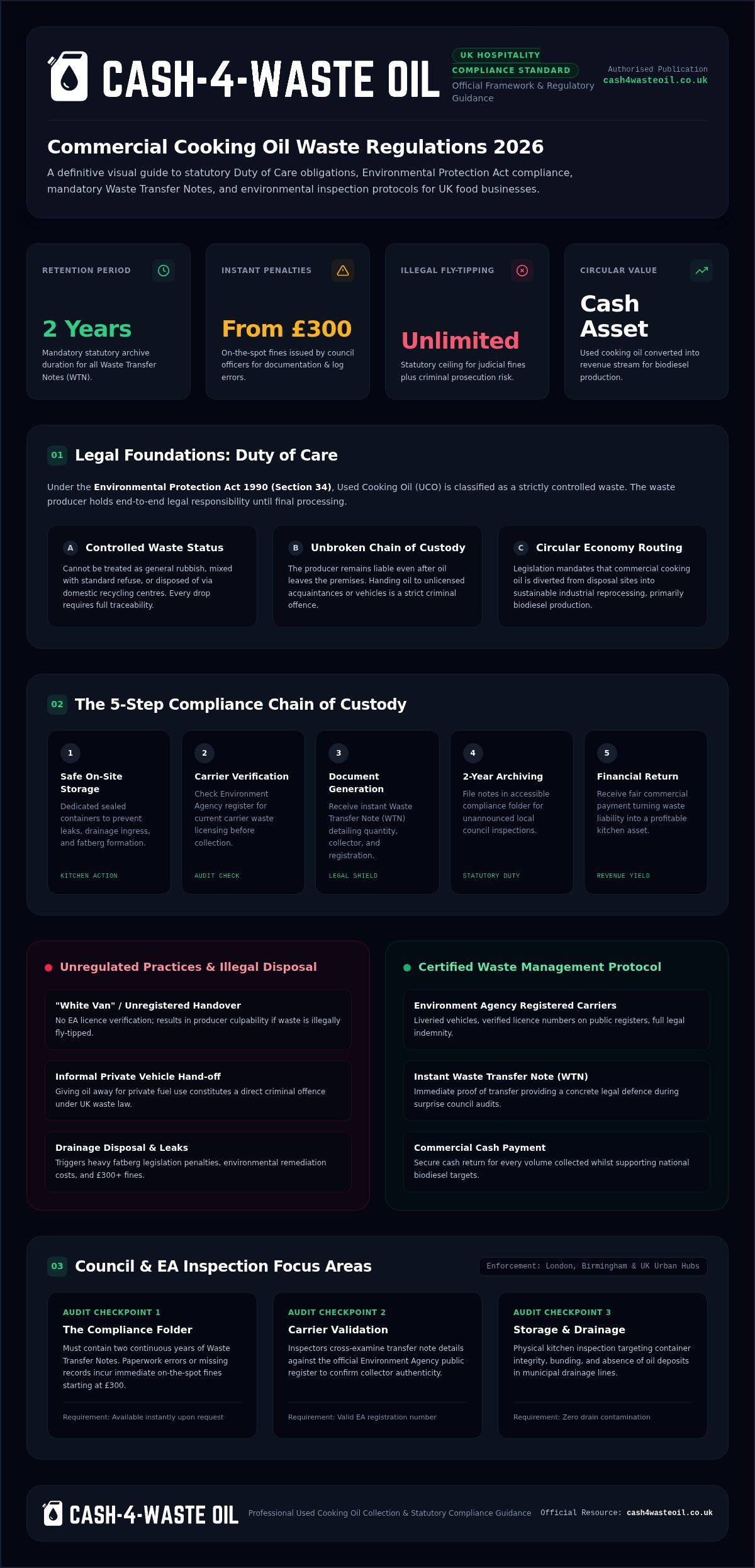
In 2026, the framework surrounding commercial cooking oil waste regulations is stricter than ever. Used cooking oil (UCO) is classified as a controlled waste, meaning it cannot be treated like general rubbish or poured away. The UK government has tightened the protocols under the Environmental Protection Act to ensure that every drop of oil is tracked from the kitchen to the processing plant. This legislative shift aims to eliminate illegal dumping and ensure that waste is diverted into the circular economy, specifically for biodiesel production. If your business produces UCO, you are part of a regulated chain of custody that requires total transparency.
Defining Your Duty of Care as a Waste Producer
The "Duty of Care" is a legal requirement that sits squarely on your shoulders. It dictates that as a waste producer, you are responsible for your cooking oil until it reaches a licensed disposal or recycling facility. You cannot simply hand your waste to anyone. Many business owners have historically fallen into the trap of "giving it to a mate" for use in a private vehicle. Under current UK waste management regulations, this is a criminal offence. If that oil is later found dumped or handled incorrectly, the Environment Agency will trace it back to your kitchen. You must verify that your collector holds a valid Environment Agency registration before any oil leaves your premises.
The 2026 Regulatory Environment for UK Hospitality
Recent updates to the Environmental Protection Act have empowered local authorities to take a more aggressive stance on enforcement. In major urban hubs like London and Birmingham, local councils have increased the frequency of unannounced inspections. They aren't just looking at your food hygiene; they are checking your waste logs. As a pub landlord in 2026, your Duty of Care means you are legally responsible for ensuring every litre of used oil is collected by an Environment Agency registered carrier and documented with a valid Waste Transfer Note.
The consequences of ignoring these commercial cooking oil waste regulations are severe. Enforcement bodies, including the Environment Agency and local council officers, have the power to issue on-the-spot fines starting at £300 for paperwork errors. However, serious breaches or evidence of "fly-tipping" through unlicensed collectors can lead to unlimited fines and criminal prosecution. Beyond the financial hit, the reputational damage of a publicised environmental breach can be terminal for a hospitality brand. Staying compliant is the only way to protect your business's future and ensure a seamless inspection process.
Primary Regulations: The Environmental Protection Act and Licensing
The Environmental Protection Act 1990 (Section 34) is the foundation of all commercial cooking oil waste regulations in the UK. It establishes that you must take every reasonable step to prevent the unauthorised or harmful deposit, treatment, or disposal of waste. In simple terms, once your oil is used, it becomes a controlled substance. You cannot legally dispose of it via general waste bins or domestic recycling centres. Compliance requires you to transfer this waste only to an "authorised person," which in 2026 remains a carrier registered with the Environment Agency.
Identifying a Licensed Waste Carrier
Don't take a collector's word for it. Professional services always display clear identifiers, such as liveried vehicles and official identification cards. However, visual cues aren't enough to satisfy an auditor. You must verify their status on the Environment Agency public register before the first collection occurs. You can check this in real-time by searching for their name or licence number on the official UK government guidance on commercial waste disposal portal.
Using "white van" collectors who offer no documentation is a high-risk gamble. These individuals often lack the necessary insurance and legal permits. If they fly-tip your oil, the trail leads back to your kitchen. A reputable carrier will always provide a Waste Transfer Note (WTN) on the spot. If you want to ensure your business stays on the right side of the law, choosing professional waste oil collection is the safest route to guaranteed compliance.
Record Keeping and Audits
The law is clear. You must keep a record of all waste leaving your premises for at least two years. This is not a suggestion; it's a statutory requirement. During a surprise inspection, a council officer or Environment Agency representative will ask to see your compliance folder. This folder should contain every WTN issued to you, organised chronologically.
While physical folders are still common, many businesses are moving toward digital records for better security. Regulators in 2026 generally prefer digital logs as they are harder to lose and easier to audit. For a deeper look at the specific policy requirements that local authorities use during these checks, refer to this DEFRA cooking oil waste guidance. Having your paperwork ready and verified ensures that commercial cooking oil waste regulations don't become a source of stress during your next health and safety audit.
The Waste Transfer Note (WTN): Your Mandatory Compliance Document
A Waste Transfer Note (WTN) is not just a receipt; it is your primary legal defence. Under commercial cooking oil waste regulations, this document proves that you have fulfilled your Duty of Care by passing your waste to a licensed carrier. Without it, you have no evidence that your oil was disposed of legally. Think of it as a "get out of jail free" card for your next health and safety inspection. It is the most important piece of paperwork in your kitchen, sitting alongside your food temperature logs and hygiene ratings.
The WTN serves a critical purpose beyond simple record-keeping. If a rogue collector fly-tips your oil in a country lane, the Environment Agency will trace the waste back to your kitchen. If you cannot produce a WTN for that specific batch, you are legally liable for the cleanup costs and associated fines. The note effectively transfers the responsibility for the waste from your business to the carrier, providing you with total peace of mind once the oil leaves your premises.
By 2026, the industry has largely moved toward digital WTNs. Paper slips are easily lost in the chaos of a busy service, but digital versions can be stored securely in the cloud and retrieved instantly during an audit. This shift to paperless compliance ensures your trail is unbreakable and always accessible to local authority inspectors. It removes the stress of digging through old folders when an officer is standing in your kitchen.
Essential Components of a Valid WTN
A valid note must be precise to satisfy a regulatory inspector. It must include the specific EWC code 20 01 25, which is the legal classification for edible oil waste. Both the kitchen manager and the collector must sign the document to confirm the transfer. Additionally, it must clearly state the exact volume collected, the date of the transfer, and the carrier's Environment Agency registration number. If any of these details are missing, the document may be deemed invalid during a compliance check.
WTN Compliance Checklist for Managers
Managing commercial cooking oil waste regulations requires a systematic approach. Before you sign any document or allow a vehicle to leave, verify these three points:
- Is the collector’s licence number clearly visible and current on the note?
- Does the document specify the final destination for the oil, such as a biodiesel processing plant?
- Have you received a digital or physical copy immediately upon collection?
Ensuring these details are correct every time will protect your business from heavy fines. For a comprehensive review of your current setup, refer to this commercial kitchen oil disposal guide for a full kitchen audit.
Practical Kitchen Management: Storage, Drainage, and Council Inspections
Managing a busy kitchen requires more than just culinary skill; it demands a tactical approach to space and safety. In high-density areas like Soho and Camden, the struggle to balance storage with service is constant. However, Environmental Health Officers (EHOs) do not make exceptions for cramped conditions. They look for clean storage areas and documented disposal routes during every visit. Regional enforcement varies significantly; for instance, London councils often focus on drainage impact, while authorities in the Midlands may prioritise storage site safety. Understanding these local nuances ensures you stay ahead of commercial cooking oil waste regulations during unannounced inspections.
Avoiding the Drain Trap
Grease traps are mandatory for a reason. They prevent fats, oils, and grease (FOG) from entering the public sewer system. If you neglect your maintenance schedule, you risk contributing to "fatbergs" that cause massive infrastructure damage. Under current legislation, water companies can levy fines of over £5,000 if they trace a blockage to your pipes. A blocked sewer can shut your doors for days, leading to lost revenue that far outweighs the effort of a collection. Regular collections are the most effective way to maintain compliance with commercial cooking oil waste regulations while keeping your floor space clear. The cost of a professional sewer jetting service is a high price to pay compared to the profit of a scheduled oil pickup.
Storage Safety Standards
Your storage setup must be both secure and fire-safe. Most kitchens utilise 60-litre blue drums for their ease of movement, while larger operations might require 1,000-litre IBCs. Regardless of size, your containers must be leak-proof and stored on a level surface. Fire safety officers will check that bulk oil is kept away from heat sources and exits. To remain compliant with environmental standards, you must ensure that your storage area includes a secondary containment system capable of holding 110% of the total oil volume stored. This "bunding" prevents accidental spills from reaching drains or contaminating the ground.
Protect your business from drainage fines and storage leaks by booking a reliable waste oil collection that keeps your kitchen running smoothly and safely.
Seamless Compliance with Cash 4 Waste Oil Collection Services
Cash 4 Waste Oil bridges the gap between complex commercial cooking oil waste regulations and the daily reality of running a high-pressure kitchen. We specialise in turning a logistical headache into a streamlined, profitable system. Instead of viewing used oil as a messy liability, our model treats it as a valuable asset that contributes directly to your bottom line. We provide professional, free collections across London, Kent, Surrey, and the Midlands, including major hubs like Birmingham and Coventry. This extensive regional presence ensures we understand the specific pressures local hospitality businesses face, from the parking restrictions of Soho to the high-volume demands of Midlands catering centres.
Why Choose an Environment Agency Registered Partner?
Selecting a registered partner is the only way to guarantee your business remains on the right side of the law. We provide an instant Waste Transfer Note with every single collection, giving you an immediate legal shield for any health and safety inspection. This documentation proves you've met your Duty of Care without you having to manage complex paperwork yourself. Beyond the paperwork, our service directly supports the circular economy. Every drop of oil we collect is 100% recycled into sustainable biodiesel, which helps reduce your business’s overall carbon footprint. It's a pragmatic business decision that yields both financial and environmental rewards, framing sustainability as a byproduct of smart operations.
Booking Your Compliant Collection Today
The booking process is designed to be as fast-paced and efficient as your service. Whether you are based in the heart of Surrey or operating across the Midlands, getting started is simple. On your first collection visit, our professional team will assess your storage containers, verify the volume of oil, and issue your first compliant digital WTN. We pay cash on the spot, rewarding you for being a responsible and organised business owner. You don't have to worry about managing storage in cramped urban kitchens when you have a reliable schedule in place. This repeatable process ensures your kitchen remains clear, safe, and fully documented at all times.
Don't let compliance become a burden that slows your kitchen down. You can schedule your free, compliant collection and get paid today to transform your waste oil into a documented profit centre. Our no-nonsense approach ensures you stay focused on your customers whilst we handle the regulatory heavy lifting and ensure you meet all commercial cooking oil waste regulations with total transparency.
Secure Your Kitchen’s Compliance and Profitability
Mastering the 2026 commercial cooking oil waste regulations is about more than just dodging a heavy drainage fine. It's about building a professional, transparent operation that stands up to any local authority inspection. You now understand that your Duty of Care requires a documented trail and that the Waste Transfer Note is your primary legal shield. By organising your storage and verifying your carrier's credentials, you protect your business from the risks of fly-tipping and environmental prosecution.
We've shown that compliance doesn't have to be a drain on your time or resources. As an Environment Agency Registered collector serving London, Kent, and the Midlands, we handle the regulatory heavy lifting for you. We provide the mandatory documentation with every visit and pay cash on the spot, ensuring your used oil supports the circular economy. It's a smart business move that yields financial rewards whilst protecting the planet.
Ready to streamline your kitchen management? Book your free, legal waste oil collection and get paid cash today. You'll gain total peace of mind and a cleaner, safer kitchen in one simple step.
Frequently Asked Questions
Is it illegal to put cooking oil in the bin in the UK?
Yes, it is illegal for commercial businesses to dispose of used oil in general waste bins. Under commercial cooking oil waste regulations, UCO is a controlled substance that must be handled by a licensed carrier. Mixing oil with general rubbish can lead to significant fines from the Environment Agency or your local council. You must ensure all fats and oils are stored separately and collected by an authorised professional to remain compliant with your statutory Duty of Care.
What is the EWC code for used cooking oil?
The correct European Waste Catalogue (EWC) code for used cooking oil is 20 01 25. This specific code identifies the waste as edible oil and fat. You must ensure this code is clearly stated on your Waste Transfer Note during every collection. Using the wrong code on your documentation can invalidate your compliance records during an inspection by local authority officers or the Environment Agency, potentially leading to warnings or fines for improper record-keeping.
How long do I need to keep Waste Transfer Notes for cooking oil?
You are legally required to keep all Waste Transfer Notes (WTNs) for a minimum of two years. These documents act as your primary proof of legal disposal and must be available for inspection at any time. Many businesses now opt for digital storage to ensure these records aren't lost or damaged in a busy kitchen environment. Keeping an organised, chronological file is the best way to handle a surprise health and safety audit without unnecessary stress.
Can I get fined for a blocked drain if I am a business?
Yes, businesses can face heavy fines for causing blockages in the public sewer system. Water companies have the power to trace fatbergs back to specific commercial kitchens and can levy fines exceeding £5,000 for breaches of the Water Industry Act 1991. Regular maintenance of grease traps and professional oil collection are essential steps to avoid these penalties. These actions protect your business from costly emergency plumbing repairs and the reputational damage of a public environmental breach.
Do I need a licence to transport my own waste oil to a recycling centre?
Yes, you typically need a waste carrier licence even if you are transporting your own business waste to a recycling centre. If you move used cooking oil in a commercial vehicle without a valid registration from the Environment Agency, you are committing an offence. It is often more cost-effective and legally safer to use a professional collection service that provides the mandatory Waste Transfer Note on-site. This ensures you stay within the law without the administrative burden.
What happens to the oil after Cash 4 Waste Oil collects it?
Every litre of oil collected by Cash 4 Waste Oil is processed for the circular economy. We refine the used oil and sell it as feedstock to specialist production facilities where it is recycled into sustainable biodiesel. This process helps your business reduce its carbon footprint whilst ensuring that waste never reaches a landfill. It turns your kitchen waste into a renewable energy source that powers transport and reduces environmental impact, making sustainability a practical byproduct of your operations.
How often should a commercial kitchen have its waste oil collected?
Collection frequency depends on your volume of deep-frying, but most busy kitchens require a pickup every one to four weeks. Storing large quantities of oil for too long can create fire hazards and attract pests, which may lead to issues during council inspections. We offer flexible schedules across London and the Midlands to ensure your drums never overflow. This keeps your kitchen clear, safe, and fully compliant with all storage requirements whilst maximising your cash-on-the-spot returns.
Are these regulations different in London compared to the Midlands?
The core commercial cooking oil waste regulations are set at a national level, but enforcement can vary between local authorities. London councils, such as those in Soho or Camden, often have stricter monitoring for drainage impact due to older infrastructure. In the Midlands, including Birmingham and Coventry, officers might focus more on storage site safety. Regardless of your location, the requirement for a licensed carrier and a valid Waste Transfer Note remains identical for every commercial kitchen in the UK.