Commercial Cooking Oil Waste Regulations UK: The 2026 Compliance Guide
Did you know that a single blocked drain or a missing piece of paperwork could now trigger unlimited fines for improper cooking oil disposal UK? It's a daunting prospect for any kitchen manager. You likely feel that waste management is just another expensive, time-consuming box to tick that gets in the way of your actual service. Between managing staff and keeping customers happy, the last thing you need is the Environment Agency or local council breathing down your neck over messy storage or confusing Waste Transfer Notes.
This guide will show you how to flip that script. You'll learn how to master the 2026 legal requirements to protect your business whilst turning that greasy waste into a consistent revenue stream. We'll break down the mandatory digital tracking rules starting in October 2026, the essential EWC code 20 01 25 for your paperwork, and how to ensure you never face those £118 hourly non-compliance charges. It's time to stop worrying about fatbergs and start focusing on your profit margins.
Key Takeaways
- Master your Duty of Care obligations under the Environmental Protection Act 1990 to ensure your commercial kitchen remains fully compliant with 2026 regulations.
- Protect your business from unlimited fines for improper cooking oil disposal UK by always using a licensed waste carrier and maintaining digital tracking records.
- Learn why retaining Waste Transfer Notes for at least two years is a non-negotiable legal requirement for passing Environment Agency inspections.
- Implement Food Standards Agency storage and hygiene standards to prevent cross-contamination and avoid costly drain-related repairs.
- Discover how to transform a waste product into a revenue stream by receiving cash payments for used food-grade vegetable oils.
The UK Legal Framework for Commercial Cooking Oil in 2026
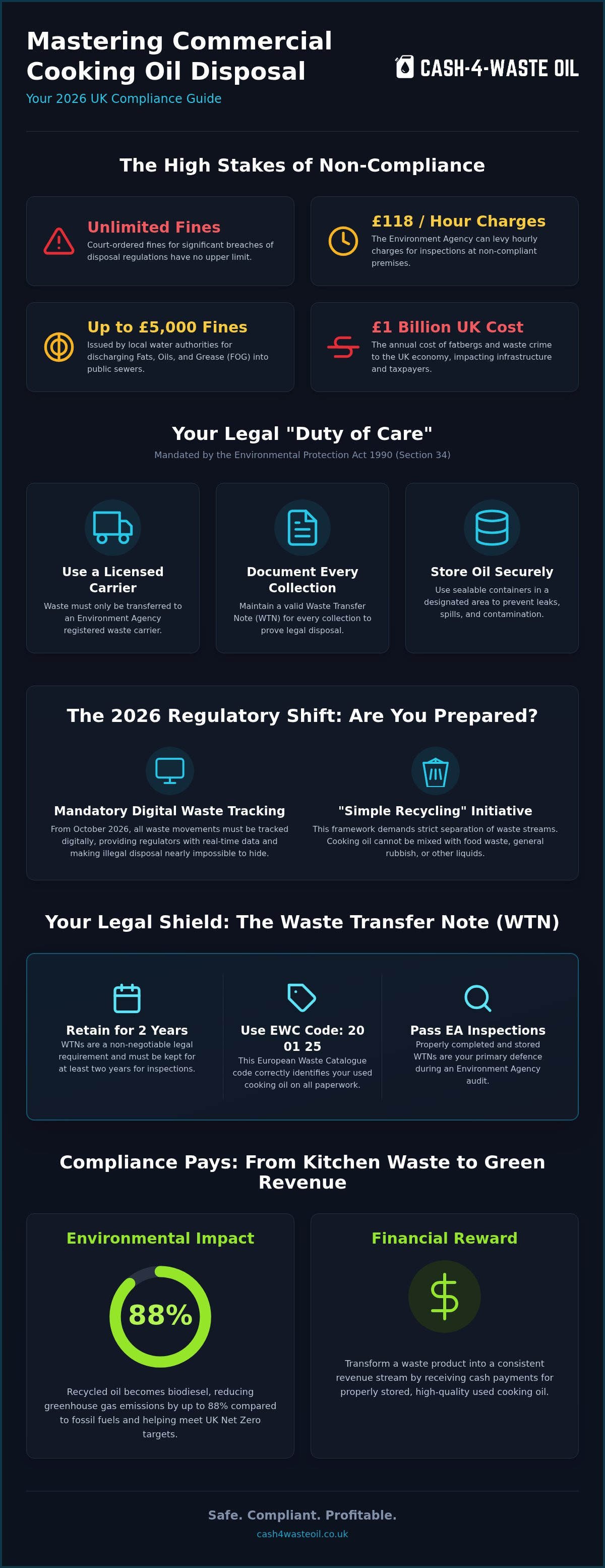
Kitchen waste oil isn't just a messy byproduct; it's legally classified as "controlled commercial waste." This designation means the UK government treats your old fryer fat with the same regulatory gravity as industrial chemicals or construction debris. The Environment Agency (EA) acts as the primary watchdog, enforcing national disposal standards to prevent environmental contamination and sewage system damage. If your kitchen fails to meet these standards, you risk more than just a stern warning. The consequences are tiered but severe. You might start with a Fixed Penalty Notice, but significant breaches often lead to unlimited court-ordered fines for improper cooking oil disposal UK. The EA can even levy hourly inspection charges of £118 if they find your premises are non-compliant.
The Environmental Protection Act 1990: Section 34
Section 34 of the Environmental Protection Act 1990 establishes your "Duty of Care." This isn't a suggestion; it's a strict mandate that applies to every commercial food business in the country. Your responsibility begins the moment the oil is poured into the fryer and doesn't end until it reaches a legitimate, licensed disposal point. You cannot dispose of oil in general waste bins or pour it down the drains. Such actions lead to the formation of fatbergs, which cost the UK economy roughly £1 billion in waste crime and infrastructure repairs annually. Duty of Care is a lifelong legal obligation that holds waste producers accountable for the safe management of their waste from the point of creation to final disposal.
To stay on the right side of the law, you must ensure:
- Waste is only transferred to an Environment Agency registered waste carrier.
- Every collection is documented with a valid Waste Transfer Note (WTN).
- Your oil is stored securely to prevent leaks or spills that could contaminate local water supplies.
2026 Updates to Waste Management Regulations
The regulatory environment has tightened significantly following the Environment Act 2021. By 2026, the "Simple Recycling" initiative has become the standard for all catering premises. This framework demands strictly separate waste streams. You're no longer permitted to mix food waste, general rubbish, or liquids with your used cooking oil. Local councils, particularly in high-density areas like London and Birmingham, have increased their Fats, Oils, and Grease (FOG) enforcement. They now conduct regular spot checks on grease traps and digital records to ensure businesses aren't bypassing the system.
From October 2026, mandatory digital waste tracking provides regulators with real-time data on where your oil goes. This transparency makes it nearly impossible to hide illegal disposal. However, these regulations also support a greener future. Properly managed waste is often repurposed as vegetable oil as a biofuel, which reduces greenhouse gas emissions by up to 88% compared to fossil fuels. By following the rules, you avoid heavy fines for improper cooking oil disposal UK whilst helping your business meet the UK's 2050 Net Zero targets.
Safe Storage and Hygiene Standards for Commercial Kitchens
Maintaining a clean kitchen starts with how you handle your used fryer fat. The Food Standards Agency (FSA) requires strict separation of waste to prevent pests and cross-contamination. Mixing fresh and used oil supplies isn't just a threat to food quality; it can ruin the recyclability of your waste. If your oil becomes contaminated with water, chemicals, or excessive food debris, it loses its commercial value. High-quality, clean waste oil is significantly easier to process into biodiesel. Smart operators treat their storage areas with the same respect as their pantry to avoid fines for improper cooking oil disposal UK and ensure their waste remains a viable revenue stream.
Managing Fats, Oils, and Greases (FOG)
Pouring oil down the sink is a criminal offence. It leads to the formation of fatbergs that choke the UK's sewer systems, with FOG causing an estimated 70% of all blockages. Local water authorities have the power to issue fines of up to £5,000 for discharging oil into public sewers. While grease traps are essential for catching incidental runoff from washing up, they aren't a substitute for a professional collection service. Relying on a used cooking oil collection partner ensures you stay compliant whilst avoiding the massive costs of emergency drain repairs and municipal penalties.
Storage Checklist for Compliance
Proper storage isn't just about hygiene; it's about safety and efficiency. Follow these best practices to keep your kitchen running smoothly:
- Use Sealable Containers: Always use leak-proof, airtight drums. This prevents odours from escaping and stops pests like rats or flies from being attracted to your waste area.
- Clear Labelling: Health inspectors look for clearly marked waste areas. Ensure all containers are labelled with the correct EWC code (20 01 25) to satisfy regulatory audits.
- Fire Safety: Large volumes of stored vegetable oil are a significant fire risk. Keep your storage area away from heat sources and ensure it's easily accessible for collection vehicles in busy centres like London.
- Bunded Pallets: If you store oil outside, use a bunded pallet. This secondary containment system catches spills before they reach the soil or drains, preventing environmental damage and potential fines for improper cooking oil disposal UK.
Effective storage makes the collection process faster and safer for everyone involved. It also ensures that your oil meets the standards required for conversion into sustainable fuel. By organising your storage area today, you protect your staff, your premises, and your bottom line.
The Waste Transfer Note (WTN): Your Shield Against Fines
A Waste Transfer Note (WTN) is more than just paperwork; it's your only legal defence during an Environment Agency inspection. Under Duty of Care regulations, you must prove that your waste was handled responsibly. A simple cash voucher or a handwritten receipt is not a substitute for a formal WTN. If you cannot produce the correct documentation, your business faces significant fines for improper cooking oil disposal UK. You're legally required to retain these records for a minimum of two years. Digital copies are acceptable, provided they're easily accessible during a surprise audit. Treat these documents like your tax records; they're the evidence that you've fulfilled your environmental obligations.
Anatomy of a Compliant Waste Transfer Note
A valid WTN must contain specific details to be legally binding. Inspectors look for transparency and accuracy. Ensure your documentation includes:
- EWC Code 20 01 25: This is the specific European Waste Catalogue code for edible oil and fat. Using the wrong code can invalidate the document.
- Waste Description: A clear statement of what's being collected, such as used vegetable oil.
- Quantity and Container: The volume in litres and the type of containers used for the transfer.
- Transfer Details: The exact date, time, and address of the collection.
- Carrier Information: The name and address of the collection company, along with their Carrier Registration Number.
Both the waste producer and the carrier must sign the document. This signature confirms that the transfer was conducted in accordance with national standards. Missing any of these details can invalidate the note and leave you vulnerable to prosecution during a spot check.
Environment Agency Registered Waste Carriers
Never hand your oil over to an unlicensed collector. Rogue collectors often fly-tip waste or dump it illegally, which can lead back to your kitchen and result in heavy fines for improper cooking oil disposal UK. You must verify a collector’s licence on the official Environment Agency public register before your first collection. A legitimate partner will always provide their registration number upfront. For a deeper look at the legalities, review the latest DEFRA cooking oil waste guidance. Using a registered carrier ensures that your waste enters a legitimate recycling stream rather than an illegal dump. It's a simple step that protects your reputation and your bank account.
Environmental Impact: From Kitchen Waste to Sustainable Biodiesel
Recycling your used cooking oil is the ultimate win-win for a modern kitchen. It transforms a hazardous waste product into a high-grade energy source. This process involves filtering out food particles and water before chemically reacting the oil to create biodiesel. By choosing to recycle, you aren't just dodging fines for improper cooking oil disposal UK; you're actively participating in the circular economy. Keeping resources in use whilst reducing the demand for virgin oils prevents waste from entering our fragile ecosystem. Every litre you save from the drain is a step towards the UK’s ambitious Net Zero targets for 2050. Your kitchen effectively becomes a small but vital contributor to the national green energy grid.
The Benefits of Biodiesel Over Fossil Fuels
Biodiesel produced from used cooking oil can reduce greenhouse gas emissions by up to 88% compared to standard fossil diesel. This reduction is a massive win for local air quality, particularly in congested urban centres where nitrogen dioxide levels are a constant concern. It also bolsters national energy security by reducing the UK’s reliance on imported virgin vegetable oils. These imported oils often carry a heavy environmental price tag due to habitat destruction in tropical regions. One litre of waste oil produces nearly one litre of biodiesel. This near-perfect conversion rate makes oil recycling one of the most efficient waste-to-energy programmes available to the hospitality sector today.
Marketing Your Green Credentials
Modern diners are increasingly selective about where they eat. They prefer businesses that demonstrate clear environmental values. Telling your customers that your kitchen oil is recycled into sustainable fuel is a powerful brand-building tool. You can turn your legal compliance into a core part of your corporate social responsibility (CSR) strategy. It shows that your business values the planet as much as its profits. For a detailed breakdown of the environmental benefits, read our guide on sustainable waste oil disposal. Positioning your business as an eco-conscious leader builds long-term trust in a competitive market.
Stop letting your waste go to waste. Get a cash payment for your waste oil today and start your journey towards a greener, more profitable kitchen.
Navigating Compliance with Cash 4 Waste Oil
Meeting national waste regulations shouldn't be a headache or a drain on your resources. Cash 4 Waste Oil flips the script by making compliance profitable for every commercial kitchen we serve. Our mission is simple: we take the burden of waste management off your shoulders and replace it with a transparent, revenue-generating service. We provide a licensed collection service that pays you cash on the spot for every litre of used food-grade vegetable oil we take away. It's a pragmatic solution for busy chefs and owners who want to stay on the right side of the law without sacrificing their profit margins.
We operate across London, Kent, Surrey, and the Midlands centres, providing a reliable link in the circular economy. As an Environment Agency registered waste carrier, we ensure your business meets its Duty of Care obligations with zero paperwork stress. You avoid the risk of unlimited fines for improper cooking oil disposal UK whilst adding a consistent new revenue stream to your bottom line. We don't believe in hidden fees or complex contracts; we believe in a straightforward exchange that benefits your business and the environment simultaneously.
Our Seamless Collection Process
Commercial kitchens are high-pressure environments that never stop. You don't have time to chase unreliable collectors or deal with messy spills in your storage area. We offer both scheduled and on-call collections to fit your specific service hours, whether you're in the heart of London or across the Midlands. Our professional team handles every transfer with precision, ensuring your premises remain clean, tidy, and odour-free. Crucially, we provide the mandatory Waste Transfer Note immediately upon collection. This instant documentation is your primary shield against regulatory scrutiny and potential fines for improper cooking oil disposal UK.
Why Choose a Local Partner?
Local knowledge matters when it comes to waste management and council-level enforcement. We understand the specific FOG (Fats, Oils, and Grease) enforcement measures used by local authorities in London, Birmingham, and Coventry. By choosing a local partner, you support the regional economy and benefit from a faster, more responsive service. We don't hide behind vague corporate promises. We outline exactly how we operate: we collect your food-grade oil, provide the legal paperwork required by the Environment Agency, and pay you for the waste. It is the most efficient way to turn a legal requirement into a commercial advantage.
Don't wait for an inspection to find out if your records are up to scratch. Get paid for your used cooking oil today and ensure your kitchen is fully compliant with the latest 2026 regulations.
Secure Your Kitchen’s Compliance and Profitability
Staying ahead of the 2026 waste regulations doesn't have to be a burden on your daily operations. By mastering your Duty of Care and maintaining precise records, you protect your business from the risk of unlimited fines for improper cooking oil disposal UK. You've seen how proper storage and mandatory Waste Transfer Notes act as your legal shield whilst contributing to the UK’s green energy goals through biodiesel production.
Now is the time to turn your waste management into a commercial advantage. As an Environment Agency Registered Waste Carrier, we provide a seamless solution that keeps your kitchen clean and your records audit-ready. We pay cash per litre on the spot and provide full Waste Transfer Notes instantly for every collection. This ensures you meet every legal requirement without the stress of complex paperwork or hidden costs.
Request a free collection and get paid for your waste oil today. It’s a smart, pragmatic choice that benefits your bottom line and the planet. Let us handle the logistics whilst you focus on delivering exceptional service.
Frequently Asked Questions
Is it a legal requirement to have a Waste Transfer Note for cooking oil?
Yes, it's a mandatory requirement under the Environmental Protection Act 1990 for every commercial kitchen. You must obtain a Waste Transfer Note (WTN) every time your oil is collected. This document acts as your proof of Duty of Care. Failing to produce these notes during a council or Environment Agency inspection can lead to immediate fixed penalty notices or even criminal prosecution.
Can I dispose of commercial cooking oil in my general waste bin?
No, you cannot put liquid vegetable oil in general waste bins or landfills. It's classified as controlled commercial waste and must be handled separately. Mixing oil with general rubbish can contaminate entire waste streams and lead to significant fines for improper cooking oil disposal UK. Always use sealable, leak-proof containers and arrange for a professional collection to ensure your business remains fully compliant.
What happens if I pour used cooking oil down the kitchen sink in the UK?
Pouring oil down the sink is a criminal offence that can lead to massive fines of up to £5,000 from local water authorities. The oil solidifies in the sewers, creating fatbergs that cause blockages and flooding. Beyond the initial fine, you may also be held liable for the costs of emergency drain repairs and infrastructure cleaning. It's far safer to store the oil for collection.
How long do I need to keep my waste oil records for an inspection?
You are legally required to keep all Waste Transfer Notes for a minimum of two years. These records must be available for inspection by the Environment Agency or local authority officers at any time. Whether you store them as physical paper copies or in a digital format, they must be organised and accessible. Keeping accurate records is your primary defence against claims of illegal waste management.
Do I have to pay a fee for commercial waste oil collection in London?
You don't have to pay for this service; in fact, it should generate revenue for your kitchen. While some general waste companies charge for collections, a specialist partner like Cash 4 Waste Oil provides free collections across London. We pay you cash on the spot for every litre of food-grade vegetable oil we collect. This turns a mandatory compliance task into a straightforward way to improve cash flow.
What is the EWC code for used cooking oil in the UK?
The correct European Waste Catalogue (EWC) code for edible oil and fat is 20 01 25. You must ensure this specific code is clearly stated on every Waste Transfer Note you receive. Using the wrong code or leaving it blank can invalidate your compliance documents during an audit. This code identifies the waste as non-hazardous food-grade oil, which is essential for its legal transport and recycling.
Can I sell my waste vegetable oil to any collector?
No, you must only transfer your waste to an Environment Agency registered waste carrier. Handing oil to an unlicensed collector is a breach of your Duty of Care and can result in heavy fines for improper cooking oil disposal UK if that oil is fly-tipped. Always verify the collector's registration number on the official public register. A legitimate partner will always provide a WTN and follow all digital tracking requirements.
Which regions do Cash 4 Waste Oil cover for commercial collections?
We provide comprehensive collection services across London, Kent, Surrey, and the Midlands. This includes major urban centres like Birmingham and Coventry. Our local teams understand the specific waste enforcement priorities of different councils in these regions. Whether you run a single restaurant or a large catering chain, we provide the same reliable, cash-on-collection service to ensure your kitchen stays clean, compliant, and profitable throughout the year.