Commercial Cooking Oil Waste Regulations UK: The 2026 Compliance Guide
Could your kitchen survive an unlimited court-ordered fine? With the Environment Agency and local councils stepping up spot checks, the financial risks of mishandling your used oil have never been higher. You're likely already balancing the stress of a busy service with the headache of messy storage and the fear of heavy fines for improper cooking oil disposal UK. It's easy to feel overwhelmed by complex paperwork and the new digital tracking mandates arriving in October 2026.
This guide cuts through the regulatory noise to help you master your legal obligations and protect your bottom line. We'll show you how to achieve full compliance whilst turning a waste product into a consistent revenue stream. We're breaking down the essential Waste Transfer Note requirements, the importance of EWC codes, and how a licensed collection service can handle the logistics for you. By the end of this article, you'll have a clear plan to stay compliant, keep your drains clear, and get paid for every litre you produce.
Key Takeaways
- Understand the 2026 legal landscape to protect your business from unlimited fines for improper cooking oil disposal UK.
- Learn why the Waste Transfer Note is your primary legal defence and how to manage these mandatory records for the required two-year period.
- Implement Food Standards Agency compliant storage to maintain kitchen hygiene and prevent costly drain blockages or fatberg penalties.
- Discover how to turn a messy waste product into a legitimate revenue stream with licensed, on-the-spot cash payments.
- See how your commercial kitchen contributes to the UK's Net Zero 2050 goals by recycling waste oil into sustainable biodiesel.
The UK Legal Framework for Commercial Cooking Oil in 2026
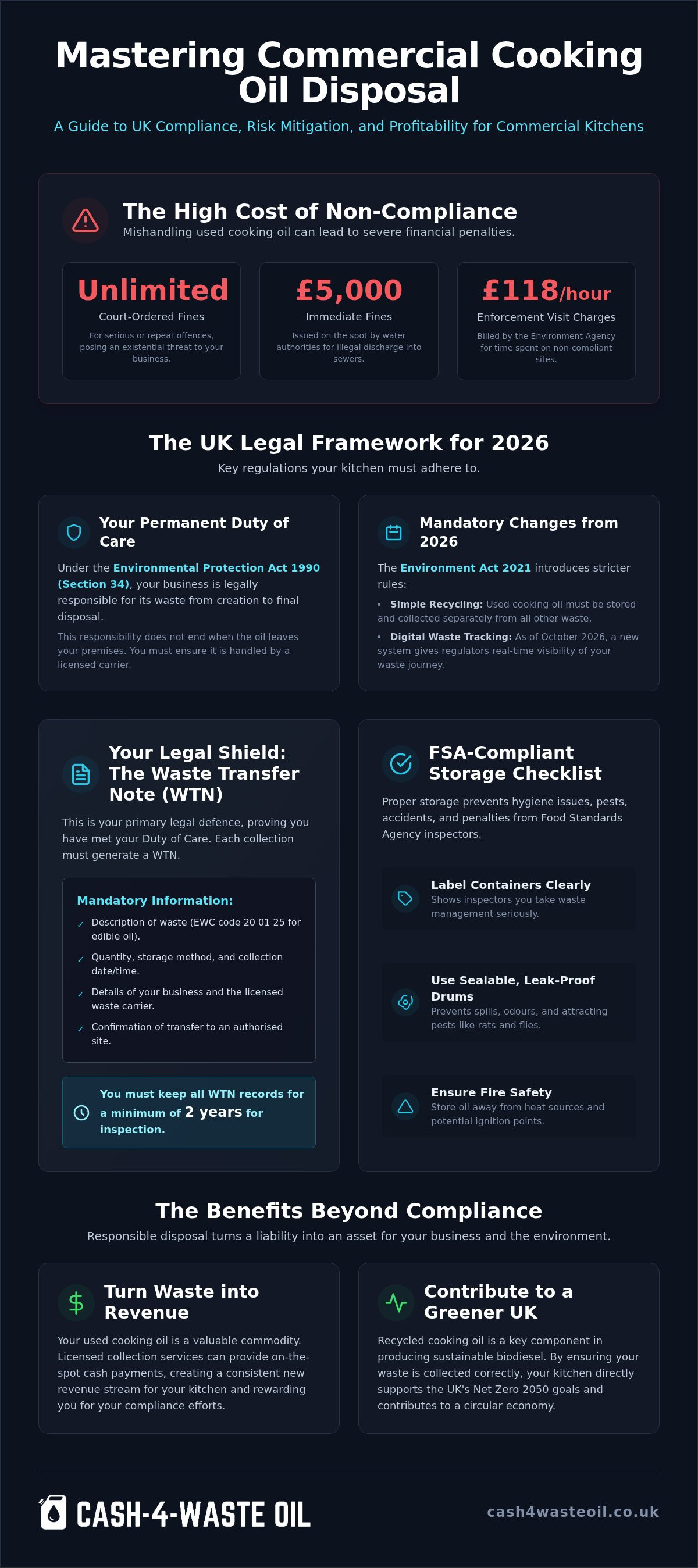
Kitchen waste oil is legally classified as controlled commercial waste in the UK. This isn't just a technical label; it's a strict regulatory category that dictates how your business must store, transport, and document every drop of used fat. The Environment Agency (EA) oversees these national standards to prevent environmental contamination and the collapse of local infrastructure. If you treat your oil like standard refuse, you're breaking the law. The EA has the power to investigate and even shut down operations that consistently fail to meet these disposal benchmarks. Staying compliant is the only way to protect your business from the risk of unlimited court-ordered fines.
The Environmental Protection Act 1990: Section 34
Under Section 34, you have a permanent Duty of Care for any waste you produce. This legal responsibility doesn't end when the oil leaves your kitchen; you're accountable for its entire journey until it reaches a licensed disposal site. Pouring oil into the drainage system or mixing it with general rubbish is a criminal offence. Such actions lead to severe blockages and are the primary cause of heavy fines for improper cooking oil disposal UK. Your Duty of Care is a lifelong legal obligation that requires you to ensure waste is handled safely from its creation to its final disposal.
2026 Updates to Waste Management Regulations
The regulatory environment has tightened following the full implementation of the Environment Act 2021. By 2026, the "Simple Recycling" initiative has become the baseline for all commercial kitchens and catering premises. This framework mandates the strict separation of waste streams, meaning oil must be stored and collected independently of other food waste. Since October 2026, the government has also introduced mandatory digital waste tracking. This system gives regulators real-time visibility into how your business handles its used oil, making it nearly impossible to hide illegal disposal habits.
Local authorities in urban hubs like London and Birmingham are now more aggressive with enforcement. They carry out regular spot checks to ensure kitchens aren't contributing to the 70% of sewer blockages caused by fats, oils, and grease. If an inspector finds you're non-compliant, the costs escalate quickly. The EA can charge £118 per hour for enforcement visits, and water authorities often issue immediate £5,000 fines for sewer discharge. For serious or repeat offences, the courts can impose unlimited fines that could easily bankrupt a small restaurant or catering firm.
Safe Storage and Hygiene Standards for Commercial Kitchens
Storing your used oil correctly is the first line of defence against health inspectors and Environment Agency audits. If your storage area is a mess, you're more likely to face scrutiny that leads to fines for improper cooking oil disposal UK. The Food Standards Agency (FSA) expects commercial kitchens to maintain strict hygiene standards for both fresh and waste products. Keeping used oil separate from fresh supplies is critical for maintaining the integrity of your ingredients and preventing cross-contamination. Use dedicated, heat-resistant containers to prevent accidents like spills or burns that could trigger an unwanted inspection.
Managing Fats, Oils, and Greases (FOG)
Fatbergs are massive blockages in the UK sewage system. They cause up to 70% of all sewer blockages and cost the economy roughly £1 billion annually in repairs and infrastructure damage. Pouring oil down the sink is a direct shortcut to receiving heavy penalties. Grease traps are an essential tool for catching smaller particles, but they require regular maintenance—which can be enhanced using microbial solutions from qmes.eu—and are not a substitute for a professional collection service. According to The UK Legal Framework for Commercial Cooking Oil, all catering premises must ensure their oil is stored safely and collected by a registered waste carrier. Relying on a professional service reduces the risk of drain repairs and ensures your kitchen remains compliant with local water authority bylaws.
- Use sealable, leak-proof drums: This stops pests like rats or flies from being attracted to your kitchen and prevents foul odours from bothering neighbours.
- Label every container clearly: Health inspectors look for transparency in waste management. Clear labelling shows you take your Duty of Care seriously.
- Fire safety: Store large volumes of vegetable oil away from heat sources and ignition points. This is particularly vital for high-density catering environments in London and the Midlands.
- Accident prevention: Keep storage areas free from spills. Used oil on the floor is a major slip hazard and can lead to environmental contamination if it reaches outdoor drains.
High-quality used oil that is free from water and food debris is more valuable for recycling into biodiesel. Organising a regular used cooking oil collection keeps your storage area manageable and ensures your business avoids the fines for improper cooking oil disposal UK that often follow poor storage habits.
The Waste Transfer Note (WTN): Your Shield Against Fines
A Waste Transfer Note (WTN) is a mandatory legal document that tracks your waste from the kitchen to its final destination. It's non-negotiable. If you can't produce a valid WTN during a surprise Environment Agency inspection, you're technically in breach of the law. This documentation serves as your primary shield against fines for improper cooking oil disposal UK. You must retain every WTN for a minimum of two years from the date of collection. A simple handwritten receipt or a cash voucher from an informal collector is not a substitute. Without a valid WTN, you have no proof that you've fulfilled your Duty of Care, leaving your business exposed to unlimited penalties.
Anatomy of a Compliant Waste Transfer Note
For a WTN to be legally binding, it must contain specific data points. Every note for used cooking oil must use the European Waste Catalogue (EWC) code 20 01 25. This code identifies the material specifically as edible oil and fat. The document must also record the quantity of oil collected, the type of containers used, and the exact date and time of the transfer. Both the waste producer (your business) and the carrier must sign the note to confirm the transfer was legal. Crucially, the document must display the collector's Carrier Registration Number. Missing any of these details makes the note invalid in the eyes of an inspector.
Environment Agency Registered Waste Carriers
Always verify your collector’s credentials before they touch your oil. You can check any company's licence on the official Environment Agency public register. Using rogue, unlicensed collectors is a massive risk. These "fly-by-night" operators often dump oil illegally in drains or rural areas. Because your Duty of Care is a lifelong obligation, you remain legally responsible for that oil even if a third party dumps it. If the EA traces that oil back to your kitchen and you have no WTN from a registered carrier, you're the one who will face fines for improper cooking oil disposal UK. For more detailed advice on meeting these standards, consult the DEFRA cooking oil waste guidance.
Licensed collectors like Cash 4 Waste Oil provide a full, digital or physical audit trail with every pickup. We ensure you get a valid WTN on the spot, protecting your business whilst putting cash back into your pocket. It's a simple, professional way to keep your records straight and your business safe from regulatory scrutiny.
Environmental Impact: From Kitchen Waste to Sustainable Biodiesel
Recycling your used cooking oil is a smart business move that goes beyond simply avoiding fines for improper cooking oil disposal UK. It's a core component of the UK’s circular economy. When you choose a licensed collector, your waste oil undergoes a transformation process through filtration and refinement. This process converts messy kitchen grease into high-quality, sustainable biodiesel. By keeping these resources in use, your business reduces the national reliance on virgin oils whilst ensuring that a potential pollutant becomes a valuable energy source. Every litre you recycle helps the UK move closer to its mandatory Net Zero targets by 2050.
The Benefits of Biodiesel Over Fossil Fuels
Biodiesel produced from used cooking oil is a far cleaner alternative to traditional petroleum diesel. It significantly improves local air quality in urban centres by reducing particulate matter and nitrogen oxide emissions. Research indicates that biodiesel from waste oil can reduce greenhouse gas emissions by up to 88% compared to fossil fuels. Efficiency is another major factor; 1 litre of waste oil produces nearly 1 litre of biodiesel. This high conversion rate makes it one of the most effective ways to lower the carbon footprint of your commercial kitchen. By diverting oil from the sewers, you're preventing the environmental catastrophe of fatbergs and protecting local ecosystems.
Marketing Your Green Credentials
Modern customers are increasingly eco-conscious and prefer dining at establishments that take environmental responsibility seriously. You can use your compliance as a powerful tool for brand building and corporate social responsibility. Telling your customers that your oil is recycled into sustainable fuel adds a layer of transparency that builds trust. It turns a logistical necessity into a positive story about your contribution to a greener planet. For more insights on how to align your business with these values, read our guide on sustainable waste oil disposal.
Aligning your kitchen with the circular economy doesn't have to be a burden. It's a pragmatic choice that protects you from fines for improper cooking oil disposal UK whilst improving your commercial reputation. If you're ready to clear out your storage and start earning, book your used cooking oil collection today. We handle the logistics so you can focus on running a sustainable, profitable kitchen.
Navigating Compliance with Cash 4 Waste Oil
Compliance doesn't have to be a drain on your resources. At Cash 4 Waste Oil, our mission is to transform a messy legal obligation into a profitable revenue stream for your kitchen. Most waste management services treat disposal as a chore, but we see it as an opportunity to support the circular economy whilst improving your bottom line. By partnering with an Environment Agency registered waste carrier, you eliminate the risk of heavy fines for improper cooking oil disposal UK. We provide the security of a fully licensed service across London, Kent, Surrey, and the Midlands, ensuring every drop of your used oil is accounted for legally.
Our model is built on transparency and efficiency. We pay cash on the spot for every litre of food-grade vegetable oil we collect. This immediate financial return helps offset other operational costs, turning a waste product into a tangible asset. Because we're fully registered, you gain total peace of mind that your Duty of Care obligations are met without the stress of complex logistics.
Our Seamless Collection Process
We understand that commercial kitchens operate on tight schedules. That's why we offer both scheduled and on-call collections to suit the specific rhythm of your service hours. Whether you're a high-volume restaurant in central London or a catering unit in the Midlands, our team arrives promptly and handles the transfer with professional care. We keep your storage area clean, tidy, and odour-free, preventing the hygiene issues that often lead to council inspections. Most importantly, we provide the mandatory Waste Transfer Note immediately upon collection. You won't have to chase paperwork or wait for digital receipts; your legal audit trail is completed before we leave the premises.
Why Choose a Local Partner?
Local knowledge is vital when dealing with varying council regulations. We possess deep expertise in the waste rules set by local authorities in London, Birmingham, and Coventry. This regional focus allows us to provide a more responsive and reliable service than distant national contractors. By choosing a local partner, you're supporting the regional economy whilst ensuring your business remains on the right side of the law. Don't let your used oil sit in storage and become a liability. Protect your business from the threat of fines for improper cooking oil disposal UK and start generating extra income. Get paid for your used cooking oil today.
Secure Your Kitchen’s Future and Profitability
Meeting your Duty of Care doesn't have to be a logistical burden. By implementing strict storage standards and maintaining a clear audit trail with Waste Transfer Notes, you protect your business from the threat of unlimited fines for improper cooking oil disposal UK. These regulations ensure that commercial kitchens play their part in preventing fatbergs and supporting the transition to sustainable energy. Turning a messy waste product into a valuable resource for biodiesel is a smart way to keep your premises clean and compliant whilst contributing to the circular economy.
Don't let used oil clutter your kitchen or risk your reputation. Partner with an Environment Agency Registered Waste Carrier to streamline your disposal process. We pay cash per litre on the spot and provide your mandatory Waste Transfer Note instantly. It's time to stop worrying about inspections and start benefiting from your waste. Request a free collection and get paid for your waste oil today. Your kitchen remains compliant, your drains stay clear, and your bottom line stays healthy.
Frequently Asked Questions
Is it a legal requirement to have a Waste Transfer Note for cooking oil?
Yes, obtaining a Waste Transfer Note (WTN) is a mandatory legal requirement for every collection of used cooking oil. This document proves you've fulfilled your Duty of Care under the Environmental Protection Act 1990. Without it, your business remains legally liable for the waste even after it leaves your premises. You must store these notes for a minimum of two years to satisfy Environment Agency inspectors during surprise audits or routine checks.
Can I dispose of commercial cooking oil in my general waste bin?
No, it's illegal to dispose of commercial cooking oil in a general waste bin or with standard food refuse. Kitchen oil is classified as controlled commercial waste, which requires separate storage and specialised collection. Mixing oil with general waste is a criminal offence that often leads to significant fines for improper cooking oil disposal UK. Proper separation is essential for compliance with the 2026 "Simple Recycling" framework for catering premises.
What happens if I pour used cooking oil down the kitchen sink in the UK?
Pouring oil down the sink is a criminal offence that can result in immediate financial penalties. Local water authorities have the power to issue fines of up to £5,000 for discharging fats, oils, and grease into the sewer system. This practice is the primary cause of fatbergs, which contribute to 70% of UK sewer blockages. Beyond the legal risk, you also face the high cost of repairing internal drain damage.
How long do I need to keep my waste oil records for an inspection?
You must keep all Waste Transfer Notes and disposal records for at least two years. These documents provide the necessary audit trail to prove your business is handling waste responsibly. During an inspection, Environment Agency or local council officers will ask to see these records to verify your compliance. Failure to produce valid documentation for the required period can trigger an investigation and lead to unlimited court-ordered fines for your business.
Do I have to pay a fee for commercial waste oil collection in London?
No, you don't have to pay a fee for commercial collection when using our service. Unlike general waste contractors who charge for pickups, Cash 4 Waste Oil provides a free collection service for commercial kitchens in London and the South East. We actually pay you cash on the spot for every litre of food-grade vegetable oil we collect. This model turns your compliance obligation into a legitimate revenue stream for your kitchen.
What is the EWC code for used cooking oil in the UK?
The correct European Waste Catalogue (EWC) code for edible oil and fat is 20 01 25. This specific code must appear on every Waste Transfer Note to identify the type of waste being moved. Using the wrong code or leaving it blank makes the documentation invalid. Accurate coding ensures that regulators can track the waste stream correctly as it moves from your kitchen to a sustainable biodiesel processing facility for recycling.
Can I sell my waste vegetable oil to any collector?
No, you must only use a collector who is an Environment Agency registered waste carrier. Selling or giving your oil to an unlicensed collector is a major risk to your business. If they dump the oil illegally, you remain legally responsible under your Duty of Care. This negligence is a common reason why restaurants face heavy fines for improper cooking oil disposal UK, even if they didn't dump the oil themselves.
Which regions do Cash 4 Waste Oil cover for commercial collections?
Cash 4 Waste Oil covers a wide range of urban centres across the UK. Our service area includes London, Kent, and Surrey. We also provide extensive coverage across the Midlands, including Birmingham, Coventry, Wolverhampton, and Leicester. We serve commercial establishments in Derbyshire, Staffordshire, Warwickshire, and Oxfordshire. Please note that our service is strictly for commercial kitchens and does not include residential or domestic oil collections from private households.