Commercial grease recycling for hospitality in Ashford
Used cooking oil needs a clear commercial collection route. For restaurants, pubs, hotels and other commercial kitchens, commercial grease recycling near Ashford means arranging the collection of used cooking oil through a commercial service. According to UK Legislation, the Environmental Protection Act 1990 places a duty on anyone who produces, imports, keeps, stores, transports, treats or disposes of waste to take reasonable steps to ensure it is disposed of properly.
That responsibility matters in day-to-day kitchen operations: oil and fats poured down drains can build up and cause sewer blockages. A suitable collection arrangement keeps waste on the right disposal route and gives your business a clear record of what happens to it.
This guide explains how Ashford hospitality businesses can arrange used cooking oil collection, how the oil is recycled, and what duty-of-care records to keep. It also covers practical steps, from storing used oil in suitable containers to retaining the paperwork for each transfer, so waste management fits smoothly into a busy kitchen.
Key Takeaways
- Restaurants, pubs, hotels and other commercial kitchens can arrange used cooking oil collection for their business waste.
- Keep used oil in suitable containers and plan a collection route that fits your kitchen’s waste-handling arrangements.
- Understand how the Environmental Protection Act 1990 applies to your business’s responsibility for waste.
- Know which transfer and disposal records help document what happens to collected oil.
- Find out how used oils and fats can be recycled for reuse instead of entering the wrong disposal route.
Environmental sustainability and landfill reduction
For an Ashford commercial kitchen, used cooking oil is a distinct waste stream. Keeping it separate makes collection and recycling easier to manage. Oils and fats can be recycled for reuse, helping businesses keep a recoverable material out of general waste. This practical approach supports environmental goals and reduces avoidable disposal.
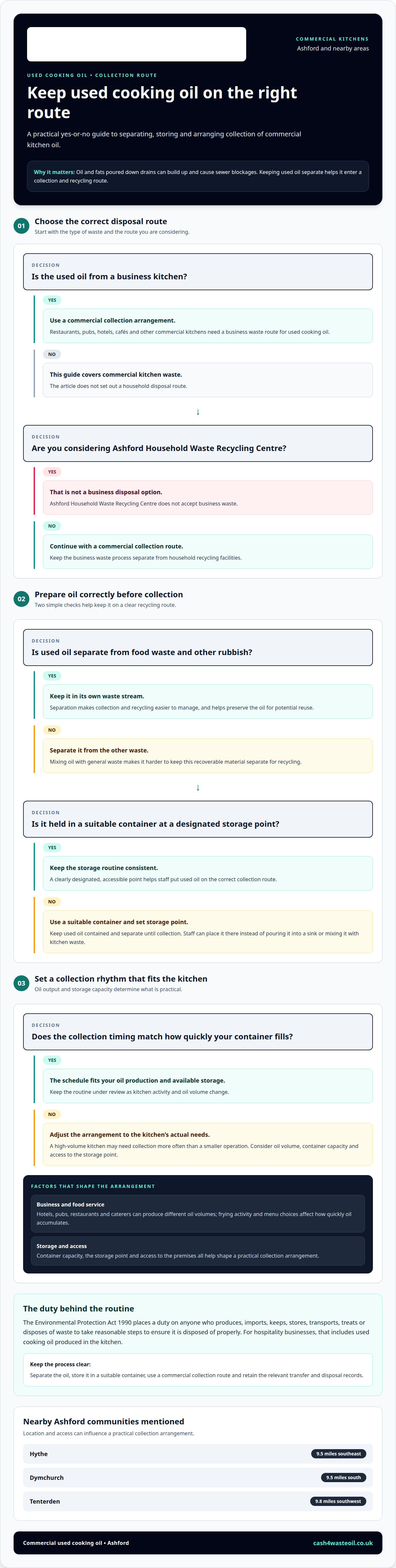
How should a business store used cooking oil before collection? Keep it in a suitable container, separate from other waste, until collection. A clearly designated storage point helps staff keep used oil on the right collection route.
What are the risks of improper grease and cooking-oil disposal? Oil and fats poured down drains can build up and cause sewer blockages and system failures, an issue often highlighted by wastewater professionals such as Lil' Stinky Septic Service. Mixing oil with general waste also makes it harder to keep this recoverable material separate for recycling.
Use a consistent routine to reduce handling errors. Staff can put used oil in a designated suitable container instead of pouring it into a sink or mixing it with other kitchen waste. A dedicated collection service then provides a route for the separated oil, keeping it out of drains and mixed refuse.
Commercial kitchens also need a suitable disposal route. Ashford Household Waste Recycling Centre does not accept business waste, so it is not a disposal option for a restaurant’s used cooking oil. A commercial collection arrangement gives hospitality businesses a route designed for their waste stream. That distinction matters for kitchens in Ashford and nearby communities such as Hythe, 9.5 miles southeast of Ashford, and Tenterden, 9.8 miles southwest.
To reduce waste and keep the process clear, build these steps into kitchen routines:
- Keep used cooking oil apart from food waste and other rubbish.
- Use suitable containers and a consistent, accessible storage point.
- Arrange professional collection so the oil can enter a recycling route.
- Keep the collection process distinct from household recycling facilities, which do not take Ashford businesses’ waste.
These steps connect everyday kitchen practice with wider environmental outcomes. Separating oil as soon as it becomes waste preserves its potential for reuse, helps staff avoid drain disposal and creates a clear collection process. In Ashford, commercial waste needs a commercial route, making dedicated collection a practical part of responsible waste management.
Businesses served in Ashford and nearby areas
Used cooking-oil collection is relevant to restaurants, pubs, hotels, cafés and other commercial kitchens. A restaurant that fries food daily may produce a different volume of used oil from a small café with a limited menu. Separating oil from food waste makes both streams easier to manage. The same principle applies to pubs, hotels and catering businesses across Ashford and Kent.
Location matters when arranging collection. Ashford is the central reference point for nearby businesses, including those in Hythe, 9.5 miles southeast, Dymchurch, 9.5 miles south, and Tenterden, 9.8 miles southwest. These places have different travel routes and business layouts. A kitchen’s access, storage point and accumulated volume all help shape a practical collection arrangement.
How often can restaurants and food businesses arrange oil collection? Collection frequency depends on how quickly a business fills its suitable storage containers. A high-volume kitchen may need collections more often than a smaller operation. The key is matching the schedule to oil production and available storage.
For example, a hotel kitchen serving meals throughout the day may generate oil steadily, while a pub’s use may vary with its food service. A caterer’s volume can change with its bookings. These differences make a single fixed timetable unsuitable for every business. When arranging collection, consider the kitchen’s oil volume and how it stores used oil between collections.
Are there local council or trade schemes for commercial grease recycling in Ashford? Ashford Household Waste Recycling Centre does not accept business waste, so it is not a route for a restaurant’s used oil. Commercial kitchens need a business waste arrangement, such as a trade collection service for used cooking oil.
Before setting a collection routine, consider the practical details that affect a kitchen’s needs:
- Business type: a hotel, pub and restaurant can produce different oil volumes.
- Food service: frying activity and menu choices affect how quickly used oil accumulates.
- Storage: container capacity determines how much oil can be held between visits.
- Location: access to the premises and storage point matters across Ashford and nearby towns.
These details help businesses plan around their actual waste output. A suitable schedule reduces the chance of storage filling before the next collection and keeps used oil separate from food and other business waste. For an Ashford kitchen, start with its oil volume and storage capacity, then choose a collection rhythm that fits its operations.
Businesses should keep their waste in suitable containers. Suitable containers provide a defined place for waste to be held before collection. Keeping waste contained supports orderly handling and helps businesses manage what they store between collection visits.
Duty-of-care documentation
In the UK, according to UK Legislation, the Environmental Protection Act 1990 places a duty on anyone who produces, imports, keeps, stores, transports, treats or disposes of waste to take reasonable steps to ensure it is disposed of properly. For an Ashford hospitality business, that responsibility includes used cooking oil produced in its kitchen. Clear documentation helps show how the waste leaves the premises and who receives it.
What records or Waste Transfer Notes must businesses keep for grease recycling? Keep the Waste Transfer Note issued for each collection alongside any other records that identify the handover. The note records the transfer between the business and its waste collection partner.
Keep the paperwork organised with the kitchen’s other waste records. For example, a restaurant can file each note by collection date and retrieve it when reviewing its waste arrangements. A regular administrative review can help staff spot a missing document before records are needed. Regularly reviewing records can help businesses keep their waste paperwork organised.
Make each handover easy to trace in the business’s files. Use a consistent approach, such as grouping notes by premises or storing them with the relevant waste collection records. A hotel with several kitchen areas can use one filing structure for the site, while a pub can keep its oil paperwork with other business waste records. Clear organisation saves time when managers review disposal arrangements.
Documentation also supports communication between a business and its collection partner. If staff change or the collection routine is updated, an orderly record helps the next person understand the process. Keep the information together rather than relying on an individual employee’s memory. For an Ashford restaurant, this means a manager can find the relevant handover record without searching through unrelated food-waste files.
Build a simple record routine around each collection:
- Retain the Waste Transfer Note for the used oil handover.
- File it with the business’s related waste documentation.
- Use a consistent date or premises-based filing method.
- Review the records regularly and follow up internally on any missing paperwork.
These steps make the disposal route more transparent. They also help hospitality businesses explain how used oil was transferred, rather than relying on informal notes or recollection. The Environmental Protection Act 1990 sets the broader duty; well-organised transfer documentation supports a clear account of the business’s waste arrangements.
That wider context applies beyond the location of a particular collection. Every commercial business or establishment that produces waste has a responsibility to manage it properly, wherever it is based. For hospitality operators, the paperwork routine can therefore sit within the business’s general approach to waste, rather than being treated as a task for one kitchen employee alone. Managers can make sure staff know where records are kept and who can check them, so the handover information remains accessible when responsibilities change.
A clear internal process keeps records connected to the relevant waste stream and the people overseeing it. A straightforward routine is easier for staff to follow consistently, without informal reminders or reliance on individual memory. This supports an organised account of the business’s waste management and keeps records available for internal review.
Legal disposal records
Commercial waste records help Ashford businesses show how used cooking oil leaves their premises. A clear disposal trail identifies the waste, the handover and the parties involved. Keep records together so managers can trace a collection without relying on staff recollection. For example, a restaurant can file each Waste Transfer Note alongside its other waste documentation.
How do businesses compare local oil collection services, including licences and recycling practices? Compare the clarity of their collection records, the information provided about the handover, and the explanation of how collected oil is handled. A documented process makes the disposal route easier to follow.
How should a business understand the rules for storing and disposing of commercial waste cooking oil? According to UK Legislation, the Environmental Protection Act 1990 places a duty on anyone who produces, imports, keeps, stores, transports, treats or disposes of waste to take reasonable steps to ensure it is disposed of properly. Suitable containers and a documented collection route support that responsibility.
Link each note to the correct premises and collection. A hotel with several kitchen areas can use a consistent filing method that makes the source of the oil clear; a small café can keep the same core details in one place. This practical structure helps staff follow the disposal process when responsibilities change.
Do not use the word “hazardous” as a substitute for identifying the waste correctly. Used cooking oil is the material being transferred, so describe it clearly in the business’s records. Accurate descriptions distinguish it from other commercial waste, such as food waste or cleaning products. Keep separate records where different waste streams follow different routes.
For a straightforward record trail, organise each collection around these points:
- Waste description: make clear that the transfer relates to used cooking oil.
- Handover record: retain the relevant waste transfer note with the business’s disposal documentation.
- Premises: file the record against the Ashford site that produced the oil.
- Collection partner: keep the receiving party identifiable in the transfer record.
- Recycling route: retain information describing how collected oil is handled after collection.
These records give a business a practical way to review its disposal arrangements. A consistent filing method helps a manager locate the Waste Transfer Note and related information for a particular collection. Clear documentation also supports communication between kitchen staff and the collection partner, creating a readable account of the oil’s route from the premises to processing.
Recycling oils and fats for reuse
Used cooking oil can remain a useful material after it leaves a commercial kitchen. Recycling gives separated oil a route towards reuse instead of disposal with mixed rubbish. For a restaurant on an Ashford street, the journey begins when used oil is collected as its own waste stream. Keeping that route distinct helps make recovery practical.
What happens after collection depends on the receiving process and the condition of the material. Oil is taken onwards for handling and processing, so it can be prepared for a suitable reuse route. The key point for the kitchen is separation: used oil should not be combined with general rubbish or poured into a drain. Oils and fats poured down drains can build up and cause sewer blockages.
Food debris and other waste can complicate the handling of used oil. Keeping oil separate makes it easier to identify during collection and transfer. For example, staff can keep oil from fryer operations apart from food waste, cleaning materials and packaging. Clear separation supports processing without requiring the kitchen to manage recycling itself.
Recycling depends on a clear chain between the business and the processing stage. The oil is collected, transferred and processed into bio-diesel. A Waste Transfer Note records each collection, giving the business a practical account of the handover and supporting a consistent approach to recovery.
Oil output varies with a business’s operations. A restaurant with a fried-food menu may generate a steadier stream than a kitchen that uses little frying. Pubs, hotels and caterers can also have different patterns. Collection planning can reflect these differences, so separated oil is collected before storage becomes inconvenient.
For hospitality businesses, recycling is more than removing a container from the kitchen. It connects day-to-day waste separation with a reuse route. A responsible collection arrangement keeps used oil apart from other waste, records the handover and sends the oil for processing into bio-diesel. This helps businesses treat cooking oil as a recoverable material rather than letting it enter drains or mixed waste.
To arrange a collection for your business’s used cooking oil, book used oil collection through the available service.
Cash 4 Waste Oil
Cash 4 Waste Oil helps hospitality businesses arrange a clear route for used cooking oil. Its collection service is for restaurants, pubs, hotels and other commercial kitchens across Kent, including Ashford. Waste Transfer Notes provide a record of the oil handover, while cash payments are available for waste oil. This combination suits businesses seeking collection alongside transfer documentation and payment for their used oil.
Turn to Cash 4 Waste Oil when your commercial kitchen needs used cooking oil collected and its disposal recorded. Keeping the collection and paperwork together can make the process easier to manage alongside other kitchen waste arrangements.
To discuss used cooking oil collection for your business, contact Cash 4 Waste Oil.
Make your next collection part of the routine
Make commercial grease recycling near Ashford a straightforward part of kitchen operations. Assign responsibility for arranging collections and keeping Waste Transfer Notes together, so the process stays clear when staff or routines change. Review oil production and storage needs regularly to keep the collection schedule practical.
With a consistent arrangement, your team can focus on service while used cooking oil follows a defined collection route. Choose a practical next step that fits your business: discuss the collection arrangement, the transfer record and how payment for waste oil is handled.
Contact Cash 4 Waste Oil to discuss used cooking oil collection for your hospitality business. A clear plan makes it easier to keep the process moving and the kitchen running smoothly.
Frequently Asked Questions
Looking for hospitality waste collection near me?
Cash 4 Waste Oil collects used cooking oil from commercial kitchens in Kent, including hospitality businesses in Ashford. For example, a pub kitchen or hotel can arrange a collection for its waste oil. The service is for commercial premises, not household cooking oil. If your business also produces animal fats or vegetable oil, those are accepted waste streams too.
Which companies collect and recycle commercial cooking oil near Ashford, Kent?
Cash 4 Waste Oil collects commercial cooking oil from restaurants, pubs, hotels and other commercial kitchens in Kent. It provides a Waste Transfer Note for each collection and recycles collected oil into biodiesel. For a business considering commercial grease recycling near Ashford, this offers a collection route with the transfer paperwork handled alongside the oil handover.
What areas around Ashford do commercial waste-oil collectors cover?
Cash 4 Waste Oil serves businesses in Kent, including Ashford, Maidstone, Canterbury, Folkestone, Medway and Tunbridge Wells. Coverage also includes London and Surrey. If your premises are outside these areas, the service’s stated coverage does not establish that collection is available there. A local hospitality business can use its town and postcode when making an enquiry about its collection arrangements.
What types of commercial grease and cooking oil can be recycled?
Cash 4 Waste Oil collects used cooking oil, vegetable oil and animal fats from commercial food-service premises. For example, a restaurant’s used fryer oil or a hotel kitchen’s collected cooking fats fit these waste streams. The service does not collect engine or motor oil, or industrial lubricants. Keep those materials separate, since they are not commercial food-service oils accepted for this collection.
Do collectors pay businesses for used cooking oil, and what are typical rates?
Cash 4 Waste Oil pays businesses for collected used cooking oil, but there is no fixed typical rate to quote. The amount depends on the oil’s volume and condition, and a quote is provided on request. For example, the quantity collected and the state of the oil affect the assessment. Payment is made on collection, so the business can discuss its circumstances when arranging service.