Cooking Oil Recycled into Biodiesel: How the Process Works
Does used fryer oil go straight from a collection tank into a vehicle’s fuel system? No. Cooking oil recycled into biodiesel passes through a controlled processing chain, and collection is only the first step. The oil must reach a processing facility, where it can be assessed, prepared and converted into fuel.
It’s understandable if the process sounds technical, or if it’s unclear what happens after a collector takes the oil away. This guide follows used cooking oil from a commercial kitchen through the main stages, explaining how it is checked, cleaned and processed. You’ll also see why keeping oil separate from water, food waste and other contaminants matters: cleaner feedstock is easier for processors to assess and prepare.
For commercial kitchens, responsible collection creates a practical route for recovering used oil. Cash 4 Waste Oil collects used food-grade cooking oil and provides a Waste Transfer Note. The collected oil then enters a recovery chain for processing into biodiesel feedstock. This guide clarifies where collection ends and industrial processing begins, and explains how to assess environmental claims without treating broad statements as proof.
Key Takeaways
- Cooking oil recycled into biodiesel passes through collection, preparation and industrial processing before it becomes fuel.
- Separating used cooking oil from water and food residues helps keep it suitable for assessment as feedstock.
- Follow the main processing stages and understand where the collector’s role ends and the processor’s begins.
- Assess environmental claims by distinguishing potential benefits from verified lifecycle results.
- Commercial kitchens can support responsible recovery by separating and storing oil, arranging collection and keeping the Waste Transfer Note.
How cooking oil recycled into biodiesel starts with used kitchen oil
The route starts with a suitable waste product, not a finished fuel. Used food-grade cooking oil from a restaurant, pub or hotel can become feedstock for biodiesel production. It must be collected separately and sent for processing. Simply straining it or letting it settle does not turn it into fuel suitable for use in an engine.
That distinction matters. Collection moves the oil into a recovery chain, but preparation and industrial conversion still need to happen before biodiesel is ready. Processors assess the material and prepare it for conversion. For commercial kitchens, a reliable collection route provides a practical way to keep used cooking oil separate from other waste and pass it on for recovery.
What does biodiesel made from used cooking oil mean?
Biodiesel is a fuel made by processing fats or oils into fatty acid esters, rather than using the oil in its original form. This controlled conversion, commonly called transesterification, changes the oil’s chemical structure. The Biodiesel overview explains how vegetable oils and animal fats can be used as feedstocks. Raw or filtered fryer oil is not the same as finished biodiesel, and removing visible crumbs does not make it ready for use as fuel.
Which used oils can enter the recovery chain?
Suitable feedstock can include used food-grade vegetable cooking oils from commercial kitchens. Water, food scraps and other residues can affect the quality and consistency of the collected material. Keep used oil apart from wash water, general food waste and unrelated fluids. Do not mix it with mineral engine oil, which belongs to a different waste stream and is not cooking-oil feedstock.
The cooking oil recycled into biodiesel process therefore depends on good separation before collection as well as the processor’s later preparation. For a kitchen, the practical starting point is to store used food-grade oil separately and arrange a commercial collection. Cash 4 Waste Oil collects used cooking oil from commercial premises, including restaurants, pubs and hotels, and the recovered oil enters a chain where it is processed into biodiesel feedstock.
The service is for commercial kitchens, not domestic households, and does not cover engine oil. Keeping these streams distinct helps prevent unsuitable material from being mixed into food-oil recovery. The collector’s role is to collect and hand over the used oil. Finished biodiesel is made further along the processing chain.
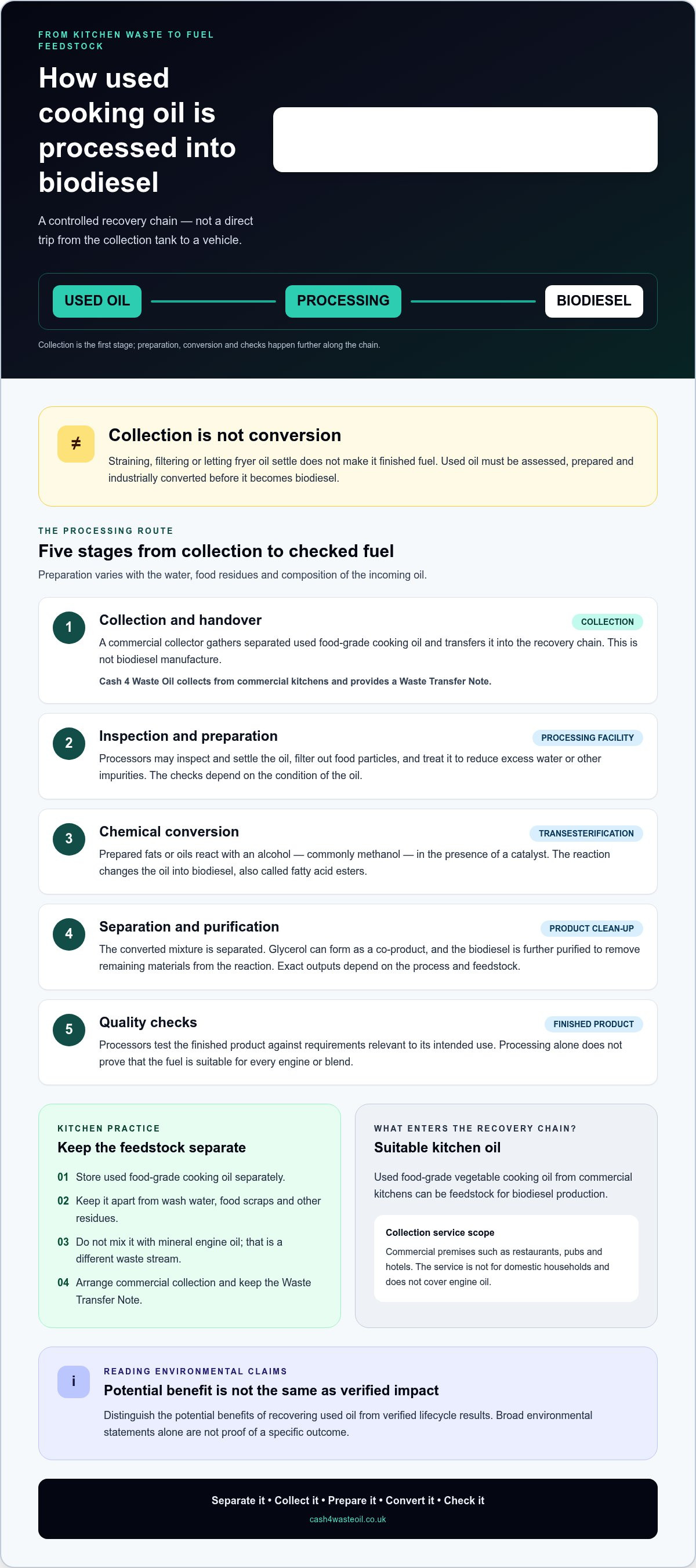
How used cooking oil is processed into biodiesel, step by step
Once collected, used cooking oil enters a processing facility. It does not become fuel simply by being filtered. Processors need to prepare the feedstock, convert it and check the resulting fuel. The exact preparation sequence can vary because oil differs in water content, food residues and composition.
- 1. Collection and handover. A commercial collector gathers separated used cooking oil and transfers it into the recovery chain. This is the collection stage, not biodiesel manufacture. Cash 4 Waste Oil collects used cooking oil from commercial kitchens, after which the oil moves on for processing into biodiesel feedstock.
- 2. Inspection and preparation. At the processing facility, the oil may be inspected and allowed to settle so heavier material can separate. It can then be filtered to remove food particles and treated to reduce excess water or other impurities. The checks and pretreatment needed depend on the condition of the incoming oil.
- 3. Chemical conversion. Prepared oil undergoes transesterification, a reaction in which fats or oils react with an alcohol, commonly methanol, in the presence of a catalyst. This changes the oil into biodiesel, also called fatty acid esters. The U.S. Department of Energy’s Biodiesel Production and Distribution guide outlines this general production method.
- 4. Separation and purification. The converted mixture is separated. Glycerol can form as a co-product alongside the biodiesel, although exact outputs depend on the process and feedstock. The biodiesel is then further purified to remove remaining materials from the reaction.
- 5. Quality checks. Processors test the finished product against the quality requirements relevant to its intended use. Processing alone does not establish that fuel is suitable for every engine or blend. That depends on the resulting fuel and applicable quality controls.
Why preparation isn’t one-size-fits-all
Oil from a busy fryer may contain food fragments and moisture, while a well-drained, carefully stored batch may need different treatment. Processors assess the feedstock and choose suitable preparation steps rather than assuming every load is identical. Keeping cooking oil separate in the kitchen supports that assessment, but does not replace industrial checks.
For commercial kitchens, the useful step is to arrange collection and make the handover clear, then let the recovery chain manage downstream processing. If your business needs a route for used cooking oil collection, commercial cooking oil collection is one practical starting point.
Why oil quality and the collection route affect biodiesel production
Used cooking oil does not arrive at a processing facility in identical condition every time. Oil kept separate from other waste is easier to assess as feedstock than oil mixed with water, food scraps or unrelated fluids. This does not guarantee a particular fuel yield or destination, but it gives processors clearer material to inspect and prepare.
What can affect the condition of used cooking oil?
Food particles may remain after frying, and water can enter during kitchen handling or cleaning. Mixing different waste streams can introduce contaminants that require attention during preparation or make the material unsuitable for a particular recovery route. The biodiesel production process involves preparing oils before conversion, though the exact steps depend on the feedstock and processor.
Keep used food-grade cooking oil separate from wash water, food waste and mineral oils such as engine oil. Use a suitable, dedicated container and avoid putting other liquids or rubbish into it. These straightforward habits help preserve a distinct oil stream for assessment. They do not remove the need for processing checks, and no single oil type or storage method guarantees a set biodiesel output.
Why a clear handover matters to commercial kitchens
A regular collection arrangement gives kitchen teams a consistent way to set aside used oil rather than leaving its disposal to ad hoc decisions. At handover, the collector takes the material into a recovery chain. A downstream processor then assesses and prepares it. The collector’s involvement does not by itself confirm the final fuel destination or that every collected load becomes biodiesel.
Keep the documentation provided for your collection, including the Waste Transfer Note. It records the handover and supports clear business records. Cash 4 Waste Oil provides a Waste Transfer Note for collected used cooking oil. For more detail on documentation and disposal considerations, see the DEFRA cooking oil waste guidance.
For a broader look at responsible disposal options, read this guide to sustainable waste oil disposal. Clear separation, a reliable handover and retained records help make cooking oil recycled into biodiesel part of a traceable recovery route, without overstating what happens after collection.
What biodiesel from cooking oil can do, and what claims need checking
Biodiesel made from used cooking oil can be used as a transport fuel, provided it meets applicable quality requirements and the vehicle or equipment is suitable for it. It is not a drop-in choice for every engine or operating situation. Check the vehicle manufacturer’s advice and the fuel specification before use, rather than assuming all biodiesel blends are interchangeable.
Potential benefits of recovering waste cooking oil
Recovering used cooking oil gives a commercial waste stream another potential use as feedstock, instead of treating it as having no further value. Where biodiesel is used in place of fossil-derived fuel, it may displace some fossil fuel use. The scale and climate effect of that displacement depend on the production pathway and the fuel it replaces.
Recovering used cooking oil for biodiesel can put a commercial waste resource to productive use, but that fact alone does not prove a specific emissions saving.
Limits and questions behind environmental claims
Fuel use is only one part of the environmental picture. A lifecycle assessment considers impacts across relevant stages, which may include collection, transport, processing and use. Results can change depending on the feedstock, how it is processed, the distance it travels and the comparison fuel chosen. Calling cooking oil recycled into biodiesel “carbon-neutral” or “emissions-free” skips over those factors.
Before relying on a carbon-saving figure, check who produced the assessment, which stages it includes and what baseline it compares against. For UK-specific claims, look for current UK Government guidance on renewable transport fuel sustainability and lifecycle greenhouse-gas reporting. Treat a general statement about waste-derived fuel as a potential benefit, not proof of a particular outcome. Biodiesel still produces emissions during use, and no recovery route can guarantee a fixed carbon saving without evidence for the specific pathway.
For commercial kitchens, the practical contribution is to keep used food-grade oil separate and send it through a clear recovery route. Cash 4 Waste Oil collects used cooking oil from commercial premises, and the recovered oil enters a chain for processing into biodiesel feedstock. To arrange used cooking oil collection for your commercial kitchen, contact the collection provider and confirm the arrangements and documentation for your premises.
How commercial kitchens can support cooking oil recycling into biodiesel
A clear routine makes used-oil recovery easier to manage. For restaurants, pubs and hotels, the aim is to keep suitable cooking oil separate, store it securely and arrange a clear handover to a commercial collector. These steps help the recovery chain assess the oil as feedstock, though processing and the final destination sit downstream from collection.
A practical recovery checklist for restaurants, pubs and hotels
- Separate: Keep used food-grade cooking oil apart from water, food waste, engine oil and other unrelated fluids. Mixing waste streams can affect the condition of oil presented for recovery.
- Store: Use an appropriate, secure arrangement for holding used oil. Follow the collector’s handling instructions, and make sure staff know what can and cannot go into the designated container.
- Arrange collection: Discuss a collection schedule that suits your business and confirm the arrangements with the collector. Agree availability and collection options directly rather than assuming them.
- Retain documentation: Keep the Waste Transfer Note with your relevant business records. It documents the handover and helps your team maintain a clear record of the collection.
Simple staff guidance helps maintain the routine across shifts. Make the separation point clear, tell team members not to add wash water or other waste, and ensure the person responsible for collections knows where to find the documentation.
Arrange a commercial used cooking oil collection
Cash 4 Waste Oil collects used cooking oil from commercial kitchens across London, Kent, Surrey and other listed UK areas. The service is for commercial premises, not domestic households. Collection is free, businesses are paid cash for collected oil, and a Waste Transfer Note is provided.
The collected oil enters a recovery chain and is processed into feedstock for biodiesel production. Cash 4 Waste Oil’s role is collection, not manufacturing finished biodiesel. A clear handover gives your business a practical route for recovering used oil while keeping the downstream process distinct from the collection service.
If your restaurant, pub or hotel needs a commercial collection arrangement, discuss your requirements and confirm the service details for your premises. Arrange a commercial cooking oil collection.
Make used cooking oil recovery part of your kitchen routine
Cooking oil recycled into biodiesel follows a chain: commercial kitchens separate and store used food-grade oil, a collector hands it into recovery, and processors prepare and convert it. Clean separation helps keep the oil suitable for assessment, but it does not guarantee a particular fuel output or environmental saving. Biodiesel’s lifecycle impact depends on the full process, so treat broad carbon claims with care.
For your business, start with a reliable collection route and keep the handover documentation. Cash 4 Waste Oil offers free collection for commercial kitchens, pays cash for collected used cooking oil and provides a Waste Transfer Note. The company is Environment Agency registered. Its role is collection and recovery into biodiesel feedstock, not manufacturing finished fuel.
Ready to discuss used-oil recovery for your commercial premises? Arrange a commercial used cooking oil collection. A clear, practical routine can help your kitchen handle used oil responsibly and support its onward recovery.
Frequently Asked Questions
How is used cooking oil turned into biodiesel?
Used cooking oil is collected, assessed and prepared before industrial conversion. Processors may let it settle, filter out food particles and reduce excess water. They then use a chemical reaction called transesterification to convert suitable oil into biodiesel, followed by separation, purification and quality checks. The sequence can vary with the oil’s condition and the processing method. Filtered fryer oil alone is not finished biodiesel and is not automatically suitable for an engine.
Can all types of cooking oil be recycled into biodiesel?
No, not every used oil is automatically suitable. Food-grade vegetable cooking oil may enter a recovery chain, but its condition and composition affect how processors assess and prepare it. Water, food residues or other mixed-in waste can complicate processing. Keep used cooking oil separate and let the collector or processor assess it. Mineral engine oil is not cooking-oil feedstock and must not be mixed into the same container.
What happens to cooking oil after a commercial collection?
After collection, the oil is handed into a recovery chain and sent for downstream assessment and processing. Depending on its condition and the processor’s methods, it may be settled, filtered and prepared before conversion into biodiesel feedstock. Collection does not mean the oil becomes fuel immediately, and the collector may not control every later stage or final destination. Cash 4 Waste Oil collects used cooking oil from commercial kitchens and provides a Waste Transfer Note.
Is biodiesel made from waste cooking oil better for the environment?
It can make productive use of a waste resource and may displace some fossil-derived fuel, but that does not prove a fixed environmental benefit. A fair assessment considers the full lifecycle, including collection, transport, processing and fuel use, and the fuel used as a comparison. Results depend on the specific pathway. Do not assume biodiesel is carbon-neutral or emissions-free. Look for evidence that explains its method, scope and comparison baseline.
Can restaurants and pubs arrange used cooking oil collection?
Yes. Cash 4 Waste Oil collects used cooking oil from restaurants, pubs, hotels and other commercial kitchens. Its stated coverage includes London, Greater London, Kent, Surrey, Birmingham, Coventry, Leicester, Wolverhampton, Leicestershire, Derbyshire, Staffordshire, Warwickshire, Northamptonshire, Oxfordshire and Worcestershire. The service is for commercial premises, not domestic households. Collection is free, businesses are paid cash for collected oil, and a Waste Transfer Note is provided.
Does used cooking oil need to be filtered before collection?
Check with your collector before taking extra steps. Kitchen staff should keep used food-grade oil separate from water, food waste and unrelated fluids, but industrial processors handle the preparation needed for recovery. Filtering at the kitchen is not the same as processing oil into biodiesel, and it may not remove water or other contaminants. Follow the collector’s handling instructions and use an appropriate, secure storage arrangement for the oil awaiting collection.
Is waste cooking oil the same as engine oil?
No. Waste cooking oil is food-grade oil used for cooking, usually vegetable oil. Engine oil is a mineral oil used to lubricate vehicle engines, so it belongs to a different waste stream and must not be mixed with cooking oil. Cash 4 Waste Oil collects used food-grade cooking oil from commercial kitchens; it does not collect engine oil. Keep each type separate and use a suitable collection route for the specific material.