Cooking Oil Waste Transfer Note Surrey: The 2026 Compliance Guide
What if your most frustrating kitchen compliance task actually paid you to complete it? For many commercial kitchens across Guildford, Woking, and the wider county, securing the cooking oil waste transfer note Surrey inspectors require feels like just another layer of exhausting paperwork. You likely find yourself juggling limited storage space with the constant fear of Environment Agency fines if your records aren't perfect. It's a common pressure in a fast-paced industry where every square foot of the kitchen counts and time is your most precious resource.
We understand that your focus should be on service, not on filing admin. This 2026 compliance guide promises to demystify Surrey’s waste oil regulations, showing you how to obtain mandatory legal documentation instantly whilst getting paid for your used oil. We will preview the upcoming shift to digital waste tracking and explain how a reliable, scheduled collection service turns a logistical burden into a seamless, profitable business decision. Discover how to protect your business from penalties and clear your storeroom without lifting a finger.
Key Takeaways
- Understand why a cooking oil waste transfer note Surrey businesses receive is a non-negotiable legal requirement under the Environmental Protection Act 1990.
- Learn the exact information your documentation must contain to satisfy Environment Agency audits and local council inspections.
- Discover how to protect your Surrey kitchen from legal liability and heavy fines by avoiding unlicensed "cash only" collectors.
- Master efficient storage and collection logistics to reclaim valuable kitchen space whilst ensuring easy access for waste carriers.
- Find out how to turn your compliance burden into a profit stream by receiving cash on the spot for every litre of used oil collected.
The Legal Necessity of a Cooking Oil Waste Transfer Note in Surrey
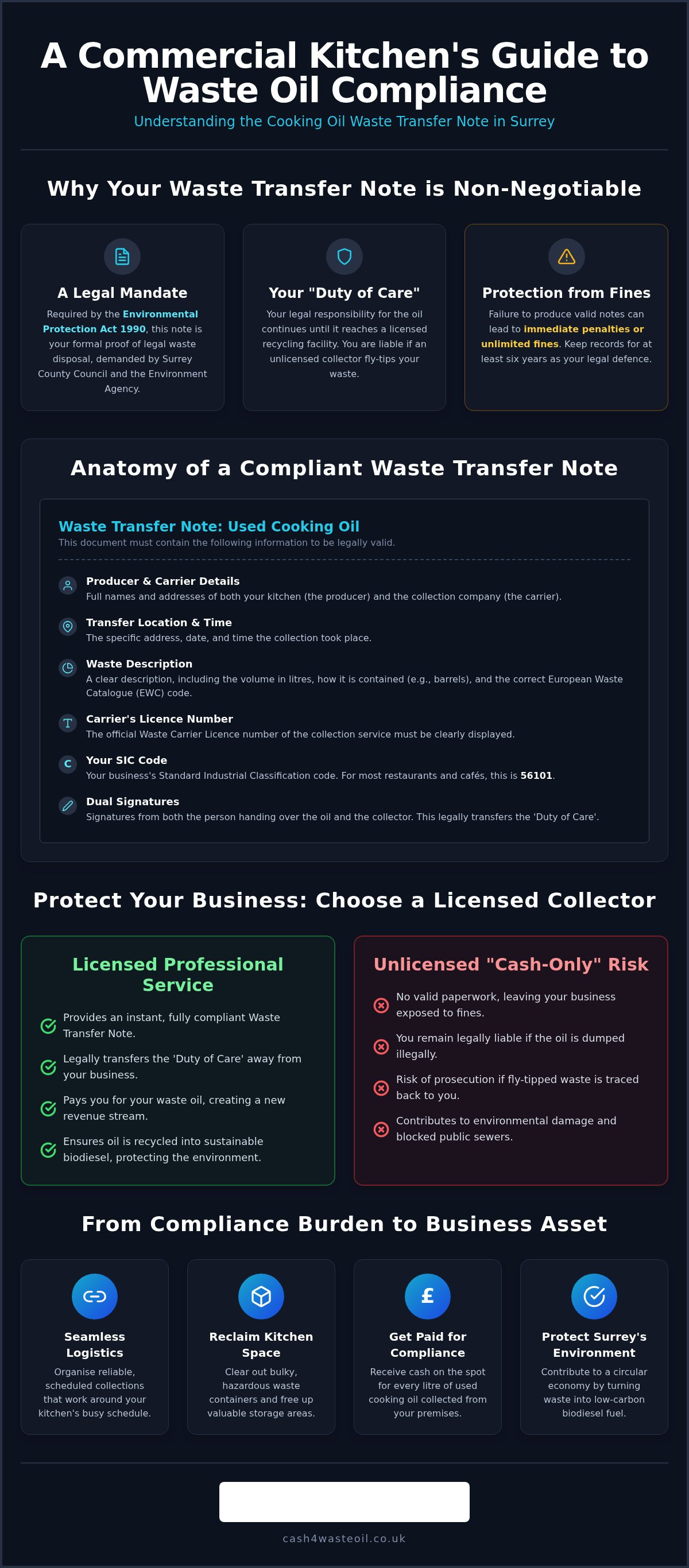
Every time a collection vehicle leaves your Surrey premises with used cooking oil, a specific legal transaction occurs. This isn't just a simple receipt; it's a mandatory document required under the Environmental Protection Act 1990. A cooking oil waste transfer note Surrey businesses receive acts as a formal record of the waste's journey from your kitchen to a processing plant. Surrey County Council and the Environment Agency demand these records to ensure that hazardous waste isn't being dumped illegally.
You hold a permanent "Duty of Care" over your waste. This legal responsibility doesn't end the moment the oil leaves your back door. You're responsible for that oil until it reaches a licensed disposal or recycling site. If an unlicensed collector fly-tips your waste in the Surrey Hills or near the River Wey, the Environment Agency will trace those containers back to your kitchen. Without a valid note to prove you handed the oil to a legitimate carrier, you're the one facing the prosecution.
Pouring oil down the sink isn't just a plumbing risk; it's a criminal offence. Improper disposal leads to massive fatbergs in Guildford's sewer systems, which cost local authorities thousands of pounds to clear. These blockages cause sewage backups and risk flooding local properties. A waste transfer note is your proof that you aren't contributing to this regional infrastructure crisis.
Why a WTN is Your Prosecution Insurance
Think of this document as your shield. During a surprise inspection from local environmental health officers, this paperwork is the first thing they'll ask to see. Securing a valid cooking oil waste transfer note Surrey inspectors can verify is your best defence against legal action. You must keep these records for six years to comply with broader UK waste management regulations. Failing to produce a valid note upon request can result in immediate fixed penalty notices or unlimited fines in a magistrate's court. It's a simple piece of paper that prevents a significant financial and reputational nightmare.
The Environmental Impact in the Surrey Countryside
Surrey is defined by its stunning green spaces and delicate local waterways. Improperly handled oil is a major pollutant that destroys aquatic life and soil health. By ensuring every drop is tracked via a transfer note, you're actively supporting a circular economy. Your waste oil doesn't just vanish; it's transported to specialist centres where it's refined into sustainable biodiesel. This process turns a kitchen byproduct into a low-carbon fuel that powers transport across the UK. It's a smart business move that directly protects the Surrey countryside whilst reducing your carbon footprint.
What Must Be Included in a Cooking Oil Waste Transfer Note?
A document is only as good as the information it holds. For a cooking oil waste transfer note Surrey inspectors will accept, accuracy is everything. Missing fields or vague descriptions can lead to the document being rejected during an audit. This leaves your business exposed to the very fines you're trying to avoid. You must ensure that every transfer is documented with precision to maintain a clean legal record.
Every valid note needs a specific set of data points to be legally binding. At a minimum, your paperwork must include:
- The names and addresses of both the waste producer (your kitchen) and the waste carrier.
- A clear description of the waste, including its volume in litres and how it's contained.
- The date, time, and specific location of the transfer.
- Your business’s Standard Industrial Classification (SIC) code, which identifies your industry to regulators.
- The signatures of both the person handing over the oil and the person collecting it.
The signature is the point where the legal "Duty of Care" moves from your hands to the collector. Without both signatures, the note doesn't prove a legal transfer occurred. It's also vital to include your SIC code; for most restaurants and cafes, this is typically 56101. This level of detail ensures your cooking oil waste transfer note Surrey records are fully transparent and professional.
Anatomy of a Compliant Transfer Note
Precision matters when dealing with the Environment Agency. Your note must display the collector's Waste Carrier Licence number. You should always verify this number before allowing oil to be loaded onto a vehicle. The waste itself must be identified using the correct European Waste Catalogue (EWC) code, which for used cooking oil is 20 01 25. These requirements are clearly defined in the Waste Duty of Care Code of Practice. Following these guidelines ensures that your waste is being handled by legitimate professionals who are part of a regulated system.
Digital vs Paper Notes: What Works Best?
Traditional paper pads are becoming a liability in modern kitchens. They get stained, lost, or filed incorrectly. Digital record-keeping is the superior choice for busy managers who need instant access to their compliance history. From October 2026, the UK's mandatory Digital Waste Tracking system will make digital records the standard for licensed waste-receiving sites. Moving to digital now prevents the "lost paperwork" excuse during an unannounced inspection. For more advice on staying ahead of these changes, see our Commercial Kitchen Oil Disposal: The 2026 Essential Compliance Checklist. If you want to simplify your admin today, you can book a compliant collection that provides instant documentation.
Licensed vs Unlicensed Collection: Protecting Your Surrey Business
Handing your used cooking oil to the first person who offers a quick collection is a gamble that rarely pays off. Unlicensed collectors, often referred to as "white van men", frequently target Surrey pubs and restaurants with promises of free disposal. However, these individuals rarely provide the cooking oil waste transfer note Surrey health inspectors will accept. By bypassing the legal paperwork, you aren't just cutting corners; you are stepping into a legal minefield that could jeopardise your entire operation.
If an unlicensed carrier fly-tips your oil in a local park or pours it into a Surrey drain, the law holds you responsible. Under your "Duty of Care", you remain legally liable for the waste until it reaches a legitimate recycling centre. The Environment Agency traces the waste back to the producer. Without a valid transfer note to prove a legal hand-over, your business faces the full weight of the penalty. A "free" collection suddenly becomes a liability that could cost you a £5,000 fine and irreparable damage to your brand’s reputation.
The Dangers of the Unlicensed Collector
Spotting an illegitimate collector is straightforward if you know the signs. Professional carriers arrive in branded vehicles and carry digital or physical proof of their credentials. Common red flags include:
- Unmarked or unbranded vehicles with no company identification.
- Refusal or hesitation to show an Environment Agency Waste Carrier Licence.
- Inability to provide a signed waste transfer note on the spot.
- Requests for "cash only" transactions without formal receipts.
These collectors often dump waste illegally to avoid the fees at legitimate sites. This behaviour directly damages Surrey’s local infrastructure and pollutes the very community your business serves. In 2026, the no-nonsense standard for commercial kitchens is clear: if there's no paperwork, there's no collection.
Verifying Your Carrier: A 2-Minute Compliance Check
Protecting your business takes less than two minutes. You can verify any collector by checking their registration number on the Environment Agency’s official website. This quick check confirms they're a licensed waste carrier authorised to handle your used oil. Cash 4 Waste Oil maintains 100% transparency, ensuring our registration is always available for inspection. We provide the necessary documentation immediately, so you're never left guessing about your compliance status. For a deeper look at the official standards you must meet, read our DEFRA Cooking Oil Waste Guidance: The 2026 Commercial Compliance Guide. Taking this small step ensures your kitchen remains a safe, legal, and professional operation.
How to Organise Efficient Waste Oil Management in Surrey
Managing used cooking oil shouldn't be an afterthought. In busy town centres like Guildford and Woking, kitchen space is often at a premium. Letting waste oil accumulate without a clear plan leads to spills, safety hazards, and unnecessary stress for your team. A structured strategy ensures you always have room for the next service whilst keeping your cooking oil waste transfer note Surrey records perfectly organised. Efficiency in the yard reflects the efficiency of your pass.
Moving from an "on-call" reactive model to a scheduled collection is the most effective way to maintain order. Reactive collections often result in overflowing drums during peak weekends in Epsom or Reigate, leaving staff to struggle with heavy, dangerous containers. A scheduled service ensures that your storage is cleared before it becomes a problem. This reliability allows your management team to focus on customer experience rather than logistics. It turns a messy chore into a predictable, hands-off process.
Optimising Your Kitchen Storage
Start with the basics: use a dedicated funnel and heat-resistant drums for all transfers. You must never mix your used oil with other waste streams like food scraps or general rubbish. Keeping the oil pure is essential for the EWC code 20 01 25 description on your transfer note. In Surrey, oil theft from pub yards is a growing concern for many landlords. Store your drums in a locked, well-lit area that remains accessible for a pallet truck. This balance of security and access speeds up the collection process and protects your rebate.
Scheduling Around Surrey’s Traffic and Logistics
Surrey’s roads are notoriously unpredictable. We plan our routes specifically to navigate the pressures of the M25 and A3, ensuring we reach your kitchen during your preferred windows. Local knowledge of the narrow streets in historic town centres makes a significant difference in service quality. We don't just arrive; we arrive when it suits your kitchen's workflow, avoiding the midday rush. Our drivers understand the local geography, from the hills of Reigate to the busy shopping quarters of Woking. To set up your hassle-free schedule and ensure your compliance is always handled, book your Surrey oil collection today.
Get Paid for Compliance: The Cash 4 Waste Oil Surrey Service
Compliance is usually seen as a cost centre for commercial kitchens. For many operators, the administrative weight of securing a cooking oil waste transfer note Surrey regulators demand feels like another tax on their time. We flip that script. Our service is designed to remove the friction from waste management by combining legal paperwork with immediate financial rewards. We ensure your kitchen stays compliant whilst adding directly to your bottom line. There are no hidden admin fees or subscription costs; just a straightforward, professional transaction that benefits your business and the environment.
Our "Cash on the Spot" model provides an immediate boost to your operational budget. We believe that professional standards should be rewarded, not penalised. By choosing a service that handles both the logistics and the legality, you free up your management team to focus on what they do best: running a high-quality kitchen. It is a pragmatic solution for a fast-paced industry that values efficiency and reliability above all else.
Turn Waste into Revenue
Our model is built on transparency and speed. We offer a competitive per-litre rebate for your used cooking oil, paid directly to you at the point of collection. This approach is far more sustainable for independent Surrey businesses than council-led services that often charge for disposal or offer no rebate at all. Whether you run a busy hotel in Guildford, a local pub in Dorking, or a high-volume takeaway in Woking, your waste oil has commercial value. We help you realise that value without the usual logistical headaches. We collect from all types of commercial kitchens across the county, ensuring that every litre of oil is put to good use.
Seamless Paperwork: We Handle the Admin
The biggest headache for any kitchen manager is the paperwork trail. We solve this by handing over a fully compliant cooking oil waste transfer note Surrey inspectors require the moment the oil is loaded. Our team ensures every detail, from the EWC code to the carrier licence number, is recorded accurately. You don't have to wait for an email or chase a head office for a PDF. The proof of your "Duty of Care" is in your hands before our vehicle leaves your site. This process ensures every box is ticked for Environment Agency standards, leaving you prepared for any unannounced inspection.
By choosing a professional recycling partner, you are also ensuring your waste is converted into sustainable biodiesel. This transition from a kitchen byproduct to a renewable fuel source is a significant CSR win. It demonstrates a commitment to the circular economy that resonates with modern Surrey diners. If you're ready to stop paying for disposal and start getting paid for compliance, contact us today for a free quote or to book your first collection.
Future-Proof Your Surrey Kitchen Operations
Managing used cooking oil is no longer a logistical burden; it's an opportunity to streamline your admin and boost your revenue. By securing a valid cooking oil waste transfer note Surrey inspectors approve, you protect your business from the risk of heavy fines and legal liability. You've seen how easy it is to switch from reactive storage to a professional, scheduled collection that turns waste into a valuable resource for sustainable biodiesel.
Don't leave your compliance to chance with unlicensed collectors. As an Environment Agency Registered Carrier, we provide full compliance documentation immediately at the point of collection. This ensures every box is ticked for your Duty of Care whilst putting money back into your pocket with instant cash payments. It's a no-nonsense approach that values your time and your commitment to the local environment.
Ready to clear your storage space and get rewarded for your compliance? Book your free Surrey oil collection and get paid cash today. Let's make your kitchen's waste management the easiest part of your service.
Frequently Asked Questions
Do I legally need a waste transfer note for cooking oil in Surrey?
Yes, a cooking oil waste transfer note Surrey businesses receive is a strict legal requirement under the Environmental Protection Act 1990. Every commercial establishment, from small cafes to large hotels, must document the transfer of used oil to a licensed carrier. Failing to produce these documents during a local council or Environment Agency inspection can lead to immediate fines. It's your primary evidence that you've fulfilled your legal Duty of Care.
How long must I keep my cooking oil waste transfer notes?
You're legally required to keep all waste transfer notes for a minimum of two years. However, many Surrey business owners choose to archive these records for six years to align with broader UK tax and business audit requirements. Whether you store them in a physical folder or a digital database, they must be easily accessible for unannounced inspections by environmental health officers or the Environment Agency at any time.
Is there a charge for the waste transfer note?
No, there's no charge for the documentation when you use a professional service like Cash 4 Waste Oil. We provide a fully compliant cooking oil waste transfer note Surrey kitchens need at the exact moment of collection. This is a standard part of our free service. Beware of collectors who attempt to charge admin fees for paperwork; legitimate, licensed carriers include this as part of their regulatory responsibility.
Can I get a waste transfer note if I take the oil to a Surrey recycling centre myself?
Surrey’s Community Recycling Centres are designed for residential use and don't typically provide the commercial Waste Transfer Notes required by businesses. If you operate a commercial kitchen, you're legally obligated to use a licensed waste carrier or have a commercial agreement with a waste site. Self-disposal at household sites often bypasses the necessary paper trail, leaving your business vulnerable to heavy fines for improper commercial waste management.
What happens if I lose my waste transfer note before an inspection?
If a note is lost, you should contact your waste carrier immediately to request a duplicate copy. This is where digital record-keeping provides a significant advantage over paper pads. At Cash 4 Waste Oil, we maintain digital records of every transaction, allowing us to provide replacement documentation quickly. Having a gap in your records is a red flag for inspectors, so you must resolve missing paperwork as soon as you notice it.
Who is authorised to sign a waste transfer note in a commercial kitchen?
Any responsible member of staff can sign the note, provided they can verify the volume of oil being collected. This is usually the head chef, kitchen manager, or business owner. The person signing is confirming that the description of the waste is accurate and that it's been handed over to the carrier. Both the waste producer and the carrier must sign the document for it to be legally valid and binding.
Does the waste transfer note prove my oil was recycled into biodiesel?
The note itself proves that the oil was legally transferred to a licensed carrier for recovery or disposal. Whilst it doesn't track the final chemical breakdown, using a specialist like Cash 4 Waste Oil ensures your waste enters the circular economy. We process collected oil specifically for use as biodiesel feedstock. The transfer note is the first link in that chain, confirming the oil has started its journey toward becoming sustainable fuel.
Can I use one waste transfer note for multiple oil collections?
No, you must have a separate waste transfer note for every individual collection that takes place. Each document must reflect the specific date, time, and volume of oil removed from your premises. Attempting to use a single note for multiple visits is a breach of compliance and will be flagged during an audit. Consistent, individual documentation is the only way to prove a continuous and legal waste management process for your kitchen.