Dark Kitchen Oil Collection Surrey: 2026 Guide
Used cooking oil needs to leave your dark kitchen without disrupting a busy shift or taking up valuable space. For Surrey operators, dark kitchen oil collection Surrey works best when storage, collection timing and paperwork fit the way the kitchen runs. Limited room and changing order volumes can make waste oil harder to manage, but a clear routine keeps the process under control.
Before arranging a collection, decide where staff will store the oil, how the collection point can be accessed and who will manage the handover. Cash 4 Waste Oil provides free commercial used cooking oil collection in Surrey, pays cash on the spot for collected oil and provides a Waste Transfer Note. That gives your team a straightforward process, from storing used cooking oil to keeping collection records organised.
This guide explains how to build a practical routine for your dark kitchen. You’ll find out how to plan storage and collection around your workflow, what to prepare for collection day and how to keep relevant waste records accessible. The aim is to make oil collection a manageable part of kitchen operations, not another last-minute task.
Key Takeaways
- Identify which used oils from commercial food preparation are suitable for collection, and choose a storage point that fits your available space.
- Use a consistent handling routine, following equipment instructions and workplace safety procedures.
- Choose between scheduled and on-call dark kitchen oil collection Surrey by considering oil output, storage capacity, site access and service patterns.
- Prepare for collection day by arranging access, making the oil ready for handover and filing the Waste Transfer Note.
- Cash 4 Waste Oil provides commercial collection, cash payment on the spot and a collection record for your Surrey kitchen.
Dark kitchen oil collection in Surrey: what needs managing?
A dark kitchen prepares food for delivery or collection, usually without a customer-facing dining area. For a quick explanation of what a dark kitchen is, the term is also used for virtual or ghost kitchens. Compact layouts and delivery-led workflows can leave little room for waste handling. A practical dark kitchen oil collection Surrey routine keeps three things organised: oil storage, collection timing and handover records.
Here, waste oil means used food-grade cooking oil generated during commercial food preparation. It’s different from fresh oil, food scraps and other kitchen waste. Keep these waste streams separate so the used cooking oil remains ready for collection rather than being mixed with materials that aren’t part of the service.
Which oil can a commercial dark kitchen arrange for collection?
Commercial kitchens can arrange collection for used food-grade vegetable and cooking oils, including oil used for frying as part of food preparation. Keep it separate from food scraps. Leftover food and mixed kitchen waste are not cooking oil and should not go into the oil collection.
Scope matters. This service is for cooking oil from a business, not oil from a household. Vehicle engine oil and industrial mineral oils are different materials and are not suitable for this cooking-oil collection. Clearly identifying the container and keeping waste streams separate helps staff understand what belongs in the collection and what needs a different handling route.
Why does the Surrey location matter to collection planning?
For a Surrey kitchen, the handover depends on the site as well as the county. A unit with limited storage may need a different routine from a larger kitchen with a dedicated service area. Delivery peaks, operating hours, access routes and the position of the stored oil all affect when and how a collection fits into daily work.
Map the route from the oil storage point to the collection access area. Decide who can provide access and how to avoid interrupting food preparation or dispatch. These details help you plan a workable handover for your particular site, rather than relying on a routine that may not suit your kitchen.
In short, choose a suitable storage point, plan collection timing around your operations and keep the handover record accessible. Staff then have a clear process, even during busy shifts or when the kitchen is short on space.
How to organise used cooking oil storage in a busy dark kitchen
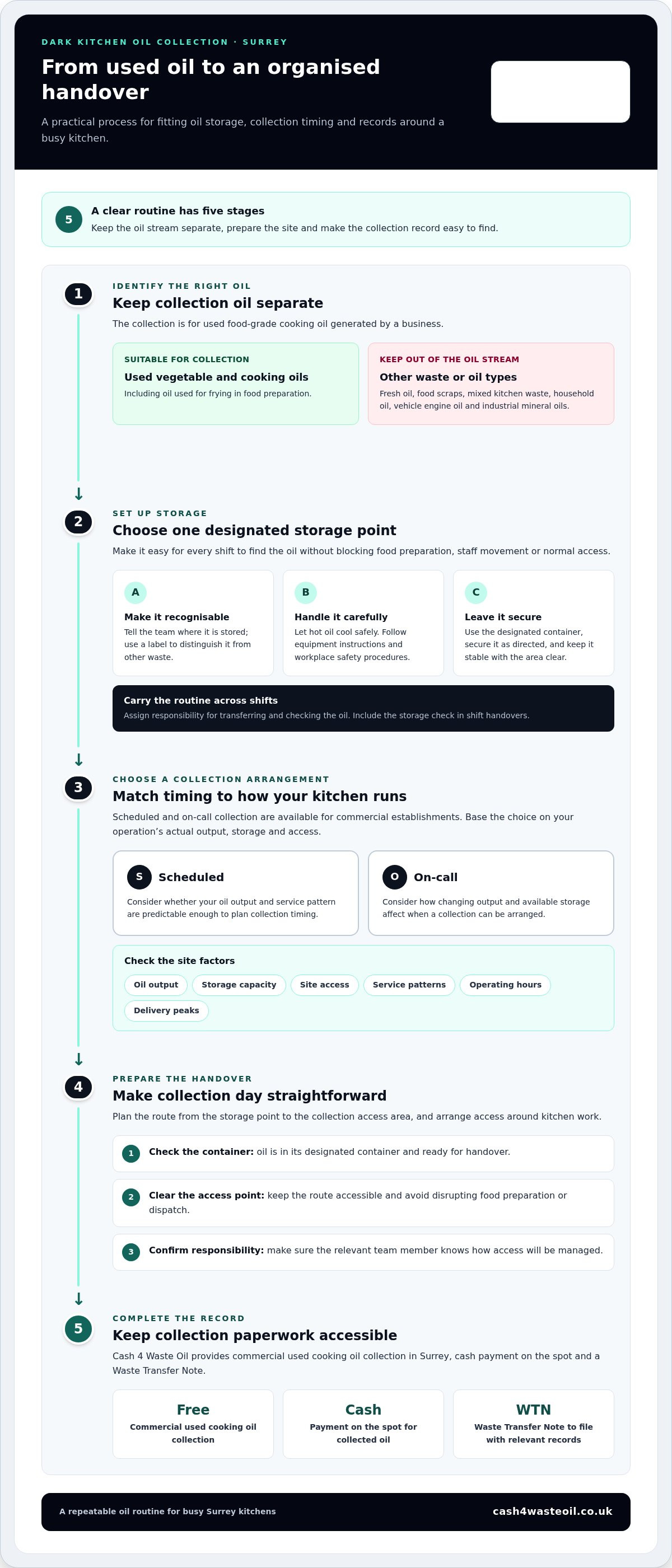
A shared routine helps staff handle used cooking oil consistently, even when shifts change and orders keep coming in. Choose one designated storage point, assign responsibility for transferring and checking the oil, and keep the collection area accessible. This reduces last-minute searching and helps the handover fit around kitchen work.
Create a storage routine that suits a compact kitchen
Choose a practical area that does not block food preparation, staff movement or normal access through the kitchen. Make sure the team knows where the oil is stored and how it should be transferred. A label at the storage point can identify its purpose and distinguish it from other kitchen waste.
Include the oil check in shift handovers. For example, the outgoing team can record whether used oil has been moved to the designated area, while the incoming team knows where to find it and who is responsible for checking it. Keep the routine consistent instead of leaving each person to decide where the oil goes.
Transfer and secure oil carefully
Never rush the transfer. Allow hot oil to cool safely before handling it, and follow the equipment instructions and your workplace safety procedures. Transfer it carefully into the container used for storing cooking oil, then secure it as directed. Use the instructions for your equipment and workplace procedures for handling and storage, rather than improvising limits or rules.
Keep the container stable and the surrounding area clear. In a compact kitchen, even a small obstruction can disrupt staff movement or food preparation. Ask the person assigned to the task to check that the oil is contained and the storage point is tidy after each transfer.
Prepare for a clean collection handover
Before collection, check that the oil is in its designated container, the collection point is accessible and the relevant team member knows how access will be managed. These simple checks help prevent delays caused by a blocked route or uncertainty about where the oil is stored.
Use the same storage routine whether collections are scheduled or arranged on call. A consistent process gives staff a predictable way to manage oil between handovers and makes dark kitchen oil collection Surrey easier to fit around daily operations. For more guidance on handling commercial cooking oil responsibly, read our guide to commercial kitchen oil disposal. When your storage point and process are ready, arrange commercial used cooking oil collection with Cash 4 Waste Oil.
Matching Surrey Oil Collection to Dark Kitchen Operations
The right collection arrangement depends on how your kitchen produces and stores used oil. A delivery menu with steady frying demand may create a predictable pattern, while changes in trading or menu activity can make output less consistent. Cash 4 Waste Oil offers scheduled or on-call collection for commercial establishments. Choose an arrangement for dark kitchen oil collection Surrey by looking at your operation’s actual output, storage and access, rather than assuming a fixed frequency or response time.
Before choosing an arrangement, consider four practical factors:
- Oil output: Is the amount generated fairly steady, or does it vary with orders and menu changes?
- Storage: How quickly does the designated storage point fill during normal operations?
- Access: Can the collection point be reached without disrupting preparation or dispatch?
- Service patterns: Which days or periods are less disruptive for staff to manage a handover?
| Arrangement | Operational fit | Planning implications | Questions it answers |
|---|---|---|---|
| Scheduled | Oil output is relatively predictable. | Plan staff and site access around an agreed collection routine. | When should the team prepare for handover? Who will provide access? |
| On-call | Oil output varies or is harder to predict. | Monitor storage and plan ahead for safe containment and access. | Who arranges the collection? Is the oil ready and the route clear? |
When might scheduled collection suit a dark kitchen?
A planned arrangement can suit a kitchen that produces used oil at a fairly steady pace. Track how quickly the designated storage point fills during ordinary trading, then use that pattern to plan a workable handover routine. Advance planning gives staff time to prepare the area and coordinate access around food preparation and delivery dispatch.
When might an on-call collection arrangement be useful?
On-call collection may suit a kitchen whose output changes with demand, menus or operating patterns. Monitor storage so staff can plan the handover before space becomes difficult to manage. Base the routine on safe storage and site access, not an assumed response time. For regional context, this collection planning article for Kent covers another area, rather than Surrey.
Whichever option suits your kitchen, make sure the team knows who arranges the handover and how the collection point will be accessed. Cash 4 Waste Oil provides commercial used cooking oil collection in Surrey, with scheduled and on-call options. Explore commercial oil collection in Surrey as you shape a routine around your kitchen’s output and access.
What happens during collection, payment and waste documentation?
A clear handover keeps collection straightforward for the kitchen team and collector. For dark kitchen oil collection Surrey, prepare the stored cooking oil, arrange site access, hand over the oil and file the collection record. Cash 4 Waste Oil provides free commercial used cooking oil collection, pays cash on the spot for collected oil and provides a Waste Transfer Note.
- Prepare the oil: Make sure the stored oil is ready for handover and the collection point is accessible.
- Arrange access: Ensure the relevant staff member knows how the collector can reach the collection area.
- Complete the handover: The oil is collected and cash is paid on the spot.
- Keep the record: Retain the Waste Transfer Note with the business’s waste documentation.
What information should the kitchen retain after collection?
The Waste Transfer Note records the collection and gives managers a document to refer to when reviewing the business’s waste arrangements. File it alongside other relevant business waste records, either in an organised paper folder or an accessible digital location. Make sure staff responsible for managing waste know where the records are kept. This makes the paperwork easier to retrieve when needed, without relying on one person’s inbox or memory.
For more detail on paperwork and compliance considerations, read this guide to Waste Transfer Note requirements. Keep records in a consistent place so each collection has a clear paper trail.
How is collected cooking oil recovered?
After collection, the used cooking oil is processed into biodiesel. This gives the oil a recovery pathway beyond the kitchen. Clear records and a well-managed handover help connect your kitchen’s routine with responsible recovery.
To learn more about the broader recovery process, see this guide to sustainable waste oil disposal.
Ready to organise commercial used cooking oil collection for your kitchen? Arrange used cooking oil collection with Cash 4 Waste Oil.
Arrange dark kitchen oil collection in Surrey with Cash 4 Waste Oil
Make the collection arrangement fit your kitchen’s working conditions. Before setting it up, identify the type of oil, where staff store it, how the collection point can be reached and whether scheduled or on-call collection better suits your workflow. A little preparation helps staff manage the handover without adding confusion during a busy shift.
A simple checklist before arranging collection
Use this short checklist to get the key details in order:
- Oil type: Confirm that the oil comes from commercial food preparation and is used food-grade cooking oil.
- Storage: Identify where staff keep the oil and make sure the designated area is understood across shifts.
- Access: Consider how the collection point can be reached and who will arrange access for the handover.
- Collection preference: Decide whether a scheduled or on-call arrangement better matches your kitchen’s output and operating pattern.
These details give your team a practical starting point. They also help you account for limited storage, delivery periods and staff responsibilities, rather than leaving the handover to the last minute.
What to expect from Cash 4 Waste Oil
Cash 4 Waste Oil provides commercial used cooking oil collection for kitchens in Surrey. Collections are fully licensed and Environment Agency registered. The service is for commercial kitchens, not household oil disposal, and handles used food-grade cooking oil rather than vehicle engine or industrial mineral oils.
Collection is free. Businesses receive cash payment on the spot for oil collected, and a Waste Transfer Note is provided for the handover. Keep the note with your business waste records so relevant staff can retrieve it when needed. With the oil type, storage point and access arrangements ready, your team has a clear process from preparation through to documented collection.
Set the routine around your kitchen’s output and preferred collection arrangement. For dark kitchen oil collection Surrey, Cash 4 Waste Oil offers a practical way to manage commercial used cooking oil around food preparation and dispatch.
Arrange used cooking oil collection for your Surrey commercial kitchen and prepare your team for a straightforward handover.
Put a practical oil collection routine in place
A workable routine starts with three decisions: store used food-grade cooking oil consistently, choose scheduled or on-call collection to suit your kitchen’s output, and make sure staff know how to prepare the handover and file its record. These steps make dark kitchen oil collection Surrey easier to manage around a busy delivery operation.
Cash 4 Waste Oil provides free scheduled or on-call collection for commercial kitchens in Surrey. Collections are fully licensed and Environment Agency registered. For collected oil, your business receives cash payment on the spot and a Waste Transfer Note to keep with its records.
Set your storage and access arrangements, then choose the collection option that fits your workflow. Arrange free commercial oil collection in Surrey and take the next step towards a clearer, more organised handover routine.
Frequently Asked Questions
How do dark kitchens in Surrey arrange used cooking oil collection?
Start by storing used food-grade cooking oil in a designated, accessible area, then choose scheduled or on-call collection to suit your kitchen’s output and working pattern. Cash 4 Waste Oil provides dark kitchen oil collection Surrey businesses can arrange, with free collection and a Waste Transfer Note for the handover. The company serves commercial kitchens in Surrey, London, Greater London, Kent, Birmingham, Coventry, Leicester, Wolverhampton, Leicestershire, Derbyshire, Staffordshire, Warwickshire, Northamptonshire, Oxfordshire and Worcestershire.
Is used cooking oil collection free for dark kitchens in Surrey?
Yes. Cash 4 Waste Oil provides free commercial used cooking oil collection in Surrey and pays cash on the spot for oil collected. The payment amount depends on the oil collected, so don’t assume a fixed rate. Have your stored oil ready and make sure the collection point is accessible for a smooth handover.
What types of oil can a Surrey dark kitchen have collected?
Commercial kitchens can arrange collection of used food-grade vegetable and cooking oils generated during food preparation. Household oil, vehicle engine oil and industrial mineral oil are not part of this service. Keep used cooking oil separate from food scraps and other waste streams. Before storing it for collection, follow your workplace procedures and equipment instructions for cooling and handling the oil safely.
How often should a dark kitchen arrange waste oil collection?
There’s no single collection frequency that suits every kitchen. Consider how much used oil you generate, how quickly the designated storage area fills and how collection access fits your working day. Cash 4 Waste Oil offers scheduled or on-call collection for commercial establishments. Choose an arrangement around your operation’s pattern rather than assuming a particular collection frequency or response time.
Does a dark kitchen need a Waste Transfer Note for used cooking oil?
Cash 4 Waste Oil provides a Waste Transfer Note for its collections. Keep the note with your business waste records in a place managers can access when reviewing the handover. Specific legal requirements and record-retention periods can depend on the circumstances and current guidance. Check authoritative UK guidance for advice on how those requirements apply to your business.
Can a Surrey dark kitchen get paid for used cooking oil?
Yes. Cash 4 Waste Oil pays businesses cash on the spot for collected used cooking oil. The payment amount depends on the oil collected, so don’t rely on an assumed rate. The service is for commercial kitchens handing over used food-grade cooking oil. It doesn’t cover household oil, vehicle engine oil or industrial mineral oils.
What happens to used cooking oil after collection?
Cash 4 Waste Oil processes collected cooking oil into biodiesel. At handover, the business receives a Waste Transfer Note, which can be filed with its waste records. Keeping the collection documentation accessible helps staff retrieve details of the oil handover when needed.