Free Commercial Cooking Oil Collection: The 2026 UK Business Guide
What if the messy, leaking drums of sludge in your storage area weren't a disposal problem, but a hidden revenue stream? Managing a fast-paced kitchen is difficult enough without the constant headache of unreliable collectors or the threat of a £5,000 fine. Securing a reliable free commercial cooking oil collection shouldn't be a gamble. You need a solution that clears your space, pays you fairly, and keeps the Environment Agency off your back without adding to your daily workload.
This 2026 guide explains how to turn your waste oil into immediate cash flow whilst staying ahead of the strict new digital waste tracking laws. We'll break down the essential legal requirements for Waste Transfer Notes and show you how to avoid the £118 hourly charges for non-compliance. You'll learn how to establish a seamless collection routine that eliminates mess and guarantees a transparent, "cash on the spot" payment for every litre you produce. It's time to stop treating your used oil as rubbish and start treating it as the liquid asset it really is.
Key Takeaways
- Discover how to transform kitchen waste into immediate revenue by switching to a "cash on the spot" model for your used oil.
- Master the 2026 regulatory landscape to ensure your business remains compliant with mandatory digital waste tracking and Waste Transfer Note requirements.
- Secure a reliable free commercial cooking oil collection that eliminates the risk of messy storage areas whilst rewarding your business financially.
- Learn the essential storage protocols to prevent leaks, avoid hefty environmental fines, and maintain a high standard of kitchen hygiene.
- Understand why choosing an Environment Agency registered carrier is the only way to satisfy your legal "Duty of Care" as a waste producer.
Understanding Free Commercial Cooking Oil Collection Services
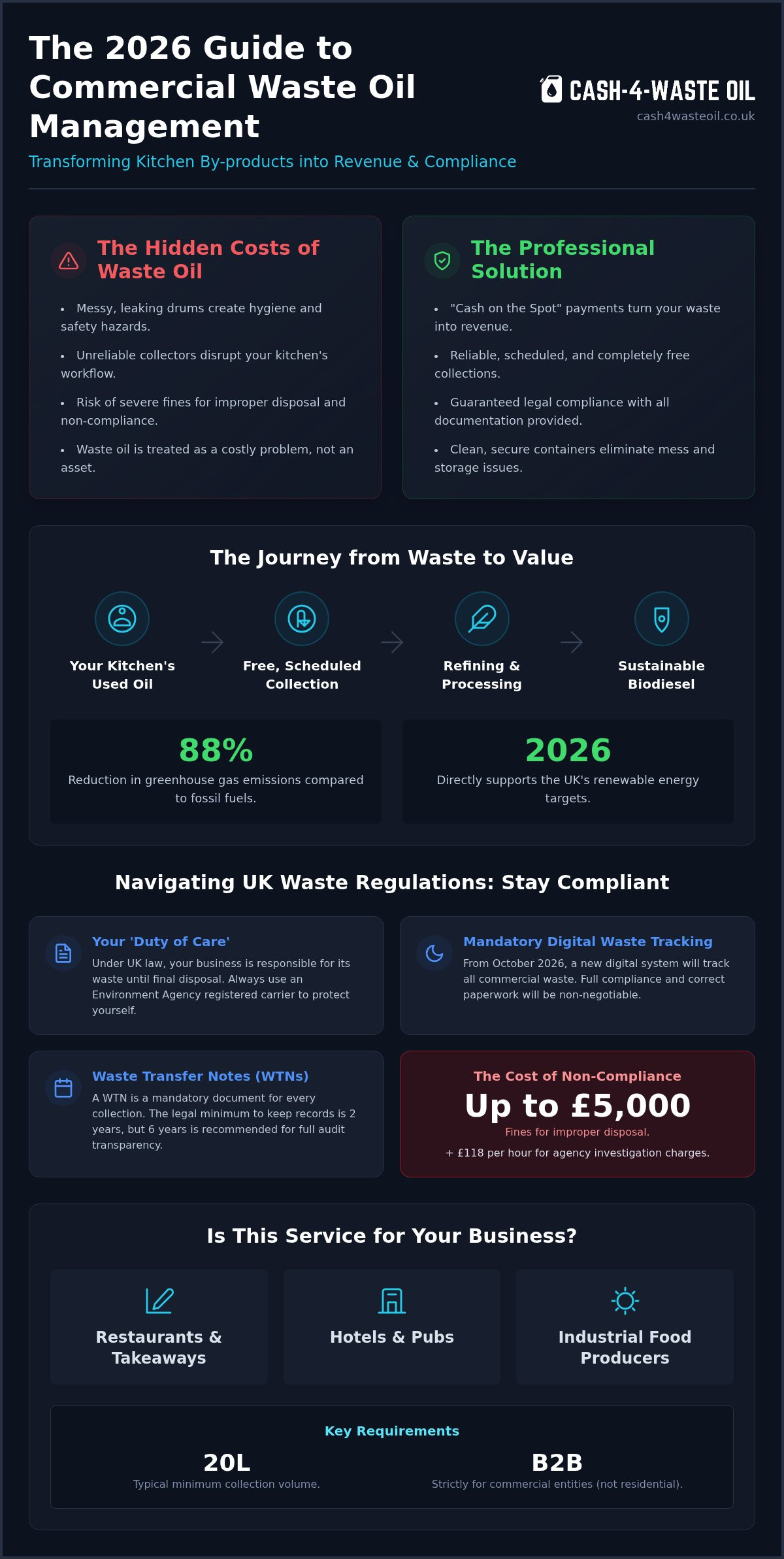
For UK business owners, a free commercial cooking oil collection service is a logistical partnership that removes a hazardous waste product at zero cost. It's a common misconception that getting rid of used oil is an expense. In reality, your waste is a valuable commodity. Professional collectors provide the containers, the transport, and the legal documentation, such as Waste Transfer Notes, without charging a penny. This arrangement allows you to focus on your kitchen operations whilst we handle the mess and the paperwork.
Why is this service free? The answer lies in the processing. Once collected, your used oil, often referred to as Yellow grease, undergoes a rigorous filtration and rendering process to remove food particles and moisture. This refined product is then sold as a primary feedstock for the production of sustainable biodiesel. By providing this material, you're directly supporting the UK’s 2026 renewable energy targets while clearing space in your kitchen. It's a smart business decision that yields environmental benefits as a practical byproduct.
Don't be tempted by "grease thieves" or unlicensed collectors who offer to take your oil without paperwork. These illegal operators often fly-tip the waste or sell it into unregulated markets, leaving you legally liable for the improper disposal. A professional service ensures your waste is handled by an Environment Agency registered carrier, protecting your business from heavy fines and reputational damage. We provide a transparent, reliable alternative that keeps your storage area clean and your business compliant.
The Economics of Waste Vegetable Oil
Collectors can afford to offer free services because the global demand for biodiesel has surged. In 2026, the push for circular economy practices means that every litre of oil is tracked and valued. The journey from your fryer to the fuel tank involves heating, settling, and transesterification. This process turns a messy byproduct into a high-performance fuel that reduces greenhouse gas emissions by up to 88% compared to traditional fossil fuels. This value chain allows us to collect your oil at no charge and, in many cases, pay you for the volume collected.
Who Can Benefit from Free Collection?
This service is designed specifically for commercial food producers. If you run a high-volume kitchen, you qualify for a scheduled pickup. The following sectors typically benefit most:
- Restaurants and Takeaways: High-frequency users of vegetable, sunflower, and rapeseed oils.
- Hotels and Pubs: Businesses with consistent frying requirements and large storage capacities.
- Industrial Food Producers: Factories and catering centres producing massive quantities of waste.
Most professional collectors require a minimum volume, typically around 20 litres, to justify the transport costs. These services are strictly for commercial entities. Residential households are excluded because the logistics of small-scale, domestic pickup aren't commercially viable and don't meet the regulatory requirements for commercial waste management.
Legal Compliance: Waste Transfer Notes and Environment Agency Rules
Compliance in a commercial kitchen isn't just about food hygiene; it's about how you manage what leaves your back door. Under the Environmental Protection Act 1990, every business has a legal "Duty of Care" regarding its waste. This means you're responsible for your used oil until it reaches a licensed disposal point. If an unlicensed collector fly-tips your oil, the Environment Agency can trace it back to you. You could face fines of up to £5,000 or even prosecution. Arranging a free commercial cooking oil collection with a legitimate partner isn't just a convenience; it's your primary shield against legal liability.
The regulatory landscape is tightening. From October 2026, the UK is introducing mandatory digital waste tracking. This system provides regulators with real-time data on waste movements, making it impossible to hide improper disposal. To stay compliant, you must ensure every drop of oil is accounted for with the correct paperwork. Whilst the legal minimum for keeping Waste Transfer Notes is two years, many local authorities and insurance providers now recommend a six-year record-keeping period for all commercial waste documentation to ensure full audit transparency.
The Anatomy of a Waste Transfer Note (WTN)
A Waste Transfer Note is a mandatory document that must be completed every time oil leaves your premises. It proves you've handed your waste to an authorised person. A valid WTN must include your business details, the collector’s license number, and the correct European Waste Catalogue (EWC) code; for used cooking oil, this is 20 01 25. It should also specify your Standard Industrial Classification (SIC) code. You must receive a physical or digital copy at the point of collection. For a full breakdown of what your kitchen needs to stay safe, see our Commercial Kitchen Oil Disposal: The 2026 Essential Compliance Checklist.
Environment Agency Registration and Licensing
Never hand your oil to someone who cannot produce a valid waste carrier license. You can easily verify a collector’s credentials on the government website to ensure they're legitimate. Professional collectors should hold "Upper Tier" status, which authorises them to transport and dispose of commercial waste. Using an unlicensed "white van" collector puts your business at significant risk, as they often lack the insurance and permits required by UK government waste oil regulations. To protect your business and ensure your waste is recycled into biodiesel, you should always book a collection with a registered professional who provides instant, compliant documentation.
Why "Free" Collection Often Pays You: Rebates and Cash Payments
Waste doesn't have to be a drain on your bottom line. While most providers offer a free commercial cooking oil collection as a basic service, the most efficient operators treat your used oil as a liquid asset. The distinction between a simple "free pickup" and a "paid collection" is significant for your annual budget. By choosing a partner that offers a rebate, you're effectively turning a disposal problem into a consistent revenue stream. In an environment where food input prices rose by 4.9% in the year to July 2026, every penny reclaimed from waste helps protect your margins.
The value of your oil is dictated by the global biodiesel market. Because your waste is refined into high-grade fuel, it holds intrinsic commercial value. However, not all rebate schemes are created equal. Some companies offer complex credit systems or delayed bank transfers that can take weeks to clear. For a busy kitchen, these administrative delays are an unnecessary burden. A transparent, immediate payment model ensures that the value of your waste is realised the moment it leaves your premises.
Cash on the Spot vs. Monthly Rebates
Cash flow is the lifeblood of any small business, especially in the competitive London hospitality sector. Waiting for a monthly rebate or a bank transfer creates extra paperwork and leaves your money sitting in someone else's account. Many kitchens now prefer "cash on the spot" transactions because they are immediate and verifiable. You see the oil weighed, you receive the payment, and you get your Waste Transfer Note all in one visit. This "no-nonsense" approach eliminates the need to chase payments or reconcile bank statements against collection receipts.
Maximising the Value of Your Used Fryer Oil
To secure the best possible rate for your oil, quality control is essential. Collectors look for high purity levels; oil that is heavily contaminated with water or food debris is harder to process and may fetch a lower price. Avoid mixing your vegetable oils with animal fats or "brown grease" from fat traps, as this can degrade the batch. For more detailed advice on improving your returns, read our guide on how to Get Paid for Used Cooking Oil in London: The 2026 Commercial Guide. Keep your storage containers sealed and dry to prevent rainwater ingress, which is the most common cause of price deductions during collection.
Best Practices for Storing Waste Oil in a Commercial Kitchen
A disorganised storage area is more than just an eyesore; it's a safety hazard and a barrier to a seamless free commercial cooking oil collection. Maintaining a clean, efficient system ensures your kitchen remains compliant and ready for pickup at any time. Professional storage prevents accidents and preserves the value of your waste. Follow these four essential steps to manage your oil effectively:
- Step 1: Cool before you pour. Never transfer oil whilst it's still hot. High temperatures can warp plastic drums, causing structural failure and dangerous spills. Allow the oil to cool completely in the fryer before moving it.
- Step 2: Use dedicated containers. Store your waste in leak-proof, high-density polyethylene drums, often referred to as blue barrels. These are designed to withstand the weight of the liquid and prevent seepage.
- Step 3: Strategic siting. Place your storage area on level ground, away from high-traffic zones and, crucially, away from drains. This reduces the risk of accidental discharge into the sewage system.
- Step 4: Ensure clear access. Your collection partner needs to reach the barrels quickly. Don't block the area with pallets or delivery crates, as this can lead to missed collections and storage overflows.
Safety and Hygiene in the Oil Storage Area
Neglected oil storage attracts pests and creates foul odours that can lead to complaints from neighbours or health inspectors. Keep lids tightly sealed at all times to maintain hygiene. For businesses storing large volumes, secondary containment or "bunding" is essential. A bund is a secondary area designed to catch leaks, ensuring that even a major barrel failure won't result in environmental damage. From a fire safety perspective, keep your storage area clear of combustible materials like cardboard or dry rubbish, as oil-soaked debris is a significant fire risk.
Avoiding Common Collection Issues
Pouring oil down the sink is never an option. This behaviour leads to "fatbergs" in the sewage system, which can result in fines of up to £5,000 from water authorities. If a spill occurs in your yard, use absorbent granules or sand immediately to contain the liquid; never hose it down the drain. Cross-contamination occurs when used cooking oil is mixed with water, food waste, or chemicals, significantly reducing its purity and market value. To ensure you get the best price and a hassle-free service, request professional collection barrels that keep your waste secure and uncontaminated until we arrive.
Efficient Oil Collection with Cash 4 Waste Oil
Cash 4 Waste Oil operates on a simple, professional principle: your waste should be our problem, not yours. We provide a free commercial cooking oil collection service that removes the administrative and logistical burden from your kitchen staff. By combining Environment Agency registration with an immediate "cash on the spot" payment model, we ensure your business remains compliant whilst improving your bottom line. We don't hide behind vague promises or delayed bank transfers. Instead, we offer a transparent, methodical service that turns your used oil into sustainable biodiesel.
Our booking process is designed for high-pressure environments. Whether you require a regular weekly slot to maintain kitchen flow or an ad-hoc pickup when your storage hits capacity, we adapt to your schedule. Every collection includes a mandatory Waste Transfer Note, ensuring your digital waste tracking records are 100% accurate for 2026 inspections. We take the burden of compliance off your shoulders, allowing you to focus on service.
Local Service in London, Kent, and Surrey
Operating in high-density urban areas requires specialised logistics. We have extensive experience navigating the unique challenges of London’s busiest boroughs, including Soho, Camden, and Wandsworth. Our fleet is fully compliant with ULEZ and congestion charge requirements, ensuring we can reach your back door without delays or extra costs. For businesses in the Home Counties, we offer an Emergency Waste Oil Collection Kent service to handle unexpected overflows or spill risks. This rapid response capability makes us a dependable ally for hospitality venues across the South East.
Expanding into the Midlands and Beyond
Reliability shouldn't be limited by geography. We have expanded our operations to provide the same high standard of service across the Midlands, covering Birmingham, Coventry, and Leicester. By maintaining local hubs, we ensure that our response times remain fast and our "cash on the spot" promise is upheld regardless of your location. We process every litre of oil we collect into sustainable biodiesel, contributing to the UK’s circular economy and reducing greenhouse gas emissions. If you're ready to streamline your waste management and boost your revenue, Book your free collection and get paid cash today. We handle the logistics; you focus on the cooking.
Streamline Your Kitchen Waste Management Today
Managing used cooking oil doesn't have to be a logistical headache or a legal risk. By implementing professional storage practices and partnering with a registered carrier, you ensure your kitchen remains compliant with the 2026 digital tracking laws. You've seen how easy it is to swap messy storage and unreliable pickups for a streamlined, profitable system. Every litre of oil you produce holds significant commercial value; there's no reason to settle for a service that doesn't reward your business. A reliable free commercial cooking oil collection provides the perfect balance of environmental responsibility and financial gain.
Securing your margins whilst satisfying your legal "Duty of Care" is a smart business move that pays immediate dividends. As an Environment Agency registered carrier, we provide full compliance documentation and immediate cash payments on the spot. Get a Free Collection Quote & Instant Cash Payment and clear your storage space today. It's time to make your kitchen operations leaner, cleaner, and more profitable.
Frequently Asked Questions
Is commercial cooking oil collection really free?
Yes, free commercial cooking oil collection is a standard industry practice for businesses. We generate revenue by processing your waste into biodiesel feedstock, which allows us to provide the service at no cost to you. Unlike some competitors who only offer free pickup, we also provide a cash rebate for every litre collected. This ensures your kitchen waste becomes a profitable asset rather than a disposal expense.
How much cash will I receive for my used cooking oil?
The amount of cash you receive depends on the current global market rate for biodiesel and the volume and purity of the oil we collect. We weigh your oil on-site using calibrated equipment and provide an immediate cash payment before we leave. Keeping your oil free from water and food debris helps you secure the highest possible rate. We provide transparent pricing based on the actual quantity of usable oil.
Can you collect waste oil from my home?
No, our service is strictly limited to commercial kitchens such as restaurants, pubs, hotels, and industrial caterers. We do not offer residential oil collection for domestic households. If you are a home cook, we recommend contacting your local council or visiting a designated recycling centre to dispose of your used cooking oil safely and legally. Our logistics and licensing are tailored specifically for the hospitality and food production sectors.
What happens if I don’t have a Waste Transfer Note?
Operating without a Waste Transfer Note (WTN) is a breach of your legal "Duty of Care" under the Environmental Protection Act 1990. Without this documentation, you cannot prove that your waste was disposed of by a licensed carrier. This can lead to heavy fines or prosecution, especially with the introduction of mandatory digital waste tracking in October 2026. We provide a compliant WTN at the point of every collection.
Do I need to filter the oil before you collect it?
You don't need to filter your oil to a professional standard, but you should ensure it's free from large food particles and water. High levels of contamination or water ingress can reduce the value of the oil and may affect your rebate rate. Simply allowing the oil to settle and ensuring storage lids are tightly sealed is usually sufficient. We handle the heavy-duty filtration and processing at our recycling facility.
Which areas of the UK do you cover for free collection?
We provide coverage across London, Kent, and Surrey, as well as extensive areas in the Midlands. Our service reaches high-density urban centres like Birmingham, Coventry, and Leicester, alongside counties such as Warwickshire and Staffordshire. Whether you're based in Soho or Wolverhampton, we maintain a reliable schedule to ensure your oil is collected promptly. Our local hubs allow us to provide efficient service throughout the South East and the Midlands.
Can you collect oil from my restaurant on the same day?
Whilst we strive for the fastest possible response times, same-day collection depends on our current vehicle routes and your specific location. We recommend booking in advance to ensure your storage area never overflows. For kitchens in Kent, we do offer rapid response options for urgent situations to prevent spillages and maintain your hygiene standards. We provide a flexible service that adapts to the fast-paced nature of your commercial kitchen operations.
What is the minimum amount of oil required for a collection?
To ensure our service remains commercially viable and free for our clients, we typically require a minimum of 20 litres for a collection. This volume is easily reached by most commercial kitchens within a week or fortnight. If you produce smaller quantities, we can discuss a less frequent collection schedule that allows you to hit the threshold. We provide the necessary barrels to store your oil safely between our visits.