Free Waste Oil Disposal London: The 2026 Commercial Kitchen Guide
Your used cooking oil isn't just a waste problem; it's an untapped revenue stream sitting in your kitchen. If you're running a commercial kitchen in the capital, you're likely tired of high waste management costs and the constant pressure of council inspections. You know that improper disposal leads to fatbergs and heavy fines, yet finding a reliable partner for free waste oil disposal London can feel like another chore on an already long list. It's frustrating to pay for the removal of a product that actually has commercial value.
We understand that London kitchens are cramped and your time is better spent on service than on paperwork. This 2026 guide shows you exactly how to turn those heavy drums into instant cash whilst staying fully compliant with Environment Agency regulations. You'll discover how to secure a clean, scheduled collection service that provides the mandatory Waste Transfer Notes you need for your records. We'll walk you through the legal requirements, storage tips for small spaces, and the simple process of getting paid for every litre you recycle.
Key Takeaways
- Understand why every commercial kitchen must retain Waste Transfer Notes for two years to stay compliant with Environment Agency "controlled waste" regulations.
- Discover how to secure free waste oil disposal London services that turn your used cooking oil into an immediate revenue stream through cash-on-the-spot payments.
- Learn the essential storage and cooling techniques that prevent kitchen hazards and ensure your waste oil is ready for a quick, hassle-free collection.
- Identify how a professional collection service helps your business avoid council fines related to fatbergs whilst contributing to sustainable biodiesel production.
- Compare the commercial benefits of different disposal models to ensure you are receiving the maximum value for your waste product.
The Challenges of Free Waste Oil Disposal in London
Managing a commercial kitchen in London is a logistical balancing act. Between rising energy costs and staff shortages, waste management often feels like another overhead you could do without. However, commercial waste oil disposal is a strictly regulated requirement for every food business in the capital. You can't simply pour it away or leave it for the general refuse team. Thames Water and local councils are currently intensifying their crackdown on "fatbergs", those massive blockages of congealed grease and non-biodegradable waste that cripple the city's Victorian sewer system. If your kitchen is found to be contributing to these blockages through improper disposal, the financial penalties are severe.
Operating in areas like Soho, Camden, or Covent Garden adds another layer of difficulty. Narrow alleys and restricted delivery windows make standard collections a nightmare. You also have to contend with ULEZ requirements and the Congestion Charge, which often deter smaller, less equipped collection services. It's vital to distinguish between used cooking oils (vegetable-based), which we collect, and mineral or engine oils, which require specialised hazardous waste handling. Our focus is strictly on the sustainable recovery of used cooking oil from the catering and hospitality sectors.
Why "Free" Disposal Often Costs More Than You Think
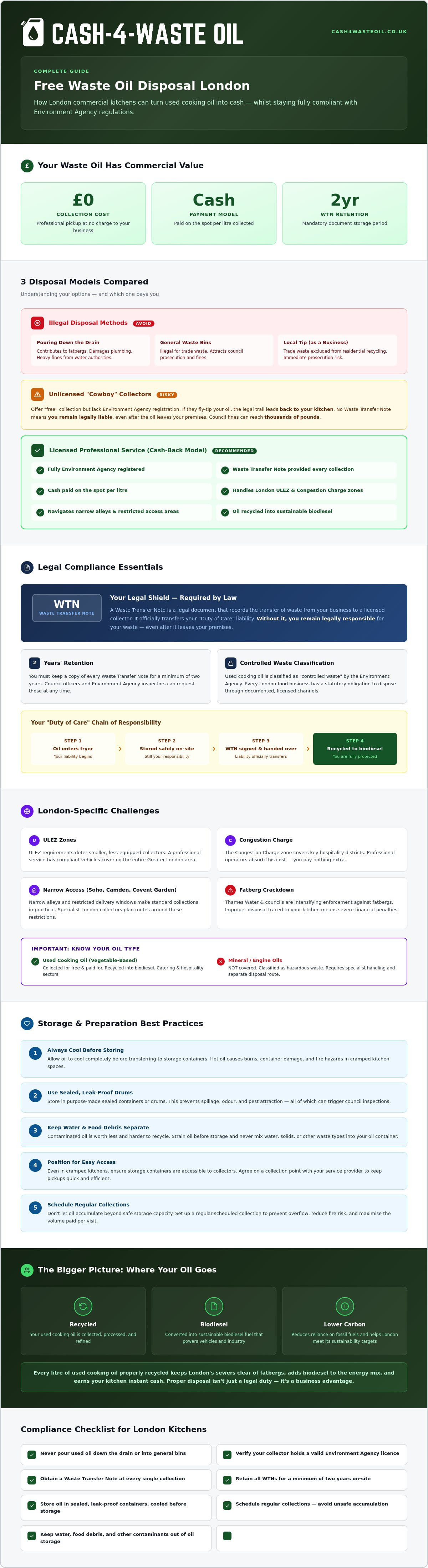
Searching for free waste oil disposal London often leads to unlicensed "cowboy" collectors. These operators might offer to take your oil for free, but they frequently lack Environment Agency registration. If they fly-tip your oil in a London back alley, the trail leads straight back to your kitchen. Without a valid Waste Transfer Note, you're legally liable for the improper disposal. A lack of documentation can result in council fines reaching thousands of pounds, even if the oil is physically gone from your premises. Professional services navigate London's unique street access rules and provide the legal shield your business needs to operate without fear of prosecution.
Commercial vs. Domestic Disposal: The Legal Divide
Trade waste is legally defined as any waste produced by a business, and it is strictly excluded from residential recycling centres. You cannot load your old oil into a car and take it to a local tip; doing so is illegal for a business and exposes you to immediate prosecution. Pouring oil down the sink or hiding it in general waste bins is equally dangerous. It damages your internal plumbing and attracts heavy fines from water authorities. A dedicated, licensed collection service is the only safe, legal route for catering businesses to protect their reputation and their bottom line whilst ensuring the oil is recycled into sustainable biodiesel.
Legal Compliance: Waste Transfer Notes and the Environment Agency
Waste oil isn't just a kitchen byproduct; it's legally classified as "controlled waste" by the Environment Agency. This means every London business has a statutory obligation to manage its disposal through specific, documented channels. Central to this process is the Waste Transfer Note (WTN). A WTN is a legal document that records the transfer of waste from one party to another. You must keep a copy of every WTN for at least two years. If a council officer or Environment Agency inspector visits your premises, these notes are your only proof that you've handled your waste responsibly.
Failing to produce these documents can lead to immediate fines or prosecution. It's not enough to simply have the oil removed; you must prove where it went. For a deeper look at your obligations, check out our guide on commercial kitchen oil disposal. Verifying your collector's credentials is the first step in protecting your business from legal fallout whilst ensuring your free waste oil disposal London service is fully legitimate.
Your Duty of Care as a London Business Owner
The "Duty of Care" legislation is the backbone of UK waste law. It dictates that you are legally responsible for your waste oil from the moment it hits the fryer until it reaches its final processing destination. You can't simply hand it over to a random van driver and consider the job done. If that driver fly-tips your oil, you are the one who faces the consequences. The WTN is your legal shield; it officially transfers that responsibility to the licensed collector. Following the DEFRA cooking oil waste guidance ensures your business meets the gold standard for environmental compliance.
Environment Agency Registration: The Non-Negotiable
Never assume a collector is legal just because they have a van. You must verify that they are a registered waste carrier. You can do this quickly by checking the Environment Agency's public register online. Look for an "upper-tier" licence, which is required for anyone transporting waste produced by others. Using an unlicensed collector is a gamble that rarely pays off. At Cash 4 Waste Oil, we are fully Environment Agency registered and provide a valid WTN with every collection. This ensures your free waste oil disposal London service is as safe as it is profitable. If you want to simplify your compliance, booking a professional oil collection is the most efficient way to protect your business.
Free vs. Paid vs. Cash-Back: Navigating London Collection Services
Choosing the right disposal model is a commercial decision that directly impacts your profit margins. In the London market, you'll generally encounter three types of service. Some general waste contractors still charge a collection fee, treating your oil like standard refuse. Others offer a basic free service, which solves the disposal problem but leaves money on the table. The most competitive model is the cash-back or rebate system. This turns a waste product into a revenue stream, ensuring you receive the full value of your feedstock whilst maintaining total regulatory compliance. For most SMEs, finding a reliable partner for free waste oil disposal London means looking for a provider that pays you for the privilege of collecting your waste. This ensures that free waste oil disposal London is a profit-centre rather than a cost-centre for your kitchen.
The value of your oil isn't fixed. Several factors dictate the rebate you receive, including the total volume collected and the purity of the product. Oil that's heavily contaminated with water or food debris is harder to process, which can reduce its market value. Regular, high-volume collections typically command the best rates. To understand how these variables affect your bottom line, you can read more about how to get paid for used cooking oil London and stay updated on current market insights.
The Economics of Biodiesel Feedstock
Whilst your kitchen sees used oil as a messy byproduct, the renewable energy sector views it as a high-value raw material. Used vegetable oil is the primary feedstock for high-grade biodiesel, a low-carbon alternative to traditional fossil fuels. This circular economy is what makes our model possible. We collect your waste, process it, and supply it to the energy industry. By participating in this loop, your business reduces its environmental footprint whilst benefiting from the financial incentives that this green fuel demand creates. It's a pragmatic solution where sustainability and profitability go hand in hand.
Why Cash on the Spot is King for London SMEs
In the fast-paced world of London hospitality, cash flow is everything. Many larger waste contractors use complex invoicing systems or credit notes that can take weeks to process. We believe in a more direct approach. Paying cash on the spot provides an immediate financial return that you can reinvest into your business straight away. This rebate can help offset other rising costs, from ingredient prices to business rates. Cash 4 Waste Oil prides itself on transparency; we weigh your oil on-site and provide an instant payment, ensuring you're never left waiting for what you've earned. It's a clean, efficient transaction that respects your time and your bank balance.
Best Practices for Storing and Preparing Your Waste Oil
Efficient free waste oil disposal London starts with a disciplined kitchen routine. London’s commercial spaces are notoriously tight, especially in historic boroughs like Westminster or Islington, where every square inch of floor space carries a premium. Storing oil haphazardly doesn't just create a mess; it invites pests and increases the risk of workplace accidents. To ensure your collection is fast and your rebate is maximised, follow this 5-step preparation guide:
- Allow cooling: Never transfer oil whilst it's hot. Let it reach room temperature to prevent container melting and staff burns.
- Filter debris: Use a simple sieve to remove large food particles. Purer oil is a higher-quality feedstock for biodiesel.
- Use sealed drums: Pour filtered oil into airtight containers immediately to contain odours.
- Designate a zone: Keep your oil drums in a consistent, accessible spot away from main thoroughfares.
- Monitor levels: Contact your collector when your containers are roughly 80% full to avoid overflows.
Filtering is a small step that makes a big difference to your bottom line. Removing breadcrumbs, char, and water preserves the chemical integrity of the vegetable oil. This purity directly influences the "cleanliness" of the feedstock, which is a key factor in the rebate you receive. If your oil is heavily contaminated, it requires more intensive processing, which can lower its market value.
Choosing the Right Storage Containers
Blue barrels are the industry standard for most London pubs and restaurants. They're durable, stackable, and fit through standard doorways. For high-volume production units, Intermediate Bulk Containers (IBCs) are more efficient but require significant floor space and pallet jack access. Avoid using original oil tins for long-term storage; they're prone to rusting and leaks. Airtight seals are non-negotiable in urban environments. They prevent the "old chip shop" smell from drifting into dining areas or neighbouring properties and ensure you don't attract rodents to your back-of-house area.
Health and Safety: Handling Hot Oil
Staff safety is your primary concern during oil transfers. Always provide appropriate PPE, including heat-resistant gloves and aprons. Ensure your kitchen is equipped with a specific oil spill kit, as standard sawdust or mops often make grease spills worse. If a leak occurs, it must be contained immediately to prevent it from reaching the drainage system. For more detailed advice on eco-safe handling, read our guide on sustainable waste oil disposal. Once your oil is cooled and sealed, you can schedule your free oil collection to clear your space and collect your cash.
Why Cash 4 Waste Oil is London’s Choice for Sustainable Recovery
Cash 4 Waste Oil has built its reputation on understanding the specific pressures of the London hospitality scene. We don't just provide free waste oil disposal London; we provide a professional partnership that turns a compliance burden into a commercial advantage. By operating across Greater London, Kent, and Surrey, we've developed the local knowledge required to navigate the city's complex logistics. Our commitment to the circular economy means every litre we collect is destined for high-grade biodiesel production. This helps your business support UK renewable energy goals whilst boosting your own cash flow through immediate rebates. We offer a service that is free, legal, and consistently profitable for our clients.
Our Seamless London Collection Process
We've stripped away the bureaucracy that often plagues commercial waste management. Our "no-fuss" approach is designed for the fast-paced catering environment. You call us, we arrive at a time that suits your service schedule, we weigh your oil on-site, and we pay you cash on the spot. Reliability is our core strength amongst the chaos of London's daily traffic. We plan our routes meticulously to ensure we're there when we say we will be, avoiding your busiest service hours. Whether you're managing a boutique hotel in Mayfair, a high-volume pub in Richmond, or a local takeaway in Croydon, we provide a consistent, professional service. Every collection includes the mandatory Waste Transfer Note as standard, ensuring your legal documentation is always up to date.
Ready to Turn Your Waste into Cash?
Don't let your used cooking oil sit in a corner taking up valuable kitchen space or risking a health and safety fine. You can choose between a regular scheduled collection or an on-call service depending on your kitchen's specific output. Both options provide the peace of mind that comes with using a fully Environment Agency registered carrier. We handle the heavy lifting, the legal compliance, and the processing, leaving you free to focus on your customers. To clear your storage area and start earning from your waste product, book your collection today via our simple online form. Our team is ready to show you why we are the capital's trusted partner for sustainable, profitable oil recovery.
Streamline Your Commercial Kitchen Operations
Managing used cooking oil shouldn't be a logistical headache or a financial drain for your business. You've learned that staying compliant with Environment Agency regulations is straightforward when you have the right documentation in place. By prioritising Waste Transfer Notes and professional storage practices, you protect your kitchen from council fines whilst contributing to a sustainable circular economy. Turning a waste product into an immediate revenue stream is a pragmatic decision that supports your bottom line in a competitive market.
Securing a reliable partner for free waste oil disposal London ensures your storage areas stay clear and your operations remain efficient. It's time to stop paying for disposal and start receiving the value your feedstock deserves. As an Environment Agency registered collector, we handle the legal paperwork and provide instant cash payments on the spot. Get a free collection and cash for your waste oil today to experience a hassle-free, professional service. We look forward to helping your London business become cleaner, more compliant, and more profitable.
Frequently Asked Questions
Is waste cooking oil collection really free in London?
Yes, commercial cooking oil collection is entirely free for businesses in the capital. It's actually better than free because our model turns this service into a profit-centre. We pay you cash for every litre of used oil we remove from your premises. You avoid the high fees often charged by general waste contractors whilst ensuring your kitchen stays compliant. This makes free waste oil disposal London a commercially smart choice for any proactive restaurant manager.
How much cash will I receive for my used cooking oil?
The exact amount you receive depends on current market rates for biodiesel feedstock and the purity of your oil. We pay a competitive rate per litre, which is calculated and paid in cash at the point of collection. Factors like oil quality and the total volume stored will influence your final rebate. We provide transparent on-site weighing to ensure you receive the correct value for your waste product every time we visit.
What is a Waste Transfer Note and why does my restaurant need one?
A Waste Transfer Note (WTN) is a mandatory legal document that tracks the movement of "controlled waste" from your premises to a licensed carrier. Every commercial kitchen in the UK is required by law to retain these notes for at least two years. It serves as your primary evidence of compliance during council or Environment Agency inspections. Without a valid WTN, your business is legally liable for any improper disposal or fly-tipping.
Can I dispose of my restaurant’s oil at a local household recycling centre?
No, you cannot use residential recycling centres for commercial waste. Trade waste is strictly prohibited at household tips; attempting to dispose of your kitchen oil there is illegal and can lead to immediate prosecution. These centres are funded by council tax for domestic use only. Businesses must use a licensed waste carrier to ensure their used cooking oil is handled through the correct commercial channels and processed into sustainable fuel.
Do you collect waste engine oil from garages in London?
No, we don't provide collection services for engine oil, mineral oils, or industrial lubricants. Our service is strictly dedicated to the recovery of used vegetable-based cooking oils from the catering sector. Engine oil is classified as hazardous waste and requires specialised handling and different Environment Agency permits. If you're running a garage, you'll need a specialist hazardous waste carrier. We focus on helping kitchens stay compliant whilst turning their fryer waste into revenue.
How often should a London restaurant schedule an oil collection?
Frequency depends entirely on your kitchen’s output and available storage space. Most busy London restaurants schedule a collection once their drums are approximately 80% full to prevent any risk of overflow or spills. We offer both regular scheduled visits and on-call collections to suit your specific needs. Maintaining a consistent routine helps you manage cramped kitchen spaces whilst ensuring you always have a steady stream of cash rebates coming in.
What happens to the oil after it is collected from my kitchen?
Every litre of oil we collect enters a circular economy where it is processed into high-grade, sustainable biodiesel. This renewable fuel is a low-carbon alternative to traditional petroleum diesel, significantly reducing the environmental impact of transport and energy production. By recycling your waste oil through a licensed carrier, you ensure your kitchen’s byproducts contribute to a greener future rather than ending up in sewers as harmful fatbergs or polluting the environment.
Which areas of London and the South East do you cover?
We provide comprehensive coverage across all boroughs of Greater London, including central zones and outer districts. Our service also extends to commercial kitchens throughout Kent and Surrey. This regional focus ensures we're a reliable partner for businesses seeking free waste oil disposal London. Our drivers understand the local traffic patterns and congestion charge requirements, ensuring your collection happens on time without disrupting your service or your kitchen's daily workflow.