Fryer Oil Recycling for Eco-Friendly Restaurants: How to Prove Your Green Credentials
A green claim is more convincing when you can show what happened. Fryer oil recycling for eco-friendly restaurants can provide evidence of one practical action, but it does not prove that the whole business is sustainable. Environmental claims need to match the records you hold: vague promises can undermine trust.
This guide explains how to document your used cooking oil’s journey, from collection to further use, and how to describe it accurately. A Waste Transfer Note records a commercial collection, while collected oil is processed into sustainable biodiesel. You’ll learn how to keep claims proportionate to the evidence, avoid unverified carbon-saving statements and fit the process into your kitchen routine.
Key Takeaways
- Use fryer oil recycling for eco-friendly restaurants as evidence of one specific environmental practice, not proof that the whole business is sustainable.
- Keep a clear record of each collection, including the Waste Transfer Note.
- Describe collection and further processing precisely. Avoid broad green language and unsupported carbon-saving claims.
- Match each environmental claim to the records that support it.
- Fit used cooking oil collection into your kitchen routine with scheduled or on-call collections. Collection is free, with cash paid on the spot.
How fryer oil recycling helps an eco-friendly restaurant prove what it does
Evidence-led environmental communication means making a specific claim and keeping records that help someone understand what happened. That is more useful than calling a restaurant “eco-friendly” without explaining what the label means. For fryer oil recycling for eco-friendly restaurants, start with the collection documentation, including the Waste Transfer Note. These records help show that used cooking oil left the kitchen through a documented collection process.
A record supports a statement about a particular action. It does not, by itself, measure the environmental performance of the whole restaurant, from energy use and purchasing to food waste and transport. Keep each claim within the evidence you hold, and distinguish completed actions from future goals or estimates.
What counts as credible environmental proof for a restaurant?
Credible proof is specific, retrievable and easy to explain. If you say your used cooking oil is collected for recovery, you should be able to show records relating to those collections. Keep each Waste Transfer Note with relevant internal notes so the information is easy to find.
- Verified fact: a collection took place, supported by its dated documentation.
- Target: a future aim, such as improving how consistently the kitchen separates waste.
- Estimate: a projection or calculation, identified as such and explained.
Don’t present a target as an achievement or an estimate as a measured result. A manager should be able to connect each public statement to the record behind it. If the evidence doesn’t support the wording, make the claim narrower.
What fryer oil recycling can, and cannot, demonstrate
Collection records can show that used cooking oil was handed over for further processing. The collected oil is processed into sustainable biodiesel, giving it a further use. For background on vegetable oil used as fuel, see the overview of how it can be used as a fuel source.
This makes oil collection a practical, traceable environmental action. It doesn’t prove that every part of the restaurant operates sustainably or establish a particular reduction in emissions. A claim about emissions would need a reliable calculation based on relevant information, rather than an assumption based on recycling alone.
Use wording that reflects the evidence: “We have our used cooking oil collected and processed into biodiesel” is specific when your collection records and processing information support it. Avoid broad statements such as “our restaurant is carbon neutral” unless you have evidence for that wider claim. Make a precise claim, keep the supporting record and be clear about what it does and doesn’t show.
Build a fryer oil recycling evidence trail your restaurant can explain
A useful evidence trail links the oil at the kitchen’s collection point with the paperwork received for collection. Keep the process simple: record what your team can observe, file the documents supplied for each collection and check that any public claim matches those records. This gives managers a practical basis for explaining fryer oil recycling for eco-friendly restaurants without relying on unsupported statements.
Collection evidence has limits. A collection record shows that used cooking oil was collected, but it does not independently verify the oil’s full lifecycle or environmental impact. A documented handover supports a claim about collection; it does not verify every step after collection or quantify wider benefits.
Which collection records can support your claim?
File each Waste Transfer Note with its date and relevant business details. Add internal notes that help your team understand the record, such as which kitchen the collection relates to or whether an operational change affected the routine. Record quantities or collection frequency only when they’re documented or measured by your business. Don’t present estimates as facts.
For general background on waste management, the US Environmental Protection Agency offers EPA guidelines on waste management. This is a US resource, not guidance on UK requirements. For claims about your restaurant’s actions, use your own collection documents; for questions about local rules, refer to UK-specific guidance.
How to keep oil-recycling records usable
Records should be easy to find during a busy service, not buried in someone’s inbox. Choose one team member to file collection documents in a shared folder, digital or paper-based, using consistent names. Keep a simple dated log alongside them. Note the collection date, the record filed and any relevant change, such as a revised collection routine. Leave out anything your team can’t verify.
- Set the claim. Write down the exact statement you want to make, such as “our used cooking oil is collected for further processing”.
- Match the evidence. Link the statement to the relevant Waste Transfer Note and any supporting information you hold.
- Check the wording. Make sure it describes what the records show without implying a measured environmental result.
- Review the file. Before publishing an update, check for missing documents and remove or qualify claims the evidence doesn’t support.
This process turns routine paperwork into a useful record without making it support more than it can. A consistent commercial used cooking oil collection routine can help kitchen teams keep documentation together and explain what happens to their waste oil.
Compare strong fryer oil recycling claims with vague green language
Good environmental wording names the action and is clear about its limits. For fryer oil recycling for eco-friendly restaurants, describe what happens to the used oil and keep the claim within the available evidence. A collection record can support a claim that oil was collected. Information about further processing can support a statement about biodiesel. Neither automatically proves an independently measured environmental benefit for your restaurant.
Use the comparison below to check whether a claim is verifiable or makes a broader promise than your records support.
| Stronger, evidence-led wording | Vague or overreaching wording | What to check |
|---|---|---|
| “Our used cooking oil was collected on the date shown on our Waste Transfer Note.” | “We dispose of waste responsibly.” | Keep the relevant collection record and make sure the wording reflects its details. |
| “Our collected used cooking oil is processed into sustainable biodiesel.” | “We turn every litre into clean energy.” | Use reliable information about the processing route. Don’t imply that every batch has separate independent verification. |
| “We send used cooking oil for further processing.” | “Our restaurant is fully green.” | Keep the claim focused on the oil. One waste practice can’t establish the environmental performance of the whole business. |
| “We measured a change in our waste handling over this stated period.” | “Our recycling cuts emissions dramatically.” | State an environmental outcome only when a defined, reliable calculation supports it. |
How to describe oil recycling without overclaiming
State the process plainly: used cooking oil is collected and processed into sustainable biodiesel. Make clear whether you’re describing the collection service’s processing route or an action your restaurant carried out. Avoid absolute labels such as “fully green” unless broader evidence supports them. Don’t claim that every litre delivers an independently verified emissions saving without suitable evidence and a calculation.
How to assess other environmental evidence fairly
Apply the same discipline to claims about energy, purchasing and waste. For example, if your business explores circular procurement—such as materials developed from repurposed agricultural or marine plastic by healix.eco—verify exactly what the supplier processes before making public statements. A dated log can document an action; a measured outcome needs a defined method, period and boundary. Label estimates as estimates, name their source and explain what they cover. Dates and records make an update easier to check, while superlatives such as “best” or “zero impact” usually go beyond what the evidence can prove.
Keep a supplier process claim separate from your restaurant’s own measured result. You can report that your oil is collected and processed into biodiesel when the information supports that wording. You can’t turn that process description into a quantified carbon benefit for your site without a calculation that accounts for the relevant assumptions and scope. This helps readers see what you did, what the collection process involves and what remains unmeasured.
Before publishing, read each sentence as a customer would. Can you show the record or source behind it? Does it refer to one practice, a supplier’s process or a measured restaurant-wide outcome? Tighten the wording wherever those categories blur. Clear limits make a sustainability message more credible.
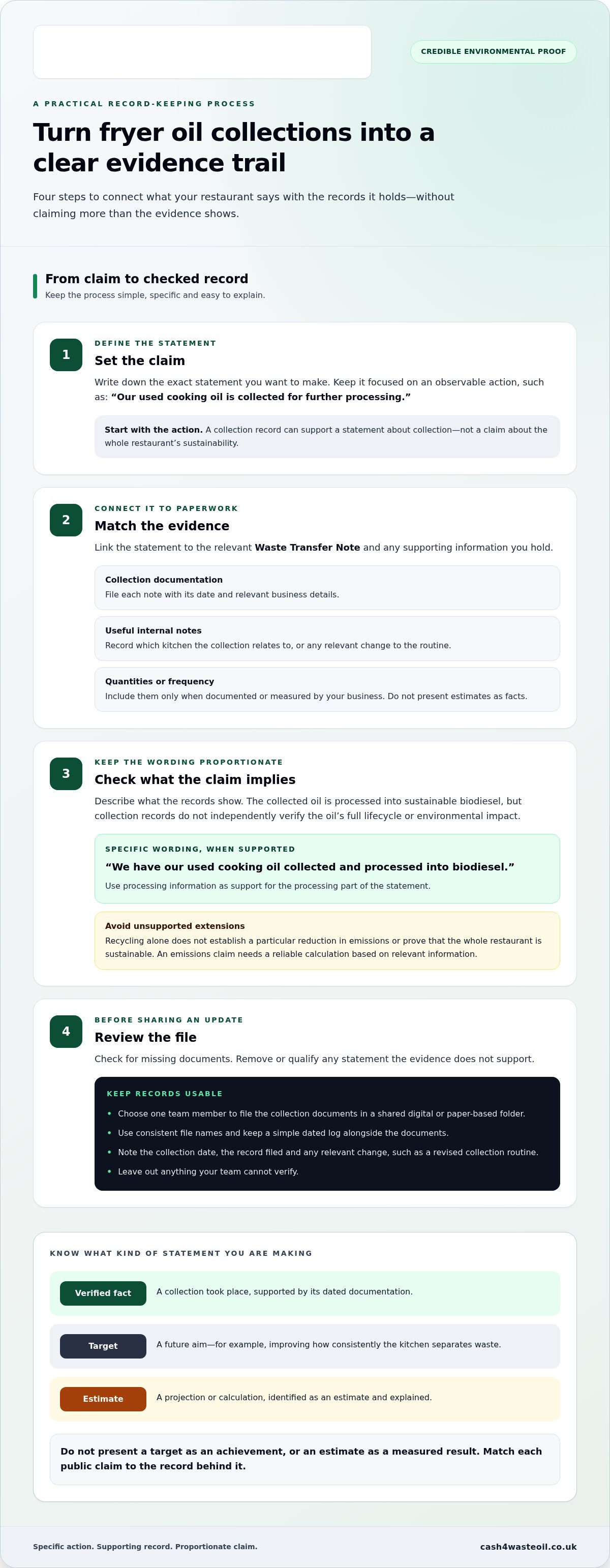
How to turn fryer oil recycling records into a restaurant proof process
Records are useful when your team can connect them to a clear claim and explain the link. A straightforward review routine helps managers keep evidence in order without adding a complicated task to kitchen operations. Use the same process for fryer oil recycling for eco-friendly restaurants as for any environmental statement: define the claim, check the evidence, then communicate only what it supports.
A simple monthly review for environmental evidence
Set aside time for a monthly check, or add it to an existing management review. Start with statements customers and business partners can see, including wording on menus, your website, proposals and staff materials. Match each statement to a document, measurement or clearly labelled target. A target describes an intention, not a completed result.
- List the claims in use. Gather environmental statements from current menus, website pages and business materials. Include claims staff regularly make on the restaurant’s behalf.
- Choose one claim to check. Make the wording precise. Distinguish “we arrange collection of our used cooking oil” from a wider claim about the restaurant’s environmental performance.
- Match evidence to the claim. File the relevant collection documents, including Waste Transfer Notes, with supporting internal notes. Use quantities or collection frequency only when those details are recorded or supplied.
- Check the reporting period. Confirm that the records cover the dates named in the statement. If a collection document is missing or a process has changed, revise the wording until the evidence is clear.
- Record the review. Note who checked the claim, which evidence they used and whether the wording stays as it is, needs an update or should be removed.
Keep this evidence file for internal use. It gives managers a consistent reference point without needing to become a lengthy report. One shared folder and a brief log can help a busy team maintain a reliable routine.
How to share proof with customers and business partners
For public updates, use a short factual statement with a clear timeframe and basis. For example: “Our used cooking oil is collected for processing into biodiesel. Our collection records document the handovers during this reporting period.” Use the second sentence only when your records cover the stated period. This explains the process without presenting it as proof of every sustainability action or a measured carbon outcome.
Review public wording when collection arrangements or internal practices change. Remove outdated timeframes and make sure a process statement still reflects what happens. If a customer or business partner asks for more detail, share the relevant evidence and explain its scope. Clear boundaries make the information easier to trust.
For a practical way to support your records, arrange used cooking oil collection with Waste Transfer Notes for your commercial kitchen.
Choose a local fryer oil recycling service that supports credible proof
A dependable collection routine can make used-oil handling easier for a busy kitchen and give managers clear documentation. Cash 4 Waste Oil provides free used cooking oil collection for commercial kitchens in London, Greater London, Kent and Surrey, as well as Birmingham, Coventry, Leicester and Wolverhampton. The service also covers Leicestershire, Derbyshire, Staffordshire, Warwickshire, Northamptonshire, Oxfordshire and Worcestershire. Choose scheduled or on-call collections to suit your kitchen routine. Businesses are paid cash on the spot, and a Waste Transfer Note is provided for each collection.
This combination supports practical operations and a clear evidence trail. It gives your team a way to connect fryer oil recycling for eco-friendly restaurants with a documented collection process, rather than relying on a general sustainability statement.
What a collection partner adds to your evidence trail
A collection partner handles the commercial transfer of used cooking oil and supplies documentation to help your restaurant record it. Cash 4 Waste Oil is fully licensed and Environment Agency registered. Collected oil is processed into sustainable biodiesel, giving it a further use. Describe these steps accurately, keeping the claim focused on collection and processing rather than suggesting a verified carbon saving or whole-business assessment.
How to start a commercial used-oil collection arrangement
Cash 4 Waste Oil collects used cooking oil from restaurants and other commercial kitchens, including pubs and hotels. Choose scheduled collection if a regular routine suits your kitchen, or on-call collection if that better fits how your used cooking oil builds up. Each collection comes with a Waste Transfer Note, which your team can file with its other collection records.
To keep the arrangement easy to manage, make sure the staff member responsible for the oil knows where it is stored and where the collection paperwork should be filed. After each collection, pass the Waste Transfer Note to the person maintaining your records. This small handover helps prevent documents getting lost among day-to-day kitchen paperwork and makes it easier to support an accurate account of your oil handling.
- Collection: Free collection of used cooking oil from commercial kitchens.
- Flexible routine: Scheduled or on-call collections to suit the kitchen’s needs.
- Documentation: A Waste Transfer Note to record the commercial collection.
- Payment: Cash paid on the spot for collected used cooking oil.
Keep public wording proportionate: state that your used cooking oil is collected and processed into sustainable biodiesel, and retain the collection document that supports the handover. This gives customers and business partners a specific action they can understand without implying that oil recycling proves every part of your restaurant is environmentally sustainable.
If your restaurant, pub or hotel operates in London, Greater London, Kent, Surrey, Birmingham, Coventry, Leicester, Wolverhampton, Leicestershire, Derbyshire, Staffordshire, Warwickshire, Northamptonshire, Oxfordshire or Worcestershire, arrange commercial used cooking oil collection with Cash 4 Waste Oil. Build a routine that works for your kitchen and keep the Waste Transfer Note as part of your evidence trail.
Make your next environmental claim one you can stand behind
Credibility comes from consistent actions and clear records, not sweeping promises. Treat fryer oil recycling for eco-friendly restaurants as one practical part of a wider environmental approach, and match each claim to what your evidence can show. This gives customers and business partners a clearer picture of your progress while leaving room to report honestly as your practices develop.
Your next step can be straightforward: build a used cooking oil collection routine that fits your kitchen and makes the handover easy to document. Cash 4 Waste Oil provides free scheduled or on-call collections for commercial kitchens, with a Waste Transfer Note for each collection. The company is fully licensed and Environment Agency registered.
Arrange commercial used cooking oil collection and take a practical step towards a more transparent waste-handling record. Keep building your environmental story one verifiable action at a time.
Frequently Asked Questions
Can fryer oil recycling alone prove that my restaurant is eco-friendly?
No. Fryer oil recycling for eco-friendly restaurants can support a specific statement about your kitchen’s used-oil handling, but it can’t establish how the whole business performs environmentally. Treat it as one part of your evidence, not a complete assessment. Keep separate records for energy use, purchasing or food waste if you make claims about those areas. Don’t present oil collection as proof of a verified carbon result.
What records should a restaurant keep to evidence fryer oil recycling?
Keep the paperwork for each collection, including the Waste Transfer Note, in a consistent file that the relevant manager can access. A simple log can link a document to the collection date and kitchen location, which is useful if a restaurant has more than one site. Note quantities only if they’re provided or measured. Before sharing a claim, check that its wording and timeframe match the records.
Does used fryer oil become biodiesel after collection?
Collected used cooking oil is processed into sustainable biodiesel. This describes a further use for the oil, but it doesn’t by itself establish the precise environmental impact of the oil collected from your restaurant. Keep those points separate in customer-facing wording. Describe the collection and processing route, but don’t add a carbon-saving figure or imply independent verification unless reliable evidence supports that specific claim.
How can a restaurant talk about recycling oil without greenwashing?
Use wording that names an action your restaurant can evidence, such as arranging collection of its used cooking oil. Avoid sweeping descriptions such as “zero impact” or “fully sustainable” unless evidence supports the full claim. Make the period clear if you refer to activity over time, and label targets or estimates so they aren’t mistaken for results. Review public wording if your collection routine or supporting evidence changes.
Is a Waste Transfer Note useful for proving a restaurant’s environmental efforts?
Yes. A Waste Transfer Note can support your record of a commercial waste transfer and help substantiate a statement about used-oil collection. It doesn’t certify your restaurant as eco-friendly or, on its own, prove a wider environmental benefit. Use it as one piece of evidence alongside an accurate description of what happened. If you’re making a claim about legal duties or how long documents must be kept, check current UK guidance.
Can small restaurants arrange used fryer oil collection?
Yes. Cash 4 Waste Oil collects used cooking oil from commercial kitchens, including restaurants, pubs and hotels. The service offers scheduled or on-call collections, cash payment on the spot and a Waste Transfer Note. It serves businesses in London and Greater London, Kent, Surrey, Birmingham, Coventry, Leicester, Wolverhampton, Leicestershire, Derbyshire, Staffordshire, Warwickshire, Northamptonshire, Oxfordshire and Worcestershire. Collection is for commercial premises, not household cooking oil.