Get Paid for Used Cooking Oil in Kent: The 2026 Commercial Guide
Is your commercial kitchen currently storing a liquid asset that could be boosting your bottom line? Most Kent restaurateurs see used oil as a messy liability, yet it's actually a valuable commodity that can provide an immediate cash injection. You've likely felt the frustration of oily drums cluttering your storage area or the stress of unreliable collectors who fail to arrive on schedule. It's time to stop letting waste drain your resources. This guide explains exactly how to get paid for used cooking oil Kent whilst maintaining total peace of mind regarding your legal obligations.
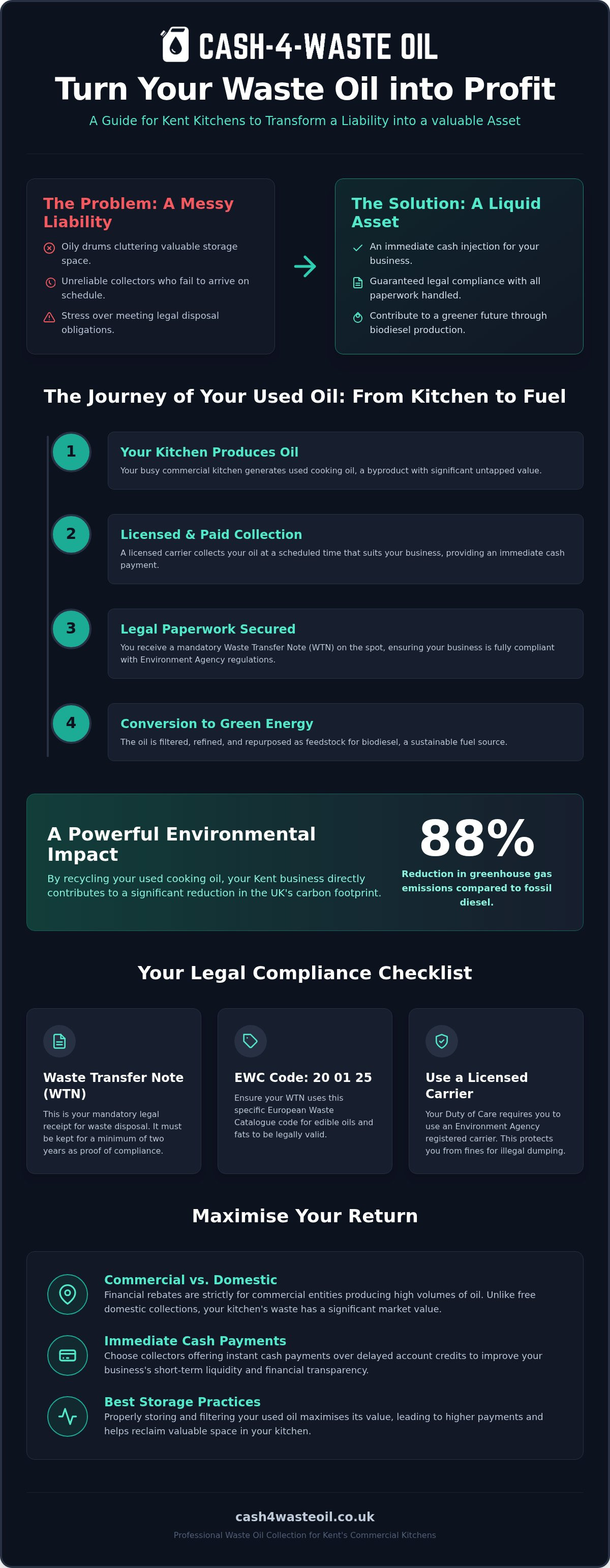
You already know that staying compliant with the Environment Agency is non-negotiable; however, the introduction of the Digital Waste Tracking Service in October 2026 adds a new layer of complexity to your paperwork. We'll simplify the process for you. You'll discover how to secure mandatory Waste Transfer Notes with the correct EWC code 20 01 25 and establish a reliable collection routine that works around your busy service. From understanding your Duty of Care to seeing your waste repurposed into biodiesel that reduces greenhouse gas emissions by up to 88%, we provide the roadmap to a cleaner, more profitable kitchen.
Key Takeaways
- Turn your kitchen waste into a legitimate revenue stream by understanding how to capitalise on the demand for sustainable biodiesel feedstock.
- Discover how to get paid for used cooking oil Kent while automatically securing the mandatory Waste Transfer Notes required by the Environment Agency.
- Compare the benefits of immediate cash payments against delayed account credits to improve your business's short-term liquidity and transparency.
- Master the best practices for oil storage and filtration to maximise the value of your collections and reclaim valuable space in your commercial kitchen.
- Identify the most efficient collection options for Kent businesses to ensure your waste is always handled by a licensed, reliable carrier.
Turning Waste into Revenue: How Kent Kitchens Get Paid for Used Oil
Stop viewing your used fryer oil as a disposal problem. In the modern Kent hospitality sector, waste oil is a legitimate revenue stream. A waste oil rebate is a financial payment made to your business in exchange for your used fats and oils, serving as a key driver in the local circular economy by repurposing waste into valuable new products. Instead of paying a contractor to haul away your "rubbish", you receive an immediate payment for a commodity that's in high demand. It's a simple shift in perspective that transforms a messy liability into a predictable cash injection for your business.
The Value of Your Used Vegetable Oil
Why are companies willing to pay for your old rapeseed or sunflower oil? The answer lies in the UK's growing demand for sustainable energy. Once your oil is collected, it's filtered and refined into Yellow grease, which serves as the essential feedstock for biodiesel production. This isn't just about getting rid of gunk; it's about powering the next generation of transport. Kent businesses are at the forefront of this transition, providing the raw materials needed to hit national renewable energy targets. Choosing to get paid for used cooking oil Kent means you're directly contributing to a process that can reduce greenhouse gas emissions by up to 88% compared to traditional fossil diesel. It's a smart business move that yields significant environmental benefits as a byproduct.
Commercial vs. Domestic Collections in Kent
It's vital to distinguish between household recycling and professional commercial recovery. While residents in Ashford or Tonbridge might take a small bottle to a local tip, a busy restaurant or pub handles volumes that require industrial-grade logistics. These financial rebates are strictly for commercial entities. High-volume oil recovery allows for a "paid collection" model rather than a simple "free collection" service. Professional collectors provide the necessary infrastructure, such as leak-proof drums and scheduled pickups, to handle the output of a high-pressure kitchen. Whether you're running a boutique hotel in Canterbury or a high-street takeaway in Maidstone, your oil has a market value that domestic waste simply doesn't reach. By partnering with a licensed carrier, you ensure that your high-volume waste is handled efficiently, legally, and profitably.
Navigating Legal Compliance: Waste Transfer Notes and Kent Regulations
Compliance isn't just about ticking boxes; it's about protecting your bottom line from unlimited fines. Under the Environmental Protection Act 1990, every Kent business owner has a legal "Duty of Care" for their waste. This responsibility doesn't vanish once the drums leave your site. If you decide to get paid for used cooking oil Kent, you must verify that your collector is fully licensed. Using unlicensed "oil cowboys" might seem tempting for a quick win, but the liability remains with you. If they dump your oil illegally, the Environment Agency (EA) will hold your business accountable.
Local council inspectors and EA officers regularly check disposal records during audits. If you can't produce the right paperwork, you face significant legal risks. Proper record-keeping is the only way to prove you've handled your kitchen's byproducts responsibly. It's a simple step that ensures your business remains operational and reputable.
What is a Waste Transfer Note?
Think of the Waste Transfer Note (WTN) as your legal receipt. It's a mandatory document that describes the waste, the parties involved, and the final destination. To be legally compliant, it must include the specific EWC code 20 01 25 for edible oils and fats. You're required to store these notes for at least two years. Missing documents are a red flag for inspectors. Cash 4 Waste Oil streamlines this by providing mandatory WTNs with every collection, removing the administrative burden from your team.
Environment Agency Registration: Why It Matters
A registered waste carrier has undergone vetting and operates under EA oversight. This registration is your guarantee of professional behaviour and environmental safety. You can easily verify a collector’s status on the government register. This check is more important than ever because of the new Digital Waste Tracking Service (DWTS). Starting in October 2026, the DWTS will require digital records for all waste movements in England. Informal, cash-only collectors who bypass these systems will put your business at risk of non-compliance. When you arrange a licensed waste oil collection, you ensure your business stays on the right side of these evolving laws. Don't leave your compliance to chance; partner with an expert who understands the Kent regulatory landscape.
Cash vs. Credit: Why Immediate Payment Benefits Your Kent Business
National waste contracts often trap businesses in a cycle of delayed account credits and opaque "market value" adjustments. For a local pub in Sevenoaks or a café in Folkestone, this creates unnecessary administrative lag. Choosing to get paid for used cooking oil Kent through immediate cash payments removes the guesswork. It settles the value of your waste right there on the kitchen floor. You avoid the "wait and see" game played by larger corporations who process payments through distant head offices weeks after the collection has occurred.
Boosting Cash Flow in the Hospitality Sector
Liquidity is essential for small businesses. While a single collection might seem small, these rebates accumulate significantly over a trading quarter. A busy kitchen can easily generate enough waste oil to turn these collections into a consistent source of revenue. Consider the practical benefits of this immediate cash injection:
- Offset Operational Costs: Use the cash to pay for incidental kitchen supplies or general waste bags.
- Reduce Debt: Apply the funds directly to other waste management invoices to keep your accounts lean.
- Immediate Gratification: There's a genuine psychological boost in seeing a waste product turn into physical currency instantly.
This straightforward approach is why getting paid for used cooking oil in London and Kent has become the preferred standard for independent operators. It keeps your cash where it belongs: in your business.
Transparency and Market Rates
Delayed credit systems often hide the true value of your oil behind "service fees" or "transportation levies" that only appear on a monthly statement. Cash on the spot forces total transparency. You watch the volume being measured and the rate applied immediately. This builds long-term trust. You don't have to spend your Sunday evenings reconciling old receipts against confusing credit notes. To ensure you're getting a fair price per litre, choose a collector who provides clear, upfront rates without hidden deductions. This no-nonsense model drastically reduces administrative overhead for pub landlords and restaurant managers. It turns a messy chore into a simple, profitable, and highly predictable exchange.
Preparing for Collection: Best Practices for Kent Restaurants and Pubs
Maximising your return starts in the kitchen. If you want to get paid for used cooking oil Kent, the quality of your storage directly impacts the efficiency of the transaction. High-quality, well-managed oil is easier to refine into biodiesel, making your site a preferred stop for local collectors. Proper preparation also ensures your kitchen remains a safe, clean environment for your staff during busy service periods.
Safe Storage and Handling
Implement the "Cool, Filter, Store" method to keep your kitchen safe and efficient. Never pour hot oil directly into storage containers. Let it reach a safe temperature first to prevent melting plastic drums or causing accidental burns. Use a simple mesh sieve to filter out large food debris as you pour. This isn't just about cleanliness; oil free from heavy contamination is significantly more valuable to processors.
Store your containers in a cool, dry area away from direct heat sources like ovens or fryers. Excessive heat accelerates oil degradation and increases fire risks. In a typical Kent kitchen layout, the best location is often a dedicated area near the rear exit or in a secure outdoor lean-to. This ensures easy access for collectors without disrupting your internal service flow. Mixing different types of vegetable oil like rapeseed, sunflower, and general vegetable oil is perfectly acceptable. However, never mix cooking oil with engine oil or chemicals, as this contaminates the entire batch and renders it unrecyclable.
Avoiding Drain Blockages and Fines
Pouring grease down the sink is a costly mistake that Kent businesses can't afford. "Fatbergs" are a massive burden on the local sewage system, often leading to blockages that can flood your own premises with wastewater. Local water authorities and councils have the power to issue heavy fines for "grease-to-drain" offences. These legal penalties are entirely avoidable with a disciplined disposal routine.
Regular, scheduled collections are your best defence against accidental discharge. When your storage drums are full, the risk of spills or staff "cutting corners" by using the sink increases. By maintaining a tidy storage area and a reliable collection schedule, you protect your business from both environmental damage and regulatory scrutiny. Ready to clear your storage space and boost your bottom line? You can book a licensed oil collection today to ensure your waste is handled correctly and profitably.
Book Your Kent Collection: Fast, Licensed, and Paid in Cash
Efficiency is the backbone of a successful kitchen. When you're ready to get paid for used cooking oil Kent, you need a partner who understands the local geography as well as you do. We provide comprehensive coverage across the entire county, including major hubs like Maidstone, Ashford, Tunbridge Wells, Canterbury, and Dartford. By choosing a local specialist, you avoid the logistical delays often associated with national contractors who don't account for Kent-specific traffic patterns or seasonal disruptions. Our team is already on the road in your area, ensuring we can offer the rapid response times your business demands.
Local Service for the Garden of England
Our deep knowledge of the Kent hospitality landscape ensures more reliable collection times. We understand that a rural pub in the Weald has different access requirements than a high-street takeaway in Gravesend. You can book your first collection in under 60 seconds, allowing you to focus on your customers rather than your waste management. We offer two flexible models to suit your pace:
- Scheduled Collections: Ideal for high-volume kitchens that need a predictable, recurring service to maintain a clear workspace.
- On-Call Collections: Best for businesses with fluctuating oil usage who prefer to call when drums are nearly full.
For those moments when storage reaches a critical limit unexpectedly, our emergency waste oil collection Kent service provides a rapid response. It's designed to keep your kitchen compliant and clear during your busiest trading periods without the stress of overflow.
Your Contribution to a Greener Kent
Every litre of oil we collect undergoes a rigorous refinement process to become sustainable biodiesel. This journey from your fryer to a biodiesel engine represents the circular economy in action. By recycling your oil with a licensed carrier, you're helping to reduce greenhouse gas emissions by up to 88% compared to standard fossil diesel. This isn't just a regulatory requirement; it's a measurable reduction in your restaurant's carbon footprint. We provide the mandatory Waste Transfer Notes to prove your commitment to sustainability, which is increasingly important to modern diners across the Garden of England. Turn your kitchen waste into a valuable resource today. It's a pragmatic business decision that benefits your cash flow, your compliance record, and the local environment whilst supporting a greener future for Kent.
Turn Your Waste Into a Kent Business Asset
Managing a commercial kitchen in Kent is demanding enough without the added stress of waste disposal. By partnering with a local expert, you transform messy, space-consuming oil drums into a clean revenue stream. You've seen how easy it is to maintain total compliance with Environment Agency regulations whilst boosting your cash flow through immediate payments. Whether you're based in Maidstone or a rural pub in the Weald, the value of your used oil is waiting to be reclaimed.
Don't let your waste oil sit idle or risk the fines associated with improper disposal. It's time to streamline your operations and secure your mandatory documentation without the administrative headache. As an Environment Agency Registered Carrier, we ensure you receive cash paid on the spot and free Waste Transfer Notes with every visit. It's the simplest way to get paid for used cooking oil Kent businesses can access today. Get a fast cash quote for your Kent waste oil today and start turning your kitchen byproducts into a sustainable resource for the Garden of England.
Frequently Asked Questions
How much can I get paid for used cooking oil in Kent?
Your rebate depends on the current market value of biodiesel feedstock and the quality of your oil. Clean, filtered oil that is free from water and food debris typically commands a higher rate. We provide a transparent quote at the point of collection so you know exactly what your waste is worth. This transparent model makes it easy to get paid for used cooking oil Kent whilst improving your business's short-term liquidity.
Is there a minimum amount of oil required for a free collection?
We typically require a minimum volume to ensure the collection is logistically viable for our Kent-based drivers. For most commercial kitchens, this is around 20 to 50 litres, though we recommend checking with us directly for your specific location. This threshold allows us to maintain our "Free Service + Cash Back" model whilst ensuring our routes through busy areas like Ashford and Maidstone remain efficient and environmentally sustainable.
Can I get a Waste Transfer Note even if I am paid in cash?
Absolutely. A Waste Transfer Note is a legal requirement regardless of the payment method. We provide a mandatory, fully compliant WTN with every collection we perform. This document contains the correct EWC code 20 01 25 and serves as your proof of legal disposal. It's essential for your records, as you must keep these documents for at least two years to satisfy Environment Agency and local council audits.
What types of oil do you collect from Kent businesses?
We collect all standard vegetable oils used in commercial frying and cooking, including rapeseed, sunflower, and blended vegetable oils. These are the specific fats required for high-quality biodiesel production. Please be aware that we cannot accept engine oil, industrial lubricants, or oil contaminated with chemicals. Keeping your used vegetable oil separate and filtered ensures you can get paid for used cooking oil Kent at the best possible rates.
How often can you collect from a busy restaurant in Maidstone?
Collection frequency is tailored to your kitchen’s output. For high-volume restaurants in Maidstone or Canterbury, we can arrange weekly or fortnightly scheduled visits to prevent storage issues. If your usage fluctuates, our on-call service allows you to request a pickup whenever your drums are nearly full. Our local knowledge of Kent roads ensures we can maintain a reliable schedule that doesn't disrupt your peak service times or delivery windows.
Is it legal to give my waste oil to an unlicensed collector?
It is a breach of your "Duty of Care" under the Environmental Protection Act 1990 to hand waste over to an unlicensed carrier. If an informal collector dumps your oil illegally, the Environment Agency holds your business legally responsible. This can result in unlimited fines or prosecution. Always verify that your collector is an Environment Agency registered waste carrier to protect your business's reputation and ensure total legal compliance.
Do you provide the storage drums for the waste oil?
We provide high-quality, leak-proof storage containers to ensure your kitchen remains clean and safe. These drums are designed for easy filling and secure transport, helping you avoid the mess and hazards associated with improvised storage. Using our provided containers also speeds up the collection process, allowing our drivers to measure your volume quickly so we can pay you cash on the spot before moving to our next Kent client.
What happens if I don’t have a Waste Transfer Note during a council inspection?
Failure to produce a valid Waste Transfer Note during an inspection is a serious offence. Council officers or Environment Agency inspectors can issue an on-the-spot Fixed Penalty Notice or pursue a prosecution leading to significant fines. Without these records, you cannot prove that your waste was handled by a licensed professional. Keeping your WTNs organised is the only way to demonstrate that your business is operating within UK environmental laws.