Hotel Cooking Oil Collection London: The 2026 Professional Compliance Guide
Your hotel's used cooking oil is a liquid asset, not a waste burden. Managing a busy kitchen in Central London is a logistical minefield that requires absolute precision. Between the £18 Congestion Charge and strict ULEZ standards, arranging a professional hotel cooking oil collection London service often feels like a constant battle against timing and traffic. You're likely already struggling with cramped storage space and the mounting pressure of Environment Agency paperwork.
We understand that compliance often feels like an administrative hurdle that distracts you from your guests. This guide shows you how to simplify that process by turning waste into a revenue stream whilst meeting every legal requirement. You'll discover how a scheduled collection service provides financial rebates that directly offset your kitchen's operating costs.
We'll examine the impact of the October 2026 digital waste tracking mandate and provide a clear roadmap for staying audit-ready. From navigating traffic zones to managing Waste Transfer Notes, this is your professional blueprint for efficient oil management in the capital.
Key Takeaways
- Ensure total legal compliance by understanding the mandatory requirements for Waste Transfer Notes and preparing for the shift to digital waste tracking in late 2026.
- Coordinate a professional hotel cooking oil collection London service to navigate ULEZ restrictions and Congestion Charge zones whilst maintaining a hazard-free kitchen.
- Turn your used cooking oil into immediate liquid capital with cash-on-the-spot payments that bypass lengthy bank transfer delays and administrative hurdles.
- Solve storage and hygiene issues in high-volume hotel kitchens through professional, scheduled collections tailored to Central London’s unique space constraints.
The Challenges of Managing Hotel Cooking Oil in London
Managing a high-output kitchen in the heart of the capital presents unique logistical hurdles. Hotels aren't standard restaurants. They operate 24/7, serving everything from breakfast buffets to late-night room service and large-scale corporate banquets. This constant activity produces a volume of waste oil that quickly overwhelms standard storage solutions. If your collection schedule isn't robust, you risk kitchen blockages, hygiene violations, and safety hazards that can halt your operations entirely.
London’s Infrastructure and Waste Management
Central London’s historic architecture often leaves kitchens with minimal storage. Basement sites in areas like Mayfair or Soho rarely have the footprint for bulk oil tanks. This makes frequent, reliable collections essential. Balancing kitchen hygiene with the accumulation of bulk oil is a daily struggle when space is at a premium. Stale oil doesn't just smell; it's a fire risk and a magnet for pests in confined urban spaces.
The city's geography adds another layer of difficulty. Narrow streets and strict traffic regulations make regular disposal a headache. With the London Congestion Charge set to rise to £18 in early 2026, many national waste carriers are reducing their Central London routes. You need a local specialist for your hotel cooking oil collection London who understands the specific timing windows required to avoid gridlock. A missed pick-up in a cramped London kitchen isn't just an inconvenience; it's a health and safety crisis.
The Scale of Waste in Modern Hospitality
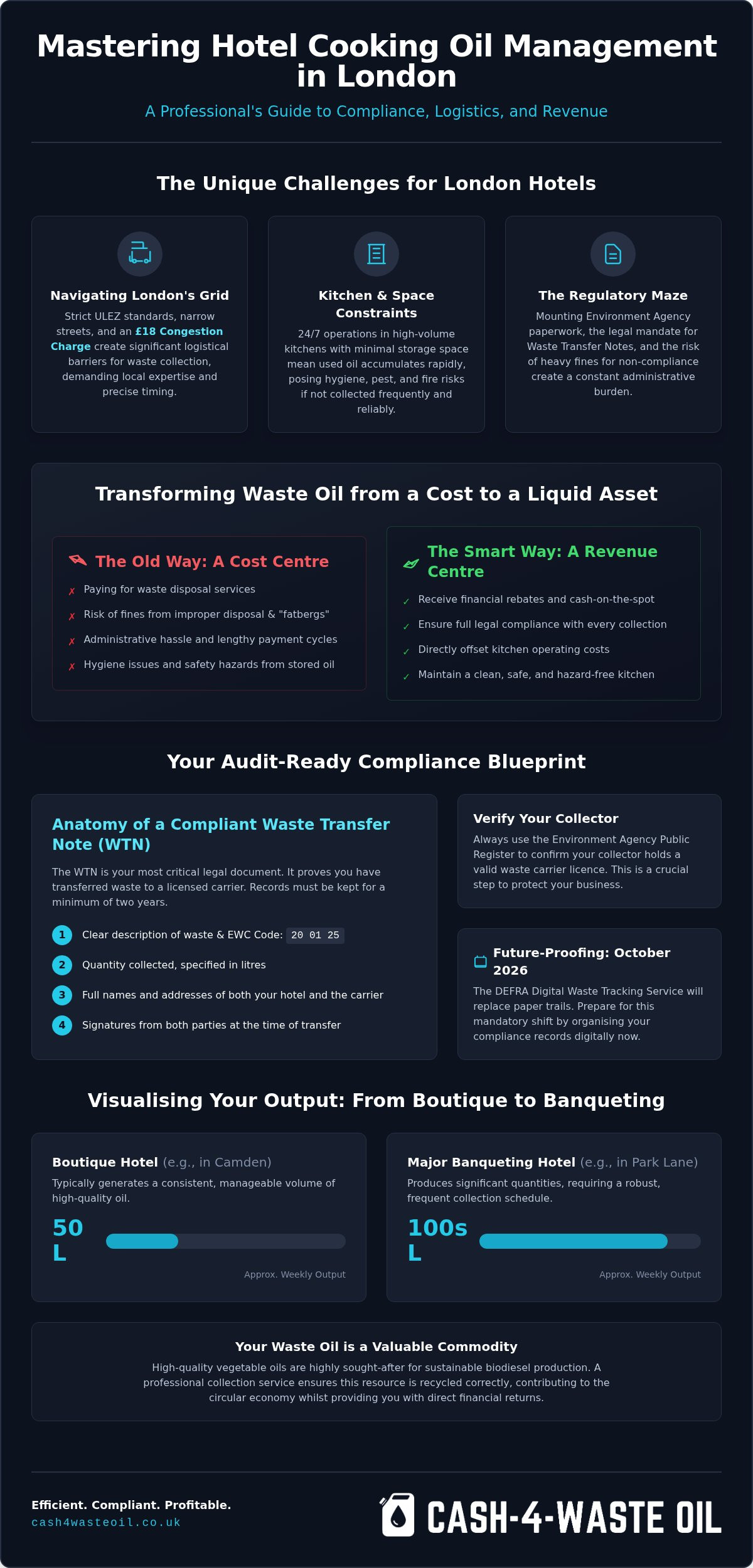
Estimating your weekly output is the first step toward a cleaner, more profitable kitchen. A boutique hotel in Camden might generate 50 litres of used rapeseed or sunflower oil weekly. In contrast, a major banqueting facility in Park Lane can easily produce hundreds of litres. Most professional kitchens rely on high-quality vegetable oils that are highly valuable for biodiesel production. If you're still paying for disposal, you're missing a significant financial opportunity. Turning this waste into a revenue stream helps offset the rising costs of kitchen consumables.
The environmental stakes are equally high. London’s ageing sewer system is notoriously prone to "fatbergs," and the Environment Agency is increasingly aggressive in tracing these blockages back to their source. Following UK regulations for used cooking oil is the only way to protect your business from heavy fines and reputational damage. By partnering with a licensed carrier, you ensure every drop is accounted for with a Waste Transfer Note. This documentation is your primary defence during a local authority audit, proving that your hotel handles its environmental liabilities with professional care.
Legal Compliance: Waste Transfer Notes and Audits
Legal compliance isn't optional. For any hotel cooking oil collection London service, the Waste Transfer Note (WTN) is your most vital document. It serves as the official receipt that proves you've handed your waste to a licensed carrier. Without this paper trail, you remain legally liable for where that oil ends up. The Environment Agency requires you to keep these records for at least two years. Failure to produce them during an unannounced health and safety or environmental audit can lead to heavy fines or prosecution.
Checking your collector's credentials is a critical step in protecting your business. Don't take their word for it. Use the Environment Agency Public Register to verify their waste carrier licence before any oil leaves your site. Using an unlicensed collector to save time puts your brand reputation at risk. One fly-tipping incident linked back to your hotel could result in a PR disaster that far outweighs any perceived convenience of a quick pick-up.
What Should Be on Your Waste Transfer Note?
A valid WTN must contain specific details to satisfy official government guidance. Ensure your documentation includes a clear description of the waste and the correct European Waste Catalogue (EWC) code, which is 20 01 25 for edible oil. The note must state the quantity collected in litres and include the names and addresses of both the hotel and the waste carrier. Finally, ensure both parties sign the document at the point of transfer. Missing any of these details can invalidate the note and leave you vulnerable during an audit.
The upcoming digital mandate in October 2026 will revolutionise how hotels track waste. The DEFRA Digital Waste Tracking Service will eventually replace paper trails with a centralised digital system. Transitioning your records now ensures you won't be caught out when the law changes. A well-organised compliance folder, whether digital or physical, is your best defence against legal scrutiny. If you need a reliable partner who provides instant documentation, you can book a compliant collection today.
Meeting ESG and CSR Targets
Professional recycling does more than just tick a legal box. It significantly boosts your Environmental, Social, and Governance (ESG) reporting. When your waste oil is refined into sustainable biodiesel, it enters the circular economy and reduces your hotel's carbon footprint. Many modern guests prioritise eco-conscious stays. Highlighting your commitment to 100% oil recycling in your marketing materials or CSR reports is a powerful way to build trust with sustainable travellers. It turns a mandatory compliance task into a genuine competitive advantage for your hotel.
Navigating London Logistics: ULEZ, Congestion, and Timing
London’s roads are a logistical puzzle. With the Congestion Charge set at £18 from January 2026 and ULEZ operating 24/7, timing is everything. A reliable hotel cooking oil collection London service must navigate these zones without passing the cost or the delay onto your kitchen. Rapid response times are essential because storage space in Central London is a luxury you likely don't have. You can't afford to let waste oil sit for days whilst waiting for a carrier to find a gap in their schedule.
Security and facilities management are your first line of defence against logistical chaos. Coordinating collections with your security team ensures the loading bay is clear and accessible. This prevents the "failed delivery" scenarios that lead to overflowing oil drums and hygiene risks. Your collector needs to be agile enough to work around your hotel's busiest delivery windows.
Coordinating with Your Collection Partner
A seamless collection depends on a clear protocol between your kitchen staff and the driver. Follow these three steps to ensure efficiency:
- Step 1: Define your access window. Aim for pre-7:00 AM collections to stay ahead of peak traffic and avoid the height of guest check-outs.
- Step 2: Establish a clear pick-up point. This area must be accessible for heavy containers and meet health and safety standards to prevent spills during transit.
- Step 3: Ensure a staff member is available. Someone needs to verify the volume collected, sign the Waste Transfer Note, and receive the cash payment immediately.
Area-Specific Considerations
Hotels in high-density areas like Soho or Camden face tighter space and more aggressive parking enforcement than those in Wandsworth or Islington. In these zones, every minute in a loading bay counts. You can read more about our specific approach to Waste oil collection in Soho and Camden. Managing collections in the City of London requires similar precision, often requiring "out-of-hours" slots to comply with local noise and traffic ordinances.
Meeting the legal requirements for waste cooking oil means ensuring your storage area is secure and leak-proof, especially in areas with high foot traffic. A local specialist understands these micro-logistics. They'll ensure your hotel remains compliant and your kitchen operations stay clear of obstructions. By choosing a partner who knows the shortcuts and restrictions of each borough, you protect your bottom line and your reputation.
Maximising the Value of Your Used Cooking Oil
Your used cooking oil is no longer a waste product to be hidden away in a dark corner of the loading bay. It's a valuable commodity. With the UK used cooking oil market projected to reach USD 435.08 Million by 2034, the demand for high-quality "yellow grease" is soaring. This growth, representing a compound annual growth rate of 6.51% from 2026, is driven by the global shift toward sustainable biodiesel. For your hotel, this means that every litre of oil poured into a collection drum has a tangible financial value.
The most efficient way to capture this value is through a rebate system that pays you directly for your waste. In a fast-paced kitchen, cash-on-the-spot payments provide an immediate injection into your petty cash or staff funds. This transparency eliminates the need to track complex bank transfers or wait for invoices to be settled. However, the amount you receive depends heavily on the quality of the oil you provide. Whilst international biodiesel markets dictate the baseline price, local factors like volume and purity determine your final rebate.
Best Practices for Oil Storage
Clean oil consistently commands the highest rebate value. Contamination is the primary reason for reduced payments. If your oil is mixed with water, heavy food debris, or cleaning chemicals, its value to the recycler drops significantly. Water, in particular, causes the oil to go rancid and complicates the refining process. You should also consider your storage vessels carefully. Whilst blue barrels are standard for many, high-volume hotel kitchens often benefit from Intermediate Bulk Containers (IBCs) to manage larger outputs safely. For more advice on maintaining a clean environment, see these tips for mess-free storage.
Financial Transparency in Waste Recovery
In 2026, paying for a hotel cooking oil collection London service is an outdated and unnecessary expense. If you're still being charged for disposal, you're effectively paying a company to take away your assets. A professional partner should offer free collection and a fair market rebate. By tracking these rebates over time, you can build a secondary revenue stream that helps offset the rising costs of fresh ingredients and kitchen labour.
Comparing a "free service" against a "paid rebate service" is a simple matter of looking at your bottom line. A collection that pays you cash on delivery turns a liability into a profit centre. It's a pragmatic business decision that aligns your financial goals with environmental responsibility. If you're ready to convert your waste into profit, request your cash rebate today.
Cash 4 Waste Oil: London’s Trusted Hotel Partner
Cash 4 Waste Oil provides a professional, fully licensed service designed specifically for the rigorous demands of the London hospitality sector. We don't just collect waste; we provide a comprehensive management solution that turns a kitchen byproduct into immediate revenue. Our "Cash on the Spot" promise ensures you receive your rebate the moment the oil is collected. There's no waiting for bank transfers or chasing invoices. This immediate liquidity is particularly beneficial for busy hotel kitchens looking to boost staff funds or manage petty cash without administrative delays.
Reliability is our cornerstone. We are Environment Agency registered and operate across Greater London, Kent, and Surrey, ensuring that your hotel cooking oil collection London schedule remains consistent regardless of your location. Every collection we perform is backed by full compliance support. We provide a legal Waste Transfer Note at the point of exchange, ensuring your hotel meets all mandatory requirements. This documentation is your shield during audits, proving your commitment to responsible waste management.
Why Choose a Local Specialist?
General waste carriers often struggle with the micro-logistics of Central London. Our team understands the capital’s unique street layouts, from the narrow alleys of Soho to the restricted access zones in the City. This local expertise allows us to offer rapid response times when your storage is full and you need an emergency pick-up. We work around your delivery windows and security protocols to ensure our presence never disrupts your guest experience. Learn more about how to get paid for used cooking oil in London through a service that prioritises your operational needs.
Starting Your Collection Programme
Setting up your collection is a straightforward process. You can book your first visit through a simple call, email, or WhatsApp message. We offer flexible recurring schedules, including weekly, fortnightly, or monthly options, tailored to your hotel’s specific volume and storage capacity. During our first visit, we conduct a brief site assessment to identify the best pick-up points and container setups for your facility. We aim to make the transition as seamless as possible, taking the burden of oil management off your shoulders so you can focus on hospitality. Our goal is to provide a hassle-free experience that rewards your business for its environmental responsibility.
Future-Proof Your Hotel's Oil Management
Streamlining your kitchen's waste management is a smart move for your bottom line and the environment. By 2026, the transition to digital waste tracking and the rising costs of London logistics make professional oversight essential. You've seen how a structured approach to hotel cooking oil collection London eliminates storage hazards whilst ensuring your hotel remains audit-ready. Moving from a "pay-to-dispose" model to a revenue-generating rebate system is a simple, pragmatic shift that rewards your commitment to the circular economy.
Cash 4 Waste Oil is your local partner for this transition. We're Environment Agency registered and serve all of London, Kent, and Surrey with prompt, reliable service. Every collection includes a mandatory Waste Transfer Note; we pay cash on the spot to keep your kitchen budget healthy. It's time to stop paying for disposal and start getting paid for your waste. We look forward to helping you build a cleaner, more profitable kitchen.
Book your free hotel oil collection and get paid cash today
Frequently Asked Questions
Do you collect used cooking oil from hotels in Central London?
Yes, we cover all Central London districts including Soho, Camden, and Mayfair. Our hotel cooking oil collection London service is specifically designed to handle the logistical challenges of high-density areas. We understand the timing restrictions and narrow access routes common in historic hotel buildings. Whether you're a boutique site or a major landmark, our team ensures a prompt and professional pick-up that fits your kitchen's schedule.
Is there a minimum amount of oil required for a free collection?
We provide free collections for commercial kitchens that produce a consistent volume of waste vegetable oil. Whilst we don't charge for the pick-up, we recommend accumulating a standard volume to make the collection more efficient for your staff and our drivers. If you're unsure if your output qualifies, our team can assess your weekly usage and suggest a collection frequency that keeps your storage areas clear and hygienic.
How much cash will my hotel receive for our waste oil?
Your hotel receives a cash payment based on the total volume and quality of the oil collected. We pay per litre on the spot, providing an immediate financial return for your waste product. The exact rate fluctuates with international biofuel market prices, but we always offer a competitive market rebate. This transparent approach ensures you see the value of your recycling effort instantly, with no need for bank transfers.
Will I receive a Waste Transfer Note for my compliance records?
Yes, we provide a mandatory Waste Transfer Note with every single collection we perform. This document is a legal requirement under UK environmental law and must be kept for at least two years. It serves as your proof of compliance for Environment Agency audits and health and safety inspections. Our drivers ensure all paperwork is properly signed and handed over before leaving your hotel premises for your records.
Can you collect oil from hotels located within the ULEZ or Congestion zones?
Absolutely. We operate throughout the Ultra Low Emission Zone (ULEZ) and Congestion Charge areas every day. Our fleet is fully compliant with London’s emission standards, so you don't have to worry about access restrictions or additional delivery surcharges. We specialise in early morning or "out-of-hours" slots to ensure we reach your hotel loading bay before peak traffic and the highest congestion charges apply to the route.
What happens to the oil once it has been collected from our kitchen?
Every drop of used cooking oil we collect is recycled into sustainable biodiesel. This process turns your kitchen waste into a high-quality renewable fuel that powers transport and reduces carbon emissions. By choosing a professional hotel cooking oil collection London service, you're directly contributing to the circular economy and helping your hotel meet its sustainability and ESG targets through responsible waste recovery and carbon reduction efforts.
Do you provide storage containers for our used oil?
We work with your existing kitchen setup to ensure oil is collected safely and efficiently. Whilst our primary service is the collection and rebate of waste oil, we can offer professional advice on the best storage solutions for your specific volume. Whether you use standard blue barrels or high-capacity containers, our equipment is designed to extract the oil without creating spills or hygiene issues in your loading area.
Can you handle collections for large hotel chains with multiple London sites?
Yes, we have the capacity to manage multiple sites for large hotel groups across Greater London, Kent, and Surrey. We can coordinate a centralised schedule that ensures every kitchen in your portfolio remains compliant and clutter-free. This multi-site approach simplifies your administration by providing consistent documentation and a single point of contact for all your waste oil recovery needs across your entire London property estate.