Hotel Waste Oil Collection London: Professional Service & Cash Rebates 2026
What if the messy, pest-attracting drums at the back of your hotel kitchen were actually a tax-compliant revenue stream waiting to be tapped? Running a high-volume kitchen in the city is stressful enough without the added burden of unreliable collectors or the risk of a £5,000 fine for improper disposal. You need a hotel waste oil collection London service that is punctual, professional, and leaves your storage area spotless every single time.
It's easy to feel overwhelmed by the complex paperwork involved in modern waste management. This article reveals how to turn your used cooking oil into a predictable source of income whilst ensuring you meet every strict Environment Agency requirement. We’ll show you how to navigate the 2026 mandatory digital waste tracking system with zero stress, ensuring your business remains on the right side of the law and avoids hidden disposal costs.
From securing instant financial rebates to obtaining the vital Waste Transfer Note for your next audit, we've outlined everything you need to hit your sustainability targets. You'll learn how a scheduled collection can support the circular economy and help your hotel contribute to the growing demand for sustainable biofuels, turning a daily chore into a genuine business advantage.
Key Takeaways
- Master the 2026 Environment Agency regulations to ensure your hotel remains fully compliant with mandatory digital waste tracking systems.
- Streamline your kitchen operations with a professional hotel waste oil collection London service that turns used cooking oil into an immediate cash rebate.
- Organise your storage areas to meet strict Food Standards Agency (FSA) requirements by choosing the right containers for your specific kitchen layout.
- Learn why local, reliable collectors often outperform large industrial firms when managing the high-volume demands of London's hospitality sector.
- Protect your business during inspections by securing a mandatory Waste Transfer Note for every single litre of oil removed from your premises.
What is Professional Hotel Waste Oil Collection in London?
Professional hotel waste oil collection London involves more than just picking up old grease. It's a specialised logistics service designed for the high-pressure environment of commercial hotel kitchens. Unlike smaller takeaways, hotels manage massive volumes of cooking oil across multiple dining shifts. This requires a collector who understands the unique constraints of the capital, from ULEZ charges to the narrow, restricted access of Soho and Mayfair.
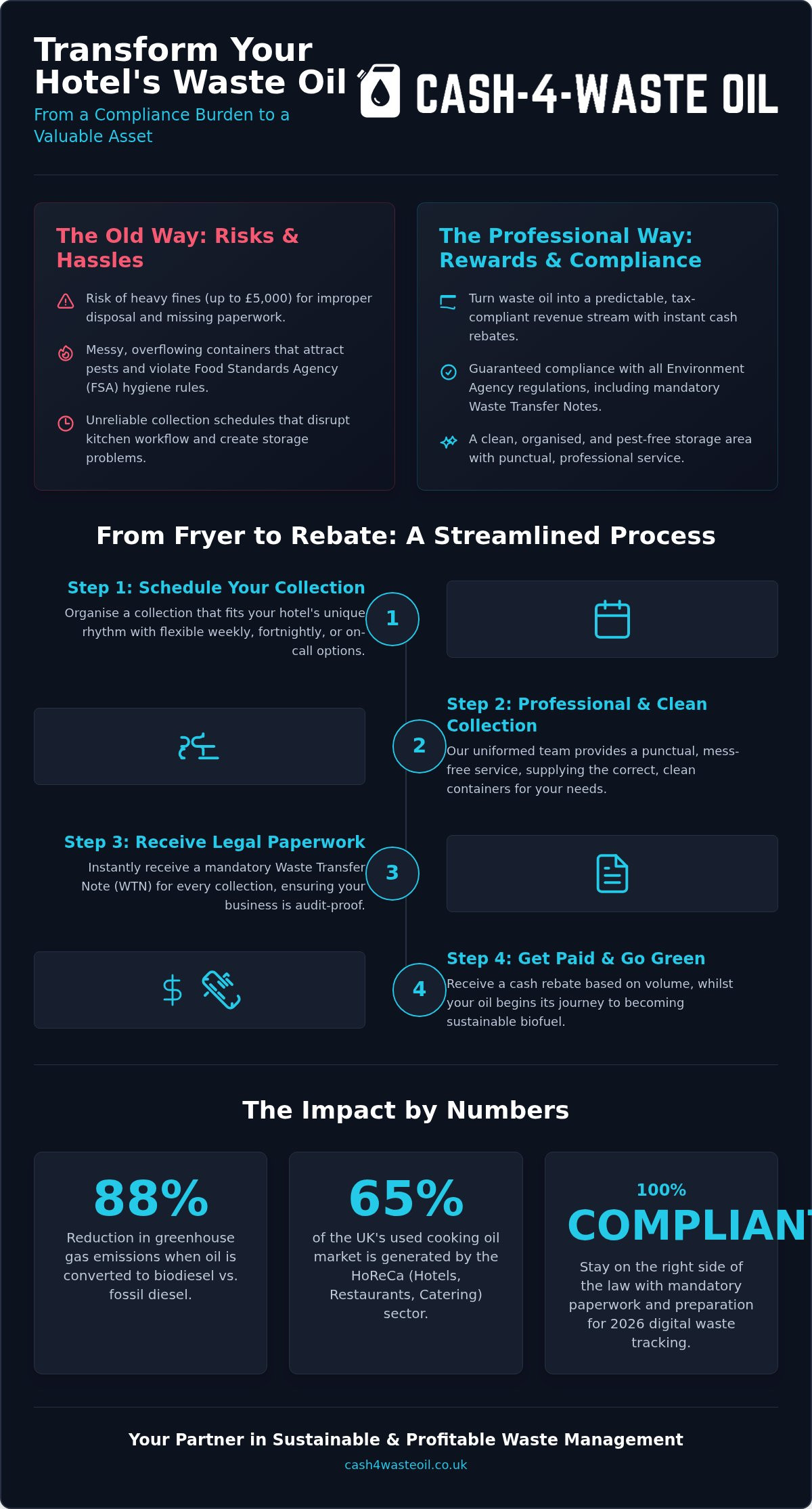
Hotels operate on a different scale to standard eateries. The HoReCa sector (Hotels, Restaurants, and Catering) accounts for roughly 65% of the UK’s used cooking oil market. This high turnover means your storage areas fill up fast. You need a reliable partner who can handle bulk volumes whilst adhering to strict health and safety protocols. Professional collectors provide the right containers to keep your loading bays tidy and pest-free.
The industry often refers to this collected material as Yellow grease. Once it leaves your kitchen, it undergoes a rigorous filtration and rendering process to remove impurities. This ensures the final product meets the standards required for energy production. Hotel waste oil collection serves as a vital link in the UK’s circular economy by transforming a hazardous byproduct into a sustainable energy source.
The Legal Necessity: Waste Transfer Notes and Compliance
Maintaining a professional hotel waste oil collection London schedule is vital for legal compliance. Compliant waste management isn't optional. Every time a collector visits your premises, they must provide a Waste Transfer Note (WTN). This document is your legal proof that you've fulfilled your Duty of Care under UK law. The Environment Agency monitors these records to ensure that commercial kitchen waste doesn't end up in landfill or down the drain. If you're missing this paperwork during an inspection, you risk heavy fines. For a deeper dive into these requirements, read our Commercial Kitchen Oil Disposal: The 2026 Essential Compliance Checklist.
Environmental Impact: From Kitchen Waste to Biodiesel
Properly recycled oil has a second life as biodiesel. This fuel can reduce greenhouse gas emissions by up to 88% compared to traditional fossil diesel. For London hotels pursuing "Green Tourism" certifications, this is a significant win. It demonstrates a commitment to sustainable operations that guests increasingly value. It's a smart way to turn a waste problem into an environmental asset.
Beyond carbon footprints, professional collection protects London's infrastructure. Pouring oil down the sink leads to "fatbergs" in the city's Victorian sewer system. These massive blockages cost millions to clear and cause devastating floods. By using a professional service, you keep your drains clear and help maintain the city's historic plumbing. It’s a practical business decision that benefits the whole community.
The Collection Process: From Fryer to Cash Rebate
Professional hotel waste oil collection London should be a seamless utility that runs in the background of your business. We've refined a streamlined four-step process to ensure your kitchen remains operational without interruption. Our service covers everything from the initial request to the final recycling stage. Professional collection is free of charge for London businesses.
Turning your waste into a resource shouldn't be a logistical headache. We focus on speed and transparency. By following UK government regulations, we ensure your oil is handled safely whilst putting money back into your kitchen budget. The rebate you receive is calculated purely on the volume of clean oil we collect. This creates a direct financial incentive to manage your waste efficiently. If you're looking to streamline your back-of-house costs, you can book a collection today to see the immediate benefit.
Step 1: Scheduling Your London Collection
Flexibility is the core of our scheduling. Hotels don't run on a standard nine-to-five, so your collection service shouldn't either. We offer weekly, fortnightly, or on-call collections that adapt to your occupancy rates. During peak tourist seasons, you might need more frequent visits. We understand the unique challenges of different London boroughs. Navigating the narrow backstreets of Soho or the busy loading bays of the West End requires local knowledge. We coordinate with your team to find the best time for access, whether you use a basement lift or a rear-loading bay. This ensures we're in and out before your main dinner service begins.
Step 2: On-Site Collection and Payment
When our driver arrives, the process is quick and clean. We use professional pumping equipment or swap out your full containers for fresh ones. Transparency is vital here. We measure the oil volume on-site so you know exactly what the rebate will be before we leave. Many collectors make you wait weeks for a bank transfer. We don't. We provide cash payments instantly whilst the driver is on-site. This allows for immediate kitchen budget replenishment, giving your chefs extra petty cash for daily essentials or small equipment repairs. For more details on how market rates affect your return, check out our Get Paid for Used Cooking Oil in London: The 2026 Commercial Guide. We then issue your digital Waste Transfer Note to complete the transaction legally.
Evaluating London Collectors: Reliability vs. Bulk Requirements
Many hotel waste oil collection London services operate on a "bulk-only" model. These large industrial firms typically demand minimum collections of 1,000 litres or more. Whilst this works for massive food processing plants, it's often impossible for boutique hotels in Soho or Mayfair. Your storage space is at a premium. You can't afford to lose valuable square footage to massive tanks just to satisfy a collector's minimum volume requirement.
Choosing a local partner ensures you aren't penalised for your location. Big firms often struggle with London's logistical hurdles. They might miss a scheduled slot because their heavy goods vehicle couldn't navigate a narrow access road or got stuck in traffic. For a hotel, a missed collection isn't just an inconvenience; it's a hygiene risk. Stagnant oil attracts pests and creates foul odours that can reach guest areas. You need a collector who understands that reliability is more important than sheer scale.
Watch out for red flags when vetting new partners. Unlicensed "cowboy" collectors are a genuine threat to your business. They might offer a quick pick-up, but they often fail to provide a Waste Transfer Note (WTN). Without this document, you have no legal proof that your waste was disposed of correctly. If that oil is later fly-tipped, the Environment Agency will trace it back to your kitchen. You'll be the one facing the legal fallout, not the collector. Always prioritise transparency over a slightly higher, undocumented cash offer.
Boutique Hotels vs. Large Chains: Scalable Solutions
Your collection schedule should match your kitchen's output, not the collector's convenience. We tailor our frequency to your specific drum capacity. This prevents overflow and keeps your loading bays clear. For hotel groups managing multiple sites across London, we provide centralised reporting. This simplifies your internal audits and ensures every branch meets the same high standard of compliance. We remove the barrier of minimum volume limits, making professional service accessible to smaller establishments that still demand high-quality care.
Licensing and Insurance: Protecting Your Business
Never let anyone remove oil from your premises without verifying their Environment Agency Waste Carrier Licence. It's your primary shield against legal trouble. Under the "Duty of Care" regulations, hotels are responsible for their waste until it reaches a licensed disposal point. Using an unlicensed carrier can lead to fines of up to £5,000. Additionally, ensure your partner carries robust public liability insurance. Accidental spills during a collection in a high-traffic hotel environment can be costly. A professional partner has the insurance and the training to handle these risks safely.
Best Practices for Storing Waste Cooking Oil in Hotels
Efficient storage is the foundation of a successful hotel waste oil collection London strategy. You must maintain a designated area that meets Food Standards Agency (FSA) requirements to pass your next hygiene inspection. This area should be level, well-lit, and easily accessible for collection vehicles whilst remaining secure from unauthorised access. A tidy storage zone doesn't just look professional; it prevents accidents and streamlines the entire uplift process.
Choosing the right vessel is a key part of your hotel waste oil collection London plan. Standard 200-litre blue barrels are ideal for boutique hotels with limited kitchen space. If you manage a large-scale operation with high-volume fryers, an Intermediate Bulk Container (IBC) might be more efficient. These 1,000-litre tanks reduce the frequency of collections and keep your loading bay organised. Used cooking oil should never be poured down drains due to the risk of legal penalties and physical blockages.
Health, Safety, and Pest Control
Secure your lids immediately after every pour. Loose lids lead to spillages that create slip hazards for your team and make the collection process messy. Beyond safety, exposed oil releases strong odours that attract rodents and insects. In dense city centres like London, poor oil management is the primary cause of pest infestations near loading bays. Position your storage away from guest entrances and ventilation intakes to maintain your hotel's premium atmosphere. Keeping the area clean with regular degreasing will also prevent your staff from tracking oil into the main kitchen.
Maximising the Value of Your Waste Oil
The quality of your oil directly impacts your financial return. Contamination is the biggest threat to your rebate. Ensure your team avoids mixing oil with water, chemicals, or general food waste. Water in the oil causes significant issues during the biodiesel conversion process, which can lower the value of your uplift. Even a small amount of debris can clog professional pumping equipment, slowing down the service and potentially impacting your payment.
Train your kitchen staff on proper pouring techniques and cooling times. Wait for the oil to cool before transferring it to the storage container to prevent heat-related damage to the barrels. Implementing a simple Standard Operating Procedure (SOP) for oil disposal ensures consistency across all shifts. If you want a partner who provides the right equipment and pays you fairly on the spot, arrange your waste oil collection with a team that values your time and efficiency.
Partnering with Cash 4 Waste Oil: London’s Trusted Hotel Service
Cash 4 Waste Oil understands that London hotels operate in a high-stakes environment where every square metre of space and every minute of staff time matters. We've built our reputation by being the most pragmatic choice for the capital's hospitality sector. Whether you're managing a boutique site in the narrow streets of Soho or a flagship establishment on Park Lane, our service adapts to your specific logistical needs. We don't just collect waste; we provide a professional, licensed, and profitable utility that supports your bottom line.
Our approach is straightforward. We provide the necessary storage containers, collect your used oil on a schedule that suits you, and pay a cash rebate per litre on the spot. This immediate financial return sets us apart from corporate collectors who often trap businesses in complex invoicing cycles. By choosing us for your hotel waste oil collection London, you're also hitting your sustainability targets. Every drop of oil we collect is 100% recycled into high-grade biodiesel, helping your hotel contribute to a cleaner, greener city without any extra effort from your team.
Local Expertise in London’s Boroughs
Navigating the capital requires more than just a GPS; it requires local knowledge of borough-specific restrictions and traffic patterns. Our drivers are experts at managing the logistics of Camden, Wandsworth, Islington, and Notting Hill. We know which hotels require small-van access and which can accommodate larger uplifts. This local presence allows us to offer a rapid response for emergency collections. If an unexpectedly busy weekend leaves your storage drums overflowing, we're positioned to clear the backlog before it becomes a hygiene issue. For a comprehensive look at how we maintain these standards, read our full guide on Hotel Waste Oil Collection London: Professional Service & Cash Rebates 2026.
Getting Started: Your First Collection
We believe in keeping business simple. You won't find complex contracts, hidden onboarding fees, or long-term tie-ins here. We let the quality of our service speak for itself. During your first site visit, we'll conduct a quick volume assessment and discuss the best placement for your storage barrels to ensure FSA compliance. Our team will walk you through the digital Waste Transfer Note process so you're ready for any future audits. It's a zero-hassle transition that turns a waste problem into a consistent revenue stream. Contact our London team for a free quote today and discover why the city's leading hotels trust us with their kitchen waste.
Streamline Your Kitchen Operations and Boost Your Bottom Line
Managing a busy kitchen requires focus on the food and the guests, not the grease drums in the loading bay. By implementing a professional hotel waste oil collection London service, you turn a messy logistics problem into a tidy, tax-compliant revenue stream. You’ve seen how proper storage and reliable scheduling protect your business from pests and legal fines. It's time to stop treating used oil as a burden and start seeing it as a valuable asset for your hotel’s sustainability and budget.
We handle the entire process to keep your operations hassle-free and efficient. Our team is Environment Agency Registered, ensuring full Waste Transfer Note compliance for every uplift we perform across the capital. Best of all, we provide cash paid on the spot, giving your kitchen team an immediate financial boost without the wait of corporate invoicing. Ready to clear your storage and support the circular economy? Book your free London hotel oil collection and get paid today. Your kitchen deserves a service that's as professional and efficient as your hospitality.
Frequently Asked Questions
Do you collect waste cooking oil from hotels in Central London?
Yes, we provide comprehensive coverage across all Central London boroughs, including Soho, Mayfair, and the City. Our drivers are experts at navigating narrow access roads and strict ULEZ requirements common in these areas. We specifically tailor our hotel waste oil collection London service to meet the high-volume needs of West End hospitality businesses, ensuring prompt uplifts that don't disrupt your guest services or kitchen operations.
How much cash will my hotel receive for our used cooking oil?
The rebate amount depends on the volume and quality of the oil we collect from your premises. We pay a competitive rate per litre, and because we pay cash on the spot, your kitchen receives an immediate budget replenishment. Clean, filtered oil typically fetches the best rates. Our driver will measure the volume transparently in front of your staff before handing over the payment and your digital Waste Transfer Note.
Is there a minimum amount of oil required for a free collection?
We generally require a minimum of 50 litres to provide a free collection service across London. This typically equates to two or three standard blue barrels. For smaller boutique hotels that struggle with storage space, we can discuss flexible scheduling to ensure your bins never overflow. Our goal is to provide a zero-hassle utility that adapts to your kitchen's specific output without charging you a collection fee.
What happens if we don’t have a Waste Transfer Note?
If you don't have a Waste Transfer Note (WTN) for previous collections, you are at risk of heavy fines during an Environment Agency or local council audit. It is a legal requirement to keep these records for at least two years. When you switch to our service, we provide a compliant WTN at every single collection, ensuring your hotel remains fully protected and legally compliant with UK waste regulations.
Can you collect oil from basement kitchens with limited access?
Yes, our team is equipped to handle collections from basement kitchens and rear-loading bays with restricted height or width. We use specialised pumping equipment and smaller vehicles designed for London’s unique architecture. Whether your oil is stored in a sub-level cellar or a narrow mews, we coordinate with your back-of-house team to ensure a clean, spill-free uplift that respects the aesthetics of your hotel and guest areas.
Is the cash payment for waste oil legal for business accounting?
The cash rebate is entirely legal and transparently documented. We provide a full receipt and a Waste Transfer Note that matches the volume collected and the payment made. Your accounts department can record this as sundry income or a credit against kitchen expenses. This immediate cash injection is a popular feature for London hotel managers who need to manage petty cash for daily kitchen essentials or equipment repairs.
Do you provide the storage barrels for our used oil?
We provide high-quality, leak-proof storage containers as part of our ongoing service. Depending on your kitchen’s footprint and oil turnover, we can supply standard 200-litre blue barrels or larger 1,000-litre IBC tanks. These containers are designed to keep your storage area tidy, prevent odours, and deter pests. We swap full barrels for clean, empty ones during every scheduled hotel waste oil collection London visit to maintain your hygiene standards.
What types of cooking oil can you collect from our hotel?
We collect all types of vegetable-based cooking oils, including rapeseed, sunflower, palm, and soy oil. We also accept used fats and oils from deep fat fryers and griddles. However, we cannot collect engine oil, mineral oil, or oil heavily contaminated with water and food debris. Keeping your oils segregated from general waste ensures you receive the maximum cash rebate and supports the 100% recycling process into sustainable biodiesel.