Legal Proof of Oil Disposal for UK Authorities
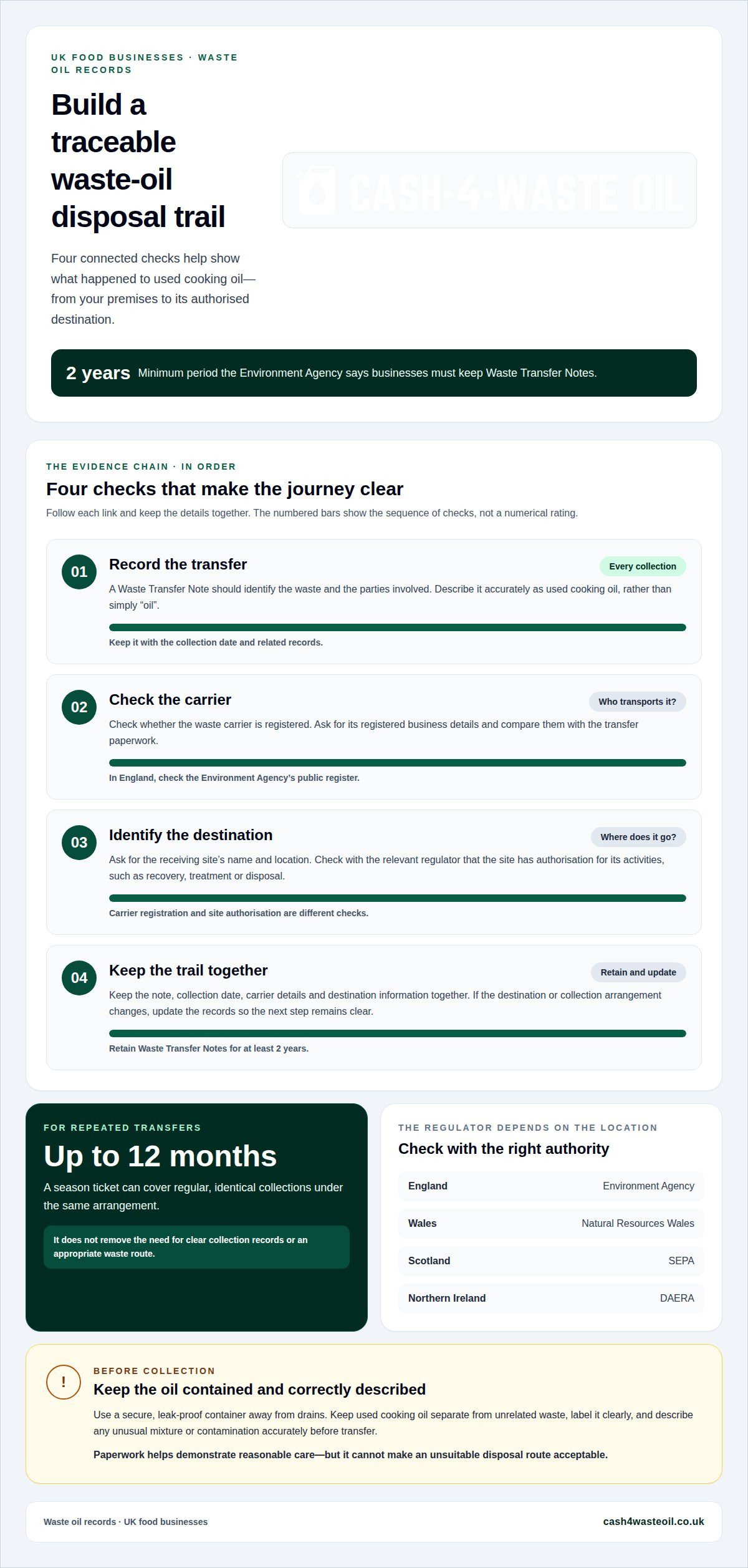
For UK food businesses, legal proof of oil disposal for authorities starts with a documented transfer to an authorised waste collector. Each used cooking oil collection should have a Waste Transfer Note, and the Environment Agency says businesses must keep these notes for at least two years. The paperwork records the waste transfer; using an authorised collector helps show it was handled through the proper route.
It’s easy to focus on getting used oil out of the kitchen, but the record matters too. If an authority asks how the waste was managed, clear paperwork can help demonstrate that it left your premises through an appropriate collection and disposal process.
This article explains how authorised collection, duty of care, suitable recovery or disposal sites and digital consignment notes fit into that evidence. You’ll see which records to retain and how to make the disposal trail easier to follow, so you can manage used cooking oil with greater confidence.
Key Takeaways
- For regular, identical collections, a season ticket can cover collections for up to 12 months.
- Understand how your duty of care continues through the waste transfer and why the collection route matters.
- Learn what an authorised recovery or disposal site contributes to a clear record of where the oil went.
- Digital consignment notes may be available on request, helping keep collection records together.
- Find out which documents to retain so you can present a clear account of your waste oil’s journey.
Collection by an authorised collector
In England, use the Environment Agency’s public register to check whether a waste carrier is registered. Ask for the receiving site’s name and location, then check with the relevant environmental regulator whether it has the authorisation required for its activities. Regulators differ across the UK: the Environment Agency covers England, Natural Resources Wales covers Wales, SEPA covers Scotland, and DAERA is relevant in Northern Ireland.
Carrier registration and site authorisation answer different questions. Registration relates to the business transporting the waste; authorisation concerns the place receiving it and the activities carried out there. A collector should be able to explain the route. If the destination changes, the collection records should reflect the updated details so the oil’s next step is clear.
Before collection, ask for the collector’s registered business details and the proposed destination. Compare these with the transfer paperwork. A Waste Transfer Note should identify the waste and the parties involved. Keep it with the collection date and any related records, so you can trace the transfer if an authority asks about it later.
Collection arrangements can also affect the records. For regular, identical collections, UK food businesses can use a season ticket valid for up to 12 months. This can cover repeated transfers under the same arrangement. It does not remove the need to keep clear records of collections or to ensure the waste is handled through an appropriate route.
Storage before collection matters as well. According to the UK legislation register, the Control of Pollution (Oil Storage) Regulations 2001 set out oil storage requirements intended to prevent leaks and environmental contamination. A secure, suitable container helps keep waste cooking oil contained while it awaits collection. For example, a leaking drum beside a drain creates a pollution risk before a carrier arrives.
Keep the oil separate from unrelated waste and make its contents clear to the person collecting it. Clear identification helps avoid confusion between waste cooking oil and other oil types. If a collection includes an unusual mixture or contamination, describe it accurately before transfer. The collector can then handle the waste according to its actual contents, rather than relying on an incorrect description.
An authorised collection helps create legal proof of oil disposal for authorities by linking the waste, carrier and destination in a traceable chain. Check that the carrier details, collection record and destination information are consistent. This is more useful than a receipt that confirms collection but does not identify who took the oil or where it went.
Duty of care when disposing of cooking oil
Used cooking oil remains your business’s responsibility while it is stored and transferred. In the UK, used cooking oil is classified as controlled waste under the Environmental Protection Act 1990, according to the UK legislation register. This means the way your kitchen handles waste oil matters before, during and after collection.
Duty of care means keeping waste contained and ensuring it follows a suitable route. Pouring cooking oil into a drain risks pollution and removes control over where the waste goes. Store it in a secure, leak-proof container away from drains, and keep it separate from unrelated waste. Clear labels help staff identify the contents and prevent accidental mixing.
How do waste oil duty of care rules differ across England, Wales, Scotland and Northern Ireland? The core duty to manage waste responsibly applies across the UK, but regulators and some waste rules differ between nations. The Environment Agency operates in England, Natural Resources Wales in Wales, SEPA in Scotland, and DAERA in Northern Ireland.
At transfer, make sure the record describes the waste accurately and identifies the parties involved. A note that says only “oil” is less useful than one that clearly identifies used cooking oil. Keep it with the collection date and the collector’s details. The Environment Agency says UK food businesses must retain Waste Transfer Notes for at least two years.
What penalties apply for illegal waste oil disposal or missing waste records in the UK? Failing to produce waste transfer documentation can result in a spot fine or prosecution. Pouring oil down a drain or putting it into general waste can also cause a pollution incident, with consequences depending on the circumstances.
Good records help show that your business took reasonable care, but paperwork cannot make an unsuitable disposal route acceptable. Keep a consistent trail from storage through collection, ensuring each record relates to the actual transfer. If collection is delayed, record the arrangements and keep the oil secure rather than moving it into an undocumented waste stream.
If your kitchen changes its collection arrangements, your duty of care remains. Update the collection record with the new transfer details. Accurate notes give an authority a clearer account of how the oil was handled, without gaps between storage and collection.
Delivery to an authorised recovery or disposal site
A collection record identifies the carrier, while destination details complete the waste journey. The receiving site should be authorised for the waste and the activity it carries out, such as recovery, treatment or disposal. Paperwork should identify the destination clearly, rather than simply stating that oil was removed from your premises.
In England, the Environment Agency is the environmental regulator for waste. Wales, Scotland and Northern Ireland have their own regulators: Natural Resources Wales, SEPA and DAERA. The relevant agency depends on where the receiving site operates. Its name and location help connect the collection record to the correct place and regulator.
Keep transfer documentation with any receipt or confirmation from the receiving facility. Together, these records can show the movement from your kitchen, through the carrier, to the site. Check that the business names, waste description and destination details form a consistent chain. If a note names one site and a receipt names another, keep a record explaining the route.
Do not treat all oil as interchangeable. Waste cooking oil from a restaurant differs from waste engine oil drained during vehicle maintenance. Most used engine oils and many industrial lubricants are classified as hazardous waste in the UK. The waste description matters because the receiving site must be suitable for the material it accepts.
Storage also affects the handover. Keep containers closed and secure until collection, and avoid transferring oil into an unlabelled drum. If a container leaks before reaching the facility, the intended destination does not undo the pollution risk. The Control of Pollution (Oil Storage) Regulations 2001 address storage requirements intended to prevent leaks and environmental contamination.
Household lubricating oil follows a different route from commercial kitchen collections. Household oil should be placed in an undamaged container with a secure lid and taken to a local household recycling site. A restaurant should not use this household route for its commercial waste cooking oil.
When reviewing a completed transfer, check that the collection date, waste description, carrier and receiving site connect. A record identifying only a carrier leaves the destination unclear; a receipt without a matching transfer record can also leave gaps. Together, consistent records support the duty of care trail if an authority asks how the oil was handled.
Keep records in a consistent place, such as a digital folder organised by collection date. If the carrier changes the destination, retain the updated details with the transfer paperwork. That small recordkeeping step helps distinguish an authorised recovery route from an undocumented handover, and makes the disposal trail easier to explain.
Digital consignment notes
Digital notes can keep waste transfer information organised and accessible. Their value depends on linking each record to the correct collection and waste.
Records proving proper disposal
A disposal record connects your business’s waste with its collection and onward handling. For a food business, keep the Waste Transfer Note for each collection and any relevant consignment note. Digital consignment notes are available on request for waste oil collections. Together, these records help show what was transferred, when it left your premises and who handled it.
A note is useful only when it can be matched to the right movement. Save each collection record under its date and include the waste description in the filename. If a folder contains records for different oils and waste types, clear labels help staff quickly find the relevant evidence.
Retaining transfer and consignment notes
The Environment Agency says UK food businesses must keep Waste Transfer Notes for at least two years. Keep each note accessible throughout that period, whether digitally or on paper. File related consignment notes alongside transfer records so the documents can be reviewed together.
A separate consignment note may be relevant when the waste and its classification require one. Keep it with the associated transfer paperwork in a readable format. A collection date, waste description and matching filename help staff retrieve the right documents without searching unrelated folders.
Digital storage can make records easier to sort by collection date, waste type or site. Use a consistent naming format, such as the collection date followed by the premises name and waste description. This creates a clear sequence when records cover several kitchens or collections.
Keep the original digital file rather than relying on a screenshot that cuts off key information. If a document is corrected, retain a clear version history so the final record is distinguishable from an earlier copy. A revised destination, for example, should not leave two conflicting files with identical names.
Access controls matter too. Store notes in a business system that relevant staff can access, rather than on one employee’s device. Records should remain available if staff change roles. Routine backups help preserve digital files if a device fails or a folder is accidentally deleted.
Digital paperwork supports the evidence trail but does not replace correct handling or an appropriate waste route. Match each note to its collection and keep supporting records together. This makes it easier to explain a specific transfer to an authority without confusing it with another kitchen’s waste or a different oil type.
What legal records must UK businesses keep to prove waste oil was disposed of properly?
For commercial waste cooking oil, create a record trail that connects the waste produced at your premises with its transfer and onward handling. Your paperwork should identify each collection, rather than relying on a general note that oil was removed.
The Environmental Protection Act 1990 establishes a duty of care for UK businesses producing waste. That responsibility continues until the waste is properly recovered or disposed of. For each used cooking oil collection, keep a Waste Transfer Note showing the transfer details and the parties involved.
A useful record set can include:
- The Waste Transfer Note for the specific collection.
- Any consignment note required for waste classified as hazardous.
- A receipt or site confirmation that relates to the same transfer.
- Collection details that help identify the date, waste type and destination.
These documents serve different purposes. A Waste Transfer Note records a waste transfer, while a consignment note tracks hazardous waste movements where applicable. Do not assume every record labelled “oil” describes the same material. Used cooking oil from a kitchen and waste engine oil from a workshop can have different classifications and handling requirements.
The Environment Agency says UK food businesses must retain Waste Transfer Notes for at least two years. Keep related consignment paperwork with the matching transfer record. This makes it easier to explain a specific collection without confusing it with another site, waste type or destination.
Organisation matters during an inspection. Store records by collection date or premises, and use filenames that identify the waste and transfer. A file titled with the kitchen name, collection date and “used cooking oil” is easier to find than an untitled scan. Preserve the full document so its details remain readable.
If paperwork is corrected, keep the final version clear and avoid conflicting copies in the same folder. A collection note naming one waste type and a receipt naming another can make the trail harder to follow. Keep related records together so the transfer can be understood as a whole.
For a practical collection record, arrange documented used oil collection with the transfer paperwork linked to the relevant collection. Accurate documents help demonstrate how your business handled its waste, but they should reflect the actual material and movement. Keep the records available to staff responsible for environmental compliance, not solely in an individual employee’s inbox.
Cash 4 Waste Oil
Cash 4 Waste Oil helps commercial kitchens manage used cooking oil through collection and clear transfer records. Its service includes Waste Transfer Notes, giving businesses documentation linked to their collection. Cash payments for waste oil are also available.
For restaurants, pubs, hotels and other commercial kitchens in London, Kent and Surrey, this provides a practical route from stored oil to documented collection. Cash 4 Waste Oil is fully licensed and Environment Agency registered, supporting a traceable waste-handling process.
If you need used cooking oil collected and the transfer documented, contact Cash 4 Waste Oil to discuss your requirements.
Make oil records part of routine operations
Make waste-oil paperwork part of a simple handover routine, rather than leaving it until the end of the year. Assign responsibility for saving each collection record, use consistent filenames, and keep relevant documents with the kitchen’s operational records. This makes legal proof of oil disposal for authorities easier to retrieve when a manager changes or an inspection concerns a particular collection.
If responsibility moves between shifts or managers, record where files are stored and who can access them. This keeps the process workable during staff changes and helps prevent collection records becoming separated from supporting documents. Make recordkeeping part of day-to-day kitchen administration.
Review the workflow whenever collection arrangements or premises change. A brief internal check can reveal missing files, duplicates or unclear ownership before gaps become harder to resolve. Staff should know where records belong and who maintains access, without relying on one person’s inbox or memory.
For commercial kitchens ready to put that routine in place, arrange a documented oil collection with Cash 4 Waste Oil. A clear process can make ongoing waste management easier to handle and explain. Take the next step with confidence.
Frequently Asked Questions
Why Is Disposal Important?
Dispose of used cooking oil through a suitable waste route to reduce pollution risks and maintain a traceable record. Oil poured into a drain can cause problems beyond the kitchen, while oil placed in general waste may leave no clear account of its handling. Retaining collection paperwork helps connect the oil leaving your restaurant with the transfer that took place.
When is a waste transfer note required for used oil in England, Scotland and Wales?
A Waste Transfer Note documents each commercial used cooking oil collection in England, Scotland and Wales. It records the transfer between the business producing the waste and the party taking it. Keep the note with the relevant collection details so staff can retrieve the right record for a particular premises or date. The Environment Agency says UK food businesses must retain Waste Transfer Notes for at least two years.
When is a hazardous waste consignment note required for waste oil in the UK?
A consignment note may be needed when waste oil is classified as hazardous, but used cooking oil is not automatically hazardous just because it is waste. The waste type and classification determine which records apply. Waste engine oil, for example, differs from edible oil collected from a kitchen. If a transfer includes other oil or mixed material, its classification affects the required paperwork.
What information must appear on a waste oil transfer note or consignment note?
Make records useful by identifying the waste, the parties involved and the transfer date. Include carrier and receiving destination details where available, and distinguish used cooking oil from other oils in the description. Keep any consignment note with the specific waste movement. Clear, consistent details help staff match paperwork to a collection without relying on memory.
How should a business document waste oil collections, quantities and disposal receipts?
Keep a collection log linking each date and premises to its transfer note and any disposal receipt. Record a quantity when it appears on the collection paperwork, using the same unit shown there rather than making an unsupported conversion. File the receipt with the matching collection record. This joined-up process helps build legal proof of oil disposal for authorities and makes each collection easier to trace.