Licensed Waste Oil Collector London: What Commercial Kitchens Should Check
What if the collector removing your kitchen’s used oil is the weakest link in your waste records? For London food businesses, a smooth collection matters, but so does knowing that your oil is handled by a properly licensed and Environment Agency registered service. Choosing a licensed waste oil collector London kitchens can rely on means checking more than a vehicle and a collection slot.
You need a service that handles commercial cooking oil, vegetable oil and animal fats, provides clear transfer paperwork and fits around your kitchen’s routine. Knowing what the collection includes, how payment works and how often collections can be arranged helps avoid confusion and unexpected costs.
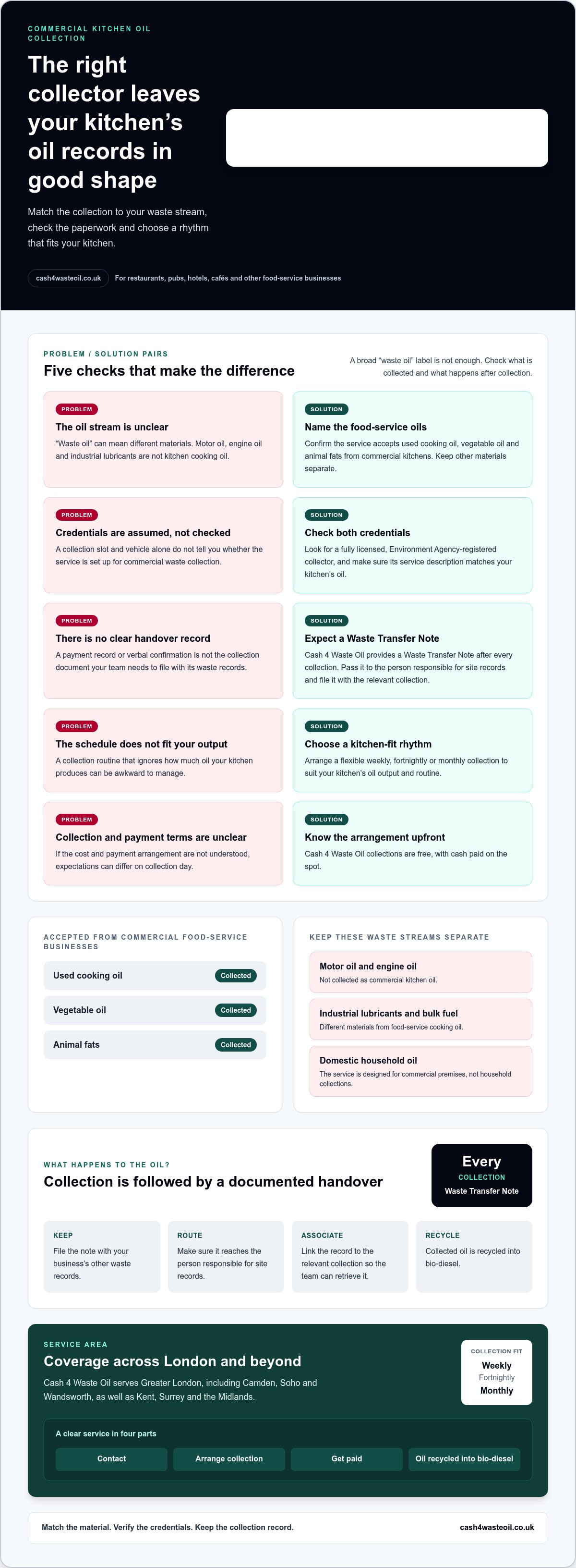
This guide explains what to look for in licensing and collection paperwork, how to choose a suitable schedule and how food-service oil collection differs from other waste streams. Cash 4 Waste Oil is fully licensed and Environment Agency registered. Every collection is free, cash is paid on the spot and a Waste Transfer Note is provided. The collected oil is recycled into bio-diesel.
Key Takeaways
- Check that a licensed waste oil collector London kitchens use handles the right waste and provides a Waste Transfer Note after every collection.
- Compare services by accepted oil types, licensing, paperwork, collection schedule and payment arrangements.
- Cash 4 Waste Oil serves Greater London, including Camden, Soho and Wandsworth, as well as Kent, Surrey and the Midlands.
- Choose a flexible weekly, fortnightly or monthly collection rhythm that suits your kitchen’s oil output.
- Follow the four-step process: contact us, arrange collection, get paid and have the oil recycled into bio-diesel.
What a Licensed Waste Oil Collector in London Should Handle
Who collects commercial kitchen oil responsibly in London? Look for a collector that is fully licensed and Environment Agency registered, accepts the oil your business produces and provides documentation after collection. These details help distinguish a food-service collection from services handling other waste streams.
For a restaurant, pub, hotel, café or other commercial kitchen, the service should be for used cooking oil and related food-service fats. The broad phrase “waste oil” can refer to different materials, so identify your oil type before arranging collection. The Waste oil overview covers a wider range of materials, which is why the distinction matters.
Which oil types fit a commercial kitchen collection service?
Cash 4 Waste Oil collects used cooking oil, vegetable oil and animal fats from commercial food-service businesses. These are oils and fats generated through food preparation, not every material described as oil. Motor oil, engine oil and industrial lubricants are not collected and should not be mixed with cooking oil.
The service is designed for commercial premises, including restaurants, pubs, hotels, cafés and other food-service businesses. It is not a domestic household collection service. Be clear about the materials your kitchen produces so the collection is matched to the right waste stream.
Why check licensing and Environment Agency registration?
Licensing and Environment Agency registration are important credentials to look for when choosing a collector. They help you assess whether the service is set up to handle commercial waste collection. Also check that the service description matches your food-service oil and that the paperwork relates to the collection.
Cash 4 Waste Oil is fully licensed and Environment Agency registered. It collects used cooking oil, vegetable oil and animal fats from commercial kitchens and provides a Waste Transfer Note after every collection. Keep the note with your business records as documentation of the handover. This information is not a substitute for current guidance on legal duties, which can change. Check official requirements before relying on specific rules or statutory wording.
In practice, the key checks are straightforward: confirm the right credentials, the right oil stream and the paperwork provided after collection. Keeping those points together helps you choose a service that fits your kitchen’s needs.
How London Kitchens Can Check Licensing and Collection Paperwork
Before arranging collection, establish three things: the collector’s credentials, the type of oil accepted and the document you’ll receive afterwards. Cash 4 Waste Oil is fully licensed and Environment Agency registered, collects food-service oils and provides a Waste Transfer Note after every collection.
- Check licensing and registration. Cash 4 Waste Oil is fully licensed and Environment Agency registered. The official Register as a waste carrier, broker or dealer guidance explains the registration process.
- Confirm the waste stream. The collection service handles commercial food-service oil, including used cooking oil, vegetable oil and animal fats. It does not collect engine oil or bulk fuel.
- Know what records you’ll receive. A Waste Transfer Note is provided after every collection, giving your business a record of the handover.
What should a kitchen expect after each collection?
After every collection, Cash 4 Waste Oil provides a Waste Transfer Note. Make sure it reaches the person responsible for site records, file it where the team can retrieve it and associate it with the relevant collection. A simple, consistent filing routine is useful when managers change or someone needs to locate a collection record.
Keep the Waste Transfer Note with your business’s other waste records. A payment record or verbal confirmation is not a substitute for the collection document. Specific retention periods and document requirements can depend on current rules, so check official guidance before setting a legal record-keeping policy. For a wider operational overview, read this commercial kitchen oil disposal compliance checklist.
How to distinguish cooking-oil collection from bulk-oil services
Start with the material your site produces. Used frying oil from a restaurant and vegetable oil from a hotel kitchen are food-service waste streams. Bulk fuel and industrial oil services deal with different materials and may have different site requirements. Choose a service based on the actual oil, rather than the general label “waste oil”.
For example, Crown Oil Environmental’s published bulk-service information refers to a 1,000-litre threshold for listed fuels. That figure relates to its stated bulk-fuel context, not a general rule for cooking-oil collection. Cash 4 Waste Oil collects used cooking oil, vegetable oil and animal fats from commercial food-service businesses of all sizes.
For a practical next step, arrange commercial cooking oil collection with a service that provides a Waste Transfer Note after every collection.
Comparing Licensed Waste Oil Collection Services in London
Compare services against the waste your kitchen actually produces. A restaurant with used cooking oil needs a collector for food-service oils, clear paperwork and a schedule suited to its output. A bulk fuel removal service has a different purpose. Looking at accepted materials, licensing, collection records and payment terms makes the comparison more useful than relying on a broad headline offer.
| What to compare | Cash 4 Waste Oil | Bulk fuel service |
|---|---|---|
| Accepted materials | Used cooking oil, vegetable oil and animal fats from commercial food-service businesses. | Designed for bulk fuels or other listed oil streams; accepted materials depend on the provider’s stated service. |
| Licensing | Fully licensed and Environment Agency registered. | Assess the individual provider’s stated credentials and the service being compared. |
| Paperwork | A Waste Transfer Note is provided after every collection. | Paperwork arrangements vary by service and should be read in the provider’s own description. |
| Collection pattern | Flexible weekly, fortnightly or monthly schedules. | May be planned around bulk fuel or tank-removal requirements, rather than routine kitchen oil output. |
| Payment model | Collection is free, with cash paid on the spot. Rates are competitive and transparent, provided via a free quote. | Charges and payment terms depend on the provider and the particular service. |
Which service criteria matter most to a London restaurant?
Begin with the oil type. Cash 4 Waste Oil collects used cooking oil, vegetable oil and animal fats from commercial food-service businesses. Check that the service fits your kitchen, then consider the practical details: licensing, the Waste Transfer Note provided after collection and the available schedule.
Collection frequency should reflect how quickly your kitchen generates oil. Cash 4 Waste Oil offers flexible weekly, fortnightly or monthly collection, with a Waste Transfer Note after every collection. Comparing these details together helps you choose a routine that suits your operation.
How do payment and collection arrangements differ?
Cash 4 Waste Oil’s collection service is free, and cash is paid on the spot at collection. Rates depend on the volume and condition of the oil. A free quote gives you competitive and transparent pricing for your business, rather than relying on an unqualified industry-wide price.
Bulk fuel services operate on their own terms. For example, Crown Oil Environmental’s published information gives a 1,000-litre threshold for certain listed fuels. That relates to its stated bulk-service context, not a general minimum for kitchen cooking-oil collections. It should not be used to judge a food-service oil collection.
For a London kitchen, compare accepted oils, licensing, paperwork, schedule and payment terms. Cash 4 Waste Oil matches its collection service to commercial cooking oil and provides a Waste Transfer Note after every collection.
London Collection Coverage, Scheduling and Kitchen Fit
A collection routine should suit both your location and the pace of your kitchen. Cash 4 Waste Oil serves commercial food-service businesses across Greater London, including Camden, Islington, Soho, Notting Hill and Wandsworth. Coverage also includes Kent, Surrey and the Midlands, across 30 regions. Named Midlands locations include Birmingham, Coventry, Leicester and Wolverhampton, alongside Leicestershire, Derbyshire, Staffordshire, Warwickshire, Northamptonshire, Oxfordshire and Worcestershire.
The service is for commercial premises, not domestic households. Restaurants, pubs, hotels, cafés and other food-service businesses can arrange collections around the used cooking oil they produce. For hotels managing several kitchen areas or varied service periods, the hotel waste oil collection service in London offers relevant context for planning oil collection around hospitality operations.
Choosing a collection rhythm for a busy kitchen
Have an approximate monthly oil volume ready when you request a quote. This helps shape a collection routine around your kitchen’s output. You do not need a perfect estimate: a practical approximation is a useful starting point, and rates depend on the volume and condition of the oil.
Cash 4 Waste Oil offers flexible weekly, fortnightly or monthly schedules. A restaurant with steady output may suit a weekly routine, while a café or pub with a different pattern may prefer fortnightly or monthly collection. Choose the schedule that reflects how quickly oil accumulates and fits your working routine.
Collections take place on-site and are arranged around an agreed schedule. Sharing your location and approximate monthly volume helps plan a reliable handover that fits your kitchen’s operations.
Which London-area businesses can use the service?
The service is for commercial food-service premises that produce used cooking oil, vegetable oil or animal fats. That includes independent cafés, restaurant groups, pubs, hotels and other professional kitchens. It does not cover domestic households, engine oil or industrial lubricants.
For a site in Greater London, named areas include central Soho and neighbourhoods such as Islington and Wandsworth. Wider coverage includes Kent, Surrey and the Midlands, including Birmingham, Coventry, Leicester, Wolverhampton, Leicestershire, Derbyshire, Staffordshire, Warwickshire, Northamptonshire, Oxfordshire and Worcestershire. If your premises are outside these named locations, call 0207 377 4221 to confirm coverage for the address.
To make your quote useful, have your business location and approximate monthly oil volume ready. Then choose a schedule that matches your kitchen’s routine. Request a collection quote for your commercial kitchen.
How to Arrange a Licensed Waste Oil Collection in London
Cash 4 Waste Oil makes collection straightforward with a four-step process, from the first enquiry through to recycling. Share your premises’ location and approximate oil output, arrange a suitable schedule and receive payment and a Waste Transfer Note at collection.
What information should a business provide when enquiring?
Provide your business location and approximate monthly oil volume. Rates depend on the volume and condition of the oil, and a free quote gives you competitive and transparent pricing for your collection. Enquire by phone on 0207 377 4221, email admin@cash4wasteoil.co.uk or use the online form. Enquiries receive a response within 2 hours on weekdays.
The service journey follows this order:
- Contact us. Share your location and approximate monthly oil volume by phone, email or online form.
- Arrange collection. Choose a suitable weekly, fortnightly or monthly collection schedule for your commercial kitchen.
- You get paid. Collection is free, and cash is paid on the spot. You also receive a Waste Transfer Note after every collection.
- Oil gets recycled. 100% of the collected oil is recycled into bio-diesel.
What happens after the collection is arranged?
Collection takes place on-site at the arranged slot. Your team can plan for the handover around the agreed schedule. Cash is paid on the spot, and you receive a Waste Transfer Note after every collection. Payment and paperwork are part of the same collection process.
When choosing a service, match the accepted materials to your kitchen’s waste, understand the schedule and know what documentation is provided. Cash 4 Waste Oil is fully licensed and Environment Agency registered, and collects used cooking oil, vegetable oil and animal fats from commercial food-service businesses.
Ready to arrange a collection? Request a free collection quote with your location and approximate monthly oil volume to get started.
Make Your Oil Collection Part of the Kitchen Routine
Make collection part of your kitchen’s routine by assigning a team member to oversee the arrangement and keeping the schedule clear for staff who handle used oil. That helps everyone know what to expect and makes the handover easier to manage across shifts.
A suitable licensed waste oil collector London kitchens rely on should fit the way the business works. With a clear collection schedule, your team can focus on service while used cooking oil is collected through an organised process. Cash 4 Waste Oil provides free collection, pays cash on the spot and issues a Waste Transfer Note after every collection.
Ready to set up a collection for your kitchen? Request a free quote for your London kitchen and take the next step towards a dependable collection routine.
Frequently Asked Questions
Can a licensed waste oil collector in London take engine oil?
No. Cash 4 Waste Oil collects used cooking oil, vegetable oil and animal fats from commercial food-service businesses, not motor oil, engine oil or industrial lubricants. Oil from a restaurant fryer is a suitable food-service stream, while oil drained from a vehicle engine is not. Identify the material before arranging collection so the service matches your kitchen’s waste.
How much will I be paid for used cooking oil in London?
The amount depends on the volume and condition of your oil, so there is no fixed price per litre. Cash 4 Waste Oil provides competitive and transparent rates via a free quote. Share an approximate monthly volume to receive a quote relevant to your business. Payment is made in cash on the spot when the collection takes place.
Is there a minimum volume for commercial cooking oil collection?
No. Cash 4 Waste Oil has no set minimum volume and works with commercial food-service businesses of all sizes. A small café can enquire even if it produces less oil than a large restaurant. Share an approximate monthly volume when requesting a quote so the arrangement reflects your output. Collections can be scheduled weekly, fortnightly or monthly.
What information should I provide to get a waste oil collection quote?
Provide your business location and an approximate monthly volume of used cooking oil. These details help Cash 4 Waste Oil prepare a free quote based on the volume and condition of the oil. Enquire by calling 0207 377 4221, emailing admin@cash4wasteoil.co.uk or using the online form. Enquiries receive a response within 2 hours on weekdays.
Which areas outside Greater London does Cash 4 Waste Oil cover?
Coverage includes Kent, Surrey and the Midlands. Named locations include Birmingham, Coventry, Leicester and Wolverhampton, as well as Leicestershire, Derbyshire, Staffordshire, Warwickshire, Northamptonshire, Oxfordshire and Worcestershire. Greater London examples include Camden, Islington, Soho, Notting Hill and Wandsworth. Cash 4 Waste Oil covers 30 regions. For an address outside these named locations, call 0207 377 4221 to confirm coverage.
Can a small café arrange used cooking oil collection?
Yes. Cash 4 Waste Oil works with commercial food-service businesses of all sizes and has no set minimum volume. The service is for business premises, including cafés, restaurants, pubs and hotels, rather than domestic households. When enquiring, share the café’s location and approximate monthly oil volume to receive a free quote based on the volume and condition of the oil.