Outdoor Grease Container Regulations UK: What Must Comply
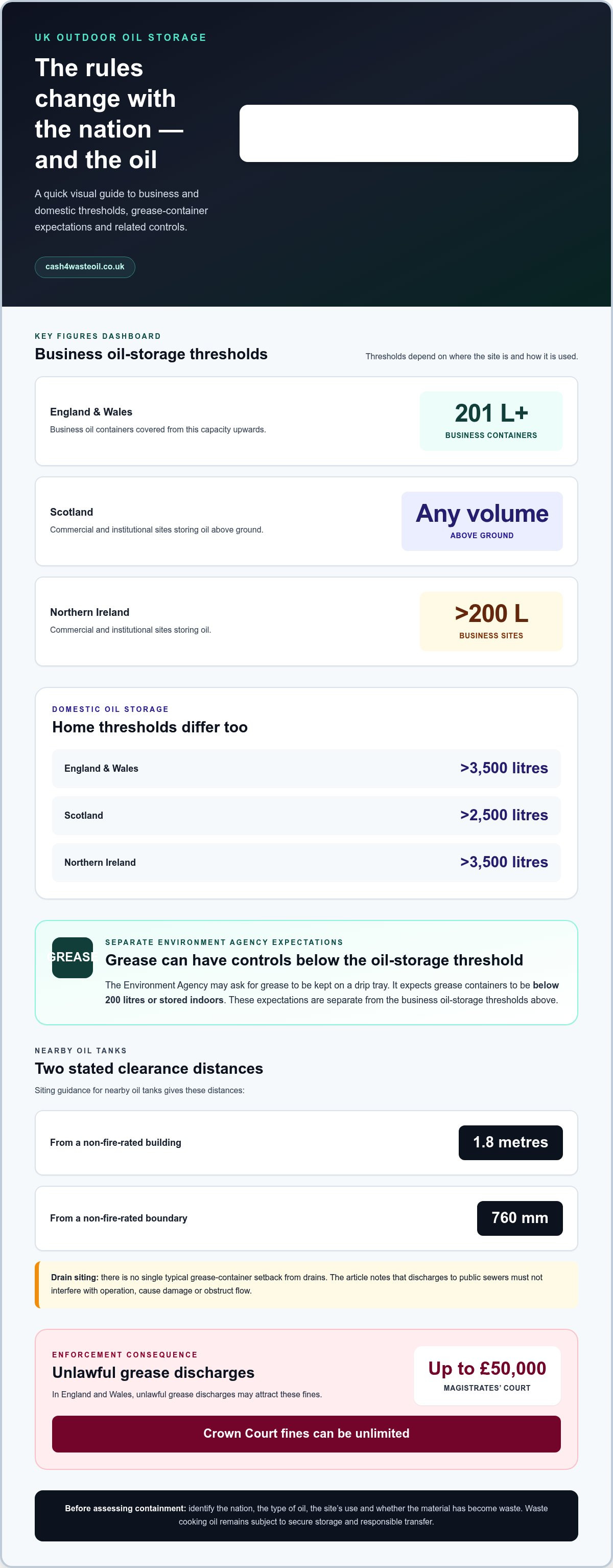
The outdoor grease container regulations in the UK depend on where your business operates and what it stores. In England and Wales, UK legislation applies oil storage controls to business containers holding 201 litres or more. The Environment Agency may ask for grease to be kept on a drip tray and expects grease containers to be below 200 litres or stored indoors.
It’s easy to assume the same threshold applies everywhere, but oil storage rules differ across the UK, and the type of oil matters. Knowing which controls apply helps you understand what your container and secondary containment need to do.
This guide explains who the rules cover, which oils they include, and practical requirements for outdoor containers, bunds and drums. It also clarifies how waste cooking oil fits into storage and waste-handling duties, helping you identify the controls relevant to your site.
Key Takeaways
- Identify which nation’s rules apply to your site, as oil storage controls and thresholds differ across the UK.
- Check whether the rules cover the oil you store, including waste cooking oil and certain other waste oils.
- Assess your container, its location and the risk of leaks when considering suitable secondary containment.
- Work out the required containment capacity based on whether you store one container or several drums.
- Understand how container design and impermeable bund construction help prevent oil escaping into the environment.
Who do oil and fuel storage controls apply to?
Outdoor grease storage is affected by oil-storage, waste and sewer rules, with requirements varying across the UK. In England and Wales, business oil containers holding 201 litres or more fall within oil storage rules, according to UK legislation.
Business and Institutional Storage Controls
Commercial and institutional controls govern how premises store oil and prevent pollution. In England, businesses storing or using oil are subject to The Control of Pollution (Oil Storage) (England) Regulations 2001, according to UK legislation. This matters to kitchens because waste cooking oil is included in business oil-storage rules, not treated as exempt merely because it is grease.
Waste duties apply as well as storage controls. Section 34 of the Environmental Protection Act 1990 requires commercial premises arranging waste collection and disposal to control storage and transfer to an authorised person, and keep controlled documentation, according to UK legislation. A Waste Transfer Note records the transfer. Keep it with the relevant waste records so the business can account for how stored oil leaves the premises.
Oil Storage Thresholds for Homes and Businesses
Thresholds help distinguish commercial storage controls from domestic oil storage. In England and Wales, businesses must comply for containers with a capacity of 201 litres or more, while domestic premises are covered when storing more than 3,500 litres. These are oil-storage thresholds; the Environment Agency’s expectations for grease containers are separate and can affect smaller containers.
Rules also vary by nation and site type. In Scotland, oil storage controls apply to commercial and institutional sites storing oil above ground in containers of any volume. In Northern Ireland, the threshold for those sites is over 200 litres. Domestic thresholds differ too: Scotland’s is more than 2,500 litres, while Northern Ireland’s is more than 3,500 litres. Check the nation and use of the premises when identifying which regime applies.
For grease specifically, the Environment Agency may ask for storage on a drip tray and expects containers to be below 200 litres or stored indoors. Outdoor placement also needs to prevent leaks reaching drains. For nearby oil tanks, siting guidance gives clearances of 1.8 metres from non-fire-rated buildings and 760 millimetres from a non-fire-rated boundary. There is no single grease-container setback from drains; Section 111 of the Water Industry Act 1991 prohibits discharges into public sewers that may interfere with operation, cause damage or obstruct flow, according to UK legislation.
Planning permission is separate from oil-storage controls: whether installation needs it depends on the proposed works and site under local planning controls. There is no single typical UK cost for a container, installation and collection; costs depend on capacity, materials, site preparation and collection frequency. Improper storage can lead to leaks, pollution and enforcement. In England and Wales, unlawful grease discharges may attract fines up to £50,000 in Magistrates’ Court, while Crown Court fines can be unlimited.
Oil types covered by the rules
Oil-storage controls cover more than fuel kept in a fixed tank. They may also apply to waste oils, including used cooking oil from commercial kitchens. For outdoor grease container regulations UK requirements, identify the oil type, its use and whether it has become waste. These details help distinguish relevant storage rules from waste-handling duties.
In England, storing waste synthetic or vegetable oils is subject to The Control of Pollution (Oil Storage) (England) Regulations 2001. Used cooking oil is vegetable oil discarded after food preparation. Once it becomes waste, it still needs secure storage and responsible transfer. Keep it identifiable and separate from other waste streams, such as engine oil, so its collection and disposal can be managed appropriately.
Mineral oils, synthetic oils and vegetable oils are separate categories, and different legal provisions may apply. In England, storing waste mineral oils is subject to the Environmental Permitting (England and Wales) Regulations 2010. That is distinct from the 2001 regulations covering waste synthetic or vegetable oils. A container holding waste mineral oil and one holding used cooking oil therefore shouldn’t automatically be treated as the same waste stream.
Agricultural fuel oil has its own regulatory route. In England, agricultural fuel oil is covered by the Water Resources (Control of Pollution) (Silage, Slurry and Agricultural Fuel Oil) Regulations 2010. Oil used for agricultural work is not the same waste stream as cooking oil from a café or hotel kitchen. Identify the oil’s original purpose and whether it has become waste before deciding which requirements apply.
Food businesses may store cooking oil alongside fat or grease from food preparation. Keep these materials contained and prevent them reaching surface-water drains or the foul sewer. Section 34 of the Environmental Protection Act 1990 requires commercial premises arranging waste collection and disposal to control waste storage and transfer, and retain controlled documentation. Clear separation and records help staff manage each waste stream correctly.
Understanding outdoor grease container regulations UK also means planning for the oil’s next step after storage. Arrange collection through an authorised waste route and retain the transfer documentation. For kitchens producing used vegetable oil, used cooking oil collection provides a practical disposal route. Keep the oil identifiable until collection, and record its movement from the premises.
In England and Wales, homes must follow oil storage rules for containers with a capacity of 3,501 litres or more. In Scotland, premises used for onward oil distribution are covered by the oil storage regulations.
Bund construction and impermeability
A bund is secondary containment that holds liquid if an oil container leaks or fails. Its walls and base must be impermeable to oil and water. This matters outdoors, where waste oil could otherwise soak into the ground or run towards a drain. Treat the bund as part of the storage system, not simply as a platform beneath the container.
Impermeability depends on the whole structure. A sound base will not contain a spill if cracks, joints or openings let liquid escape. Inspect the floor, walls and joins for damage, including pipework or other equipment that could leak within the containment area. Keep outlets closed or arranged so stored liquid cannot escape into the surrounding ground.
Choose bund materials and construction suited to the oil and site conditions. Oil and water must not pass through the base or walls. Check the structure after installation and during routine site inspections, especially after an impact, maintenance or visible deterioration. A stain, crack or damp patch may indicate a weak point that needs attention before a larger spill occurs.
Rainwater can reduce the containment space available in an outdoor bund. Keep the area clear of avoidable debris and inspect for standing liquid. If rainwater is present, do not release it where it could carry oil into a drain or onto the ground. Set a safe inspection and removal routine that preserves capacity and prevents contaminated liquid from escaping.
Positioning matters too. The bund should sit on stable ground and remain accessible for checking the container, walls and base. Protect the storage area from vehicle movement and other impacts that could damage it. Keep ancillary equipment within secondary containment when not in use, so a leak from a hose or fitting remains contained.
Rules can vary by oil type and location. In Scotland, oil containers holding more than 200 litres require secondary containment for leaks from the container and ancillary equipment. In Northern Ireland, site-specific oil storage controls also apply, so the containment arrangement must suit the stored material and premises. For domestic oil tanks, bunding requirements can depend on capacity and proximity to water sources.
After installation, keep the bund’s condition under review rather than relying on its original specification. Record inspections and repairs alongside waste oil storage records, so staff can identify recurring defects. A durable, impermeable structure helps contain leaks, but does not replace secure containers, careful handling or responsible waste transfer.
Container design standards
Container design affects whether cooking oil stays contained during routine handling and outdoor storage. Match the container to the oil, its location and how staff will fill, move and empty it. A fixed tank, portable drum and small grease vessel serve different purposes. Oil storage regulations also vary by UK nation, so distinguish a design standard from general good practice.
In England and Wales, fixed metal oil tanks made to British Standard 799-5 meet the stated design standard. Fixed oil tanks made to British Standard 5410 meet the stated design standard there too. These references concern fixed tanks, not every portable container used for waste cooking oil. Don’t treat a standard for a fixed tank as proof that a drum or grease container is suitable for its intended use.
Scotland has a specific requirement for smaller oil containers: those with a capacity of less than 200 litres must be strong enough not to burst or leak in ordinary use. That test focuses on practical performance, not simply the container’s appearance. A vessel used for regular kitchen oil storage needs to withstand normal filling, movement and handling without failing.
Inspect the container before use and during routine storage checks. Look for cracks, corrosion, damaged seams, loose fittings or a lid that no longer closes properly. Check the base and handles before moving a full drum. If a container is visibly damaged, stop using it for oil and prevent any remaining contents from escaping.
Keep closures secure between cooking shifts and use a stable, level position for outdoor storage. Place the container where staff can inspect it without moving other equipment. Avoid locations where vehicles, deliveries or discarded items could strike it. These steps help protect the vessel, but do not replace applicable oil storage regulations or secondary containment.
Capacity labels help staff identify what a container is designed to hold. Keep the stated capacity legible and avoid filling beyond it. Clearly distinguish a drum for waste oil from containers holding fresh cooking oil or other site materials. Clear identification supports safe handling and helps prevent the wrong contents entering a waste stream.
For a new installation, record the container type, intended contents and any applicable design standard in site records. This gives managers a straightforward reference during inspections or when replacing equipment. A compliant fixed-tank standard cannot establish the suitability of every outdoor grease container; assess the actual vessel, its condition and its use.
Drum containment capacity
Secondary containment must hold a spill if a drum, tank or fitting leaks. Calculate capacity from the container’s maximum contents, not the amount currently stored. In England and Wales, a bund used for oil storage must hold 110% of the container’s capacity, according to UK legislation. This requirement also matters when storing waste cooking oil outdoors.
For a single drum, use its full capacity as the basis for the calculation. A 2,500-litre container, for example, requires containment for 2,750 litres in England and Wales. The extra capacity provides room beyond the container’s stated contents. Keep the bund clear, so stored items or accumulated liquid don’t reduce the space available to contain a leak.
Multiple containers need a different calculation. For several fixed tanks, mobile bowsers or intermediate bulk containers, secondary containment must hold whichever is greater: one quarter of their combined capacity or 110% of the largest container’s capacity. A drip tray used for multiple oil drums must hold one quarter of their combined capacity. These calculations address different storage arrangements, so identify the container type before selecting containment.
Hydraulically linked containers are treated as one container. Their containment must hold 110% of their combined capacity. Separate bunds or drip trays don’t change that calculation: each must still hold at least 110% of the linked containers’ combined capacity. This prevents separate trays from being sized as though the connected vessels were independent.
Scotland uses its own stated capacity rules. For a single oil container, secondary containment must hold at least 110% of its maximum contents. For multiple containers, it must hold 110% of the largest container’s capacity or 25% of total storage capacity, whichever is greater. Don’t carry England and Wales calculations across to Scotland without applying the Scottish rule.
Before installing a drum tray or bund, list every container and its capacity, then identify whether any are hydraulically linked. Calculate the applicable capacity and confirm the containment dimensions provide that usable volume. Keep the calculation with site records, alongside information about the stored oil and any agricultural fuel oil arrangements. Requirements differ across the UK, including Northern Ireland, so apply the legislation for the nation where the premises operates.
Correct containment helps keep a leak within the storage area, but it doesn’t replace responsible waste transfer. Arrange a responsible waste oil collection to support proper handling of used cooking oil.
Cash 4 Waste Oil: Used Cooking Oil Collection
Cash 4 Waste Oil collects used cooking oil from restaurants, pubs, hotels and other commercial kitchens in London, Kent and Surrey. It’s a practical next step when your kitchen needs its waste oil collected and the transfer documented. The service includes a Waste Transfer Note, helping you keep a record of the waste transfer. Cash 4 Waste Oil also pays cash for waste oil on collection.
Keep your container and containment arrangements suitable for storing oil outdoors, and arrange collection before waste storage becomes difficult to manage. Used cooking oil collection supports responsible disposal, while the Waste Transfer Note helps with your commercial waste records.
For used cooking oil collection in London, Kent or Surrey, visit cash4wasteoil.co.uk.
Make waste oil management part of your routine
Turn the UK’s outdoor grease container regulations into a practical site routine. Assign responsibility for checking storage, keeping waste records together and arranging collection before containers become difficult to manage. A clear process helps staff handle used oil consistently, even during busy service periods, and makes waste management easier to maintain as kitchen operations change.
For commercial kitchens, Cash 4 Waste Oil provides used cooking oil collection, Waste Transfer Notes and cash payments for waste oil. These offerings support the next stage of managing used oil after it has been stored. Keep the transfer documentation with your business records so the movement of waste is accounted for.
Make your next step straightforward. Contact Cash 4 Waste Oil to discuss used cooking oil collection for your commercial kitchen. With a clear routine and suitable waste arrangements, you can keep your operation organised and move forward with confidence.
Frequently Asked Questions
Are outdoor grease containers subject to waste duty of care rules in England, Scotland, Wales and Northern Ireland?
Commercial waste-handling duties apply, but the specific rules differ across the UK. In England and Wales, Section 34 of the Environmental Protection Act 1990 requires businesses arranging waste collection and disposal to manage storage and transfer to an authorised person, and retain controlled documentation, according to UK legislation. Requirements for storing waste, including oils, can vary depending on the circumstances. Northern Ireland has a Paragraph 12 exemption for certain secure waste-oil storage.
What requirements apply to storing used cooking oil and grease outdoors at commercial premises?
Keep used cooking oil in a secure container and prevent leaks reaching the ground or drains. The Environment Agency may ask for grease to be stored on a drip tray and expects grease containers to be below 200 litres or stored indoors. Keep the storage area accessible for inspection, and separate cooking oil from other waste streams. Record waste movements and retain the relevant transfer documentation for your premises.
Do outdoor grease containers need bunding, leak-proof construction or secondary containment in the UK?
Requirements depend on the container, oil and nation. In England and Wales, oil-storage bunds must hold 110% of a container’s capacity, according to UK legislation. Scotland requires secondary containment for oil containers holding more than 200 litres, including ancillary equipment. For grease, use a drip tray where requested by the Environment Agency. Keep containment impermeable and inspect it for cracks, damaged joints or other escape routes.
What fire safety and environmental rules apply to outdoor used cooking oil containers?
Environmental controls focus on preventing oil escaping into soil, drains or water. Employers also have duties under the Control of Substances Hazardous to Health Regulations 2002 concerning equipment and procedures for incidents involving hazardous substances. Keep an appropriate spill kit available and train staff to use it. Fire precautions are separate from spill containment, so include the container’s position and contents in your site’s fire-safety arrangements.
How should businesses arrange collection and disposal of waste cooking oil and grease in the UK?
Use an authorised waste route, keep the oil separate from engine or industrial oils, and retain transfer records. Cash 4 Waste Oil collects used cooking oil, vegetable oil and animal fats from commercial kitchens, and provides a Waste Transfer Note after every collection. It serves London, Greater London, Kent, Surrey, Birmingham, Coventry, Leicester, Wolverhampton, Leicestershire, Derbyshire, Staffordshire, Warwickshire, Northamptonshire, Oxfordshire and Worcestershire. Cash payments for waste oil are also offered.