Professional Waste Oil Collection in Soho | Fast & Compliant
It's 5:00 PM on a Friday in a packed Soho kitchen, and those bulky drums of used fryer oil are obstructing the narrowest thoroughfare in the building. You're juggling the pressure of a full house with the constant worry of Westminster Council's strict "Bags Off Street" enforcement and the looming threat of an unlimited fine for a single drainage slip-up. Finding a reliable partner for waste oil collection Soho can feel like just another chore on an already overflowing list, especially when you're battling ULEZ charges and tight West End loading windows.
We understand that for a busy W1 restaurant, efficiency isn't a luxury; it's a necessity. This article reveals how you can transform your used cooking oil into immediate on-site cash whilst remaining fully compliant with the 2026 Digital Waste Tracking regulations. We'll outline how to get fast, dependable collections that fit around your service hours, providing you with the essential Waste Transfer Notes required for your next health and safety audit. Discover how a professional approach to oil disposal improves your kitchen margins and keeps your operation running within the law.
Key Takeaways
- Turn your used cooking oil into immediate revenue with cash paid per litre on-site, improving your kitchen's bottom line.
- Guarantee 100% legal compliance by ensuring you receive a valid Waste Transfer Note at the exact point of collection.
- Optimise your logistics with a professional waste oil collection Soho service that handles West End loading restrictions and ULEZ costs.
- Clear valuable storage space in cramped West End kitchens by arranging fast, reliable pickups that respect your service schedule.
- Contribute to the circular economy by recycling waste fryer oil into sustainable biodiesel, reducing the carbon footprint of the Soho hospitality sector.
Professional Waste Cooking Oil Collection in Soho & the West End
Soho's hospitality sector operates at a higher intensity than almost anywhere else in the UK. With hundreds of kitchens packed into a square mile, the volume of used cooking oil produced is staggering. A professional waste oil collection Soho service isn't just a convenience; it's a vital part of your operational infrastructure. We provide a streamlined "collect, pay, recycle" model that ensures your kitchen stays compliant while turning a waste product into immediate revenue.
Why W1 Kitchens Require Specialised Waste Management
Space is the primary currency in the West End. Finding the right partner for waste oil collection Soho means choosing a team that understands the logistical nightmare of W1's narrow streets. Most kitchens on Wardour Street or Old Compton Street operate out of cramped basement levels where storing multiple 60-litre drums isn't feasible. Frequent, reliable collections prevent your workspace from becoming a hazard.
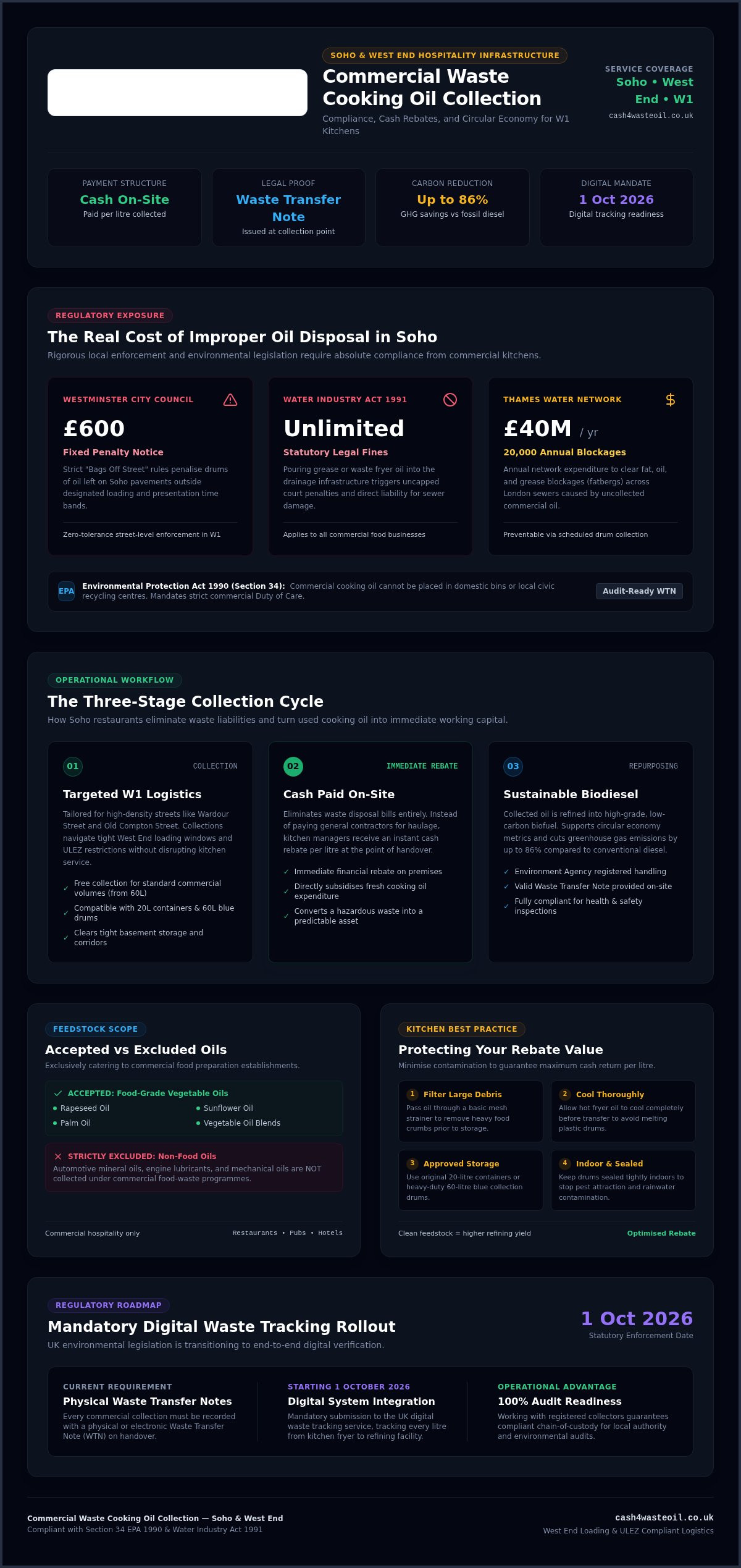
Beyond space, there's the critical issue of sewer health. Thames Water spends approximately £40 million every year clearing 20,000 fat, oil, and grease blockages. Professional collection prevents these "fatbergs" from forming, protecting your business from the unlimited fines associated with the Water Industry Act 1991. Regular pickups also eliminate the spills and odours that attract pests, maintaining the high hygiene standards expected in Soho.
Commercial vs Residential: Knowing the Difference
Our service is strictly for commercial entities: restaurants, pubs, hotels, and catering units. You cannot dispose of commercial waste oil via domestic bins or local recycling centres; doing so is a breach of your Duty of Care under Section 34 of the Environmental Protection Act 1990. We exclusively handle food-grade vegetable oils, such as:
- Rapeseed oil
- Sunflower oil
- Palm oil
- Vegetable oil blends
It's essential to distinguish these from automotive mineral oils, which we don't collect. Once we've gathered your used oil, it begins its conversion into sustainable biodiesel. This process turns your kitchen waste into a low-carbon fuel that delivers up to 86% greenhouse gas savings compared to fossil diesel. By choosing an Environment Agency registered collector, you ensure every drop is tracked digitally and repurposed legally, meeting the requirements of the mandatory Digital Waste Tracking rollout starting 1 October 2026.
Maximising Your Rebate: Cash for Used Fryer Oil
Waste cooking oil isn't just a byproduct of a busy shift; it's a liquid asset. For independent Soho cafes and West End restaurants, every penny added to the bottom line matters. The days of paying for waste removal are over. A professional waste oil collection Soho service flips the script by paying you for a material you used to treat as rubbish. We provide instant cash payments on-site, giving your kitchen an immediate financial boost exactly when you need it.
Recycling vs Improper Disposal: A Financial Comparison
The financial logic is simple. Paying a general waste contractor to haul away oil is an unnecessary drain on your resources. Even worse, improper disposal carries catastrophic risks. Westminster City Council strictly enforces waste presentation rules; leaving drums on a Soho pavement outside of designated time bands can lead to a £600 Fixed Penalty Notice. If oil enters the sewerage system, Thames Water can pursue unlimited fines under the Water Industry Act 1991.
Professional collection is free for standard commercial volumes, typically starting from 60 litres. Instead of a bill, you receive a rebate based on the volume and quality of your used rapeseed, sunflower, or vegetable oils. This rebate serves as a direct boost to kitchen margins by effectively subsidising the cost of your fresh oil supply. It's a pragmatic business decision that replaces a legal liability with a predictable revenue stream.
How to Prepare Your Oil for Maximum Value
To ensure you get the best possible return, you need to maintain the quality of your feedstock. High moisture content or heavy food debris can reduce the value of your oil during the refining process. Follow these simple steps to protect your rebate:
- Filter your oil through a basic mesh strainer to remove large food particles before storage.
- Allow the oil to cool completely before transferring it to avoid melting plastic containers.
- Store the waste in original 20-litre containers or secure 60-litre blue drums provided by your collector.
- Keep all containers sealed and stored indoors to prevent rainwater contamination and pest issues.
While the financial gain is significant, you must never compromise on documentation. Every transaction must comply with UK waste transfer note requirements to ensure your business is protected during local authority inspections. For a detailed look at how to navigate the local market this year, check our guide on how to Get paid for used cooking oil in London. If you're ready to clear your storage space and improve your margins, request a collection quote today to see how much your waste is worth.
Staying Compliant: Waste Transfer Notes and UK Regulations
Compliance in Soho is a non-negotiable aspect of running a commercial kitchen. If you can't prove where your oil went, you're legally liable for its eventual disposal. A professional waste oil collection Soho service provides the necessary paper trail to satisfy Westminster City Council inspectors. These officers frequently conduct spot checks across the West End. Failing to produce a valid Waste Transfer Note (WTN) on demand results in a £300 Fixed Penalty Notice, while repeated failures can lead to unlimited fines in Magistrates' Court.
We ensure every collection meets the highest Environment Agency standards. This includes strict adherence to the Food Standards Agency waste oil guidance, which mandates that only authorised carriers remove your waste. Unlicensed "white van" collectors might offer cash, but they often lack the credentials to provide a legal WTN. If they fly-tip your oil in a Soho alleyway, the legal trail leads directly back to your restaurant door under "Duty of Care" legislation.
The Anatomy of a Legal Waste Transfer Note
A valid WTN is more than just a receipt; it's a statutory document. It must contain specific data points, including your Standard Industrial Classification (SIC) code and the European Waste Catalogue (EWC) code for edible oil, which is 20 01 25. The note also requires a precise description of the waste and the signatures of both the producer and the carrier. You must retain these records for a minimum of two years. To stay ahead of local enforcement, review our Commercial kitchen oil disposal compliance checklist for 2026.
Environment Agency Licensing Explained
Always verify that your collector is an "Upper Tier" Waste Carrier registered with the Environment Agency. This registration confirms they're legally permitted to transport and dispose of commercial waste. You can check a collector's status on the public register using their registration number. Dealing with an Upper Tier carrier protects your business from "duty of care" prosecutions. It ensures that your waste oil is handled by professionals who process it into biodiesel rather than dumping it into London's sewers. From 1 October 2026, this process becomes even more rigorous with the mandatory Digital Waste Tracking rollout, requiring API-compatible documentation for every litre collected in Soho.
Soho Logistics: Collection Schedules That Work for the West End
Operating a restaurant on Old Compton Street or Dean Street requires precision timing. Between the pedestrianised evening zones and the strict Westminster Council loading windows, there's little room for error. A professional waste oil collection Soho partner must do more than just show up; they must navigate the most congested streets in London without disrupting your service. We've built our logistics around these West End constraints, ensuring your used oil is removed quickly and quietly.
Transporting waste in Central London is expensive. Between the £12.50 daily ULEZ charge and the £15.00 Congestion Charge, many generic waste carriers pass these overheads directly to the business owner. We absorb these costs entirely. By utilising a compliant fleet designed for the city centre, we remove the financial friction of waste management. You get a reliable service that respects both your budget and the environment, whilst allowing your chefs to focus on the pass rather than the pavement.
Accessing Narrow Streets and Pedestrianised Zones
Our vehicles are specifically chosen for their ability to navigate Soho's narrowest thoroughfares. Whether your kitchen is tucked away on Wardour Street or located in a basement on Greek Street, our drivers coordinate directly with your staff for a rapid "in-and-out" collection. This prioritises efficiency and keeps you compliant with the 30-minute waste presentation rules strictly enforced by Westminster City Council.
Speed is a core part of our identity. While we often highlight our Emergency waste oil collection Kent as a benchmark for rapid response, we bring that same level of urgency to the West End. We offer same-day or emergency pickups for high-volume kitchens that find themselves with a storage crisis during a busy weekend shift or following a major event.
Tailored Collection Frequencies
Every Soho venue has a different rhythm. A small boutique cafe might only need a monthly pickup, whereas a high-volume brasserie requires weekly visits to clear its 60-litre drums. We tailor our schedules to your specific footfall, offering on-call collections during peak periods like the Christmas service or West End festivals. This "Zero Hassle" approach means no administrative burden and no disruption to your front-of-house experience. Ready to streamline your back-of-house operations? Book your Soho oil collection today and let us handle the logistics of the West End for you.
Recycling Soho’s Oil into Sustainable Biodiesel
The journey from your fryer to the fuel tank is a remarkable feat of chemical engineering. Once we complete your waste oil collection Soho, the raw feedstock is transported to a specialised UK refinery. Here, it undergoes transesterification; this chemical process removes glycerine and impurities to create Fatty Acid Methyl Ester (FAME). This high-quality biodiesel is then blended with standard fuel, powering everything from public transport to heavy freight across the country. It's a seamless transition that ensures your kitchen waste never sees a landfill or a sewer. The science of transesterification is simple but effective. By reacting the oil with an alcohol, we separate the valuable esters from the glycerine. The resulting fuel is cleaner, more sustainable, and perfectly compatible with modern diesel engines.
Environmental Benefits for Your Brand
Modern diners in the West End are increasingly conscious of the ecological impact of their favourite restaurants. By partnering with a registered carrier, you aren't just getting rid of waste; you're actively reducing the carbon footprint of the London hospitality industry. Displaying your commitment to recycling isn't just about ethics; it's good for business. Customers appreciate transparency. When you can prove that your waste oil is being repurposed into low-carbon fuel, you build trust and loyalty amongst a demographic that values environmental responsibility. You can use your collection records and Waste Transfer Notes to bolster your restaurant's "Green" credentials during marketing or sustainability audits. Biodiesel produced from used cooking oil delivers between 82% and 86% greenhouse gas savings compared to conventional fossil diesel. For more on how to align your kitchen with modern environmental standards, read our Sustainable waste oil disposal guide.
Supporting Local UK Industry
Choosing a domestic recycling route strengthens the UK's regional bio-fuel supply chain and enhances national energy security. Instead of relying on imported oils or virgin crops that contribute to deforestation, we recover energy from a product that's already reached its culinary end of life. This is the circular economy in action. It turns a logistical burden into a renewable resource that stays within the UK economy, supporting local jobs and reducing our reliance on global fossil fuel markets. It's a pragmatic solution that benefits your business, the local community, and the planet. Every litre we collect is a step toward a more resilient and sustainable London. Don't let your used oil go to waste when it could be powering the future. Join the circular economy in Soho today by scheduling your next collection with a team that values efficiency as much as you do.
Secure Your Soho Kitchen's Compliance and Profitability Today
Managing a high-pressure kitchen in the West End requires a partner who understands the unique logistical and regulatory hurdles of W1. You've seen how a professional waste oil collection Soho service does more than just clear floor space; it protects your business from heavy fines while providing a direct boost to your margins. By choosing an Environment Agency registered carrier, you ensure that every litre of used oil is tracked digitally and repurposed into sustainable biodiesel.
Don't let used cooking oil become a storage headache or a compliance risk. We provide the essential Waste Transfer Note at the point of collection, giving you total peace of mind for your next health and safety audit. With cash paid on the spot and a team that navigates Soho’s loading windows with ease, there's no reason to settle for less than a professional service.
Get a Free Soho Collection Quote & Instant Cash Payment and start turning your kitchen waste into a reliable revenue stream today. We're ready to help your business thrive in the heart of London.
Frequently Asked Questions
Is waste oil collection in Soho really free?
Yes, our collection service is entirely free for all commercial kitchens in the West End. We don't charge for the pickup, the logistics, or the provision of legal documentation. Instead of a bill, you receive a payment for the oil we remove. This model allows you to clear valuable storage space and meet your environmental obligations without any administrative or operational costs.
How much cash will I receive for my used cooking oil?
We pay cash on the spot based on the total volume and quality of the oil collected during the visit. Our drivers measure the oil on-site and provide immediate compensation per litre. The exact amount depends on current market rates for biodiesel feedstock and the cleanliness of your oil. Properly filtered oil with low moisture content always attracts the best possible rebate for your kitchen.
What happens if I don’t have a Waste Transfer Note for my Soho restaurant?
Operating without a Waste Transfer Note (WTN) is a serious breach of UK waste regulations. Westminster City Council inspectors can issue a £300 Fixed Penalty Notice on the spot if you cannot produce these records. We provide a valid, Environment Agency compliant WTN at every collection. This document protects you from unlimited fines and proves you've fulfilled your legal Duty of Care.
Can you collect oil from basements or difficult-to-reach West End kitchens?
Yes, we're experts at navigating the logistical hurdles of Soho's historic buildings. Our team is equipped to handle collections from basement kitchens, narrow cellars, and premises with restricted access. We coordinate directly with your kitchen porters to ensure a fast, "in-and-out" service. This approach minimises disruption to your prep shift and ensures we stay within the strict West End loading windows.
Do you provide the storage drums for the waste oil?
We provide secure, leak-proof 60-litre blue drums to our regular clients to help organise back-of-house storage. These drums are specifically chosen for their small footprint, making them ideal for cramped Soho kitchens. Alternatively, we can collect oil stored in your original 20-litre containers. Our goal is to provide a flexible storage solution that prevents spills and maintains high hygiene standards in your workspace.
What types of cooking oil do you collect in Soho?
We collect all food-grade vegetable oils, including rapeseed, sunflower, corn, and palm oil. Our facility is designed to process these into sustainable biodiesel. Please ensure the oil isn't contaminated with chemicals or water. We do not collect animal fats, lard, or mineral oils. If you use a blend of vegetable oils in your fryers, we can collect this without any issues.
How quickly can you arrange a collection in the W1 postcode?
We pride ourselves on a two-hour response time for all initial enquiries. For a standard waste oil collection Soho, we can typically have a driver at your door within 24 to 48 hours. We also offer emergency response options for high-volume venues that experience an unexpected surge in waste during busy weekend shifts or major West End festivals and events.
Are you fully insured to operate in commercial West End premises?
Yes, we maintain comprehensive public and employer's liability insurance tailored for the commercial hospitality sector. As an Environment Agency registered waste carrier, we follow rigorous safety protocols during every collection. This insurance coverage ensures that your business is fully protected against any accidental damage or incidents whilst our team is operating on your premises, providing complete peace of mind for restaurant owners.