Restaurant Oil Disposal Regulations Kent: The 2026 Compliance Guide
Handing your used cooking oil to an unlicensed collector isn't just a shortcut; it's a gamble that could cost your business an unlimited fine. With the rollout of the mandatory Digital Waste Tracking Service in October 2026, the margin for error with restaurant oil disposal regulations Kent has disappeared. We understand that keeping up with Environment Agency audits and Kent County Council inspections feels like a full-time job when you're already trying to run a profitable kitchen.
You shouldn't have to choose between operational efficiency and legal compliance. This guide breaks down the complex 2026 requirements into a manageable checklist, ensuring you have the correct Waste Transfer Notes and storage solutions to satisfy any inspector. We'll show you how to protect your business from the £300 fixed penalty notices for paperwork errors and explain how a reliable, licensed collection partner can actually pay you for your waste. From understanding EWC codes to mastering the 110% storage rule, you're about to turn a messy compliance headache into a streamlined, profitable part of your circular economy strategy.
Key Takeaways
- Understand your Section 34 Duty of Care to ensure all used cooking oil is handled only by Environment Agency-registered carriers to avoid unlimited fines.
- Learn how to navigate restaurant oil disposal regulations Kent to remain compliant with the mandatory digital waste tracking systems arriving in 2026.
- Secure your kitchen by implementing secondary containment for oil storage, a legal requirement for larger volumes that prevents environmental contamination.
- Maintain a robust evidence trail by retaining Waste Transfer Notes for at least two years to provide immediate proof of compliance during local council inspections.
- Discover how to transform a waste expense into a revenue stream by choosing a licensed partner that provides cash payments for your used vegetable oil.
Understanding Restaurant Oil Disposal Regulations in Kent (2026)
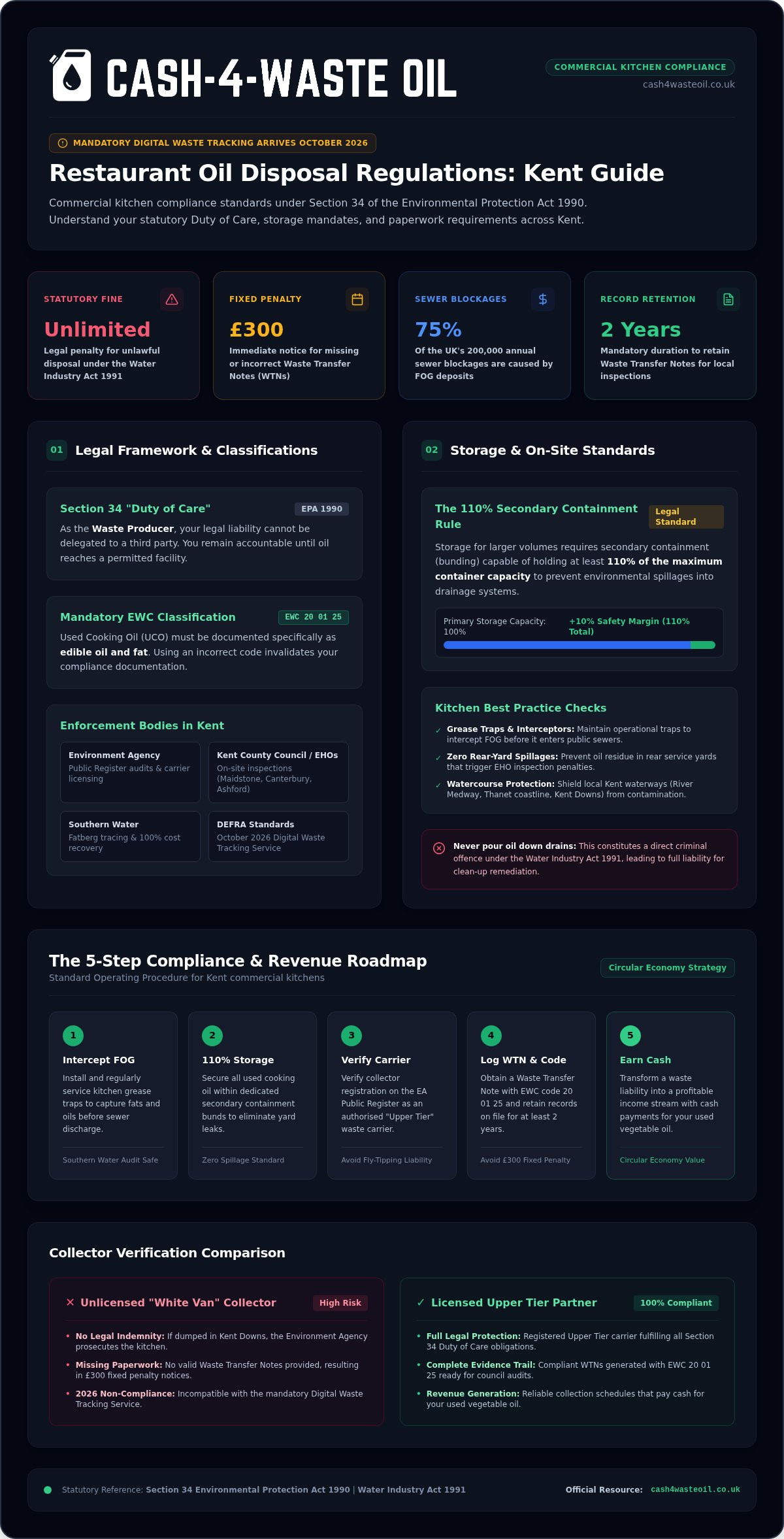
Operating a commercial kitchen in Maidstone, Canterbury, or Tunbridge Wells comes with heavy legal responsibilities. Under Section 34 of the Environmental Protection Act, you have a permanent "Duty of Care" for your waste. By 2026, the introduction of mandatory digital tracking has made restaurant oil disposal regulations Kent more transparent for regulators and more demanding for owners. You can't simply treat used oil as a nuisance; it's a controlled substance. Pouring it down the drain is a criminal offence under the Water Industry Act 1991, potentially leading to unlimited fines and a criminal record.
The Environmental Impact on Kent’s Waterways
Kent's waterways, from the River Medway to the Thanet coastline, suffer when kitchens fail to manage fats, oils, and grease (FOG). These substances cause roughly 75% of the 200,000 annual sewer blockages in the UK. Southern Water now uses proactive audits to trace fatbergs back to the source. Modern 2026 standards focus on total traceability, requiring you to intercept waste before it leaves your site. Installing and maintaining grease traps and interceptors is no longer optional for those wanting to avoid the massive cleanup costs water companies now legally recover from offending businesses. If your kitchen contributes to a blockage, you're liable for 100% of the remediation fees.
Who is Responsible for Compliance?
As the "Waste Producer", the legal buck stops with you. You can't delegate this responsibility to a third party. If an unlicensed collector illegally dumps your oil, the Environment Agency will prosecute your business, not just the carrier. Verification is key. You must ensure your partner is a registered Upper Tier carrier and provides a Waste Transfer Note for every collection. In 2026, failing to produce these documents for a Kent County Council inspector results in an immediate £300 fixed penalty notice. It's a simple choice: maintain a clear paper trail or face the financial and reputational damage of prosecution. Always check the Environment Agency Public Register before handing over your waste to ensure your collector's credentials are current.
The Legal Framework: Environment Agency and DEFRA Requirements
Section 34 of the Environmental Protection Act 1990 remains the backbone of UK waste law. For your kitchen, this means you must ensure all waste oil is handled safely and legally until it reaches a permitted facility. Under 2026 standards, Used Cooking Oil (UCO) is classified as controlled commercial waste, specifically under EWC code 20 01 25. This classification is vital; using the wrong code on your paperwork invalidates your compliance. The DEFRA cooking oil waste guidance has recently tightened to reflect the 2026 Digital Waste Tracking Service, placing more pressure on Kent businesses to prove their oil didn't end up in a landfill or a local stream. Adhering to restaurant oil disposal regulations Kent isn't just about good practice; it's a statutory requirement that protects your business from prosecution.
Verify Your Waste Carrier’s Licence
Handing your oil to a "white van" collector who offers a quick pickup without paperwork is a high-risk move. If that oil is fly-tipped in the Kent Downs, the Environment Agency will trace it back to your kitchen. You must check the EA Public Register of Waste Carriers, Brokers, and Dealers before any collection takes place. Simply enter the company name or registration number to confirm they are an "Upper Tier" carrier. A Licensed Waste Carrier is an entity authorised by the Environment Agency to transport controlled waste, providing the legal indemnity required for businesses to satisfy their 2026 Duty of Care obligations. Without this verification, you remain legally liable for any environmental damage caused by the collector. Following GOV.UK Waste Transfer Note guidance ensures you have the necessary proof if an officer visits your premises.
National vs Local Enforcement in Kent
Enforcement in the Garden of England is a collaborative effort. Environment Agency officers often work alongside Environmental Health Officers (EHOs) from councils in Maidstone, Ashford, and Canterbury. They look for specific triggers during routine inspections. These include evidence of grease spillages in rear yards, a lack of secondary containment for oil drums, or a missing folder of Waste Transfer Notes. If your oil storage is visible from the street or smells, you're more likely to face a spot check. Avoid these risks by partnering with a licensed waste oil collection service that handles the legal heavy lifting for you. This proactive approach keeps your records clean and your kitchen running without the threat of unexpected legal action. By ensuring every drop of oil is tracked, you satisfy both national restaurant oil disposal regulations Kent and local trade waste policies.
The Mandatory Waste Transfer Note (WTN): Your Proof of Compliance
A Waste Transfer Note (WTN) is more than just a receipt; it's your only legal shield against prosecution. This document tracks the journey of your waste from your kitchen to its final processing point. Under 2026 restaurant oil disposal regulations Kent, the government has transitioned toward a mandatory digital tracking system to eliminate paper fraud. Whether you use a digital app or a physical form, every transfer of used cooking oil must be recorded. This paperwork ensures that everyone involved in the chain takes responsibility for the waste. If you can't produce a valid WTN, the law assumes you've disposed of the oil illegally.
For a WTN to be legally valid in 2026, it must contain specific data points. You'll need the correct European Waste Catalogue (EWC) code, which is 20 01 25 for edible oil. It must also state the exact quantity in litres, the date of transfer, and the full address of both the producer and the carrier. Both parties must sign the document to confirm the transfer. Following Environment Agency oil storage regulations ensures your containers are compliant, but the WTN is what proves you've emptied them legally. You're required by law to retain these records for a minimum of two years. Keep them organised in a dedicated folder or a secure digital drive for immediate access.
What Happens During a Council Inspection?
Inspectors from Kent's local authorities, such as those in Ashford, Canterbury, or Medway, won't just check your kitchen's cleanliness. They'll ask to see "The Log" of your waste transfers. They're looking for a consistent history of collections that matches your oil usage. A simple credit card receipt or a handwritten note from a driver isn't a legal substitute for a proper WTN. Failing to produce these documents upon request can lead to an immediate fixed penalty notice. It's an avoidable expense that can damage your business's reputation and lead to more frequent, intrusive audits from the Environment Agency.
The Circular Economy Audit Trail
Your WTN is also a badge of sustainability. It provides a transparent audit trail showing that your waste oil was recycled into high-grade biodiesel rather than being dumped. This paperwork is the cornerstone of sustainable waste oil disposal, proving your kitchen supports the UK's renewable energy goals. You can use these compliance records to bolster your restaurant’s "green" credentials in marketing materials. Customers in Kent increasingly value businesses that can prove their commitment to the circular economy. By maintaining perfect records, you turn a mandatory legal burden into a powerful tool for building trust with your local community.
Practical Steps for Compliant Oil Storage and Disposal in Kent
Compliance starts with how you handle the drum, not just the paperwork. Many Kent business owners mistakenly follow advice meant for households, such as taking waste to a local recycling centre. For a commercial kitchen, this is a direct violation of restaurant oil disposal regulations Kent. You must have a professional collection service in place to manage your vegetable oil waste. Proper storage prevents leaks, eliminates foul odours, and reduces the risk of fire in your prep areas. By setting a regular collection schedule, you avoid the hazards of overflowing drums that attract pests and create slip risks for your staff.
Safe Storage and Bunding Requirements
Choosing the right container is your first step toward a safer kitchen. Most Kentish pubs and restaurants use 60-litre or 120-litre blue drums, whilst high-volume sites may require 1,000-litre Intermediate Bulk Containers (IBCs). If you store more than 200 litres of oil on-site, the law requires "secondary containment," commonly known as a bund. This area must be able to hold 110% of the largest container's capacity. If you store your oil outside, ensure the area is secure. Kent has seen a rise in used cooking oil theft; syndicates target unsecured drums to sell the waste to unlicensed processors. A locked, bunded storage area protects your assets and your legal standing.
Avoiding Drain Blockages and Fines
Grease traps are a vital component of your FOG (Fats, Oils, and Grease) management, but they aren't a substitute for oil collection. You must never pour liquid oil into your grease trap; its purpose is to catch trace amounts from washing up. A common mistake is using chemical "degreasers" or hot water to flush oil down the sink. These chemicals don't dissolve the oil; they simply move it further down the Kentish sewage network where it cools and solidifies into fatbergs. Southern Water uses CCTV to trace these blockages back to specific commercial drains, leading to heavy remediation costs for the business owner. If you find your storage is at capacity and a spill is imminent, you should arrange an emergency waste oil collection Kent to clear the backlog safely.
Managing your waste shouldn't be a struggle. We help Kentish kitchens stay compliant whilst putting money back in their pockets. Book your licensed waste oil collection today to ensure your kitchen meets every 2026 regulatory standard.
Choosing a Licensed Partner for Waste Oil Collection in Kent
Navigating restaurant oil disposal regulations Kent shouldn't feel like a barrier to your kitchen's productivity. Many national providers charge hefty admin fees or take weeks to process rebates. We've built a service that treats compliance as a baseline, not a premium feature. Cash 4 Waste Oil provides a local, reliable solution for pubs, cafes, and restaurants across the county. Whether you're operating a busy bistro in Dartford and Sevenoaks or a seaside chippy in Dover and Thanet, we ensure your waste is handled legally whilst providing an immediate financial return. We don't just collect oil; we act as a local partner that understands the fast-paced nature of the Kentish hospitality sector.
The Cash 4 Waste Oil Advantage
Our model is built on transparency and efficiency. We don't hide behind "documentation charges" or administrative fees for your mandatory Waste Transfer Notes. Every collection we perform is free of charge. We provide "Cash on the Spot" based on current market rates for biodiesel feedstock, turning a standard waste management task into a reliable revenue stream. Our drivers are fully licensed waste carriers, and our Environment Agency registration is always available for your records. We've tailored our scheduling to suit the industry. We organise our routes to avoid your peak service times, ensuring our presence never disrupts your front-of-house operations or kitchen flow.
Getting Started with Your First Collection
Setting up your first pickup is designed to be a zero-hassle process. You don't need to fill out lengthy contracts or wait for head office approval. You can book a collection in under two minutes via WhatsApp or a quick phone call. When our professional driver arrives, they'll verify the oil quality, measure the volume, and pay you immediately. You'll receive your legal Waste Transfer Note on-site, fulfilling your Duty of Care requirements for the next two years. We take the entire burden of documentation off your shoulders, keeping your compliance folder audit-ready for any surprise visits from local Environmental Health Officers. We convert your used vegetable oil into high-quality biodiesel to support the UK energy grid and reduce lifecycle greenhouse gas emissions.
By choosing a partner that prioritises both your profit and your legal safety, you can focus on what matters most: your food and your customers. Our service ensures you stay ahead of the 2026 digital tracking requirements without adding a single minute of extra work to your day. Let us handle the logistics whilst you reap the rewards of a cleaner, more compliant commercial kitchen.
Securing Your Kitchen's Future in 2026
Staying ahead of restaurant oil disposal regulations Kent doesn't have to be a logistical burden. By mastering your Section 34 Duty of Care and maintaining a strict log of Waste Transfer Notes, you protect your commercial kitchen from unlimited fines and environmental prosecution. The transition to digital tracking in 2026 simply means that transparency is now the industry standard. You've seen how to secure your storage with secondary containment and why verifying your carrier's credentials is non-negotiable. Now it's time to turn that compliance into a commercial advantage.
As an Environment Agency Registered collector, we provide a legal Waste Transfer Note with every visit and pay cash on the spot for your used vegetable oil. This ensures your kitchen remains audit-ready whilst converting a waste expense into a small revenue stream. Book your free Kent oil collection and get paid cash today to streamline your operations and support the local circular economy. Your kitchen is ready for the 2026 standards; let's make it more profitable too.
Frequently Asked Questions
What are the legal requirements for waste oil disposal in the UK for 2026?
From 1 October 2026, the Digital Waste Tracking Service (DWTS) becomes mandatory for all waste receiving sites in England. You must ensure your used cooking oil is collected by an Environment Agency registered carrier and that every transfer is recorded digitally or on a valid Waste Transfer Note. This system replaces traditional paper logs to ensure 100% traceability. Failing to follow these updated restaurant oil disposal regulations Kent can lead to unlimited fines under the Environmental Protection Act.
Is it illegal to pour cooking oil down a commercial drain in Kent?
Yes, it's a criminal offence under Section 111 of the Water Industry Act 1991 to discharge fats, oils, and grease into the public sewer. Southern Water and Thames Water actively monitor the Kentish network for blockages using CCTV. If they trace a fatberg back to your kitchen, you face unlimited fines and potential imprisonment for up to two years. You're also liable for the full cost of clearing the sewer and any property remediation.
How long must I keep my Waste Transfer Notes for my Kent restaurant?
You're legally required to retain all Waste Transfer Notes for a minimum of two years. These documents serve as your primary proof of compliance during inspections by Kent County Council or local Environmental Health Officers. In 2026, these records will increasingly transition to digital formats via the DEFRA tracking service. Keeping these files organised ensures you can provide immediate evidence of your Duty of Care during a routine audit or spot check.
Do I need a special licence to store waste oil on my premises?
You don't need a specific licence to store your own waste oil, but you must follow strict storage regulations. If you store more than 200 litres of used cooking oil, you must use secondary containment, such as a bund, that holds at least 110% of the largest container's capacity. Containers must be strong enough to prevent leaks and kept in a secure area to prevent theft or environmental contamination in your local Kent community.
Can I get paid for my used cooking oil in Kent?
Yes, you can turn your waste into a revenue stream by using a licensed collection partner. Cash 4 Waste Oil provides cash payments on the spot for used vegetable oils collected from commercial kitchens across Kent. This service is free and includes the provision of mandatory Waste Transfer Notes for every pickup. It's a pragmatic way to satisfy restaurant oil disposal regulations Kent whilst recouping some of the costs associated with your kitchen's high-volume oil usage.
What is the EWC code for used cooking oil in a commercial kitchen?
The correct European Waste Catalogue (EWC) code for used edible oil and fat is 20 01 25. It's vital to ensure this specific code appears on all your Waste Transfer Notes. Using the wrong code, such as those meant for grease trap waste (19 08 09), invalidates your compliance and can result in a £300 fixed penalty notice. Accurate classification is a core requirement of the 2026 digital waste tracking system to ensure waste remains traceable.
What happens if I use an unlicensed waste oil collector?
Using an unlicensed collector is a breach of your legal Duty of Care. If the collector fly-tips your oil or disposes of it illegally, the Environment Agency will prosecute your restaurant as the original waste producer. You face unlimited fines and significant reputational damage. Always verify that your collector appears on the Environment Agency Public Register as an Upper Tier carrier before handing over any containers or signing any documentation at your premises.
Are there specific Kent council rules for grease trap maintenance?
While Kent County Council sets broad waste policies, individual district and borough councils in areas like Canterbury and Maidstone enforce specific grease trap standards through Environmental Health inspections. Your drainage must comply with Building Regulations Document H, which requires grease separators to meet BS EN 1825 standards. EHOs will check your maintenance logs to ensure your traps are regularly emptied by licensed professionals and aren't causing a nuisance to the public sewer network.