Restaurant Oil Recycling Service: The 2026 Guide to Compliance and Cash Rebates
Why are you treating your used cooking oil as a costly waste product when it is actually a liquid asset? For many commercial kitchens, managing old fat is a constant source of frustration. You have likely dealt with national contractors who miss scheduled collections, leaving you with overflowing drums and a messy yard. Worse still, the confusion surrounding Environment Agency paperwork and Waste Transfer Notes can leave your business vulnerable to heavy fines. You deserve a restaurant oil recycling service that respects your time and your bottom line.
We understand that a busy kitchen doesn't have time for unreliable drivers or complex regulatory jargon. You need a clean, predictable solution that turns a messy chore into a profit centre. This 2026 guide reveals exactly how to streamline your disposal process to ensure total legal compliance whilst securing immediate cash rebates. We will walk through the current market demand for used oil, the essential documentation you need to stay protected, and how a local, professional partner can transform your kitchen's efficiency. Stop letting your profits go down the drain and start making your waste work for you.
Key Takeaways
- Learn why proper documentation is non-negotiable for Environment Agency compliance and how Waste Transfer Notes protect your business from heavy fines.
- Discover how to choose a reliable restaurant oil recycling service that pays immediate cash rebates, turning your kitchen waste into a steady revenue stream.
- Understand the difference between national waste giants and local specialists to ensure you receive a punctual, hassle-free collection every time.
- Master safe storage techniques to prevent spills and accidents, ensuring your used vegetable oil remains a high-quality commodity for biodiesel production.
- Find out how commercial kitchens in London and the Midlands can access free collections and on-the-spot payments with zero administrative delays.
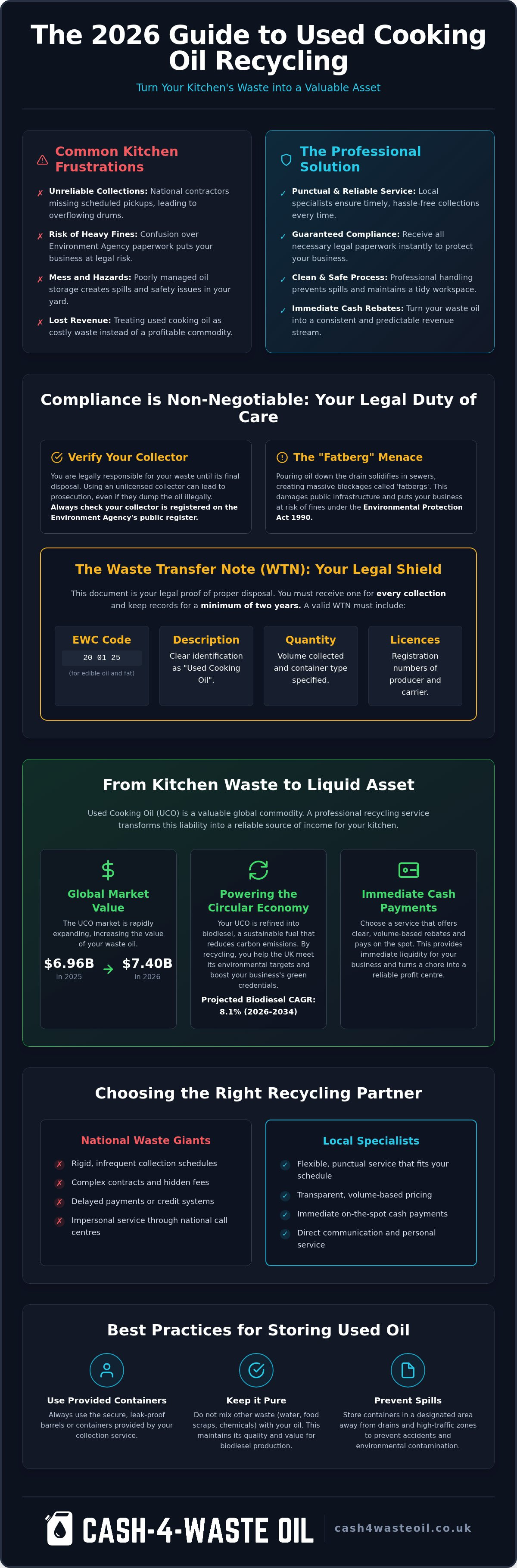
Managing used cooking oil is not merely a matter of good housekeeping; it is a strict legal requirement for every food business in the UK. The Environment Agency (EA) oversees the disposal of waste vegetable oil (WVO) to ensure it does not damage the environment or public infrastructure. If you pour oil down the sink, it solidifies and creates fatbergs that cost water companies millions to clear. This behaviour also puts your business at risk of prosecution under the Environmental Protection Act 1990. Using a professional restaurant oil recycling service is the only way to satisfy your Duty of Care and ensure your waste is recycled into biofuel rather than causing a blockage.
Your legal responsibility, known as the Duty of Care, means you are responsible for your waste from the moment it is produced until it is properly disposed of. You cannot simply hand your oil over to anyone with a van. If an unlicensed collector dumps your oil illegally, the authorities can trace it back to your kitchen, leading to heavy fines or even closure. You must verify that your collector is an Environment Agency registered carrier to stay on the right side of the law.
The Critical Role of the Waste Transfer Note (WTN)
A Waste Transfer Note is more than just a receipt; it is your legal proof of compliance. You must receive a WTN for every single collection and keep these documents on file for a minimum of two years. If a local council inspector or EA officer visits your premises, this document is your only shield against allegations of improper disposal. A valid WTN must include specific details:
- EWC Code: Typically 20 01 25 for edible oil and fat.
- Waste Description: A clear statement identifying the material as used cooking oil.
- Quantity and Container Type: The volume collected and how it was stored.
- Licence Details: The registration numbers for both the waste producer and the carrier.
Avoiding the Pitfalls of Unlicensed Collectors
The rise in the value of used oil has attracted "fly-by-night" collectors who operate without proper licensing. These individuals often lack the equipment to handle spills and rarely provide the necessary paperwork. Before booking a restaurant oil recycling service, always check the collector's credentials on the Environment Agency’s public register. It only takes a minute to search a company name or registration number, but it could save you thousands in legal costs. As the business owner, your legal liability remains active even after the oil leaves your premises if you fail to hire a licensed carrier.
Reliable specialists like Cash 4 Waste Oil ensure this process is seamless. They provide immediate Waste Transfer Notes at the point of collection, giving you instant peace of mind and full regulatory protection.
The Financial Benefits of a Professional Waste Oil Collection
Used cooking oil (UCO) is no longer a disposal headache; it is a globally traded commodity. The global market for UCO was valued at USD 6.96 billion in 2025 and is projected to grow to USD 7.40 billion in 2026. For a commercial kitchen, this means your waste has a specific market value. While some national contractors require complex quote requests or bury their rates in fine print, a professional restaurant oil recycling service should provide a clear, volume-based rebate structure. It is a liquid asset that belongs on your balance sheet, not in your bins.
The "cash on the spot" model provides immediate liquidity for your business. This is particularly useful for independent kitchens needing to top up petty cash or offset daily operational costs. By choosing a provider that pays per litre at the point of collection, you turn a logistical necessity into a predictable revenue stream. Beyond direct payments, regular professional collection reduces the strain on your plumbing. When oil is stored correctly and collected frequently, there is less chance of accidental spills entering your drainage system. This helps lower your long-term grease trap maintenance costs and prevents expensive emergency call-out fees.
How Your Waste Oil Powers the Circular Economy
Your kitchen plays a vital role in the circular economy. Once collected, your UCO travels to a specialised facility where it is refined into biodiesel. This process is the fastest-growing application for used oil, with a projected CAGR of 8.1% from 2026 to 2034. Switching from fossil fuels to UCO-based biofuels reduces carbon emissions significantly. By participating, you help the UK meet its sustainability targets whilst demonstrating corporate social responsibility to your customers. It is a smart business move that also protects the planet.
Maximising the Value of Your Used Fryer Oil
Not all oil is valued equally. High-quality vegetable oils like rapeseed and sunflower typically fetch the highest rebates because they are easier to process into fuel. To get the best return, you must keep your waste oil clean. Excessive food debris or water contamination can lower the grade of the oil and reduce your payment. For those operating in the capital, you can find specific details on local rates in our guide on how to Get Paid for Used Cooking Oil in London. If you want to start earning today, it's worth speaking to an expert who offers cash payments for waste oil.
Evaluating the Best Oil Recycling Partners for Your Kitchen
Choosing a restaurant oil recycling service shouldn't be a gamble. While many providers promise the "best rates", the real value lies in reliability and transparency. You need a partner that arrives when they say they will. If a collection is missed, your storage area quickly becomes a hazard. Look for a company that offers both fixed-frequency schedules for stability and on-call flexibility for those unexpectedly busy weekends. A professional partner should also provide free, high-quality storage containers and barrels to keep your kitchen yard organised and spill-free.
National waste giants often treat independent kitchens as an afterthought. Their drivers follow rigid routes determined by a distant head office, often struggling to adapt to local traffic or site-specific access issues. Conversely, local specialists offer a more personal, responsive service. They understand that a 3:00 PM collection in a narrow Soho alleyway requires specific vehicle sizes and local knowledge that a national contractor simply cannot provide. This agility is what keeps your operations running smoothly without the stress of missed pickups.
Local Service in London, Kent, and the Midlands
Regional expertise is essential for navigating the complexities of urban logistics. Whether you are operating in the heart of Soho, the bustling markets of Camden, or Birmingham city centre, your collector needs to be agile. Rapid response times are critical in congested areas where storage space is at a premium. Local providers across Kent, Surrey, and the West Midlands, including Leicester and Coventry, can offer the prompt service that larger firms miss. This proximity ensures that your waste oil is moved quickly, keeping your premises clean and compliant.
Transparency in Payment and Documentation
Transparency is the foundation of a good partnership. You should never be surprised by "environmental levies" or "bin cleaning fees" on your statement. A reputable restaurant oil recycling service will be upfront about its rebate structure. Insist on receiving an immediate physical or digital Waste Transfer Note (WTN) at the point of collection. This document is your only proof of legal compliance. Working with an Environment Agency registered partner like Cash 4 Waste Oil guarantees that your documentation is handled correctly. This provides the peace of mind that your business is fully protected during any snap inspection by the local council.
Best Practices for Storing and Preparing Waste Vegetable Oil
Safe storage is the backbone of an efficient kitchen. It protects your staff from burns and ensures your used oil remains a high-value commodity. Pouring hot oil directly into plastic drums is a recipe for disaster; it melts the container and creates a hazardous spill that is difficult to clean. Always use the high-quality, leak-proof barrels provided by your restaurant oil recycling service. These containers are designed to withstand the rigours of a busy yard whilst keeping the contents secure from pests and the elements.
Contamination is the biggest threat to your rebate. Water, cleaning chemicals, and excessive food waste lower the quality of the oil and can even make it unrecyclable. In 2026, oil theft has become a significant issue due to the rising market value of biofuels. If your storage area is outdoors, ensure your bins are kept in a well-lit, secure area or fitted with locks. Protecting your stock is just as important as protecting your equipment.
Step-by-Step Preparation for Collection Day
A smooth collection starts with proper preparation. Follow these steps to ensure your kitchen is ready when the driver arrives:
- Cooling: Ensure all oil is cooled to below 40°C before transferring it to storage drums. This prevents heat-related accidents and container damage.
- Filtering: Use a basic sieve to filter out large food particles. Whilst small amounts of sediment are expected, removing large debris maintains the oil's purity and value.
- Accessibility: Place your containers in a clear, easily accessible area. Congested yards delay the driver and can lead to missed collections in tight urban centres.
Avoiding Common Kitchen Compliance Errors
The "No Drains" rule is absolute. Even small amounts of oil washed away with soapy water contribute to fatbergs and can lead to immediate fines from water authorities. If a spill occurs, use absorbent materials rather than a hose. For a full breakdown of your legal duties, refer to our Commercial Kitchen Oil Disposal Compliance Checklist. You must also be vigilant about cross-contamination. Never mix your vegetable oil with engine oil or mineral oils. If these substances are mixed, the entire batch becomes hazardous waste, which is significantly more expensive to dispose of and carries different legal requirements. If you follow these simple steps, you'll maintain a clean, profitable kitchen. Ready to get started? You can book your free used cooking oil collection today and turn your waste into immediate cash.
Why Independent Restaurants Choose Cash 4 Waste Oil
Independent kitchens operate on tight margins and even tighter schedules. You don't have the time to chase national contractors or navigate complex portals just to have your bins emptied. Cash 4 Waste Oil provides a pragmatic restaurant oil recycling service designed specifically for the fast-paced hospitality sector. We eliminate the administrative burden by offering a "no-nonsense" transaction: we collect your used oil for free, pay you cash on the spot, and hand over a mandatory Waste Transfer Note before we leave. This immediate result respects your time and provides instant liquidity for your kitchen petty cash.
Our focus remains strictly on commercial kitchens across London, the South East, and the Midlands. By keeping our operations regional, we ensure that our drivers understand local logistics, from the congestion of central London to the industrial centres of the West Midlands. This local approach also maximises the environmental benefit. Your waste oil is diverted from drains and processed into sustainable biodiesel right here in the UK, supporting a local circular economy whilst reducing your carbon footprint. It is a smart business decision that benefits both your bottom line and the planet.
A Hassle-Free Solution for Busy Kitchens
Efficiency is our priority. We don't trap you in long-term contracts or bury you in complex sign-up processes. Whether you need a one-off pickup or a regular schedule, you can simply call or book online. To keep your kitchen yard clean and compliant, we provide free, high-quality 60L or 200L barrels that suit any volume of production. Our drivers are friendly professionals who understand the pressures of a service environment; they arrive on time, work quickly, and leave your storage area tidy. It’s a seamless addition to your kitchen routine that ensures you never have to worry about oil storage overflows again.
Ready to Turn Your Waste into Cash?
Taking control of your waste oil has never been simpler. If you are a commercial operator in London, Surrey, Kent, or the Midlands, you can book your first collection in minutes. We are an Environment Agency registered collector, ensuring that every litre we take is handled with total legal compliance. You get the cash, you get the paperwork, and you get a cleaner kitchen. Don't let your used oil sit and attract pests or potential theft. Visit our booking form or call our team today to secure the best rates for your used cooking oil and experience a restaurant oil recycling service that actually works for your business.
Secure Your Kitchen’s Compliance and Profitability
Navigating the complexities of waste management doesn't have to be a drain on your resources. By now, it's clear that proper documentation and safe storage are the only ways to satisfy the Environment Agency whilst protecting your business from heavy fines. You've seen that your used cooking oil is a valuable commodity that can boost your daily revenue through immediate cash rebates. Shifting from a national contractor to a local specialist ensures you receive the reliable, punctual service your busy kitchen demands. It's time to stop viewing oil disposal as a chore and start treating it as a smart business opportunity.
Choosing a professional restaurant oil recycling service is the final step in streamlining your operations. We take the stress out of compliance by handling the logistics and the paperwork for you. As an Environment Agency Registered collector, we pay cash on the spot and provide free Waste Transfer Notes for every visit. Don't let your waste sit in the yard when it could be working for your bottom line. Book your free restaurant oil recycling collection and get paid cash today. Let’s turn your kitchen waste into a sustainable, profitable asset.
Frequently Asked Questions
Do you provide a Waste Transfer Note for every collection?
Yes, we provide a mandatory Waste Transfer Note (WTN) at the point of every collection. This document is your legal shield during local council or Environment Agency inspections, proving that you've disposed of your waste vegetable oil responsibly. You must keep these notes for at least two years. Our drivers ensure the paperwork is completed and handed over before they leave your premises, providing instant compliance for your kitchen records.
How much cash will I receive for my used cooking oil?
The amount of cash you receive depends on the volume of oil collected and the current market value of used cooking oil. We pay a competitive rate per litre directly at the point of collection, ensuring your business sees an immediate financial benefit. High-quality oils that are free from excessive food debris or water contamination typically fetch the best returns. This transparent payment model helps turn your kitchen waste into a predictable revenue stream.
Which areas of the UK do you cover for restaurant oil recycling?
We provide a comprehensive restaurant oil recycling service across London, the South East, and the Midlands. Our coverage includes all London boroughs, Kent, and Surrey, as well as major hubs like Birmingham, Coventry, Wolverhampton, and Leicester. We also serve establishments in Leicestershire, Derbyshire, Staffordshire, Warwickshire, Northamptonshire, Oxfordshire, and Worcestershire. This local focus allows us to offer prompt, reliable collections that national contractors often struggle to match in busy urban centres.
What types of cooking oil can be recycled?
We collect all types of food-grade vegetable oils, including rapeseed, sunflower, palm, and soy oils. These are the primary ingredients needed for high-quality biodiesel production. It's important to keep these oils separate from other waste. We don't collect engine oil, industrial lubricants, or mineral oils, as these are classified as hazardous waste and require different disposal methods. Mixing these with your cooking oil will prevent it from being recycled and may lead to extra costs.
Is there a minimum volume required for a free collection?
We offer free collections for commercial kitchens that produce standard volumes of used cooking oil. Our service is designed to support restaurants, hotels, and pubs of all sizes by removing the cost of waste disposal. Whether you fill a single 60-litre barrel or multiple 200-litre drums, we can arrange a schedule that keeps your yard clear. For very low-volume producers, we recommend calling our team to discuss the most efficient collection frequency for your specific needs.
Can you collect waste oil from a basement or upstairs kitchen?
Our drivers are experienced in navigating various kitchen layouts, but we generally require oil to be stored in an accessible area for collection. To ensure a fast and safe service, barrels should ideally be kept at ground level with clear access for our vehicles. If your kitchen is located in a basement or on an upper floor, please mention this when booking. We'll work with you to find a practical solution that maintains safety and efficiency.
What happens to the oil after it is collected from my restaurant?
Every litre of oil we collect is refined and repurposed as sustainable biodiesel. This process supports the circular economy by turning a waste product into a renewable fuel source that powers transport and reduces carbon emissions. By choosing a professional restaurant oil recycling service, you're directly contributing to the UK’s 2026 sustainability targets. It’s a simple way to improve your restaurant’s environmental credentials whilst ensuring your waste never ends up in the public drainage system.
Do you charge for the blue barrels or storage containers?
No, we provide high-quality blue barrels and storage containers to our regular clients completely free of charge. We offer both 60-litre and 200-litre drums to suit the space constraints and oil output of your specific kitchen. These containers are leak-proof and secure, helping you maintain a clean and safe storage area. When we arrive for your scheduled collection, we simply swap your full barrels for clean, empty ones, ensuring your operations are never interrupted.