Scheduled Oil Collection Near Southwark: Kitchen Guide
Your used-oil collection schedule should fit your kitchen, not disrupt it. If you’re looking for a scheduled oil pickup near Southwark, you need a routine that reflects how much oil you produce and how your kitchen operates, without leaving storage difficult to manage between visits.
A planned collection makes used cooking oil easier to handle. This guide explains how to estimate your output, prepare for collection and choose between a recurring and on-call arrangement. It also covers the cash payment and Waste Transfer Note provided when oil is collected.
Cash 4 Waste Oil provides free scheduled collection of food-grade used cooking oil from commercial kitchens in Southwark. Collections are carried out by a fully licensed, Environment Agency-registered service. The collected oil is processed into biodiesel, giving your kitchen a clear route for responsible recycling.
Key Takeaways
- Estimate your kitchen’s used-oil output and note how fryer use, service days and seasonal trading affect it.
- A scheduled oil pickup near Southwark creates a predictable routine, while on-call collection can suit output that varies.
- Review storage and collection access so staff can prepare used cooking oil for pickup without disrupting kitchen operations.
- Have your business type, oil-output pattern and preferred collection arrangement ready when setting up a schedule.
- Know what a Waste Transfer Note records and where your business will keep it.
Scheduled oil pickup near Southwark: what commercial kitchens need
A scheduled pickup is a recurring arrangement for collecting a commercial kitchen’s used cooking oil. Instead of waiting until storage becomes difficult, your team can build oil collection into its regular operations. The right routine depends on how much oil your kitchen produces and how its trading patterns change, rather than on a one-size-fits-all timetable.
Fryer use can vary with menus, service days and seasonal trading. A restaurant, pub or hotel with steady output may benefit from a predictable collection routine, while a kitchen with more variable volumes may prefer on-call collection. Cash 4 Waste Oil provides both options for commercial kitchens, with free collection, cash paid on collection and a Waste Transfer Note provided.
Which Southwark businesses can use commercial oil collection?
The service is for businesses producing food-grade used vegetable or cooking oil, including restaurants, pubs, hotels and other commercial kitchens. It is a specialist collection for this waste stream, not a household-bin or general council waste arrangement. Domestic household oil, vehicle oil, engine oil and industrial mineral oils are not collected.
Keeping these categories separate helps staff identify what belongs in the cooking-oil container and what needs a different handling route. For background on the term, Yellow grease, also known as used cooking oil (UCO), is collected from businesses and industries that use oil for cooking. This service focuses on food-grade oil produced during commercial food preparation in Southwark.
What does a scheduled pickup include?
A scheduled collection follows a recurring arrangement. If your kitchen’s output changes, on-call collection gives you another way to organise pickup as needed. In either case, the service covers used cooking oil, cash payment on collection and a Waste Transfer Note. Your team receives payment and documentation as part of the handover.
That distinction matters for day-to-day waste planning. A commercial kitchen needs a collection routine suited to its ongoing food-service operations, while general business-waste arrangements cover broader waste needs. Specialist cooking-oil collection is focused on the used food-grade oil itself.
In short: commercial kitchens in Southwark can arrange free scheduled or on-call collection of used cooking oil, receive cash on collection and get a Waste Transfer Note. A scheduled oil pickup near Southwark gives your kitchen a recurring arrangement based on its oil output, with payment and documentation handled at pickup.
How to Schedule Oil Collection for Your Southwark Kitchen
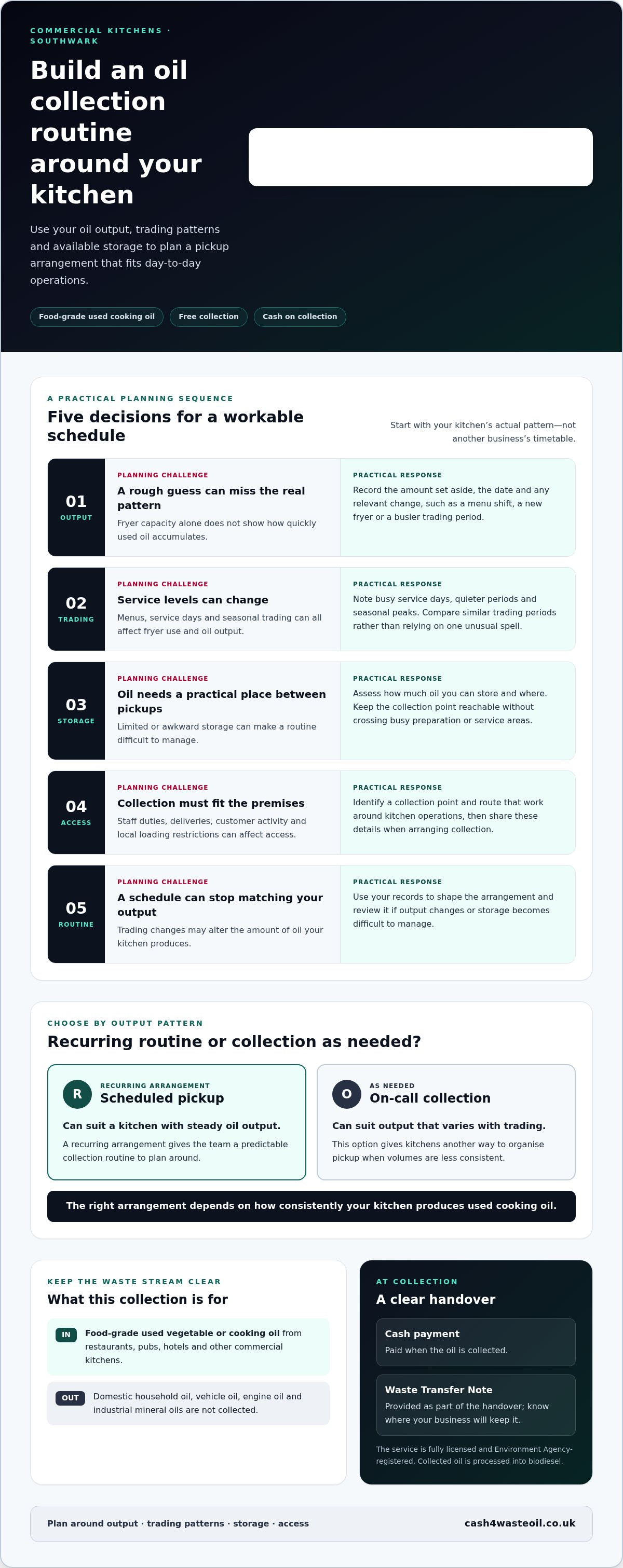
Start with your kitchen’s actual output, rather than copying another business’s collection routine. Fryer capacity is a useful starting point, but it doesn’t show how quickly oil accumulates in practice. Menus, trading days, service patterns and seasonal peaks can all affect output. Track these factors before agreeing a recurring arrangement.
Use this sequence to plan:
- Estimate output: Record the amount of used oil your kitchen sets aside over representative operating periods.
- Note trading patterns: Mark busy service days, quieter periods and seasonal changes that affect fryer use.
- Review storage: Work out how much oil you can store practically between pickups and where it can be kept.
- Plan access: Identify a collection point and route that work around staff duties and service.
- Agree a routine: Use your records and operating pattern to shape the arrangement, then review it if output changes.
Estimate how much used cooking oil your kitchen produces
Keep a simple record each time oil is set aside for collection. Note the amount, date and any relevant change, such as a menu shift, a new fryer or a busier trading period. Compare similar periods: a run of ordinary service days may not reflect a seasonal peak. Consistent records give you a more useful basis for planning a recurring arrangement than a rough estimate.
Plan around storage space and kitchen operations
Consider how much space is available for used oil and whether staff can reach it without crossing busy preparation or service areas. Choose a practical collection point and account for deliveries, customer activity and local loading restrictions in Southwark. Sharing these details when arranging collection helps make the routine workable for both the premises and the volume of oil.
There’s no need to force your kitchen into a preset frequency or volume. A restaurant with steady fryer use may produce a more consistent amount than a hotel with changing menus and service levels. Use your records to show the pattern. If trading changes, update the arrangement before storage becomes difficult or the routine no longer fits.
Scheduling checklist:
- Record oil output across representative trading periods.
- Note fryer use, service days, menu changes and seasonal peaks.
- Assess available storage and practical collection access.
- Share your business pattern and preferred arrangement when organising collection.
For a practical scheduled oil pickup near Southwark, use these details to build a routine around your kitchen’s output. You can also arrange used cooking oil collection around the pattern you’ve recorded.
Compare scheduled and on-call oil pickup for Southwark businesses
The best arrangement depends on how consistently your kitchen produces used cooking oil. A recurring pickup gives your team a routine to plan around, while on-call collection can suit output that changes with trading. Cash 4 Waste Oil offers both options for commercial kitchens, so you can choose the approach that fits your operations.
Use this comparison to weigh up the practical differences:
| Consideration | Scheduled collection | On-call collection |
|---|---|---|
| Planning | A recurring arrangement makes collections easier to build into kitchen routines. | You arrange collection as needed, so staff need to monitor oil levels. |
| Steady output | Can suit kitchens whose oil production follows a consistent pattern. | May require more coordination when oil builds up predictably. |
| Changing output | The routine may need reviewing if menus, trading or fryer use change. | Offers flexibility when production varies or trading patterns shift. |
| Storage planning | A known recurring arrangement can help staff plan storage between pickups. | Staff need to monitor storage and organise collection when it suits the business. |
When does a recurring oil pickup suit a kitchen?
A recurring arrangement can work well when your oil output is relatively predictable. If fryer use and service patterns stay similar, staff can include oil handling in their routine and plan storage around collection. This can reduce last-minute coordination. Review the arrangement if trading changes or oil starts accumulating faster or more slowly than expected.
When might on-call collection offer more flexibility?
On-call collection may suit a kitchen whose output varies with changing menus, irregular service or seasonal trading. Staff can monitor the oil produced and organise pickup as needed, rather than relying on a recurring routine. This option works best when someone is responsible for tracking storage and arranging collection.
Consider the work involved as well as the oil volume. A kitchen with steady output may prefer the predictability of a scheduled arrangement; one with less consistent production may value the flexibility of on-call collection. If your pattern changes, reassess which option is more practical. Cash 4 Waste Oil provides scheduled and on-call collection for Southwark commercial kitchens.
For a scheduled oil pickup near Southwark, consider how regularly oil accumulates, how much storage space is available and who will monitor it. Then choose the collection arrangement that makes day-to-day planning simplest. If payment for collected oil is part of your decision, weigh it alongside routine, flexibility and the documentation provided at collection.
Prepare your Southwark kitchen for a smooth oil collection
A little preparation makes the handover clearer for staff and the collector. Set a routine for keeping used food-grade cooking oil separate, making the agreed collection point accessible and ensuring someone on the team knows what to expect. These steps help a scheduled oil pickup near Southwark fit into a busy kitchen day without disrupting food preparation or service.
What should staff do before the collector arrives?
Keep used cooking oil separate from fresh oil and other waste. Make the collection point accessible, then brief relevant staff on where the oil is stored and who will handle the handover. A clear internal routine helps prevent confusion when shifts change or the usual contact is away.
Use this practical checklist before collection:
- Separate the oil: Keep food-grade used cooking oil apart from fresh oil and unrelated waste.
- Check the handover point: Make the agreed collection area accessible and remove anything that could obstruct it.
- Brief the team: Tell relevant staff who is responsible for the handover and where the oil is kept.
- Keep the process consistent: Make sure staff know how to identify the oil intended for collection.
Follow the arrangements for your premises rather than assuming a particular container, label or access setup. If collection involves a shared area or loading space, make sure the staff member responsible understands how the collector will reach the agreed point. In Southwark, access conditions can differ between premises, so account for your building layout and daily operations.
What paperwork should the business expect?
Cash 4 Waste Oil provides a Waste Transfer Note for the collection. It records the transfer of used cooking oil from your business to the collector, giving your team a document to file with its waste records. Decide who receives the note, where it is kept and how it will be linked to the relevant collection.
Set a straightforward record-keeping process so the appropriate staff member can retrieve the note when needed. Retain and organise waste records in line with the requirements that apply to your business. Avoid relying on an assumed retention period or a general rule for every type of waste; check specific duties and timeframes against current official guidance before using them as policy.
A useful handover routine covers more than access. Staff should know which oil is being collected, who is overseeing the transfer and where the paperwork will be stored. For a wider operational review, include used-oil handling in your commercial kitchen oil disposal compliance checklist alongside the business’s other waste procedures.
Prepare the handover and paperwork routine before your next collection. Arrange used cooking oil collection for your Southwark commercial kitchen with the collection point and staff process ready.
Arrange scheduled used cooking oil pickup near Southwark
A suitable collection arrangement starts with a clear picture of your kitchen’s operations. Share the details that help match collection planning to your used cooking oil output, rather than guessing at a frequency or relying on a routine that may not suit your business. Cash 4 Waste Oil offers free scheduled or on-call collection for commercial kitchens, with cash paid on the spot and a Waste Transfer Note provided.
What information helps arrange a suitable collection?
Have your Southwark business location and a short description of your kitchen operations ready. Explain how oil output changes with fryer use, service patterns or seasonal trading, and whether a recurring or on-call arrangement currently suits you. An estimate based on your records makes the discussion more practical, even if production varies from one trading period to another.
Also consider the day-to-day handover: where used cooking oil is kept, how the collection point can be accessed and which staff member can oversee collection. These details help shape an arrangement around your operations. If the business changes its menu, opening pattern or fryer use, revisit the arrangement so it continues to reflect current output.
What happens after collection is arranged?
Once the arrangement is agreed, your team can prepare the used food-grade cooking oil and make the collection point accessible. The aim is to organise a routine that fits your commercial kitchen and its output. At collection, Cash 4 Waste Oil pays cash on the spot and provides a Waste Transfer Note for your records.
Collected cooking oil is processed into biodiesel. This gives used oil a productive next use and supports its recovery as part of the circular economy. It’s a practical recycling outcome alongside the collection, payment and paperwork process.
Before arranging a scheduled oil pickup near Southwark, bring together your business location, kitchen type, estimated output pattern and preferred collection arrangement. This makes it easier to plan around how your kitchen actually works. If output is steady, a recurring collection may suit; if it changes with trading, an on-call arrangement may offer more flexibility.
Cash 4 Waste Oil collects food-grade used cooking oil from commercial kitchens, including restaurants, pubs and hotels. Collection is free, payment is made in cash on the spot, and a Waste Transfer Note is provided. The service is for commercial kitchens, not domestic household oil or vehicle and industrial oils. Alongside Southwark, the company serves businesses in London and Greater London, Kent, Surrey, Birmingham, Coventry, Leicester, Wolverhampton, Leicestershire, Derbyshire, Staffordshire, Warwickshire, Northamptonshire, Oxfordshire and Worcestershire.
Arrange commercial used cooking oil collection for your Southwark kitchen and choose a collection arrangement that fits your operations.
Make used-oil collection part of your kitchen routine
A collection arrangement works best when it keeps pace with your business. As menus, fryer use or trading patterns change, review how your kitchen handles used oil and whether its routine still fits. A practical scheduled oil pickup near Southwark can help your team keep oil management organised as the business evolves.
Cash 4 Waste Oil provides free scheduled or on-call collection for commercial kitchens. The service includes cash payment on the spot and a Waste Transfer Note, with collections fully licensed and Environment Agency registered. It gives your kitchen a straightforward way to arrange collection and supports responsible handling of used cooking oil.
Take the next step with the collection arrangement that suits your commercial kitchen. Arrange a straightforward used cooking oil collection and put a workable plan in place for your Southwark business.
Frequently Asked Questions
Can a restaurant in Southwark arrange scheduled used cooking oil collection?
Yes. Restaurants in Southwark can arrange a scheduled oil pickup near Southwark for used food-grade cooking oil. Have your business location, kitchen type and an estimate of how output varies across trading periods ready when organising collection. This helps shape a recurring arrangement around your operation. If output changes, review the plan so it continues to suit the restaurant’s trading pattern.
Is used cooking oil collection free for Southwark businesses?
Yes. Used cooking oil collection is free for commercial kitchens, including Southwark businesses. Cash 4 Waste Oil also pays cash on the spot for oil collected and provides a Waste Transfer Note. The collection is free, and the business receives payment for the used oil. Payment is based on the oil collected, so no fixed rate should be assumed.
How do I choose an oil collection schedule for my commercial kitchen?
Base the arrangement on your kitchen’s actual oil output rather than choosing a routine simply because another business uses it. Record the oil set aside for collection and note changes such as a revised menu, different fryer use or busier trading periods. If output is consistent, a recurring collection may be practical; if it fluctuates, an on-call arrangement may fit better. Reassess when operations change.
What happens to used cooking oil after collection?
Collected used cooking oil is processed into biodiesel. This gives oil from commercial food preparation a further use as a feedstock, rather than leaving it as an unmanaged by-product. Keep used food-grade oil separate from unrelated waste so it can be collected for processing.
Do I receive a Waste Transfer Note when my used cooking oil is collected?
Yes. Cash 4 Waste Oil provides a Waste Transfer Note for collected used cooking oil. The note records the waste transfer and gives your business documentation to keep with its collection records. Make sure the person overseeing the handover knows where the note should be filed so it can be retrieved with the relevant paperwork when needed.
Can a household arrange used cooking oil pickup near Southwark?
No. This collection service is for commercial kitchens, such as restaurants, pubs and hotels, rather than domestic households. It is intended for used cooking oil produced through business food preparation. Household oil is a different waste stream and is not covered by this commercial collection service.
Does the collection service take engine oil as well as cooking oil?
No. The service collects food-grade vegetable and cooking oils from commercial kitchens. It doesn’t collect engine oil, vehicle oil or industrial mineral oil. Keep these materials separate, as they are not part of a used cooking oil handover. This helps kitchen staff identify which oil belongs in the commercial cooking-oil collection and prevents unrelated materials from being mixed with it.