Switching Waste Oil Service Provider in Kent: A Practical 2026 Guide
What is the point of changing waste oil collectors if missed pickups still leave used cooking oil taking up valuable kitchen space? Switching waste oil service provider Kent businesses can rely on means planning the handover, not just ending one arrangement and starting another.
Unreliable collections, unclear payment and uncertainty about waste records can make a change feel more complicated than it needs to be. With mandatory digital waste tracking in effect from April 2026, accurate collection information matters too. A clear transition plan can help maintain continuity and keep your records in order.
This guide explains how to arrange a final collection with your current provider, set up a new schedule and keep track of payment and Waste Transfer Notes during the changeover. It also outlines how Cash 4 Waste Oil’s commercial used cooking oil collection in Kent works, including cash payment on the spot and a Waste Transfer Note for collected oil. Follow the steps to reduce disruption to your kitchen’s operations.
Key Takeaways
- Identify when missed collections, unclear payment or unsuitable pickup patterns make a change worth planning.
- Compare collection schedules, payment methods, documentation and accepted oil types to find an arrangement that suits your kitchen.
- Plan a clear handover when switching waste oil service provider Kent businesses can follow, with an agreed transition point to avoid gaps or overlap.
- Record each collection and keep the corresponding Waste Transfer Note.
- Cash 4 Waste Oil provides free scheduled or on-call commercial collections, on-the-spot cash payments and Waste Transfer Notes.
When should a Kent business switch waste oil service provider?
Missed or poorly timed collections can disrupt a busy kitchen. Used cooking oil may build up while staff manage storage space and keep daily routines moving. If you’re considering switching waste oil service provider Kent businesses rely on, first identify what isn’t working and whether it’s a recurring service issue or a one-off change.
Practical reasons to review your arrangement include:
- Missed appointments: collections repeatedly fail to happen as agreed, leaving you unsure when storage will be cleared.
- Unclear payment: it’s difficult to understand how payment for collected oil is handled.
- Unsuitable collection patterns: pickups don’t match the volume of oil your kitchen produces or its operating routine.
- Incomplete handover information: you don’t have clear collection details or documentation for your records.
Separate collection issues from equipment or storage problems. Changing providers can address how and when oil is collected, but it won’t fix a poorly positioned container, limited storage capacity or fryer-management issues. Waste oil is a broad category; this guide focuses on food-grade cooking oil from commercial kitchens, not engine or industrial mineral oil.
What are the signs your current collection arrangement no longer fits?
Review whether the collection pattern still suits your kitchen’s oil output. If volumes or operating routines have changed, a schedule that once worked may now leave oil sitting longer than planned or result in pickups that don’t fit the business. Keep a simple record of missed or changed appointments. This helps you distinguish a recurring service problem from an isolated scheduling change before deciding to switch.
What should a Kent kitchen expect from a provider change?
A well-planned change should give you a clear handover point, a collection arrangement suited to your kitchen and straightforward payment details. Cash 4 Waste Oil collects used food-grade cooking oil from commercial kitchens in Kent, with scheduled or on-call collections, cash payment on the spot and a Waste Transfer Note for collected oil.
A successful provider switch is a planned handover that keeps collections, payment and records clear. Use this as your measure of a change that supports kitchen operations rather than creating another task for staff.
How to compare waste oil collection arrangements before switching in Kent
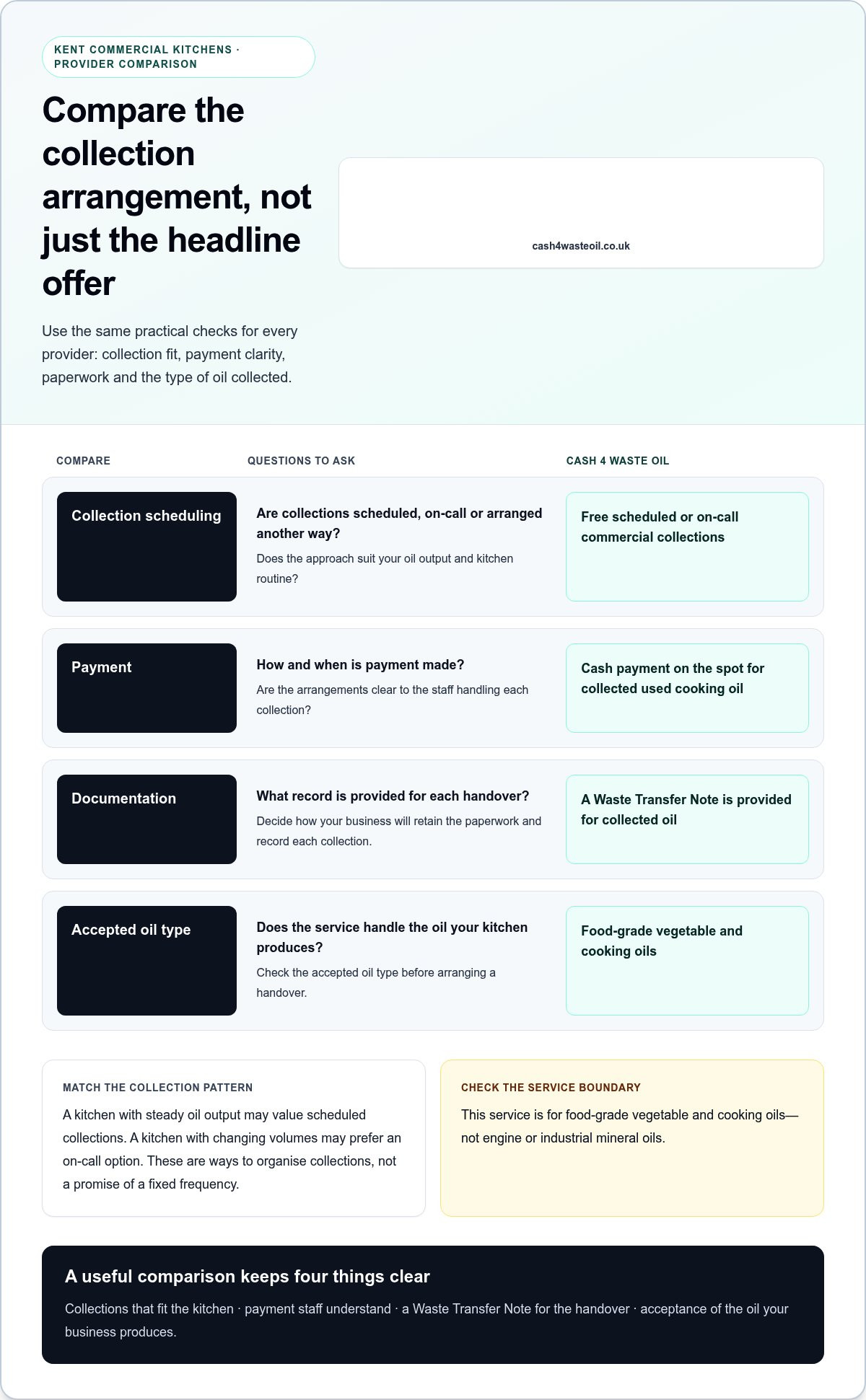
A useful comparison focuses on how the service fits your kitchen, not just on a headline offer. Note your usual oil output, how quickly storage fills and whether staff need planned pickups or more flexibility. Then compare arrangements against the same criteria.
| What to compare | Questions to consider | Cash 4 Waste Oil |
|---|---|---|
| Collection scheduling | Are collections scheduled, on-call or arranged another way? Does the approach suit your oil output and kitchen routine? | Free scheduled or on-call commercial collections. |
| Payment | How and when is payment made? Are the arrangements clear to the staff handling each collection? | Cash payment on the spot for collected used cooking oil. |
| Documentation | What record is provided for each handover, and how will your business retain it? | A Waste Transfer Note is provided for collected oil. |
| Accepted oil type | Does the service handle the oil your kitchen produces? | Food-grade vegetable and cooking oils. |
Which collection and payment details matter most?
Match the collection approach to your operating pattern. A restaurant with steady oil output may value scheduled collections, while a kitchen with changing volumes may prefer an on-call option. These are ways to organise collections, not a promise of a fixed frequency. Cash 4 Waste Oil offers both options for commercial kitchens in Kent. Payment is made in cash on the spot; record the payment details alongside each collection for clear accounts.
How do documentation and accepted oil types affect the decision?
A Waste Transfer Note records the waste handover and helps keep collection paperwork together. Make sure the oil your kitchen produces matches what the collection service handles: this service is for food-grade vegetable and cooking oils, not engine or industrial mineral oils. For related handling and compliance guidance, read the commercial kitchen oil disposal checklist.
Also consider where used oil is stored during the changeover. GOV.UK explains the legal requirements for storing oil, including storage measures relevant to larger quantities. Keep storage planning separate from collection scheduling: a new collection arrangement won’t resolve a separate capacity or storage issue.
Comparing these details makes switching waste oil service provider Kent kitchens use a more informed decision. For details of the collection and payment arrangements, explore Cash 4 Waste Oil collection.
How to plan a smooth waste oil provider changeover in Kent
A clear handover helps prevent a missed collection or two providers arriving for the same oil. Set a definite transition point: identify the last collection under the current arrangement and the first under the new one. Don’t assume a standard notice period or lead time. Review your existing agreement and plan the changeover around its terms.
What should you organise before the final collection?
Gather practical details about your kitchen before arranging the change. Note how much used oil you typically produce, where and how it’s stored, and the collection pattern you currently follow. Share this information with the incoming collection service so the arrangement can be planned around your operation rather than assumptions about your output.
Review your current agreement for notice and handover terms. Keep a written note of the agreed final collection and transition point. This gives the person managing kitchen waste a clear reference if staff or collection arrangements change during the handover.
How can you keep the handover clear and documented?
Record collection dates and retain the relevant Waste Transfer Notes with your waste records. Make sure staff know who is responsible for each collection during the transition. For background on waste carrier registration, see the Environment Agency’s public register.
If storage is nearing capacity before the handover is complete, see the emergency waste oil collection guidance for Kent for relevant context.
Changeover checklist for the kitchen waste lead
- Note typical oil output, storage arrangements and the current collection pattern.
- Review the current agreement for notice and handover terms.
- Write down the agreed final collection and the new service’s starting point.
- Make clear to staff who is responsible for each collection during the transition.
- Record collection dates and file each corresponding Waste Transfer Note.
Keep this checklist with the records used by the person responsible for kitchen waste. For commercial kitchens in Kent, Cash 4 Waste Oil provides used cooking oil collection and a Waste Transfer Note for collected oil. A planned handover makes switching waste oil service provider Kent businesses use easier to track, without relying on memory or guesswork. Read more about Cash 4 Waste Oil’s collection service.
What to check after switching waste oil service provider in Kent
Once the new collection arrangement is under way, review how it works in practice. Check whether collections took place as arranged and whether the timing suits your kitchen’s routine. If oil is building up faster than expected or a collection falls outside the agreed plan, record the details and raise the issue promptly so the arrangement can be addressed.
How do you review collection, payment and records?
Use your handover notes to check each collection. Aim for a straightforward match between what your team recorded and the collection paperwork.
- Collection: compare the collection date with your kitchen’s notes and check that the oil was handed over as expected.
- Documentation: make sure each handover has its corresponding Waste Transfer Note, then file it with the relevant collection record.
- Payment: compare the payment received with the details recorded for the oil collected. If something doesn’t match, keep the records together while you clarify the discrepancy.
- Routine: review whether the collection pattern continues to suit your oil output and day-to-day operation.
Keep the review practical. This checklist helps you spot missing paperwork, unclear payments or collection patterns that need attention. It doesn’t set a legal retention period; follow the current guidance applicable to your business for record-keeping requirements.
Cash 4 Waste Oil’s collections are fully licensed and Environment Agency registered, and the company provides a Waste Transfer Note for collected oil. Clear records make it easier to track the service after switching waste oil service provider Kent kitchens use, and to address early issues using specific collection details.
What happens to collected cooking oil afterwards?
Cash 4 Waste Oil processes collected cooking oil into biodiesel. This gives used oil a practical recovery route without implying a specific carbon saving for your business. Understanding what happens after collection can also help you assess whether the service supports your waste-handling priorities. For more on the wider recovery context, read the sustainable waste oil disposal guide.
Ready to put a clear collection and record-keeping arrangement in place? Arrange commercial used cooking oil collection with Cash 4 Waste Oil.
Switch to Cash 4 Waste Oil collection for your Kent commercial kitchen
For restaurants, pubs, hotels and other commercial kitchens in Kent, changing collection arrangements is an opportunity to put a clear service in place for used food-grade cooking oil. Cash 4 Waste Oil provides free scheduled or on-call collection, pays cash on the spot for oil collected and supplies a Waste Transfer Note for each handover.
The service is for commercial kitchens handling food-grade vegetable and cooking oils, not household oil, engine oil or industrial mineral oil. Keeping the accepted oil type clear helps staff know what to set aside for collection and what to manage separately.
What does Cash 4 Waste Oil provide for Kent businesses?
Cash 4 Waste Oil collects used cooking oil from commercial establishments in Kent. Businesses can arrange scheduled or on-call collections to suit their kitchen’s needs, without assuming a fixed collection frequency. Payment is made in cash on the spot for collected oil, and a Waste Transfer Note records the handover for your business records.
The company’s collections are fully licensed and Environment Agency registered. These details, alongside clear payment and collection records, give managers practical information to include in their provider-change review.
How can a business get started with the switch?
Prepare a short outline of your kitchen type, the food-grade oil you produce, your usual collection needs and how your current arrangement works. Include relevant handover details, such as the planned final collection under the existing service. This gives you a clear starting point for organising the transition without assuming a collection date or schedule.
Make sure the person responsible for kitchen waste knows how the new handover will be recorded and where to keep the Waste Transfer Note. Share collection and payment information with the staff who manage the oil, so the change is understood on the floor as well as in the office.
If you’re switching waste oil service provider Kent kitchens depend on, choose a changeover that keeps collection, payment and documentation easy to follow. Cash 4 Waste Oil offers commercial used cooking oil collection in Kent.
Arrange commercial waste cooking oil collection for your kitchen and take the next step towards a clear provider changeover.
Make your next collection arrangement work better
A successful change starts with a clear handover. Match the collection approach to your kitchen’s oil output, agree when responsibility changes, and check that each collection has a corresponding Waste Transfer Note and payment record.
This guide gives Kent businesses a practical process for switching waste oil service provider Kent kitchens can depend on, from comparing arrangements to reviewing the first collections. Cash 4 Waste Oil provides free scheduled or on-call commercial used cooking oil collection, cash payment on the spot and a Waste Transfer Note. Its collections are fully licensed and Environment Agency registered.
Cash 4 Waste Oil collects used cooking oil from commercial kitchens across London, Greater London, Kent, Surrey, Birmingham, Coventry, Leicester, Wolverhampton, Leicestershire, Derbyshire, Staffordshire, Warwickshire, Northamptonshire, Oxfordshire and Worcestershire. If your restaurant, pub, hotel or other commercial kitchen is ready to change its collection arrangement, arrange commercial waste cooking oil collection and start planning a clear, well-documented handover.
Frequently Asked Questions
How do I switch waste oil service provider in Kent?
Start by reviewing your current agreement and noting any notice or handover terms. Record your usual oil output, storage arrangements and collection pattern, then agree a clear final collection and a start point for the new arrangement. This practical approach to switching waste oil service provider Kent businesses can use helps avoid confusion over collection responsibility. Keep collection records and Waste Transfer Notes organised as the service changes.
Can I change waste cooking oil collectors without interrupting collections?
You can plan the change to reduce the risk of a collection gap, but uninterrupted service can’t be guaranteed. Agree a clear transition point, including the last collection under the existing arrangement and when the new one takes responsibility. Review the existing agreement for its handover terms. Share your kitchen’s oil output and collection needs with the incoming provider so the arrangement can be planned around your operations.
What happens to my Waste Transfer Notes when I change oil collectors?
Keep the Waste Transfer Notes for collections made under your previous arrangement with your business records. They relate to those individual handovers and aren’t replaced by paperwork from a new collector. For each collection after the change, file the corresponding new Waste Transfer Note alongside your record of the date and oil handed over. Grouping records by collection makes it easier to trace the handover history.
How much can a Kent business get for used cooking oil?
The payment depends on the arrangement. Cash 4 Waste Oil pays cash on the spot for collected used cooking oil. For clear accounts, record the collection and payment details together each time. Commercial used cooking oil collection is free, with no collection charge.
Does Cash 4 Waste Oil collect from restaurants and pubs in Kent?
Yes. Cash 4 Waste Oil collects used food-grade cooking oil from restaurants, pubs, hotels and other commercial kitchens in Kent. The service offers free scheduled or on-call collection, cash payment on the spot and a Waste Transfer Note for collected oil. The company also serves London, Greater London, Surrey, Birmingham, Coventry, Leicester, Wolverhampton, Leicestershire, Derbyshire, Staffordshire, Warwickshire, Northamptonshire, Oxfordshire and Worcestershire.
What happens if my current waste oil collector misses a collection?
Note the missed collection date and any related messages, then follow up through the contact route in your existing arrangement. Review your storage situation and update the person responsible for kitchen waste so staff know what to expect. If missed pickups are recurring, include them in your provider review and agree a clear handover plan before switching. Don’t assume the new collection arrangement begins until its transition point is agreed.