The Critical Benefits of Recycling Cooking Oil into Biodiesel for UK Businesses
Could the waste oil currently cluttering your storage area actually be the simplest way to boost your kitchen's profit margins? For many UK hospitality businesses, used cooking oil is seen as a messy logistics problem or a potential £5,000 fine waiting to happen. However, when handled correctly, it transforms from a liability into a high-value commodity. Understanding the benefits of recycling cooking oil into biodiesel is now essential for any operator looking to stay competitive whilst meeting strict environmental standards.
We know that managing a commercial kitchen is a high-pressure job. Between rising energy costs and complex Environment Agency regulations, you don't need the added stress of manual waste tracking or disposal headaches. To help manage your utility overheads, you can visit Easy2switch UK Ltd for professional energy consultancy. This article explains how you can secure your business against the new October 2026 digital waste mandates and generate immediate cash through professional oil rebates. We will break down the transition from waste to fuel, showing you how to lower your carbon footprint and ensure 100% legal compliance without any extra effort from your team.
Key Takeaways
- Transform your kitchen's waste oil from a disposal cost into a reliable revenue stream with immediate cash payments.
- Discover the environmental benefits of recycling cooking oil into biodiesel, including how it delivers an 89% carbon saving compared to fossil fuels.
- Ensure 100% legal compliance with Environment Agency regulations and prepare for the mandatory digital waste tracking system launching in October 2026.
- Streamline your back-of-house operations with a professional collection service that handles all logistics and provides essential Waste Transfer Notes.
- Identify how a registered local partner can manage your waste oil across London, the Midlands, and the South East without disrupting service.
What is Biodiesel and Why is it the Best Use for Waste Cooking Oil?
If you are asking What is Biodiesel?, it is essentially a renewable, biodegradable fuel source derived from organic fats rather than crude oil. For commercial kitchens, it represents the most efficient way to repurpose used cooking oil (UCO). Unlike traditional diesel, which relies on finite fossil fuels, biodiesel is a circular energy solution that keeps resources within the economy whilst drastically reducing tailpipe emissions.
Used cooking oil is classified as a "second-generation" biofuel. This distinction is vital for your business's sustainability credentials. First-generation biofuels often rely on crops grown specifically for fuel, which can drive up food prices and lead to deforestation. By using UCO, you ensure that no extra land is cleared and no food supplies are diverted. You are simply taking a waste product that has already served its primary purpose and giving it a second life as high-quality fuel.
This process is central to meeting the UK’s 2026 Net Zero targets. Under the Renewable Transport Fuel Obligation (RTFO), biofuels must achieve at least a 60% greenhouse gas saving compared to fossil fuels. Biodiesel produced from waste oil far exceeds this, often delivering savings of up to 89%. As the UK moves towards stricter environmental reporting, including the mandatory Digital Waste Tracking system launching in October 2026, choosing the right disposal route is a smart strategic move.
The Chemistry of Sustainable Fuel
Refining waste oil into fuel involves a process called transesterification. This sounds technical, but it is essentially a deep-cleaning and thinning process. Raw waste oil is too thick and contains too many impurities to be used in modern engines; it would quickly clog filters and cause damage. During refining, the glycerine is separated from the vegetable fat, leaving behind a thin, clear, and engine-ready liquid. This refined fuel can be used in most diesel engines without expensive modifications, making it a practical tool for decarbonising UK transport.
Why Landfill and Drains are Never an Option
Disposing of oil incorrectly is a recipe for legal and operational disaster. Pouring fats down the sink leads to "fatbergs" that block UK sewage systems, costing millions to clear and risking heavy fines for your business. Landfill is equally destructive. When oil decomposes in a landfill site without oxygen, it produces methane, a greenhouse gas significantly more potent than carbon dioxide. One of the primary benefits of recycling cooking oil into biodiesel is that it completely bypasses these environmental hazards, turning a potential pollutant into a productive asset.
Recycling ensures your kitchen remains a clean, compliant, and efficient environment. By choosing to process your waste into fuel, you contribute to a cleaner local atmosphere and a stronger circular economy. It is a simple shift that protects both your bottom line and the planet.
Environmental Benefits: Reducing Carbon Footprints in the UK
Choosing to recycle your kitchen waste offers more than just a tidy storage area. One of the most significant benefits of recycling cooking oil into biodiesel is the massive reduction in greenhouse gas emissions. Specifically, biodiesel produced from used cooking oil (UCO) provides an 89% carbon saving compared to traditional mineral diesel. This isn't a vague estimate; it's a verified figure that accounts for the entire lifecycle of the fuel. By switching to a waste-derived fuel, the UK transport sector avoids the heavy carbon cost of oil extraction and refining. This transition allows businesses to participate in large-scale decarbonisation without changing their daily operations.
Local air quality also sees immediate improvements. Biodiesel significantly reduces tailpipe emissions of particulate matter and sulphur. Since sulphur is a major contributor to acid rain and particulate matter affects respiratory health in urban centres, your kitchen's waste directly contributes to cleaner air in your local community. This represents the "Circular Economy" in action: a problematic waste product is captured, refined under the strict quality protocol for biodiesel, and returned to the road as a clean resource. It's a pragmatic way to ensure that nothing of value is lost to the drain or landfill.
Using UCO protects global biodiversity. Unlike crop-based biofuels, which require vast tracts of land that could be used for food or left as natural forest, recycled oil requires zero additional land. This prevents the deforestation often associated with industrial agriculture. By recycling your oil, you help maintain the balance between food production and fuel needs, avoiding the ethical dilemmas of the "food vs fuel" debate whilst protecting natural habitats.
Protecting Our Waterways and Soil
Accidental spills are a constant risk in busy kitchens. Professional collection services eliminate the danger of oil leaching into groundwater or contaminating local soil. Licensed collectors use specialised equipment to ensure a secure transfer from your site to the processing facility. Because biodiesel is biodegradable and far less toxic than petroleum, the entire supply chain is inherently safer for the British countryside. It is a proactive step that protects the local environment from the catastrophic damage caused by improper disposal.
Meeting Your Restaurant’s Sustainability Goals
Modern diners are increasingly selective about where they eat. They look for businesses that demonstrate genuine environmental responsibility. Including your oil recycling data in your annual CSR report provides a tangible metric for your sustainability efforts. It proves you're actively moving away from fossil fuels and supporting the UK's green transition. If you want to start improving your green credentials today, you can arrange a professional collection to see how easily waste becomes a valuable resource.
Commercial and Legal Advantages for Your Kitchen
Managing a commercial kitchen often feels like a constant battle against rising overheads. One of the most overlooked benefits of recycling cooking oil into biodiesel is the immediate impact on your bottom line. Instead of paying a waste management firm to haul away your used fats, you can turn that liability into a cash rebate. This shift effectively converts a waste cost into a revenue stream, providing liquid capital that goes straight back into your business operations. It’s a pragmatic way to capitalise on a resource you already produce daily.
This financial gain is possible because your waste oil is a high-demand feedstock for the production of environmentally friendly biodiesel. By selling your oil to a registered collector, you ensure it is diverted from landfills and processed into a valuable fuel. This isn't just about being green; it’s about smart resource management that rewards your business for responsible behaviour. It turns a messy logistics problem into a professional transaction.
Legal compliance is the second pillar of this commercial advantage. The Environment Agency and DEFRA have strict rules regarding controlled waste. If you fail to dispose of your oil correctly or cannot produce the right paperwork, you face fines of up to £5,000. Every collection must be documented with a Waste Transfer Note (WTN), which you are legally required to keep for at least two years. These notes are your primary defence during health and safety inspections or environmental audits. They prove you have met your legal obligations and handled your waste with due diligence.
The Value of Your Waste Oil
The rebate you receive depends on a few key factors: volume, oil quality, and purity. Oil that is free from food debris and water contamination fetches a higher price. For many independent landlords and busy restaurant managers, the cash on the spot model is the preferred payment method. It offers instant transparency and eliminates the need to chase invoices or wait for bank transfers. This 'cash for waste' approach is common in other recycling sectors too; for instance, you can read more about how Cash For Cars Perth applies this to vehicle salvage in other regions. Beyond the money, a regular collection schedule frees up valuable storage space and keeps your back-of-house area clean and safe.
Staying Compliant with UK Law
Under the Environmental Protection Act 1990, every UK business has a Duty of Care to manage waste safely. This means you must only use an Environment Agency registered waste carrier. Handing your oil to an unlicensed collector makes you legally liable for where that oil ends up. With the mandatory Digital Waste Tracking system launching in October 2026, the margin for error is disappearing. For a complete guide on how to protect your business, read our Commercial Kitchen Oil Disposal: The 2026 Essential Compliance Checklist.
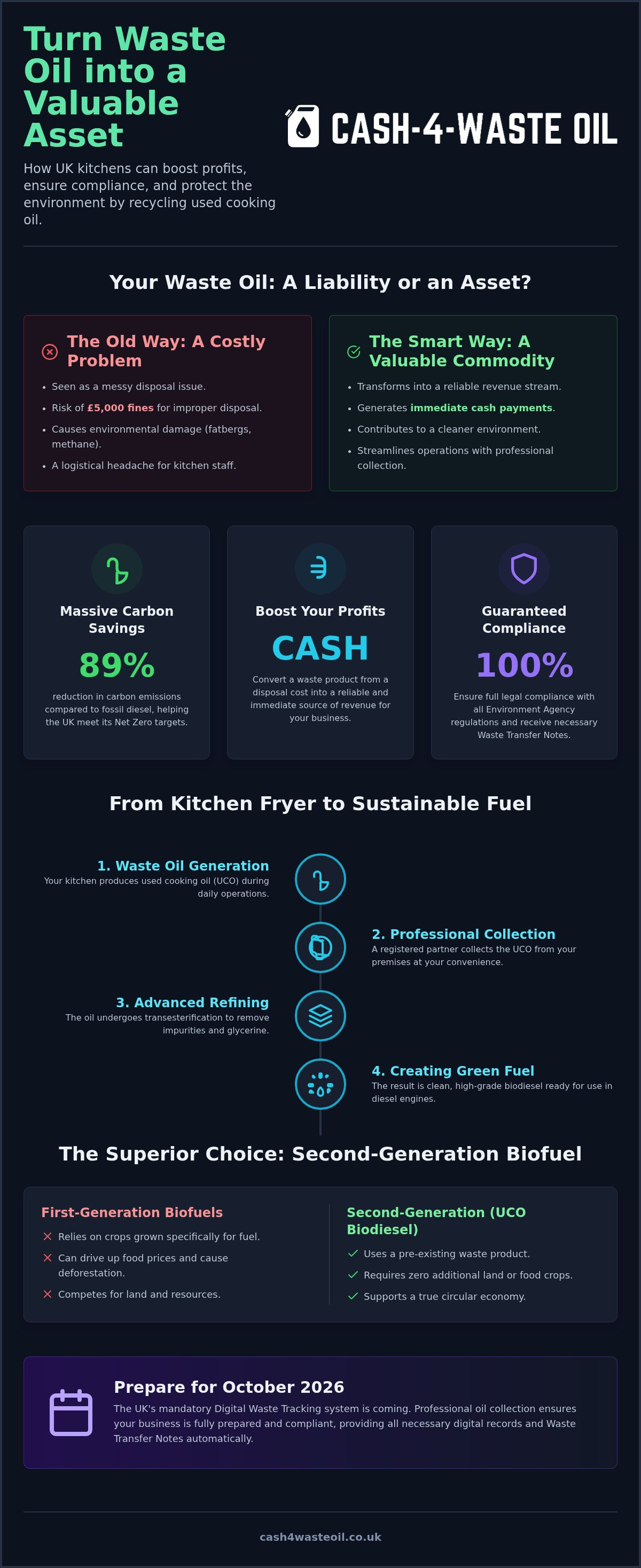
The Recycling Journey: From Commercial Fryer to Sustainable Fuel
Turning used vegetable fat into high-performance fuel is a methodical process. It starts in your kitchen and ends at a UK fuel pump, adhering to strict industrial standards throughout. Understanding this journey helps you appreciate the benefits of recycling cooking oil into biodiesel as more than just a waste collection service; it's a sophisticated manufacturing chain. The first step involves safe storage in high-quality, leak-proof containers. Once these are full, a professional collector arrives to remove the oil and issue a mandatory Waste Transfer Note. This document is your legal proof that the oil has entered a regulated recycling stream.
At the processing centre, the oil undergoes intense filtration. Modern equipment removes food particles, batter scraps, and any residual water that could compromise the final fuel quality. Following this, the oil enters the transesterification phase. This is a chemical reaction where the oil is mixed with an alcohol, typically methanol, and a catalyst. This process separates the glycerine from the vegetable fat, creating a low-viscosity liquid that mirrors the properties of mineral diesel. Finally, every batch undergoes rigorous quality testing to meet EN14214 standards, ensuring it's safe for use in commercial vehicle engines across the UK.
Best Practices for Kitchen Oil Storage
While recycling oil supports the transition to cleaner transport, the vehicles themselves also require sustainable disposal at the end of their life. In the broader automotive industry, companies like Oriental Car Removal facilitate this by recycling unwanted vehicles, ensuring that scrap metal is salvaged and repurposed rather than wasted.
To maximise the rebate value of your waste, you must keep the oil as clean as possible. Don't mix your used oil with water, chemicals, or engine lubricants, as this renders it unrecyclable. Always allow the oil to cool to a safe temperature before transferring it to storage drums to avoid burns or melting plastic containers. It's also vital to store your drums on a flat, stable surface away from drains. This prevents accidental spills from entering the water system, which could lead to heavy Environment Agency fines. If you need a reliable partner to manage this process, book your oil collection today for a hassle-free service.
What Happens to the "Waste from the Waste"?
A true circular economy leaves nothing behind. The food particles and water removed during the initial filtration phase aren't simply discarded. Instead, they're typically diverted to anaerobic digestion plants. Here, they're broken down by bacteria to produce biogas for electricity generation or organic fertiliser for British farmland. This zero-waste philosophy ensures that every litre of material collected from your kitchen finds a sustainable second life. It reinforces the benefits of recycling cooking oil into biodiesel by proving that even the contaminants in your fryer can contribute to a greener UK energy grid.
Why Choose Cash 4 Waste Oil for Your Biodiesel Recycling?
Finding a reliable partner for your kitchen waste shouldn't be a chore. Cash 4 Waste Oil operates with deep local expertise across London, the Midlands, and the South East, including Kent and Surrey. We understand the fast-paced nature of the hospitality sector. Our "Hassle-Free" promise means we provide prompt, scheduled collections that never disrupt your service. We handle the heavy lifting so you can focus on running your kitchen without worrying about messy storage or disposal logistics.
Financial transparency is at the heart of our service. We offer fair, competitive rates and provide immediate cash payments per litre on the spot. You won't have to wait for bank transfers or chase outstanding invoices. Beyond the money, we provide full peace of mind. As an Environment Agency registered collector, we issue a legal Waste Transfer Note for every collection. This ensures you are fully prepared for health inspections and the upcoming October 2026 digital waste tracking mandates. It's a professional, no-nonsense approach to waste management.
Supporting the Local Circular Economy
By partnering with us, you keep the benefits of recycling cooking oil into biodiesel within the UK economy. We don't just haul waste; we ensure it is processed to support the UK's green energy grid. Our commitment is to help local businesses thrive by turning a messy problem into a sustainable byproduct. It's a smart business decision that benefits your bottom line and the planet simultaneously. For a deeper look at our mission and how we operate, read our Sustainable Waste Oil Disposal: A 2026 Guide for UK Commercial Kitchens.
Getting Started: A Simple, Professional Service
Booking your first free collection is straightforward. Simply contact our team to arrange a time that suits your kitchen's schedule. When our professional team arrives, they'll assess your oil volume, pay you on the spot, and provide your mandatory paperwork. There are no hidden fees or complex contracts. You'll join hundreds of UK businesses already turning their used fats into a reliable profit stream. It’s the most efficient way to manage your waste whilst securing the long-term benefits of recycling cooking oil into biodiesel for your brand.
Secure Your Kitchen’s Future and Profit Today
Recycling your used cooking oil is no longer just a "green" choice; it's a vital business strategy for the modern UK kitchen. By converting your waste into fuel, you eliminate messy storage issues and protect your business from heavy fines. You also secure a transparent revenue stream that pays out immediately. The benefits of recycling cooking oil into biodiesel extend from your bottom line to the local air quality in your community.
Staying compliant doesn't have to be a complex process. As an Environment Agency registered collector, we provide the mandatory Waste Transfer Notes you need for every collection. Our team ensures the transition is seamless, providing cash on the spot without ever disrupting your service. It is a simple, results-oriented solution that turns a problematic byproduct into a sustainable resource.
Ready to streamline your waste management and boost your profits? Book your free waste oil collection and get paid cash today. We look forward to helping your business grow whilst protecting the planet.
Frequently Asked Questions
Is it legal to put used cooking oil in the bin or down the drain?
It is strictly illegal for commercial kitchens to dispose of used cooking oil in general waste bins or down the drain. Understanding the benefits of recycling cooking oil into biodiesel starts with knowing that improper disposal is a crime that causes fatbergs in the UK sewage system. Under the Environmental Protection Act 1990, businesses face fines of up to £5,000 for these actions. You must use a licensed carrier to remain compliant.
How much cash will I receive for my used cooking oil?
The amount of cash you receive depends on the volume and quality of the oil collected from your kitchen. We pay a competitive rate per litre directly on the spot at the time of collection. Factors such as the purity of the oil and the absence of food debris or water ensure you receive the best possible rebate. This turns your waste into an immediate revenue stream for your hospitality business.
What is a Waste Transfer Note and why does my restaurant need one?
A Waste Transfer Note (WTN) is a mandatory legal document that tracks the movement of waste from your premises to its final destination. Your restaurant needs one for every collection to prove that you have met your duty of care under UK law. You are required to keep these records for at least two years. They are the first thing Environment Agency inspectors will ask for during a routine compliance check.
Can all types of vegetable oil be recycled into biodiesel?
Most common food-grade vegetable oils used in commercial fryers, such as rapeseed, sunflower, and corn oil, are perfectly suited for recycling. However, it is vital that these oils are not contaminated with water, chemicals, or animal fats like lard. We specifically collect vegetable-based oils for conversion into fuel. Please note that we don't collect or recycle automotive engine oils or industrial mineral lubricants as they require different processing.
How often should a commercial kitchen have their waste oil collected?
Collection frequency depends entirely on your kitchen's output and storage capacity. High-volume restaurants in busy areas like London, Birmingham, or Coventry may require weekly pickups, whilst smaller cafes might only need a collection every month. We offer both scheduled visits and on-call services to ensure your oil drums never overflow. Regular collections help maintain a safe, clean working environment and prevent the buildup of hazardous waste in your storage areas.
Does recycling oil really help reduce a restaurant’s carbon footprint?
Yes, it is one of the most effective ways to lower your environmental impact. One of the primary benefits of recycling cooking oil into biodiesel is the 89% carbon saving it offers compared to fossil fuels. By diverting your waste from landfills where it would produce methane, you are actively supporting the UK's transition to a circular economy. This measurable reduction is a powerful addition to any business’s annual sustainability report.
Do I need to clean the oil before it is collected?
You don't need to perform any professional filtration or cleaning before our team arrives. Our processing centre handles the removal of food particles and moisture using industrial-grade equipment. However, you should try to keep the oil as clean as possible by avoiding mixing it with water, detergents, or general kitchen waste. Maintaining high oil purity ensures the refining process is efficient and helps you secure a fair rebate for your waste.
What happens if I use an unlicensed collector for my waste oil?
Using an unlicensed collector is a major legal risk that leaves your business liable for any environmental damage they cause. Without a registered carrier, you won't receive a valid Waste Transfer Note, meaning you cannot prove legal disposal to the authorities. This can lead to heavy fines of up to £5,000 and the loss of operating licences. It is essential for businesses across Surrey, Kent, and the Midlands to only use registered professionals.