Used Cooking Oil Collection Maidstone: The 2026 Cash & Compliance Guide
Your kitchen's waste oil is either a growing legal liability or a consistent revenue stream; in the current regulatory climate, there is simply no middle ground. You probably deal with the daily headache of messy storage drums taking up valuable floor space whilst worrying if your collector will actually show up on time. It is a common frustration for busy Maidstone caterers who just want a clean kitchen and a clear conscience. If you are tired of chasing unreliable collectors or stressing over complex environmental paperwork, you are not alone.
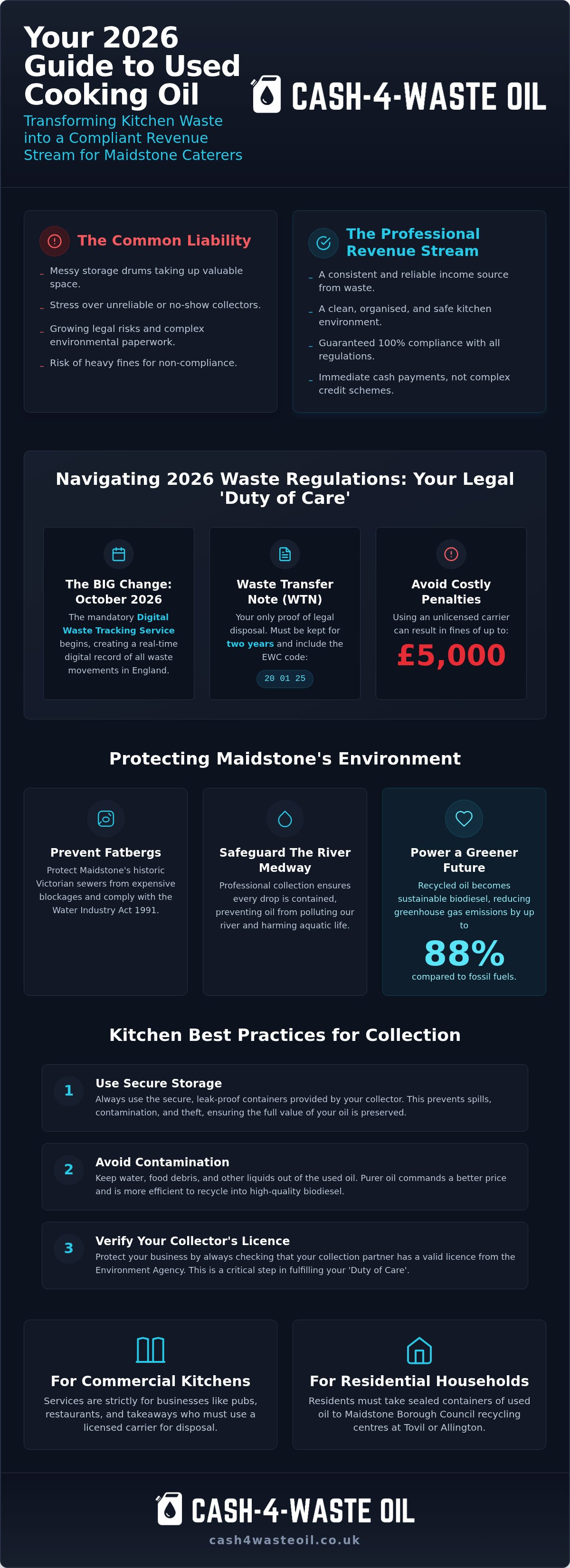
Securing a professional used cooking oil collection Maidstone service should be a profit centre for your business, not a logistical burden. We understand that your priority is service delivery, not deciphering waste legislation. This 2026 guide reveals how to transform your used oil into immediate cash whilst ensuring 100% compliance with Environment Agency regulations. We will explore the impact of the mandatory Digital Waste Tracking Service arriving in October 2026, how to guarantee you receive a valid Waste Transfer Note every time, and the exact steps to keep your kitchen tidy and your bank balance healthy.
Key Takeaways
- Meet your "Duty of Care" and prepare for the 2026 Digital Waste Tracking Service to ensure your business remains fully compliant with Environment Agency standards.
- Maximise your kitchen’s liquidity by choosing immediate cash payments on the spot rather than waiting for complex credit-based rebate schemes.
- Streamline your operations with a reliable used cooking oil collection Maidstone service that removes messy waste whilst protecting local Victorian sewer systems from fatbergs.
- Implement best practices for oil storage and transfer to prevent contamination and theft, ensuring you receive the best possible rate for every litre.
- Secure a valid Waste Transfer Note at every visit to satisfy local authority inspections and maintain your legal documentation for the required two-year period.
Why Professional Used Cooking Oil Collection in Maidstone is Essential
Professional used cooking oil collection Maidstone isn't just a convenience; it's a legal safeguard for your catering business. Disposing of fats, oils, and greases (FOG) down the sink is a direct violation of the Water Industry Act 1991. For Maidstone's historic town centre, the stakes are even higher. Much of our local drainage relies on Victorian-era brickwork sewers. These narrow pipes are highly susceptible to fatbergs, which are massive blockages that cause back-ups and expensive repairs for businesses. By choosing a professional collector, you prevent these blockages and avoid the heavy fines associated with improper disposal.
The shift towards a circular economy has transformed how we view kitchen waste. Recycled oil has numerous uses, but its most critical role in 2026 is as a feedstock for sustainable biodiesel. This process turns your messy waste into a high-value commodity. While national aggregators often treat your oil as just another logistical tick-box, local specialists offer a more responsive service tailored to the Maidstone hospitality scene. You get reliable, scheduled pickups that align with your service hours rather than waiting for a distant lorry that might never arrive.
The Environmental Impact on the River Medway
The River Medway is the lifeblood of Kent's ecosystem. Improperly stored oil can leak into drainage systems, eventually reaching the river and suffocating local aquatic life. Professional collection ensures every drop of your waste oil is contained and processed safely. Converting this waste into biodiesel can reduce greenhouse gas emissions by up to 88% compared to traditional fossil fuels. Your kitchen effectively becomes a part of the solution for UK carbon reduction targets. It is a smart business decision that yields tangible environmental benefits for our local community.
Commercial vs. Residential Disposal
It's vital to clarify that professional collection services are strictly for commercial entities like pubs, restaurants, and takeaways. We don't provide residential collections. If you're a local resident looking to dispose of household frying oil, please don't leave it outside your property or try to book a commercial pickup. Instead, take your sealed containers to the Maidstone Borough Council recycling centres at Tovil or Allington. Commercial kitchens, however, must use a licensed carrier to maintain their legal 'Duty of Care' and receive the necessary Waste Transfer Note at every visit.
Navigating 2026 Cooking Oil Waste Regulations in Kent
Every business producing waste oil in Kent carries a legal "Duty of Care" that cannot be ignored. This regulation means you are legally responsible for your oil from the moment it leaves the fryer until it reaches a licensed disposal site. The Environment Agency actively monitors commercial kitchens to ensure this waste doesn't end up in landfill or local sewers. One of the most common pitfalls for Maidstone eateries is using an unlicensed "white van" collector. If an unauthorised carrier fly-tips your waste, the legal liability rests squarely on your shoulders. Always verify a carrier's registration on the Environment Agency website before booking a used cooking oil collection Maidstone service. Failure to meet these standards can result in fines of up to £5,000, which is a heavy price for a simple administrative oversight.
Staying ahead of these rules requires a proactive approach to documentation. By Navigating 2026 Cooking Oil Waste Regulations correctly, you protect your business from litigation and ensure your kitchen operates within the law. If you want to simplify your back-of-house management, choosing a licensed collection service that handles the paperwork for you is the most efficient route to total compliance.
The Importance of the Waste Transfer Note (WTN)
A Waste Transfer Note is your only proof of legal disposal. For a WTN to be valid in 2026, it must include specific details: your business address, the collector's licence number, and the correct European Waste Catalogue (EWC) code, which is 20 01 25. A significant shift occurs in October 2026 with the introduction of the mandatory Digital Waste Tracking Service. This new system will create a real-time digital record of all waste movements across England. Regardless of whether your records are digital or paper, you must store them for at least two years. Local authority inspectors can demand these notes at any time during a routine visit. For a comprehensive breakdown of these requirements, see our Commercial Kitchen Oil Disposal: The 2026 Essential Compliance Checklist.
Maidstone Borough Council Inspections
Local health and safety officers from Maidstone Borough Council focus heavily on how oil is stored before collection. They look for secondary containment solutions, such as bunded pallets, which can catch 110% of the oil if a drum leaks. Storing oil in open or damaged containers is a major red flag; it attracts pests and creates foul odours that lead to neighbour complaints. Ensure your storage area is clean, flat, and located away from surface water drains. Proper spill prevention and containment are now the baseline standard for any professional kitchen in the South East.
Cash vs. Rebates: Maximising Your Waste Oil Value
Choosing between immediate cash and credit-based rebates is a critical financial decision for any catering manager. While many national collectors push for rebate schemes, these often result in delayed bank transfers and administrative headaches. Independent pubs and cafes in Maidstone usually find that "Cash on the Spot" is the superior model. It provides instant liquidity that stays within the business rather than sitting in a collector's account for thirty days. When you opt for a professional used cooking oil collection Maidstone service, you shouldn't have to wait to see the value of your waste. Immediate payment simplifies your bookkeeping and ensures the transaction is settled before the collection vehicle even leaves your premises.
Your oil's value isn't static; it fluctuates based on global biodiesel demand and the quality of the feedstock you provide. Transparency in measurement is where many businesses lose out. Some collectors use "estimated" volumes, but a professional partner will measure your oil accurately on-site. To get the best possible rate, ensure your oil is free from excessive food debris and water contamination. Clean, well-filtered oil is a premium commodity in the 2026 circular economy. If you can't see the measurement happening, you can't be sure you're getting a fair deal.
Immediate Liquidity for Your Business
Operating a busy kitchen involves constant small expenses, from emergency ingredient runs to staff sundries. Cash payments for your waste oil provide a handy "petty cash" injection that doesn't require complex tracking through accounting software. It removes the burden of chasing missing credits or reconciling bank statements weeks after the collection. This straightforward approach is why many operators are moving away from corporate contracts. For those managing multiple sites across the South East, you might find our guide on how to Get Paid for Used Cooking Oil in London: The 2026 Commercial Guide useful for comparing regional payment trends.
Volume Requirements and Pricing
To secure the most competitive cash rates, it's often beneficial to group your collections. While "free" collection is the industry baseline, receiving a payment is the gold standard that turns a waste product into a profit centre. Most providers have a minimum volume requirement, typically around 60 to 100 litres, to trigger a cash payment. You can maximise your payout by organising your storage efficiently; using larger, stackable drums allows you to store more oil in a smaller footprint. This means you can wait until you've reached the volume threshold for the best rates without cluttering your kitchen. A reliable used cooking oil collection Maidstone partner will help you determine the ideal collection frequency to balance your space constraints with your financial returns.
Preparing Your Maidstone Kitchen for Oil Collection
Efficient kitchen management starts with how you handle your waste. To get the most from your used cooking oil collection Maidstone, your staff must follow a clear protocol for oil transfer. Never pour oil into storage drums while it's still hot; let it cool completely to avoid damaging containers or causing severe burns. Use a dedicated funnel to prevent spills and keep the exterior of your drums clean. Contamination is the fastest way to lower your oil's market value. Ensure your team doesn't scrape food debris into the oil drums and keep lids tightly sealed to prevent rainwater from entering. Water contamination makes the refining process more difficult and often leads to lower cash payments.
Choosing a secure storage location is also vital. Oil theft has become a genuine concern for businesses in Kent, so keep your drums in a locked, well-lit area if possible. This also prevents accidental contamination from other kitchen waste or outdoor pollutants. A tidy storage area isn't just about aesthetics; it makes the collection process faster and safer for everyone involved. If you're ready to streamline your waste management and boost your kitchen's efficiency, book your Maidstone oil collection today.
Maidstone Town Centre Logistics
Maidstone's unique layout presents specific challenges for waste management. If your business is located on Bank Street or within other pedestrianised zones, vehicle access is strictly timed. Coordinating your collection to avoid peak service hours and traffic congestion on the A229 ensures our drivers can reach you without delay. Regular, scheduled pickups are far more effective than emergency calls, as they allow us to plan routes around local parking restrictions. This reliability keeps your storage area from overflowing during busy weekends and ensures you always have space for fresh stock.
Health and Safety for Kitchen Staff
Staff safety is paramount when handling waste vegetable oils. Slippery floors are a leading cause of kitchen accidents, so any spills must be treated immediately with absorbent materials. Provide your team with appropriate PPE, including heat-resistant gloves and aprons, for the transfer process. Every waste container should be clearly labelled with the European Waste Catalogue code 20 01 25. This prevents cross-contamination with other chemicals and ensures you remain compliant with the storage standards mentioned earlier in this guide. Proper labelling also helps new staff understand exactly where waste oil should be deposited, reducing the risk of costly mistakes.
Why Choose Cash 4 Waste Oil for Your Maidstone Collection?
Choosing a partner for your used cooking oil collection Maidstone means balancing financial return with total peace of mind. We've built our reputation by supporting Maidstone’s independent pubs, cafes, and top-rated restaurants with a service that prioritises your time. Our "No-Hassle" promise is simple: we handle the regulatory paperwork and pay you cash on the spot. You don't have to chase bank transfers or wait for credit notes to appear on your account. By processing your oil for UK biodiesel production, we ensure your waste stays within the local circular economy. It’s a pragmatic solution that turns a messy kitchen byproduct into immediate liquidity whilst protecting the Kent environment.
Reliability is the cornerstone of our operations across the South East. We understand that a missed collection leads to overflowing drums and hygiene risks. That is why we provide a consistent, scheduled service that adapts to your kitchen's specific output. Our team knows the Maidstone area intimately, allowing us to navigate local traffic and access restrictions without disrupting your service. When you work with us, you are partnering with a local specialist that understands the fast-paced nature of the hospitality industry.
Our Licensed and Registered Service
We operate a direct-service model, which means you deal with our team, not a faceless subcontractor. This ensures accountability and consistency in every collection we perform. We are fully Environment Agency registered and insured, providing a valid Waste Transfer Note at every visit. This documentation is your primary defence during local authority inspections. For more on the future of eco-friendly kitchen management, read our Sustainable Waste Oil Disposal: A 2026 Guide for UK Commercial Kitchens. Using a licensed carrier isn't just a recommendation; it's a legal necessity that protects your business from the risks of fly-tipping and non-compliance fines.
Booking Your Free Collection Today
Getting started is a straightforward process designed to fit around your busy service schedule. Follow these three steps to secure your collection:
- Request a Visit: Contact our local team via phone or our website to book your slot.
- Schedule Your Time: We’ll agree on a collection window that avoids your peak kitchen hours.
- Get Paid: Receive your cash payment and Waste Transfer Note instantly upon collection.
During your first visit, our driver will assess your storage setup and confirm your oil quality. We aim to provide a seamless experience that doesn't disrupt your staff or your customers. Contact our Maidstone team today for a bespoke quote based on your specific volume and frequency needs.
Secure Your Kitchen’s Compliance and Cash Flow Today
Managing a commercial kitchen in Maidstone involves juggling tight margins and strict environmental laws. You now understand that professional used cooking oil collection Maidstone isn't just about keeping the drains clear; it's a strategic business move. By moving away from delayed rebate schemes and choosing immediate cash payments, you inject liquidity directly back into your operations. With the mandatory Digital Waste Tracking Service arriving in October 2026, having a licensed partner who provides a valid Waste Transfer Note at every visit is more critical than ever.
Cash 4 Waste Oil offers the reliability your business needs to stay ahead of these changes. We remove the administrative burden of compliance whilst ensuring you receive the maximum value for your waste oil. Our service is fully Environment Agency Licensed, and we pride ourselves on prompt, professional collections that don't disrupt your service. We handle the logistics so you can focus on your customers.
Stop letting messy oil take up space and start turning your waste into a consistent profit centre. Book your free Maidstone oil collection and get paid cash today. It's the simplest way to keep your kitchen clean, your records straight, and your cash flow healthy.
Frequently Asked Questions
Is used cooking oil collection really free in Maidstone?
Yes, our used cooking oil collection Maidstone service is entirely free for all commercial kitchens, including pubs, restaurants, and hotels. We don't charge for the pickup or the administration involved in providing your legal documentation. In fact, we turn the traditional waste model on its head by paying you for the oil we collect. This ensures your business stays compliant without any out-of-pocket expenses while adding a consistent revenue stream to your kitchen budget.
How much cash will I receive for my waste oil?
The amount you receive depends on the volume of oil collected and the current market value of biodiesel feedstock in 2026. We pay cash per litre on the spot, ensuring you get immediate value for your waste. Higher volumes and cleaner oil typically command better rates. During our first visit, we'll assess your typical output and provide a clear, transparent rate so you know exactly what to expect at every scheduled collection.
Do you provide the containers for storing the oil?
We focus on the efficient removal and recycling of your waste oil. Whilst we don't supply fresh oil, we can advise you on the best storage solutions to keep your kitchen tidy and compliant with Environment Agency regulations. Most kitchens use standard 20-litre or 60-litre drums for storage. Our team ensures that the collection process is quick and clean, helping you maintain a safe storage area that meets all local health and safety standards.
Can you collect oil from my home in Maidstone?
No, our services are strictly limited to commercial kitchens such as restaurants, cafes, and catering businesses. We don't provide residential collections for domestic households in Maidstone. If you have used cooking oil from your home, you should take it to a local Borough Council recycling centre, such as the facilities at Tovil or Allington. This ensures that domestic waste is handled through the correct municipal channels while we focus on high-volume commercial recovery.
What happens if I don't have a Waste Transfer Note?
Operating without a valid Waste Transfer Note puts your business at significant legal risk. These documents are mandatory proof that you've met your "Duty of Care" under the Environmental Protection Act. If a local authority inspector visits and you can't produce records for the last two years, you could face heavy fines or prosecution. We provide a legal Waste Transfer Note at every visit to ensure your used cooking oil collection Maidstone remains 100% compliant.
Do you collect used engine or motor oil?
No, we only collect food-grade vegetable and cooking oils used in the catering industry. We don't handle engine oil, motor oil, or any other industrial mineral oils. These substances require specialist hazardous waste disposal and can't be processed into biodiesel through our facility. If you need to dispose of automotive oils, you should contact a licensed hazardous waste specialist who is equipped to handle mineral-based lubricants and industrial chemical waste safely.
How often can you collect from my restaurant in Kent?
We offer flexible collection frequencies across Kent to suit your kitchen's specific needs. Whether you require a weekly scheduled pickup or an on-call service when your drums are full, we can accommodate your schedule. Most busy restaurants find that a fortnightly or monthly collection works best to prevent storage areas from becoming overcrowded. We aim to provide a reliable, predictable service that ensures you never have to worry about messy, overflowing oil drums.
What types of oil do you accept for recycling?
We accept all common types of vegetable-based cooking oils, including rapeseed, sunflower, corn, and palm oil. We also collect used deep-frying fats. It's important that the oil is kept separate from other kitchen waste, such as food debris or water, to maintain its recycling value. By recycling these oils, we help produce sustainable biodiesel, which significantly reduces the carbon footprint of the UK transport sector compared to traditional fossil fuels.