Used Cooking Oil Price Per Litre UK: 2026 Market Rates and Rebate Guide
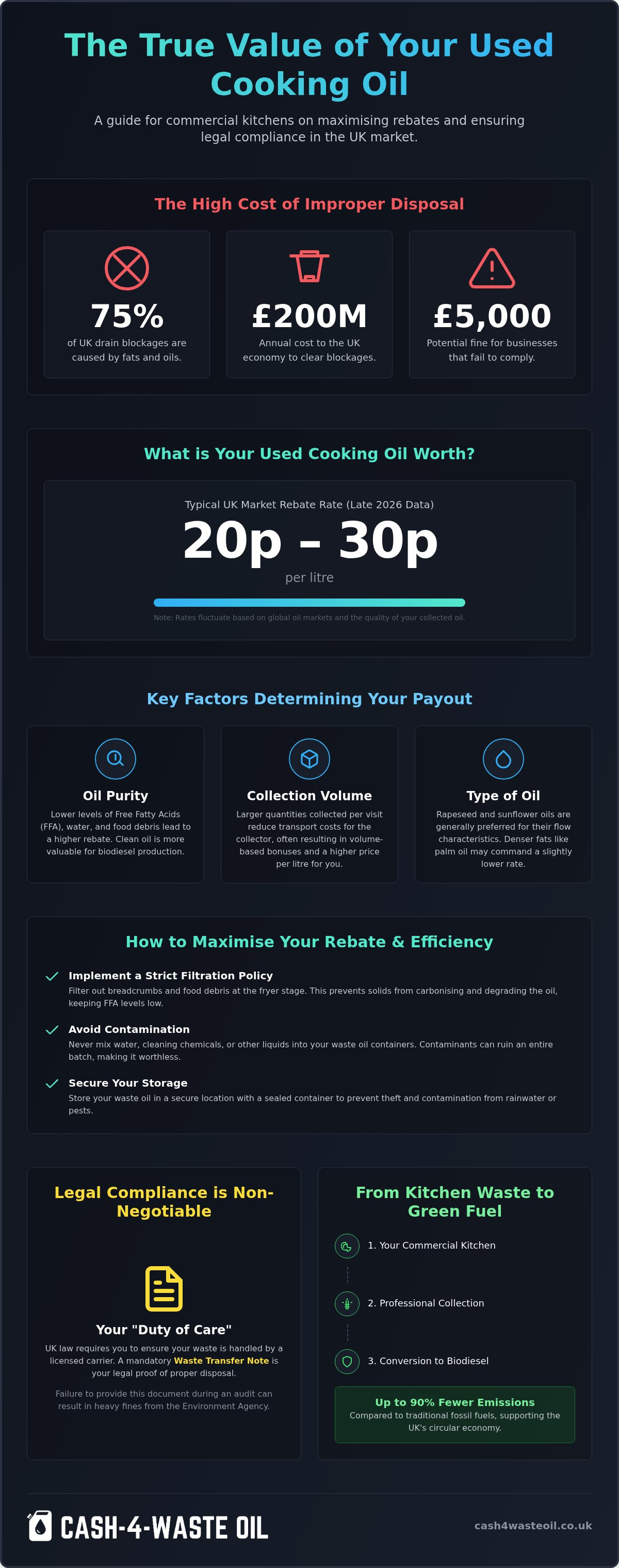
Did you know that improper disposal of fats and oils triggers 75% of the UK’s annual drain blockages, costing the economy up to £200 million every year? For a commercial kitchen, failing to manage this waste properly doesn't just cause environmental damage; it risks heavy fines of up to £5,000. Finding a competitive used cooking oil price per litre UK is essential for your bottom line, but the true value lies in a service that balances rebates with total legal security.
We know that managing messy storage areas and navigating complex environmental regulations is a constant drain on your time. You want a reliable partner who turns up on schedule, pays you instantly, and provides the documentation required for a stress-free audit. It's about making a smart business decision that simplifies your logistics whilst boosting your revenue. You shouldn't have to choose between a fair price and a professional service.
This guide explores the 2026 market landscape, including the impact of the mandatory digital waste tracking system launching this October. You'll learn how to secure a fair, transparent price per litre and obtain the legal Waste Transfer Notes necessary to stay compliant. We will also outline how your waste oil is transformed into sustainable biodiesel, supporting a local circular economy.
Key Takeaways
- Learn how the 2026 biodiesel market influences the current used cooking oil price per litre UK and why demand remains high for commercial waste.
- Discover how maintaining low acidity levels and high storage volumes can significantly increase the rebate value of your waste oil.
- Implement simple kitchen policies and secure storage solutions to protect your oil from theft and contamination.
- Understand your legal "Duty of Care" and why a mandatory Waste Transfer Note is essential to avoid heavy Environment Agency fines.
- Find out how to secure instant cash payments and free collections from a fully licensed waste carrier.
Current Market Rates for Used Cooking Oil in the UK
For most commercial kitchens, waste oil is no longer a disposal headache but a consistent revenue stream. The industry operates on a "rebate" system. Instead of paying for waste removal, you receive a payment back for every litre collected. This financial return helps offset the rising costs of fresh ingredients and utilities. The used cooking oil price per litre UK businesses receive is currently driven by the massive demand from the renewable energy sector, where your old frying fat is the primary ingredient for sustainable fuel.
The UK biodiesel industry relies heavily on these waste streams to meet national carbon reduction targets. Because your waste oil is a high-energy feedstock, collectors are willing to pay for the privilege of hauling it away. However, the headline rates you see online often represent the maximum possible payout for high-volume, premium-quality oil. Your final quote might vary based on how much you store and how well you've looked after the product before it's collected.
Why Used Cooking Oil is a Valuable Commodity
Waste oil is classified as a "second-generation" biofuel feedstock. This means it doesn't compete with food crops for land, making it environmentally superior to virgin oils. The UK’s Renewable Transport Fuel Obligation (RTFO) mandates that fuel suppliers include a percentage of renewable content in their petrol and diesel. This regulation creates a permanent, high-value market for Vegetable oil fuel produced from recycled kitchen waste. The commercial value of waste oil is fundamentally determined by its energy density and its level of purity after filtration. By diverting this waste into the circular economy, kitchens contribute to a process that produces up to 90% fewer greenhouse gas emissions than traditional fossil fuels.
Spot Prices vs. Contracted Rates
Market data from late 2026 shows that commercial collectors are offering between 20p and 30p per litre for used oil. These rates aren't fixed; they fluctuate alongside global vegetable oil markets and the price of crude oil. If you rely on one-off, ad-hoc collections, you're often subject to "spot prices" which can change weekly. In contrast, scheduled service agreements provide more stability, though they still reflect broader market shifts.
When evaluating the used cooking oil price per litre UK collectors offer, you must look at the total package. A high headline rate is less attractive if the collector charges for container hire or document processing. A truly professional service should provide free collection and all necessary legal paperwork as part of the deal. The most efficient way to maximise your return is to provide large volumes of clean, settled oil, as this reduces the collector's transport and processing overheads, allowing them to pass more of the value back to you in cash.
What Determines the Price Per Litre You Receive?
While market averages provide a useful baseline, your actual payout is dictated by the specific "grade" of your waste. Collectors don't just see oil; they see a feedstock that must meet strict refinery standards. If your oil is heavily degraded or full of debris, the processor incurs higher costs to clean it, which inevitably lowers your rebate. According to the UK Used Cooking Oil Market Report, the demand for high-quality feedstock is rising as the UK scales up its renewable energy infrastructure, but only for oil that meets purity benchmarks.
The type of oil you use also matters. Rapeseed and sunflower oils are generally more desirable because they have better flow characteristics for biodiesel production. Palm oil, which is solid at room temperature, can be more difficult to handle and may command a slightly lower rate. Additionally, volume is a major lever. Collecting 500 litres from one site is far more efficient than visiting five sites for 100 litres each. Most collectors offer volume bonuses because the transport overhead per litre drops significantly as the quantity increases.
The Impact of Oil Purity on Your Rebate
Purity is the single most important factor within your control. High levels of Free Fatty Acids (FFA) indicate that the oil has been used past its prime, reducing its value to fuel producers. You can maintain a higher used cooking oil price per litre UK rebate by implementing a strict filtration policy. Filtering out breadcrumbs and food debris at the fryer stage prevents these solids from carbonising and spoiling the batch. Avoid mixing water or cleaning chemicals into your waste containers; even a small percentage of water can lead to significant financial penalties or a refusal to collect. Proper storage in sealed, weather-proof containers is essential to prevent rain ingress whilst the oil waits for pickup.
Logistics and Location Factors
Your location relative to major processing hubs in London or the Midlands plays a role in the final price. Collectors must account for fuel and driver time. If your storage area is difficult to access or requires the driver to navigate narrow alleys, it slows down the collection cycle. To get the best results, ensure your containers are kept in a clear, accessible spot. Most professional collectors require a "collection minimum" to make the journey viable. If you're a high-volume site, you're in a much stronger position to negotiate a premium rate. Request a free site assessment to see how your volume and location impact your potential rebate.
How to Maximise Your Oil Rebate and Efficiency
Securing a high used cooking oil price per litre UK rebate isn't just about market timing. It's about how you manage your waste on-site. Implementing a "clean oil" policy in your kitchen is the most effective way to protect your revenue. By training staff to filter oil daily and allowing it to settle before decanting, you reduce the amount of food debris and moisture in your collection containers. This simple habit preserves the energy density of the oil, making it more valuable to biodiesel processors. Scheduling your collections to match your peak usage cycles, such as after busy bank holiday weekends, ensures your storage never overflows and your kitchen remains organised.
For businesses operating in the capital, local expertise is vital. You can find specific tips on how to Get paid for used cooking oil in London to navigate the unique logistical challenges of the city. Efficiency in the kitchen translates directly into more cash on the spot when the collector arrives.
Optimising Storage for Better Rates
The right container depends on your kitchen's footprint and volume. Whilst large industrial IBCs (Intermediate Bulk Containers) are efficient for high-volume sites, they aren't practical for a compact Soho kitchen or an independent pub. Standard 200-litre blue barrels often provide the best balance of capacity and manoeuvrability. Secure storage is also a financial necessity. Used oil theft is a growing issue in the UK; thieves target unsecured containers to sell on the black market. Using lockable bins or keeping containers in a fenced area protects your rebate. A tidy, accessible collection area also allows drivers to work faster, which helps maintain a reliable schedule for everyone in the circuit.
Regional Service Hubs: From London to the Midlands
National waste chains often struggle with the nuances of local service. They might miss collections due to a lack of familiarity with London’s congestion zones or the specific traffic patterns of the West Midlands. Using a regional specialist with hubs in Kent, Surrey, and Oxfordshire ensures a more responsive service. Local drivers understand the quickest routes to your back door and the best times to avoid gridlock. This regional focus is especially important in areas like Birmingham and the Black Country, where promptness is key to keeping a busy commercial kitchen running smoothly. Choosing a partner with local roots means you get the reliability of a neighbour with the professional standards of a national carrier.
Legal Compliance: Why the Waste Transfer Note is Part of the Value
A competitive used cooking oil price per litre UK rebate is only profitable if it comes with total legal indemnity. Many kitchen managers overlook the fact that their "Duty of Care" doesn't end when the oil leaves the premises. If your waste is handled by an unlicensed collector who subsequently fly-tips the containers, the Environment Agency can trace that waste back to your business. You remain legally liable for the environmental impact. Securing a Waste Transfer Note (WTN) for every single collection is your only shield against prosecution and heavy financial penalties.
Working with an Environment Agency registered carrier ensures that your oil enters a legitimate recycling stream. It's about more than just a receipt; it's a legal record that proves you have fulfilled your statutory obligations. For a deeper dive into the specific regulations governing your site, review our Commercial kitchen oil disposal compliance checklist. Choosing an authorised partner protects your reputation and your bank account from the fallout of illegal waste crime.
Avoiding Environment Agency Fines
The regulatory landscape is tightening. From 1 October 2026, a new mandatory digital waste tracking system comes into force across England and Wales. This shift from paper-based records to digital transparency means regulators have a real-time view of waste movements. Failing to produce a valid WTN can result in an immediate fixed penalty of £300, whilst more serious breaches or improper disposal into drainage systems can lead to fines of up to £5,000. Every legitimate carrier must possess a valid Environment Agency registration number to prove they are authorised to transport controlled waste. You must retain these records for at least two years to ensure you are prepared for any snap inspections or audits.
Sustainable Disposal and the Circular Economy
Compliance also serves your brand's sustainability goals. When you use a licensed carrier, your waste oil is processed into high-quality biodiesel, directly reducing the UK's reliance on carbon-intensive fossil fuels. This circular economy model turns a problematic waste product into a sustainable energy source. You can use your collection records as "Green Proof" in your marketing and CSR reports, showing customers that your kitchen operates with environmental integrity. For more information on the recycling process, see our Sustainable waste oil disposal guide. Professional disposal is a smart business decision that rewards you with both cash and peace of mind. Book your licensed oil collection today to ensure your kitchen stays fully compliant.
Get Instant Cash for Your Waste Oil with Cash 4 Waste Oil
Managing a commercial kitchen is expensive, and maintaining a healthy cash flow is a constant challenge. Many waste collectors process rebates via bank transfer, which often means waiting days or even weeks for your money to arrive. We do things differently. We pay cash on the spot at the point of collection. This ensures that the used cooking oil price per litre UK kitchens receive from us is immediately available to be reinvested into the business. It is a simple, transparent transaction that rewards you for your waste without the administrative delays.
Our service is designed to be completely hassle-free. We provide the collection, the containers, and the legal paperwork at no cost to you. There are no monthly rental fees for barrels and no hidden charges for processing your documentation. We serve commercial kitchens across London, Kent, Surrey, and the heart of the Midlands. Whether you're a small independent café or a high-volume restaurant chain, we ensure your waste oil is removed promptly and paid for fairly at every visit.
The Cash 4 Waste Oil Difference
We prioritise speed and transparency because we know how fast the hospitality industry moves. Our drivers are trained to assess your oil volume and quality quickly, providing an instant payout based on the current used cooking oil price per litre UK market rates. We don't just take the oil and leave; we provide a fully compliant Waste Transfer Note right there on your doorstep. This immediate service supports local businesses in cities like Birmingham, Coventry, and Leicester by keeping their records tidy and their storage areas clear. We act as a local partner, ensuring you get a reliable, personal service that national carriers often fail to provide.
Book Your 2026 Collection Today
Booking your first collection takes less than 60 seconds. You can reach out via phone, send us a quick WhatsApp message, or use our online form to request a pickup. Once scheduled, our driver arrives in a professional vehicle equipped to handle your volume safely and cleanly. They will swap your full containers for fresh, clean ones, calculate your rebate, and hand over the cash along with your legal documentation. It is a methodical, logical process that ensures minimal disruption to your kitchen service. Don't let your waste oil sit in a corner taking up valuable space or attracting pests. Turn your waste into cash today and experience a collection service that actually works for your business.
Secure Your Rebate and Stay Compliant in 2026
Managing waste oil doesn't have to be a logistical burden or a legal risk for your kitchen. By prioritising oil purity and choosing a licensed carrier, you ensure your business remains profitable whilst meeting strict Environment Agency standards. You've seen how the used cooking oil price per litre UK is influenced by global demand and local quality, but the most important factor is finding a partner who values your time and cash flow.
Cash 4 Waste Oil takes the hassle out of the disposal process. We are Environment Agency registered and provide mandatory Waste Transfer Notes with every collection to keep you fully compliant. Serving London, Kent, Surrey, and the Midlands, we provide free containers and a reliable schedule that fits your peak business hours. Best of all, we pay cash on the spot, so you don't have to wait for bank transfers to clear. It’s a smart, sustainable choice that supports the circular economy whilst boosting your bottom line.
Don't let your waste oil sit in storage. Get an instant quote and book your cash collection today. It's time to turn your kitchen waste into immediate revenue.
Frequently Asked Questions
How much is used cooking oil worth per litre in the UK for 2026?
The market value of waste oil fluctuates based on global demand for biodiesel and the purity of the product. In 2026, a competitive used cooking oil price per litre UK businesses receive typically depends on the total volume collected and the levels of Free Fatty Acids (FFA). Higher quality oil with minimal food debris and moisture always commands a better rebate. We provide instant, transparent quotes based on current market data to ensure your kitchen receives a fair return.
Do you pay cash for used cooking oil on the spot?
Yes, we provide cash payments on the spot at the time of every collection. We understand that maintaining a healthy cash flow is vital for hospitality businesses, so we avoid the delayed bank transfers common with national carriers. Once our driver verifies the volume and quality of your oil, you receive your payment immediately. This direct approach makes the entire transaction fast, transparent, and rewarding for your business.
Is there a minimum amount of oil required for a free collection?
We provide free collections for commercial establishments, but we usually require a minimum volume to ensure the journey is logistically viable. This allows us to maintain our "no-fee" commitment, which includes free container swaps and the provision of all legal documentation. If you are unsure whether your current stock meets the threshold, contact us for a quick assessment. We work with everything from independent pubs to large-scale catering operations across our service regions.
What areas do you cover for waste oil collection?
Our team provides extensive coverage across London, Greater London, Kent, and Surrey. We also serve the Midlands, including major hubs such as Birmingham, Coventry, Leicester, and Wolverhampton. Our regional focus allows us to navigate local logistics efficiently, ensuring we reach your premises on schedule regardless of congestion zones or traffic patterns. Whether you are based in Oxfordshire, Warwickshire, or Northamptonshire, we act as your local partner for reliable waste management.
Can I get a Waste Transfer Note for my restaurant’s compliance?
Yes, we provide a mandatory Waste Transfer Note (WTN) with every collection we perform. This document is a legal requirement that proves you have fulfilled your "Duty of Care" under Environment Agency regulations. It confirms that your used cooking oil price per litre UK rebate was handled by a licensed carrier and that the waste is destined for legitimate recycling. We complete all paperwork on-site to ensure your restaurant remains fully audit-ready.
Do you collect waste oil from residential houses?
No, our services are strictly limited to commercial kitchens and businesses. We do not provide oil collections for domestic households or residential properties. We focus our expertise on supporting the commercial sector, including restaurants, hotels, and schools. If you are a business owner in our service area, we can help you manage your waste oil professionally. Residential users should contact their local council to find the nearest domestic recycling centre.
What happens to the oil after you collect it?
Every litre of oil we collect is diverted into the circular economy to be processed into sustainable biodiesel. After collection, the oil is filtered and refined to remove impurities, moisture, and food particles. This recycled feedstock is then used to produce a renewable fuel that powers transport and machinery across the country. This process helps reduce the UK’s reliance on fossil fuels whilst ensuring your kitchen waste is disposed of in an environmentally responsible manner.
Can I sell used engine oil to Cash 4 Waste Oil?
No, we do not collect or purchase used engine oil, hydraulic fluid, or any other industrial mineral oils. Our facilities are designed exclusively for recycling food-grade vegetable oils and fats from the catering industry. Mixing mineral oils with cooking oil is a major contamination risk that prevents the production of biodiesel. We recommend contacting a specialist automotive waste carrier for the safe and legal disposal of engine oil and other non-food lubricants.