Used Cooking Oil Recycling Surrey: The 2026 Sustainable Kitchen Checklist
Could your kitchen's most frustrating waste product actually be its most reliable revenue stream? Many Surrey chefs view old grease as a logistical headache that invites pests and risks heavy Environment Agency fines. However, in 2026, used cooking oil recycling Surrey has evolved from a chore into a smart business decision. If you're tired of messy drums and the fear of a £300 on-the-spot fine for missing paperwork, it's time to change your approach.
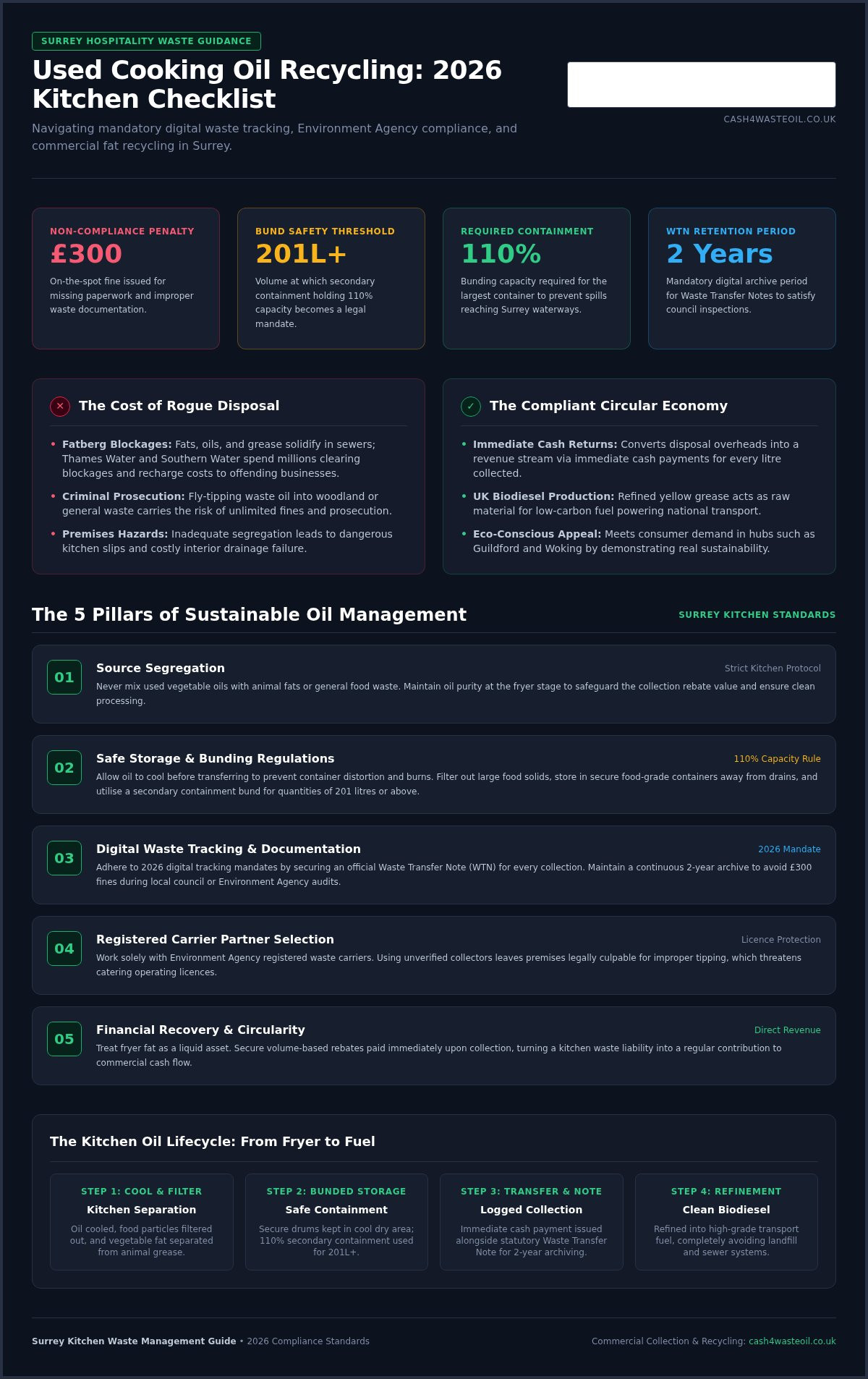
We understand that keeping a kitchen compliant whilst managing a busy service is a constant balancing act. You need a disposal system that works without constant supervision or messy overflows. This article outlines the essential 2026 sustainable kitchen checklist to ensure your business stays ahead of the latest mandatory digital waste tracking laws. You will discover how to transform your disposal routine into a clean, efficient process that generates immediate cash payments for your business. We will walk through the five pillars of sustainable oil management, from proper secondary containment to securing the legal Waste Transfer Notes you need to protect your licence.
Key Takeaways
- Learn how to navigate the 2026 digital waste tracking mandates and maintain a compliant two-year archive of Waste Transfer Notes to protect your business from Environment Agency fines.
- Discover how to transform a disposal overhead into a consistent revenue stream by securing immediate cash payments for every litre of oil collected from your premises.
- Implement the five essential pillars of used cooking oil recycling Surrey to ensure your storage area remains pest-free and meets the strict 110% bunding safety requirements.
- Optimise your kitchen workflow by adopting professional segregation and storage techniques that prevent hazardous slips and costly drainage blockages.
- Understand the role your kitchen plays in the local circular economy by partnering with licensed experts who refine waste fats into sustainable biodiesel.
Understanding Used Cooking Oil Recycling in Surrey
Used cooking oil (UCO) recycling is the professional process of collecting, refining, and repurposing waste vegetable fats from commercial environments. Instead of viewing old fryer fat as a burden, modern kitchens treat it as a raw material. This process, often technically described as used cooking oil recycling and yellow grease recovery, involves filtering out food particles and water to create a clean, high-energy product. Once refined, this oil becomes a primary feedstock for the UK biodiesel industry, powering transport networks with a significantly lower carbon footprint than traditional fossil fuels.
In 2026, the value of waste oil has never been higher. It's no longer acceptable to treat UCO as rubbish. For Surrey businesses, legal recycling is a strict requirement that separates professional operators from "rogue" kitchens. Attempting to dispose of oil through general waste or, worse, via "fly-tipping" in local woodlands, carries the risk of unlimited fines and criminal prosecution. By contrast, partnering with a licensed collector ensures your waste is handled transparently and contributes directly to the UK's renewable energy targets.
Why Surrey Businesses are Going Green
The hospitality sector in hubs like Guildford and Woking is facing a shift in consumer behaviour. Diners are increasingly choosing establishments that can prove their environmental credentials. Implementing used cooking oil recycling Surrey is one of the simplest ways to demonstrate this commitment. It allows pubs and restaurants to participate in a local circular economy that keeps resources in use for as long as possible. In the context of Surrey catering, the circular economy is a sustainable model where waste vegetable oil is captured and repurposed into high-grade biodiesel, ensuring that kitchen byproducts remain useful resources rather than environmental pollutants. This approach doesn't just help the planet; it builds a resilient brand that resonates with the eco-conscious local community.
The Environmental Impact of Improper Disposal
Improper disposal is a direct threat to Surrey's local infrastructure and natural beauty. When fats, oils, and grease (FOG) are poured down commercial sinks, they cool and solidify in the sewers. These deposits combine with other debris to form "fatbergs," which cause massive blockages and internal flooding. Thames Water and Southern Water spend millions every year clearing these obstructions, often recharging the costs to the offending businesses. Beyond the financial hit, a business linked to a local sewer collapse suffers a devastating blow to its reputation. By diverting waste from Surrey landfills and drainage systems, kitchens prevent groundwater contamination and protect the biodiversity of our local rivers and green spaces.
The Surrey Sustainable Kitchen Checklist: 5 Essential Pillars
Operating a professional kitchen in Surrey requires more than just culinary skill; it demands strict operational discipline. To ensure your business remains compliant and profitable, you must treat your waste fats with the same level of care as your fresh ingredients. Adhering to a structured checklist simplifies the logistics of used cooking oil recycling Surrey while protecting you from regulatory scrutiny.
- Source Segregation: Never mix vegetable oils with animal fats or general food waste.
- Safe Storage: Use secure, food-grade containers to prevent environmental contamination.
- Documentation: Secure a Waste Transfer Note for every collection to satisfy local council inspections.
- Partner Selection: Work exclusively with Environment Agency registered carriers.
- Financial Recovery: Turn your waste into a liquid asset through volume-based rebates.
Pillar 1: Efficient Oil Segregation and Storage
Effective management starts at the fryer. Always allow oil to cool before transferring it to storage drums to prevent burns and container damage. Filtering out large food particles helps maintain the quality of the oil, which can impact the rebate value you receive. Store your containers in a cool, dry area away from internal drains. If you store 201 litres or more, you are legally required to use secondary containment, or a "bund," capable of holding 110% of the largest container's capacity. This prevents spills from entering the Surrey water system, keeping you in line with UK business waste Duty of Care legal obligations.
Pillar 2: Verifying Your Surrey Collection Partner
Not all collectors operate to the same standard. Before handing over your waste, verify that your partner holds a current Environment Agency Waste Carrier Licence. A reputable local firm understands the specific logistical challenges of Surrey's high streets, from Woking to Reigate, and will offer prompt, reliable service. The gold standard for professional collection is a "cash on the spot" model. This provides immediate liquidity for your kitchen and proves the collector values your waste as a resource. Choosing a professional partner for used cooking oil recycling Surrey ensures your storage area stays tidy, so you might consider how to book a licensed oil collection for your premises.
Documentation is your primary defence against fines. With the mandatory UK digital waste tracking rollout taking effect on 1 October 2026, requirements for all commercial producers have tightened. You must retain all Waste Transfer Notes for a minimum of two years. These notes prove you've fulfilled your legal duty and that your oil hasn't ended up in a Surrey sewer. Finally, ensure you're receiving a fair market rate. In the current South East market, uncontaminated oil typically yields rebates between 15p and 30p per litre, turning a former waste expense into a genuine boost for your kitchen margins.
Compliance and Legality: Navigating Surrey Waste Regulations
Your legal Duty of Care is a perpetual responsibility. It doesn't end when the oil leaves your kitchen; it ends only when that oil is safely recycled. In Surrey, local council Environmental Health Officers (EHOs) and the Environment Agency are tightening inspections. Using an unlicensed "white van" collector might save a few minutes, but it risks your entire business. If they fly-tip your waste, the law traces it back to you. You're liable for the cleanup costs and the resulting criminal charges.
Waste Transfer Notes: Your Legal Shield
Every collection requires a Waste Transfer Note (WTN). This document is your primary evidence of compliance. It must detail the volume of oil, the date of collection, and the carrier's licence number. From 1 October 2026, the UK digital waste tracking service becomes mandatory. This means electronic WTNs and QR-coded logs are now the standard for used cooking oil recycling Surrey. You must retain these records for at least two years. Failure to produce a WTN on demand can result in an immediate £300 Fixed Penalty Notice. For a deeper dive into these requirements, read our Commercial Kitchen Oil Disposal: The 2026 Essential Compliance Checklist.
Environment Agency Oversight in Surrey
The Environment Agency (EA) actively monitors waste movements across the South East. They focus on identifying unlicensed carriers who undercut legitimate businesses. Only an EA-registered carrier provides the legal protection you need. Using a registered carrier is a legal necessity to ensure your business remains on the right side of UK environmental law. It's a non-negotiable requirement for any commercial kitchen. If you use an unregistered collector, you're technically in breach of the law from the moment the oil is loaded. Beyond the £300 FPNs, serious Duty of Care violations can lead to unlimited fines and the revocation of your operating licences. To avoid these risks, ensure you follow the government guidelines for commercial oil storage to prevent leaks and environmental damage. Protect your margins and your reputation by choosing a partner who provides instant, compliant documentation on-site.
Maximising Efficiency: Best Practices for Storing Waste Oil
Space is a luxury for most Surrey high-street kitchens. Whether you're operating a compact bistro in Reigate or a busy pub in Woking, every square inch counts. Efficient used cooking oil recycling Surrey relies on a storage setup that doesn't disrupt your service flow. A cluttered back area isn't just an eyesore; it's a bottleneck that slows down your team and increases the risk of accidents. By optimising your storage layout, you turn a messy chore into a seamless part of your closing routine.
The oil we collect is refined into biodiesel through transesterification. This chemical process separates glycerine from the vegetable oil to create a clean-burning fuel that yields up to 90% fewer greenhouse gas emissions than fossil diesel. Purity is paramount for this conversion. Even small amounts of water, cleaning chemicals, or animal fats can ruin a batch, which is why secure, dry storage is essential for the circular economy. Maintaining high-quality waste oil ensures your resource is fit for the UK's renewable energy transport network.
Health, Safety, and Pest Control
Outdoor storage areas are a magnet for pests if not managed correctly. Rodents can detect even small amounts of vegetable fat from a distance. You must ensure all lids are hermetically sealed after every pour to prevent attracting unwanted visitors. Training your staff on correct lifting and pouring techniques is equally vital. A full 20L drum is heavy; improper handling leads to back injuries and hazardous spills. Keep a dedicated spill kit and plenty of blue-roll near your collection point. This keeps your site professional and prevents oil from reaching the pavement or drains, maintaining a safe environment for both staff and the public.
Scheduling for Peak Times
Surrey's hospitality scene sees significant surges during the Christmas period and summer bank holidays. A fixed monthly collection might not be enough during these peak times. Overfilled drums lead to leaks, unpleasant smells, and potential complaints from neighbouring businesses. It's often better to use an "on-call" service to handle unexpected waste spikes. This proactive approach keeps your kitchen clean and your margins protected. For more detailed advice on managing your kitchen's output, see our Sustainable Waste Oil Disposal: A 2026 Guide for UK Commercial Kitchens.
If your storage area is reaching capacity, you can request a prompt waste oil pickup to keep your operations running smoothly and safely.
Choosing a Surrey Partner: Why Cash 4 Waste Oil Leads the Way
Selecting the right partner is the final, most critical step in the 2026 sustainable kitchen checklist. A reliable service should remove the burden of logistics whilst actively boosting your bottom line. We specialise in used cooking oil recycling Surrey, providing a dedicated service that caters specifically to the unique demands of the local hospitality sector. Our approach is designed to be no-nonsense; we arrive when scheduled, handle the heavy lifting, and leave your kitchen cleaner than we found it. By choosing a specialist who only handles waste collection, you ensure your kitchen receives the attention of experts who understand the legalities of waste management inside out.
The Cash 4 Waste Oil Advantage
Financial transparency is at the heart of our operations. Unlike many providers who rely on delayed bank transfers or complex invoicing, we operate a "Cash on the Spot" model. This provides your kitchen with immediate liquidity, turning your waste into a tangible asset the moment it leaves your premises. We pay a competitive rate per litre, ensuring you receive a fair market return for your resource. There are no hidden fees or service charges. Our professional package includes free collection across Surrey, including hubs like Epsom, Staines, and Elmbridge. We also provide free food-grade storage drums and generate instant, compliant Waste Transfer Notes on-site. Our drivers are local experts who understand Surrey's logistical challenges, ensuring your service is never disrupted by late arrivals or missed pick-ups.
Supporting the UK Circular Economy
Choosing a dedicated recycling partner is a direct investment in the UK's environmental future. We don't just dispose of your oil; we ensure it enters a high-value recycling stream. Every litre we collect is processed into sustainable biodiesel, a fuel that powers the transport industry whilst reducing greenhouse gas emissions by up to 90% compared to fossil alternatives. This journey from your fryer to the fuel tank is a perfect example of the circular economy in action. By partnering with us, you aren't just meeting your legal obligations; you're actively reducing the carbon footprint of the Surrey catering community. It's a pragmatic business decision that yields significant ecological benefits without any extra effort from your team. We take the hassle out of compliance so you can focus on running your kitchen.
Book your free Surrey waste oil collection today!
Future-Proof Your Surrey Kitchen Today
Managing a commercial kitchen is demanding enough without the added stress of waste logistics and regulatory threats. By following the 2026 sustainable checklist, you've seen how easy it's to secure your premises against Environment Agency fines whilst generating a new revenue stream. Professional used cooking oil recycling Surrey isn't just about disposal; it's about efficiency, safety, and participating in a local circular economy that converts waste into high-grade biodiesel.
We take the burden off your shoulders by providing a seamless, no-nonsense service. As an Environment Agency Registered carrier, we ensure you stay fully compliant with the latest digital tracking mandates. We provide free Waste Transfer Notes on-site and pay cash on the spot for every litre we collect. This immediate financial boost helps your margins whilst keeping your storage areas clean and pest-free.
Ready to streamline your operations? Get a free collection quote and cash for your oil in Surrey. Let's work together to make your kitchen more sustainable and profitable.
Frequently Asked Questions
Do you provide waste oil collection for residential homes in Surrey?
No, our service is strictly limited to commercial kitchens such as restaurants, pubs, and hotels. We don't offer residential collections or domestic household pickups. Our infrastructure is designed to handle the high-volume needs of the hospitality sector. If you run a catering business in the local area, we can arrange a professional collection, but we cannot assist with waste generated in a private home or domestic setting.
How much cash will I receive for my used cooking oil?
We pay cash on the spot based on the total volume of uncontaminated oil we collect from your premises. While market rates for used cooking oil recycling Surrey can fluctuate depending on global demand for biofuel feedstocks, we always offer a competitive rebate. The final amount depends on the quality and quantity of the vegetable oil. We'll measure the oil on-site and provide an immediate payment to boost your kitchen's daily liquidity.
Is a Waste Transfer Note mandatory for my Surrey restaurant?
Yes, a Waste Transfer Note (WTN) is a legal requirement under the Environmental Protection Act 1990. Every commercial business in the UK has a statutory Duty of Care to document where their waste goes. We provide a fully compliant WTN for every collection we perform. You must retain these records for at least two years to satisfy inspections from local council Environmental Health Officers or the Environment Agency.
Can you collect oil from pubs and hotels in Guildford and Woking?
Yes, our fleet regularly services commercial establishments across all major Surrey hubs, including Guildford and Woking. We understand the specific logistical challenges of these busy town centres, from narrow access roads to strict loading times. Whether you're a high-street bistro or a large hotel on the outskirts, we can schedule a reliable collection that fits your kitchen's operational hours. Our drivers are local experts who ensure a prompt, professional service every time.
What happens to the oil once it is collected from my kitchen?
Your waste oil is transported to a specialist facility where it's filtered and refined for the circular economy. The primary outcome for high-quality vegetable oil is the production of sustainable biodiesel. This renewable fuel is used across the UK transport network to reduce carbon emissions. By recycling your oil with a licensed partner, you're ensuring that a messy byproduct is transformed into a valuable energy resource that supports national sustainability targets.
Do I need to clean my oil before you collect it?
You don't need to perform professional refining, but basic kitchen maintenance is essential. We ask that you filter out large food debris and ensure the oil isn't contaminated with water, chemicals, or animal fats. Maintaining a high level of purity ensures the oil is suitable for biodiesel production. Clean, well-segregated oil is easier to process and helps you secure the best possible rebate for your kitchen's waste resource.
Can you provide the storage drums for the waste oil?
Yes, we provide free, food-grade storage drums to all our commercial clients. These containers are designed to be leak-proof and secure, helping you maintain a clean and safe storage area. We can supply various sizes to suit your kitchen's specific volume requirements. Using our professional drums ensures your used cooking oil recycling Surrey remains compliant with health and safety standards whilst preventing spills that could attract pests or cause accidents.
Are you an Environment Agency registered waste carrier?
Yes, we're a fully licensed and Environment Agency registered waste carrier. This registration is your guarantee that we operate within the strict legal framework of UK waste management laws. Using an unlicensed collector puts your business at risk of heavy fines and legal action. We take our regulatory responsibilities seriously, providing all the necessary documentation to prove that your waste has been handled responsibly and legally from start to finish.