Waste Fat Disposal near Canterbury: A Commercial Kitchen Guide
What if your used cooking oil could leave the kitchen with the paperwork in order and cash returned to your business? For commercial kitchens searching for waste fat disposal near Canterbury, a household food-waste caddy is not a substitute for a dedicated commercial collection. You need a practical way to manage used oil and keep a clear record of its transfer.
Commercial premises have a duty of care for their waste, so it matters who collects your oil and whether you receive a Waste Transfer Note. This guide explains how to arrange a collection near Canterbury, what to do with the paperwork and how collected oil is processed into sustainable biodiesel. It also covers how free collection with cash payment can benefit your business, without sending oil down the drain or treating it like ordinary household waste.
Key Takeaways
- For waste fat disposal near Canterbury, separate commercial used cooking oil from household food waste and choose a collection route suited to your kitchen.
- Keep a clear record when used oil leaves your premises and file the Waste Transfer Note with your business records.
- Compare disposal options by suitability, paperwork, payment and how the oil is recovered, not just by convenience.
- Prepare for collection by keeping used cooking oil separate from other waste and following your kitchen’s safe storage and handling procedures.
- Cash 4 Waste Oil provides commercial collection with cash payment and fully licensed, Environment Agency-registered handling.
Waste fat disposal near Canterbury: commercial oil or household food waste?
For a restaurant, pub, hotel or other commercial kitchen, waste fat disposal near Canterbury means managing used food-grade cooking oil generated during food preparation and frying. This is a separate waste stream from plate scrapings, food scraps and general kitchen rubbish. It also does not mean that every oily liquid can be disposed of in the same way.
This guide covers the collection of used vegetable and cooking oils from commercial kitchens near Canterbury, not household food waste or engine and industrial oils. Keeping these categories separate helps you choose the right collection route and avoid putting oil somewhere it does not belong.
What counts as commercial waste cooking oil?
Commercial waste cooking oil is food-grade vegetable or cooking oil that a business has used and no longer needs. It may come from a restaurant’s fryer, a pub kitchen or a hotel’s food-preparation area. The quantity and how it is produced will vary, but the key distinction is the source: used oil from commercial food service.
Food scraps are different. Leftover ingredients, peelings and plate waste are not liquid cooking oil, so keep them in their appropriate waste streams rather than mixing them together. Engine oil and industrial mineral oils are different again. They are not food-grade cooking oils and are not suitable for a used-cooking-oil collection.
Cash 4 Waste Oil collects used cooking oil from commercial kitchens. Separating oil as soon as it becomes waste makes the next step clear: arrange a dedicated collection instead of treating it as ordinary food waste.
Why the household food-waste caddy is not the answer
Canterbury City Council’s guidance on household food-waste collections excludes oil and liquid fat from the household food-waste caddy. That guidance is for domestic food-waste arrangements. A household caddy is not a commercial kitchen’s disposal route for used fryer or cooking oil.
Keep oil out of the caddy, even if it contains small amounts of food residue. Pouring it into a sink or drain is not a suitable alternative. Fats, oils and grease can combine with other material in sewers to form fatbergs; Fatberg formation and impact on sewers explains how these blockages develop.
For a business, use a dedicated commercial used-cooking-oil collection route. It keeps oil separate from household food scraps and other waste streams and gives your kitchen a clear handover to a collector. Council caddy guidance helps households sort food waste; commercial kitchens need a route designed for used cooking oil.
How commercial waste fat collection supports compliance near Canterbury
Good waste management does not end when used cooking oil leaves your premises. For waste fat disposal near Canterbury, a clear record of the collection helps your business document what was handed over and keep its waste paperwork organised. It also gives kitchen managers a straightforward way to track collections alongside other operational records.
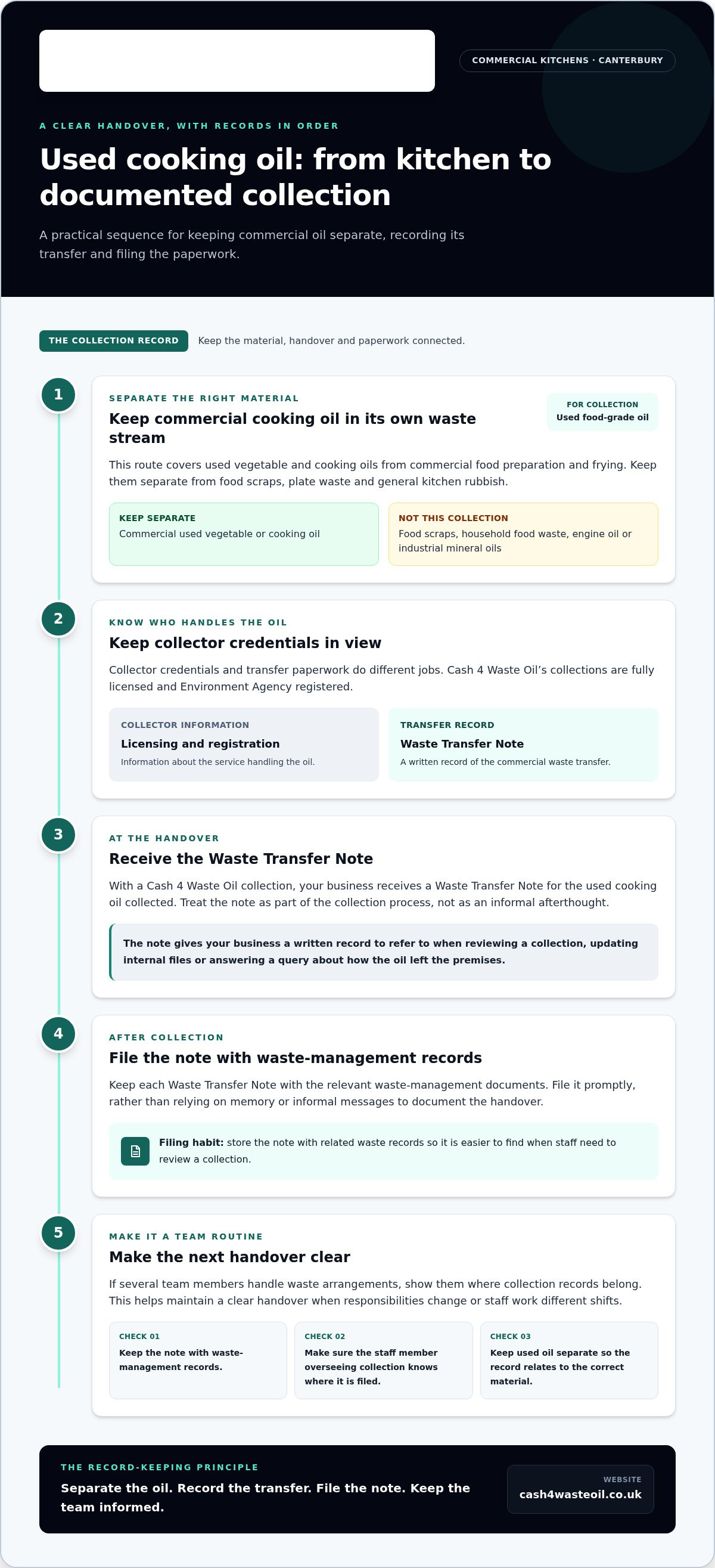
With a Cash 4 Waste Oil collection, your business receives a Waste Transfer Note for the used cooking oil collected. File the note with your relevant waste-management records rather than relying on memory or informal messages to document the handover.
What a Waste Transfer Note does for a business
A Waste Transfer Note records a commercial waste transfer. It gives your business a written record to refer to if staff need to review a collection, update internal files or answer a query about how used oil left the premises. Keep each note with related waste-management documents. A consistent filing routine makes records easier to find when kitchen responsibilities change.
Make the paperwork part of the collection process. Once the oil has been handed over, make sure you have the note and file it promptly. If several team members handle waste arrangements, show them where collection records belong. This simple routine helps prevent paperwork from being misplaced during busy service periods.
Why collector credentials matter
Credentials help a business understand who is handling its waste. Cash 4 Waste Oil’s collections are fully licensed and Environment Agency registered. Alongside a Waste Transfer Note, this gives your team information about the collector and a record of the transfer for your business files.
Paperwork and credentials serve different purposes. The note records the collection, while the collector’s registration and licensing provide information about the service handling the oil. Keep both in view, and do not assume that one document covers every part of waste management.
For a useful routine, assign responsibility for three simple checks:
- Keep the Waste Transfer Note with your waste-management records.
- Make sure the staff member overseeing the collection knows where the paperwork is filed.
- Keep used oil separate from other waste so the collection record relates to the correct material.
This approach is especially useful for kitchens with shift changes or several staff members involved in closing and waste handling. A clear handover tells the next person whether a collection has taken place and where its record is stored.
Cash 4 Waste Oil combines commercial used cooking oil collection with a Waste Transfer Note and fully licensed, Environment Agency-registered collections. To organise a documented oil handover for your kitchen, explore the commercial used cooking oil collection service.
Compare commercial cooking-oil disposal options near Canterbury
For a restaurant, pub, hotel or other commercial kitchen, the right route depends on whether the service handles used cooking oil, what paperwork it provides and what happens to the oil afterwards. A household food-waste caddy is not suitable for oil or liquid fat. General waste services are a separate category, so do not assume their arrangements cover commercial cooking oil.
Use this comparison to focus on practical fit rather than provider rankings. It distinguishes household instructions from commercial collection and shows what a dedicated oil service can offer.
| Option | Suitability for commercial cooking oil | Documentation | Payment approach | Recovery route |
|---|---|---|---|---|
| Household food-waste caddy | Not suitable. Canterbury City Council’s household guidance excludes oil and liquid fat. | Domestic food-waste guidance, not a commercial oil-transfer record. | No commercial oil payment arrangement. | Not a route for used cooking oil. |
| General waste service | Don’t assume it covers commercial used cooking oil; its purpose and arrangements can vary. | Oil-specific transfer paperwork should not be assumed. | Oil collection payment terms are not inherent to general waste services. | An oil recovery destination is not guaranteed by a general waste arrangement. |
| Dedicated commercial oil collection | Designed for used cooking oil from commercial kitchens. | Cash 4 Waste Oil provides a Waste Transfer Note. | Cash 4 Waste Oil’s collection is free, with cash paid on the spot. | Collected oil is processed into sustainable biodiesel. |
Which disposal route fits a Canterbury business?
A household caddy is for domestic food-waste arrangements, not a restaurant’s fryer oil or a hotel kitchen’s used cooking oil. A general waste service may handle other business waste, but that does not make it an oil collection route. For commercial kitchens, a dedicated used-oil collection is designed for this specific waste stream. It provides a defined handover instead of treating oil as food scraps or ordinary rubbish.
What to compare before arranging collection
Look beyond convenience. Compare whether the service handles commercial cooking oil, provides a Waste Transfer Note and has the relevant credentials. Also consider whether collection is free, whether your business receives payment and how the oil is recovered. These points show the practical difference between a general waste arrangement and an oil-specific service. With Cash 4 Waste Oil, collection is free, your business receives cash on the spot and a Waste Transfer Note, and collections are fully licensed and Environment Agency registered.
That makes waste fat disposal near Canterbury a practical business decision: use a commercial collection that documents the transfer and recovers the oil for biodiesel, rather than trying to fit it into a household or general waste route.
Prepare your kitchen for a waste oil collection
A clear routine makes a commercial used-oil handover easier for staff and keeps cooking oil separate from other waste. For kitchens arranging waste fat disposal near Canterbury, the process is straightforward: separate the oil, store it safely using your kitchen’s suitable arrangements, then organise a commercial collection.
Separate and store used cooking oil
Keep used food-grade cooking oil apart from food scraps, packaging, general rubbish and non-food oils. Engine oil and industrial mineral oils are different waste streams, not cooking oil. Do not put used oil or liquid fat in a household food-waste caddy. Clear separation helps staff identify what is ready for collection and prevents confusion during a busy shift.
Use the oil-storage arrangements suitable for your kitchen and follow your usual safe handling procedures. Keep the designated storage area clear and make sure the team knows which oil belongs there. Avoid mixing in food waste or other liquids; keeping the oil separate makes the collection handover easier to manage.
Prepare the handover and paperwork
Before arranging a collection, decide who will act as the kitchen contact. That person can coordinate the handover, tell staff where the oil is stored and take responsibility for the paperwork. Cash 4 Waste Oil offers scheduled or on-call commercial collections, so businesses can organise a collection around their needs.
Use this simple sequence:
- Separate used vegetable and cooking oil from food scraps, packaging and non-food oils.
- Store it safely using the kitchen’s suitable arrangements and handling procedures.
- Arrange a commercial collection, either scheduled or on-call.
- Keep the collection details and Waste Transfer Note with the business’s waste-management records.
After collection, file the Waste Transfer Note where the relevant staff can find it. A consistent process helps when the person who usually handles waste is away or responsibilities shift between team members. It also gives the business a clear record of the oil handover rather than leaving staff to rely on an informal note or memory.
Preparation need not add a complicated task to service. Agree the storage point, nominate a contact and decide how collection paperwork will be filed. Your team then has a repeatable routine, from separating the oil to recording its collection.
Ready to put that process in place? Arrange a commercial used-oil collection and keep your kitchen’s used cooking oil on a dedicated collection route.
Arrange Cash 4 Waste Oil collection near Canterbury
For a commercial kitchen, used cooking-oil collection should be simple and properly documented. Cash 4 Waste Oil provides free collection, pays cash on the spot for collected oil and supplies a Waste Transfer Note. Its collections are fully licensed and Environment Agency registered, giving your business a clear handover and a useful record for its waste files.
This commercial service collects used food-grade cooking oil from restaurants, pubs, hotels and other commercial kitchens. It gives businesses a dedicated route for oil instead of treating it as household food waste or general rubbish.
What the service means for your business
Free collection means there is no collection charge, while on-the-spot cash payment returns value to your business for the oil collected. Used cooking oil does not have to be just another disposal task. It can be managed as a separate waste stream, with payment and paperwork forming part of the handover.
The Waste Transfer Note records the transfer for your business files. Keep it with your relevant waste-management records so the team can refer to it later. Cash 4 Waste Oil’s fully licensed, Environment Agency-registered collections also provide information about who is handling the oil. For more on practical paperwork and kitchen responsibilities, read this guide to commercial kitchen oil disposal.
From used cooking oil to biodiesel
Collected cooking oil is processed into sustainable biodiesel, giving used oil a further use instead of treating it simply as material to discard. This is a practical circular-economy outcome alongside the immediate benefits of collection, payment and a transfer record.
If you are reviewing how your kitchen handles used oil, the sustainable waste oil disposal guide offers further context on responsible recovery. A dedicated collection and clear paperwork can make waste fat disposal near Canterbury easier to manage as part of regular kitchen operations.
Keep the process straightforward: separate used cooking oil, arrange a commercial collection and file the Waste Transfer Note when the handover is complete. Your business receives cash on the spot, while the collected oil enters a biodiesel recovery process.
Arrange your waste oil collection for your commercial kitchen.
Make used-oil collection part of your kitchen routine
Make waste fat disposal near Canterbury a simple, repeatable part of kitchen operations. Set a clear place for storing used cooking oil, decide who oversees each handover and file the collection record with your business paperwork. A consistent routine helps staff manage the oil without adding uncertainty to a busy service.
Cash 4 Waste Oil offers commercial kitchens free scheduled or on-call collection, with cash paid on the spot and a Waste Transfer Note. Its collections are fully licensed and Environment Agency registered, and the collected oil is processed into sustainable biodiesel. It is a practical way to organise this waste stream and recover value from used oil.
Take the next step and put a dedicated collection arrangement in place for your kitchen. Arrange a free commercial used-oil collection and make used-oil handling easier for your team.
Frequently Asked Questions
Can I put cooking oil in Canterbury’s household food-waste caddy?
No. Canterbury City Council’s household food-waste guidance excludes oil and liquid fat from the caddy. Do not tip leftover frying oil into the caddy with plate scraps or peelings. The household instructions apply to domestic food-waste collections, not commercial kitchen oil. If you run a restaurant or pub, keep used cooking oil separate and arrange a collection intended for commercial premises.
Who collects used cooking oil from commercial kitchens near Canterbury?
Cash 4 Waste Oil collects used cooking oil from commercial kitchens in Kent, including restaurants, pubs and hotels. Its collection locations also include London, Greater London, Surrey, Birmingham, Coventry, Leicester, Wolverhampton, Leicestershire, Derbyshire, Staffordshire, Warwickshire, Northamptonshire, Oxfordshire and Worcestershire. Businesses in the Canterbury area should use a commercial collection route for food-grade cooking oil rather than a domestic food-waste service.
Is commercial cooking-oil collection free near Canterbury?
Yes. Cash 4 Waste Oil provides free collection of used cooking oil from commercial kitchens and pays cash on the spot for the oil collected. A kitchen can arrange a waste-handling service while receiving payment for its used oil, rather than treating it as ordinary rubbish.
What paperwork should I receive when waste cooking oil is collected?
You should receive a Waste Transfer Note for the collected oil. Keep it with your business’s waste records and make sure the relevant manager or kitchen contact can locate it later. If a collection takes place during a staff handover, tell the colleague responsible for records where the note has been filed. This links the collection with the business paperwork.
Does a waste-oil collector need to be Environment Agency registered?
Commercial businesses should use a registered waste carrier for waste collections. Cash 4 Waste Oil’s collections are fully licensed and Environment Agency registered. These credentials help identify the collector handling your used cooking oil, while the Waste Transfer Note records the individual handover. Keep the note and collection details together so your team can find the relevant information if it needs to review the transfer.
Can domestic households use a commercial waste cooking-oil collection service?
No. Cash 4 Waste Oil’s used cooking-oil collection is for commercial kitchens, not domestic households. A household with leftover frying oil should not put it in Canterbury’s food-waste caddy, as the council’s household guidance excludes oil and liquid fat. Restaurants, hotels and other commercial kitchens can use a dedicated business collection; this service is not for home kitchens.
What happens to collected used cooking oil?
Collected cooking oil is processed into sustainable biodiesel. It is not returned to the kitchen as fresh cooking oil. This gives a food-service by-product a further use as biodiesel feedstock rather than leaving the business to treat it as an unwanted liquid. For a restaurant or hotel, that recovery route connects routine oil handling with recycling.