Waste Oil Buyers London: The 2026 Guide to Selling Used Cooking Oil
The used cooking oil sitting in your store room is no longer just a disposal headache; it's a liquid asset that the Environment Agency is now monitoring with unprecedented precision. You're likely fed up with unreliable collectors who vanish when you need them most, leaving you with an oily mess and the fear of a £118 hourly non-compliance charge. Finding the most professional waste oil buyers London has available is now a matter of legal survival. No mess. No fines. Just cash.
We understand that you want to clear your floor space without the stress of missing paperwork. This guide ensures you never have to choose between a clean kitchen and legal peace of mind. You'll discover how to secure immediate cash payments whilst staying ahead of the mandatory Digital Waste Tracking service launching in October 2026. We'll break down the essential EWC codes for your transfer notes, the latest permitting rules, and the simple steps to turn your commercial waste into a seamless, profitable revenue stream.
Key Takeaways
- Learn how the top waste oil buyers London has to offer are moving beyond simple free collection to provide instant financial returns for your kitchen.
- Master the legal requirements of Waste Transfer Notes to ensure your business remains fully compliant with the latest Environment Agency regulations.
- Evaluate the differences between immediate cash payments and account credits to choose the best financial model for your pub or restaurant.
- Discover professional storage techniques that protect your oil quality and maximise the rebate you receive per litre upon collection.
- Explore how your kitchen waste supports the UK circular economy through high-yield biodiesel production and sustainable waste management.
Finding the Best Waste Oil Buyers in London (2026 Update)
London's commercial kitchens are under constant pressure. Between rising operational costs and stricter environmental oversight, every resource counts. Used cooking oil (UCO) is no longer a waste product to be hidden away; it's a valuable feedstock for the renewable energy sector. While many waste oil buyers London businesses encounter might offer free collection, this is merely the baseline for service in 2026. You should expect a partner that provides financial returns, not just a removal service. The current landscape demands total transparency; you need a partner who understands that your time is as valuable as the oil itself.
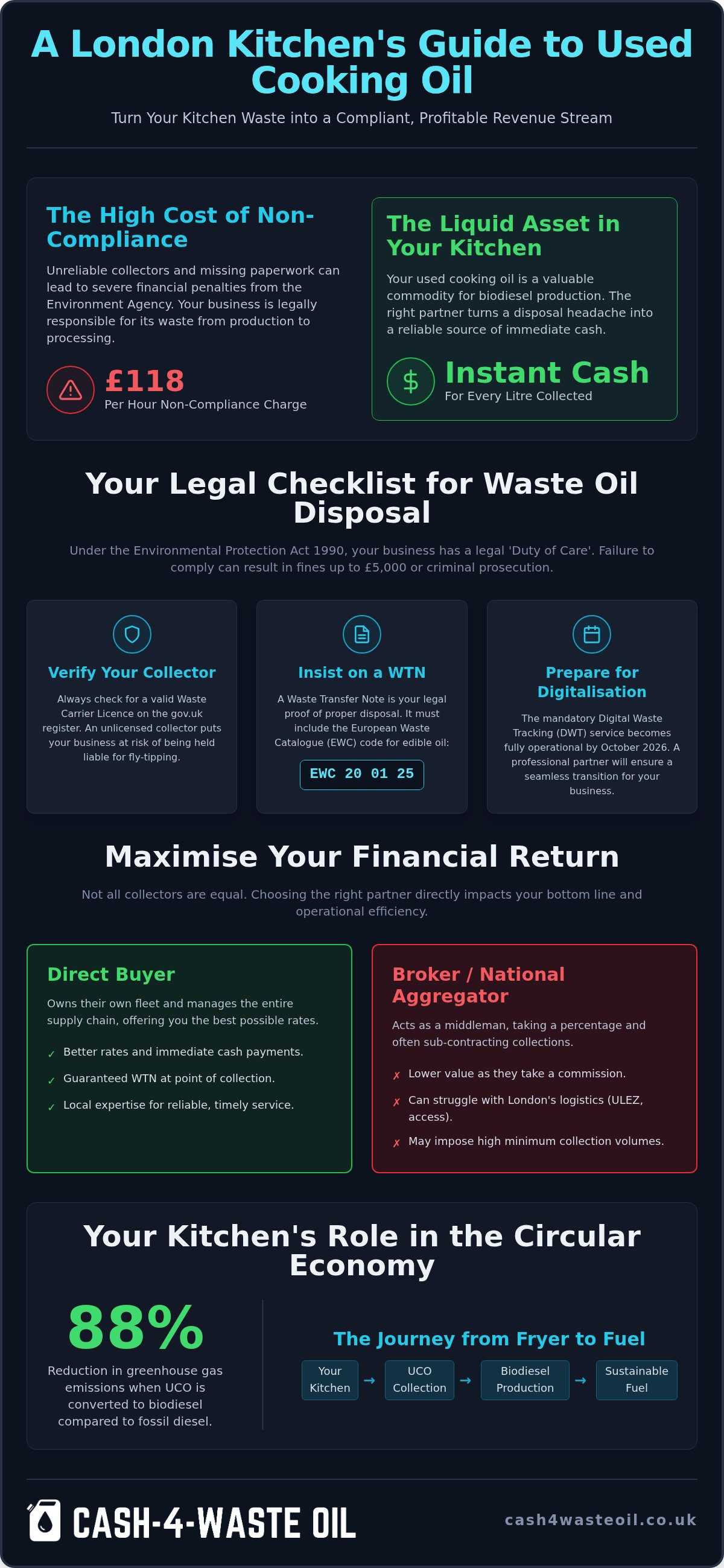
Distinguishing between brokers and direct buyers is vital for your bottom line. Brokers act as middlemen, taking a percentage of the oil's value before it reaches the processing plant. Direct buyers own their fleet and manage the entire supply chain. Choosing a direct, local specialist over a national aggregator often means better rates from waste oil buyers London kitchens can actually rely on. National firms frequently struggle with London's unique logistical hurdles or impose high minimum collection volumes that don't suit a busy Soho bistro or a Camden pub. Working with a specialist like Cash 4 Waste Oil guarantees that you receive a Waste Transfer Note at the point of collection, fulfilling your Duty of Care immediately.
The Value of Your Kitchen’s Waste Vegetable Oil
The push for sustainable fuel has transformed the value of your waste vegetable oil. Biodiesel produced from UCO can reduce greenhouse gas emissions by up to 88% compared to standard fossil diesel, making your waste a hot commodity. Several factors influence the price per litre, including the current global biodiesel market and the purity of your oil. Beyond the financial gain, regular collections are essential for kitchen hygiene. Stagnant oil attracts pests and creates slip hazards. Prompt removal keeps your workspace clear, prevents foul odours, and ensures your staff remain safe during the busiest shifts.
Service Areas: From the City to Greater London
Operating a fleet in the capital requires expert knowledge of the ULEZ and Congestion Charge zones. Professional collectors integrate these costs into their business model to ensure your pickups aren't delayed by logistical or financial oversights. Whether your kitchen is in Soho, Mayfair, or Camden, local proximity is a major advantage. It reduces the total miles travelled for each litre of oil, lowering the overall carbon footprint of your waste management. Choosing a buyer with specific London borough expertise ensures they understand the narrow access routes and specific loading restrictions unique to your neighbourhood, providing a reliable service that national aggregators simply can't match.
Legal Compliance: Waste Transfer Notes and Environment Agency Rules
Compliance is the backbone of any professional commercial kitchen. A Waste Transfer Note (WTN) is a legal document that tracks your oil from the fryer to the recycling centre. Under the Environmental Protection Act 1990, every London business has a Duty of Care for the waste they produce. This means you are legally responsible for your used oil until it is properly processed. If you hand your oil over to unlicensed collectors and they fly-tip it, the Environment Agency will hold you liable. You could face significant fines or even criminal prosecution.
Unlicensed collectors pose a massive risk to your business. If your oil is discovered in a public sewer or fly-tipped in a London borough, the trail leads back to you. The Environment Agency now issues hourly non-compliance charges of £118 for breaches of waste regulations. These costs mount up quickly during an investigation. It is far cheaper and safer to use legitimate waste oil buyers London businesses can trust; the risk to your brand reputation is simply too high to ignore.
Environment Agency Registration Explained
Always verify a collector's waste carrier licence on the gov.uk register before they touch your oil. It takes seconds but protects your brand reputation. The 2026 regulations now require operators to undergo criminal record checks and demonstrate technical competence. A licensed buyer is your best defence against local council audits. They provide the legal proof that you have handled your waste responsibly, keeping your business safe from the £5,000 fines local water authorities can issue for illegal oil discharge into public sewers.
The Paperwork Trail: From Frying Pan to Biodiesel
A compliant WTN must include the correct European Waste Catalogue (EWC) code; for edible oil, this is 20 01 25. By October 2026, the mandatory Digital Waste Tracking (DWT) service will be fully operational across England. This system provides regulators with real-time data on your waste output. Ensure your kitchen stays on the right side of the law by choosing a fully licensed waste oil collector that provides compliant documentation every time. For London caterers, the Duty of Care is a legal obligation to ensure that all waste is managed responsibly and handed only to authorised persons. You must retain these records for at least two years to satisfy Environment Agency inspectors.
Comparing London Oil Collectors: Cash Payments vs. Account Credits
Managing a commercial kitchen requires constant focus on cash flow. When you vet waste oil buyers London has to offer, you'll find two primary payment models: account credits and cash on the spot. Account credits are often favoured by large national aggregators. These credits might sit in a portal for weeks or be used to offset other service costs. For many London pubs and takeaways, this is a cumbersome approach. It adds administrative weight to an already busy schedule. Cash payments provide immediate liquidity. You receive the value of your waste oil the moment it leaves your premises.
Watch out for hidden fees that can erode your rebate. Some collectors might advertise a high price per litre but then deduct costs for container rentals, admin fees, or environmental surcharges. A truly transparent buyer provides a clear, all-inclusive rate. Your rebate should be a straightforward calculation based on the volume of oil collected. Higher volumes generally command better rates. In high-volume environments like large hotel kitchens or busy fish and chip shops, these rebates can contribute hundreds of pounds back to the budget annually. Even smaller independent cafes should expect a fair return without being penalised by surprise service charges.
Benefits of Immediate Cash for Your Business
Instant payments turn a waste product into a flexible financial tool. Many kitchen managers use this cash to top up petty cash for daily incidentals like emergency milk runs or fresh herbs. It's also an excellent way to fund staff incentive programmes. Small bonuses paid directly from oil rebates can significantly boost morale during high-pressure shifts. You bypass the slow cycle of bank transfers and monthly invoicing. This speed is a major advantage for businesses that need to remain agile in a competitive market. You get paid for what you've produced today, not what you produced three weeks ago.
Transparency in Pricing and Measurement
Accuracy matters when measuring your output. Ensure your collector uses verified equipment to record the actual litres collected. Don't rely on guesswork. The quality of your oil also impacts the final rebate. High levels of water or food contamination reduce the biodiesel yield, which may lower the price you receive. Keep your oil clean and covered to maximise its value. Establishing a consistent collection schedule also helps with financial planning. When you know exactly when your oil will be collected, you can predict exactly when that cash will hit your hand. This reliability is why many waste oil buyers London businesses choose to work with local, specialist teams.
Maximising Your Rebate: Storage and Oil Quality Tips
The rebate you receive depends heavily on the purity of the liquid you provide. Professional waste oil buyers London wide look for high-quality feedstock because clean oil yields more biodiesel. Contaminated oil requires extensive processing; this lowers its market value and your potential return. Proper storage isn't just about tidiness; it's a financial strategy. If you treat your waste oil as a product rather than a nuisance, your bottom line will reflect that effort.
Safety protocols are non-negotiable in a commercial environment. The Control of Pollution (Oil Storage) Regulations 2001 require businesses storing over 200 litres of oil to use secondary containment, such as a bunded tank or a drip tray. This prevents leaks from reaching the drainage system. Spills are not just messy; they're expensive. Local water authorities can issue fines of up to £5,000 for the illegal discharge of oil into public sewers. Keep your storage area clear of combustible materials and ensure all containers are clearly labelled to prevent accidents during busy shifts.
Avoiding Contamination and Sludge
Water is the primary enemy of used cooking oil. When water mixes with oil, it triggers hydrolysis, which breaks down the oil and produces foul odours. Similarly, food debris left in the drums will ferment, creating a thick sludge at the bottom. Never mix your cooking oil with engine oil, cleaning chemicals, or mineral oils. This makes the entire batch unrecyclable. Use a simple sieve when pouring oil into your containers to catch large food particles. This small step ensures you provide a premium product to your waste oil buyers London partner, guaranteeing the best possible price per litre.
Optimising Storage Space in Compact London Kitchens
London kitchens are notoriously tight on space. If you're managing a Soho basement or a narrow Mayfair prep area, 60-litre blue barrels are often more practical than large 1,000-litre IBCs. Barrels are easier to manoeuvre through tight corridors. If you store oil outdoors, ensure the containers are secure and lidded to prevent pest infestations and rainwater ingress. Position your collection point as close to the street level as possible. This allows for rapid, hassle-free access during pickups. If you're ready to clear your floor space and turn that waste into profit, arrange a professional used cooking oil collection and get paid on the spot.
Why London Kitchens Trust Cash 4 Waste Oil for Reliable Collection
Reliability is the most critical factor when choosing between waste oil buyers London has on offer. You need a partner that understands the high-pressure environment of a commercial kitchen. If a collector fails to show up, your storage area becomes a hazard and your operations slow down. Cash 4 Waste Oil provides a dependable, local service that prioritises your schedule. We operate with a no-nonsense approach; we arrive when we say we will and handle the heavy lifting for you. This allows your team to focus on service while we manage the logistics of your liquid waste.
Our commitment to London's circular economy is absolute. Every litre of used cooking oil we collect is diverted from landfills and sewers. Instead, it is processed into high-grade biodiesel. This sustainable fuel reduces greenhouse gas emissions by up to 88% compared to standard fossil diesel. By choosing a professional collector, you directly support the UK's renewable energy goals. We ensure your business remains fully compliant with both Environment Agency regulations and local authority requirements. This isn't just about waste removal; it's about being a responsible partner in a modern, sustainable city.
Our Seamless 3-Step Collection Process
We've designed our service to be as hassle-free as possible. Follow these three steps to turn your waste into cash:
- Book: Contact us via our online form or phone to schedule your free collection. We offer weekly, fortnightly, or on-call slots to suit your kitchen's volume.
- Uplift: Our licensed drivers arrive at your London premises. We pump out the oil or swap your containers quickly and cleanly.
- Payment: We pay you cash on the spot and issue a mandatory Waste Transfer Note immediately. You get instant liquidity and instant legal compliance.
Serving the Hospitality Industry Across the South East
Our expertise extends beyond the capital. We provide the same reliable service to kitchens across Kent and Surrey, ensuring regional pub groups receive a consistent experience. We recently helped a busy London-wide pub group streamline their waste management by synchronising their collection days across twelve sites. This reduced their administrative burden and ensured every manager remained compliant without constant oversight. Whether you manage a small cafe or require professional service for London hotels, our team delivers results. Don't let waste oil clutter your kitchen or risk your compliance status. Get a quote for your waste oil today and experience a faster, more professional way to recycle.
Turn Your Waste Oil Into a Strategic Asset
Manage your commercial kitchen with total confidence by turning your used cooking oil into immediate liquidity. You now have the tools to navigate the 2026 Digital Waste Tracking requirements whilst ensuring your kitchen remains safe, clean, and profitable. Professional waste oil buyers London specialists like Cash 4 Waste Oil ensure that your legal Duty of Care is met with every single uplift.
As an Environment Agency Registered Waste Carrier, we offer a fully licensed London-wide service designed specifically for the fast-paced hospitality sector. We don't make you wait for bank transfers or complex account credits. Instead, we provide immediate cash payments on collection along with your mandatory Waste Transfer Note. It's the simplest way to clear your floor space and reward your team for their hard work.
Book your free waste oil collection and get paid cash today. Take control of your kitchen waste and start seeing the financial benefits of a smarter, more sustainable disposal strategy.
Frequently Asked Questions
Do you provide free waste oil collection in Central London?
Yes, we provide free used cooking oil collection across Central London and the surrounding boroughs. Our service area includes busy commercial hubs like Soho, Mayfair, and Camden, as well as extending into Kent and Surrey. We understand the logistical challenges of the capital, including ULEZ and Congestion Charge zones, and we manage these costs internally. This ensures your kitchen receives a prompt, professional uplift without any call-out fees or hidden service charges.
How much do waste oil buyers pay per litre in 2026?
Payment rates for used cooking oil are determined by the current global biodiesel market and the quality of the oil provided. While some waste oil buyers London has available might offer fixed rates, we provide competitive rebates based on the volume and purity of your specific batch. To ensure you receive the maximum return, keep your oil free from water and food debris. Contact us for a real-time quote tailored to your kitchen's output.
Is a Waste Transfer Note really necessary for my small café?
Yes, a Waste Transfer Note is a mandatory legal requirement for every commercial entity, regardless of size. Whether you run a large hotel or a small independent café, you must possess a WTN for every load of waste that leaves your premises. This document proves you have fulfilled your legal Duty of Care under the Environmental Protection Act. Failing to produce these records during a council or Environment Agency audit can result in significant fines.
Can you collect waste oil from a basement kitchen in Soho?
We specialise in navigating difficult access points, including basement kitchens and narrow alleyways in Soho. Our team uses various container sizes, such as 60-litre blue barrels, which are much easier to manoeuvre through tight corridors and stairs than large industrial tanks. We pride ourselves on being the most adaptable waste oil buyers London businesses can hire, ensuring that even the most compact urban sites receive a seamless, rapid collection service.
What happens to the used cooking oil after it is collected?
Your used cooking oil is transported to a specialist facility where it is refined into sustainable biodiesel. This process is a key part of the circular economy, transforming a waste product into a low-carbon fuel source. Biodiesel produced from UCO can reduce greenhouse gas emissions by up to 88% compared to traditional fossil diesel. By recycling your oil with us, your kitchen actively contributes to the UK's renewable energy targets and reduces environmental impact.
Do you collect waste oil from residential properties?
No, we don't provide collection services for residential properties or household waste. Our operations are strictly focused on commercial kitchens, pubs, restaurants, and catering businesses. If you are a domestic resident looking to dispose of small amounts of cooking oil, we recommend contacting your local London borough council. They can provide information on nearby household waste recycling centres that are equipped to handle residential vegetable oil disposal safely and legally.
What should I do if my oil storage area is hard to access?
If your storage area is difficult to reach, please inform our team during the booking process so we can plan accordingly. We have extensive experience in managing restricted access sites across London and can deploy specialist equipment or smaller containers to facilitate the uplift. Clear communication allows us to maintain our no-nonsense approach, ensuring the collection is fast and tidy without causing any disruption to your kitchen's busy service hours or staff.
Are there any hidden costs for the Waste Transfer Note?
No, there are absolutely no hidden costs or administrative fees for your Waste Transfer Note. We provide a compliant WTN free of charge with every single collection we perform. Transparency is a core value of our business, so the price we quote for your oil is the price you receive in cash. You won't face deductions for paperwork, container rentals, or environmental surcharges, ensuring your rebate stays exactly where it belongs in your pocket.