Waste transfer note requirements for your business
Every load of non-hazardous business waste needs a clear paper trail. If you’re getting a waste transfer note for your business, each load moved from your premises must be covered by a note or a document containing the same information. Keep copies for at least two years.
It’s easy to assume the carrier handles all the paperwork. The note still needs an accurate description of the waste and the required transfer details, giving both the business passing on the waste and the receiver a clear record.
This guide explains what a Waste Transfer Note must include, when a season ticket can cover repeat collections, and how to obtain and keep the right records. It also distinguishes non-hazardous waste transfers from hazardous waste, which requires separate documentation. You’ll learn how the paperwork supports your business’s waste duty of care.
Key Takeaways
- Find out when each business waste transfer needs its own note and when a season ticket may cover repeat movements.
- Learn which waste and business details make a transfer note useful for safe handling and traceability.
- Understand what to expect from a carrier’s paperwork and how to keep transfer records ready for inspection.
- See how Waste Transfer Notes from Cash 4 Waste Oil fit into commercial used cooking oil collections.
What are Waste Transfer Notes?
A Waste Transfer Note records the movement of business waste from one party to another. It supports the duty of care that applies when businesses handle controlled waste.
What a transfer note records
A waste transfer note identifies the parties, the transfer, the waste and its destination. It should describe the type of waste and record its European Waste Catalogue code, quantity, packaging and handling instructions. This information helps the receiving business handle and dispose of the waste safely.
The note also records the transfer date and time, a declaration that the information is accurate, and relevant compliance details, including permits and emergency contacts. These records make it easier to trace a load if questions arise about its destination or handling. Describe the waste accurately: the business producing it is best placed to explain what it contains.
For repeat movements of non-hazardous waste, a season ticket can cover transfers for up to a year. Keep its schedule with the note. Record the date, time and quantity of each transfer, and include the site where required. If every transfer uses the same site, you can record it once on the season ticket. A spreadsheet, invoice or weighbridge record can hold schedule details.
UK rules and local guidance
Waste transfer note rules share a duty-of-care foundation across the UK, but forms and some requirements differ between nations. Section 34 of the Environmental Protection Act 1990 establishes the duty of care for people who handle controlled waste in the UK, according to The National Archives (legislation.gov.uk).
In England, businesses with 10 or more employees have been required to separate specified waste streams before collection since 31 March 2025, according to the Department for Environment, Food & Rural Affairs. For local requirements, use the guidance and forms published for the nation where the transfer takes place, alongside relevant council information. In Northern Ireland, the note must state that the waste hierarchy has been applied.
Keep waste transfer notes for at least two years. Retain a season ticket and its schedule for two years after the last transfer. Store paper records securely. Electronic records are also acceptable if stored securely and readily retrievable when an enforcement officer requests them.
A standard waste transfer note covers non-hazardous controlled waste. Hazardous waste requires a separate hazardous waste consignment note, which you must retain for three years from the transfer date. A season ticket also needs replacing if the waste holder, carrier or type of waste changes.
Waste transfer note requirements and required information
A valid waste transfer note gives both businesses a clear record of what changed hands. Complete each field accurately so the receiving business can handle the waste safely and the document supports your duty of care.
Information required on the note
The note identifies both parties and describes the waste, its quantity and destination. Include the waste’s six-digit European Waste Catalogue code and the producer’s five-digit Standard Industry Classification code. Add the transfer date and time, packaging details, handling instructions, and relevant permit or emergency contact information. These details explain what the load contains and how it should be managed.
Use a precise description rather than a broad label such as “rubbish”. Identify the material and its condition so the receiver can distinguish it from other waste. As the producer, you are best placed to describe it accurately, so don’t rely on the carrier to make that assessment.
Signatures and completion steps
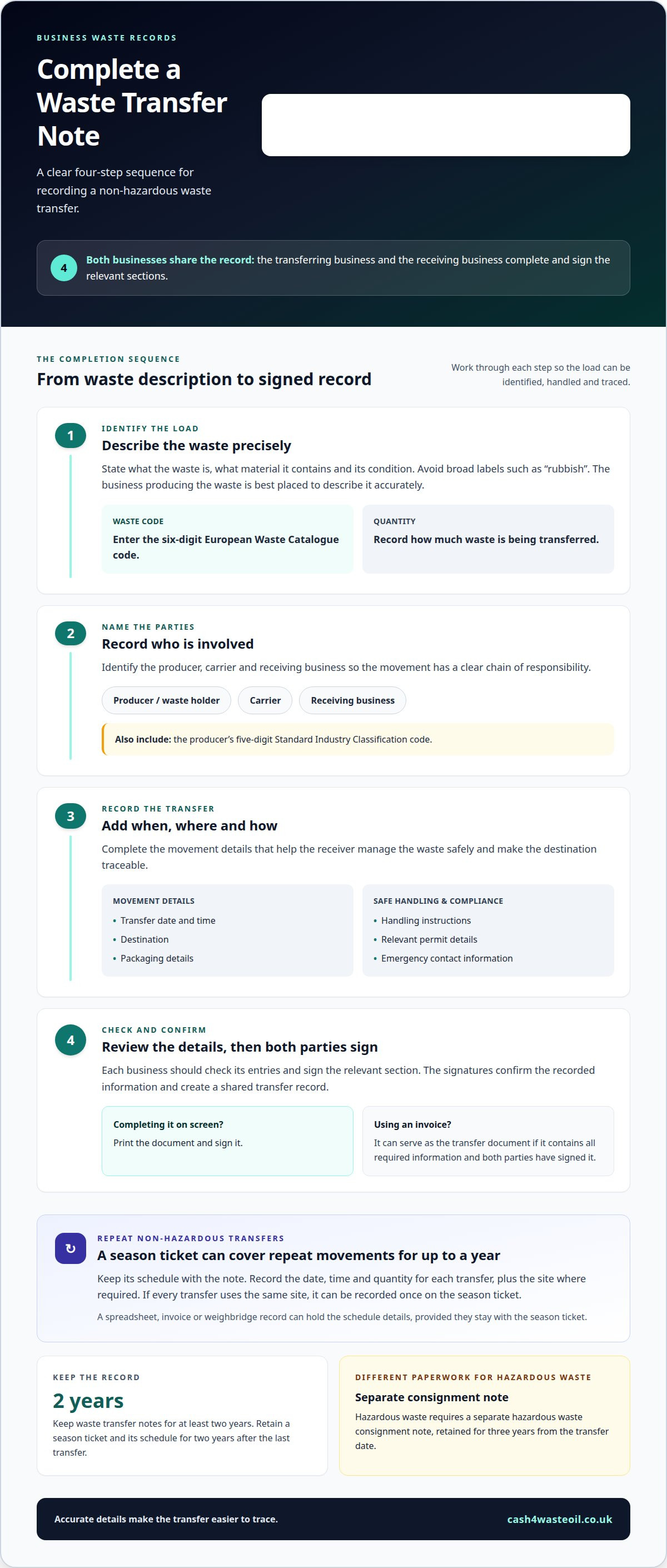
A waste transfer note is the record completed by the business transferring waste and the business receiving it. Both parties must complete and sign the relevant sections. Their signatures confirm the recorded information and create a shared record of the transfer.
To complete a note, identify the parties and describe the waste, including its code and quantity. Then add the transfer details, destination and handling information. Both businesses should review their entries and sign. If you complete the document on screen, print and sign it.
Use this information as a practical sequence when preparing a note:
- Describe the waste clearly and enter its code and quantity.
- Record the producer, carrier and receiving business details.
- Add the transfer date, time, destination and handling instructions.
- Complete any applicable compliance details, then have both parties sign.
An invoice can serve as the transfer document if it contains all the required information and both parties have signed it. The title matters less than the contents: missing waste details, party information or signatures can leave the record incomplete.
For repeat transfers covered by a season ticket, record each movement in its schedule. Include the date, time and quantity, plus the site where required. A spreadsheet, invoice or weighbridge record can hold these entries, provided it captures the relevant details and stays with the season ticket.
Keep the completed note and any schedule together so the transfer can be traced later. For a commercial kitchen arranging used cooking oil collections, used cooking oil transfer paperwork forms part of documenting the movement.
Getting a waste transfer note from a carrier
A waste carrier commonly provides a transfer note as part of collection and disposal. The paperwork may look different from another carrier’s because there is no standard note format.
Checking carrier registration
Carrier registration identifies a waste carrier authorised to transport waste and helps you trace who takes a load from your premises. Ask for the carrier’s registered name and registration details, then check they match the business collecting your waste.
Keep the registration information with the transfer note and collection records. If a different business or vehicle handles a later collection, record who actually receives the waste. The note should identify the relevant parties and make clear which carrier took responsibility for the load.
Checking carrier authorisations
Authorisations show whether the receiving business has the relevant registration, permit or exemption for that type of waste. Check that the authorisation is appropriate to the waste and destination. A carrier’s registration does not necessarily cover every treatment or disposal activity.
A carrier may transport waste to a separate treatment facility. In that case, the destination and relevant facility details help maintain a traceable chain of custody. Keep the note and any schedule showing where the load went, so your records connect collection with its intended waste management route.
Before collection, ask the carrier for its waste transfer note and ensure the form has sections for both parties. The form should capture the waste description, quantity, date and time, destination, and other required transfer information. A carrier’s template may have a different layout, but it must still support safe handling and disposal.
Use the collection details to make the record specific:
- Match the carrier and receiving business names to the organisations involved.
- Describe the waste and identify its type, quantity and destination.
- Record the actual transfer date and time, not an estimated collection slot.
- Complete and sign the relevant sections with the receiving business.
A signed form does not prove that every part of the route is covered. The business transferring waste must ensure the person receiving it has the relevant authorisation. Keep the note even when the carrier handles the paperwork, and make sure the completed record describes the actual load. Whether managing site waste or arranging vehicle scrapping through scrapcar123.co.uk, always confirm that the collector operates an authorised, compliant route.
Waste businesses must ensure each load they receive or pass to another party is covered by a transfer note, except household waste received directly from its householder producer. If a carrier illegally disposes of your waste, report the incident through an appropriate reporting channel. A complete note supports the evidence trail, but accurate records and appropriate authorisations remain essential parts of responsible waste management.
When a waste transfer note is required
A UK business needs a Waste Transfer Note, or a document containing the same information, for each load of non-hazardous waste moved from its premises. This applies whether the waste is collected once or produced through regular commercial activity.
For example, a restaurant sending packaging waste for collection needs a transfer record. The note documents who passed on the waste, who received it and what happened to it. A valid record helps show that the waste was handed to an appropriate recipient for proper handling and disposal, rather than abandoned without a traceable route. Similar principles of chain-of-custody apply when businesses retire automotive assets, where specialist vehicle salvage operators such as Rapid Car Removal manage the collection and processing of unwanted or wrecked commercial cars and vans.
For repeat movements, a season ticket can cover multiple transfers of non-hazardous waste for up to a year. It is useful when the waste holder, carrier and type of waste remain the same. If any of these changes, use a new season ticket or a single transfer note. In Wales, a business transferring non-hazardous waste to another business must complete a note with the recipient each time.
A season ticket does not remove the need to record individual movements. Keep a schedule with it and enter the date, time and quantity for each transfer. Record the site as well where required. If the transfer site stays the same, the season ticket can state it once. A spreadsheet or invoicing record can hold schedule details, provided each entry clearly identifies the movement.
Each note or equivalent document should include enough information to describe the transfer and the waste. Include:
- The names and details of the businesses transferring and receiving the waste.
- The transfer date and time, plus the quantity moved.
- A clear waste description and its six-digit European Waste Catalogue code.
- The producer’s five-digit Standard Industry Classification code.
- The destination and relevant packaging or handling instructions.
Both parties must complete and sign their relevant sections. The information should help the receiving business handle the load safely and follow its intended route. You can use an invoice as the transfer document only if it contains all the required information and both parties have signed it.
Waste separation rules can also affect collections. In England, businesses with 10 or more employees have been required to separate specified waste streams before collection since 31 March 2025, according to the Department for Environment, Food & Rural Affairs. Separate streams need records that accurately describe each type of waste, rather than combining them under a vague label.
Keep the completed records available for enforcement. A local council can issue a £300 fixed penalty notice for failing to have a valid Waste Transfer Note. That paperwork is not a substitute for proper handling, but it provides evidence of the transfer and helps maintain a traceable chain from business premises to disposal or recovery.
Getting a Waste Transfer Note
You can get a Waste Transfer Note from the carrier collecting your waste or create one using a suitable template. There is no standard form, so check that the document captures the required information for the transfer.
A government website provides a Waste Transfer Note template. You can also prepare your own document, provided it captures the information needed for the transfer. An invoice may serve as the transfer document if it contains all the required information and both parties sign it.
For a straightforward non-hazardous transfer, use this sequence:
- Identify the waste producer, carrier and receiving business.
- Describe the waste accurately, including its six-digit European Waste Catalogue code.
- Record the quantity, transfer date and time, and destination.
- Add required handling, packaging and compliance details.
- Have both parties complete their relevant sections and sign.
The waste producer should supply the description because they know how the waste was produced and what it contains. Don’t rely on a carrier to identify unfamiliar material. A precise description helps the receiving party choose a safe handling and disposal route.
For repeat transfers, a season ticket can cover the same non-hazardous waste movements for up to a year. Keep a schedule with it, recording the date, time and quantity of each transfer. Include the site when required. A spreadsheet, invoice or weighbridge record can hold the schedule entries.
Replace the season ticket with a new one or a single note if the waste holder, carrier or type of waste changes. This keeps the document aligned with the parties and material involved. If you complete the note on screen, print and sign it.
Keep records securely and make them retrievable if an enforcement officer requests them. Retain waste transfer notes for at least two years. For hazardous waste, use a separate hazardous waste consignment note instead of a standard transfer note, and retain it for three years from the transfer date.
Getting a waste transfer note for your business means creating a reliable record, not simply filling in a form. Review the completed details with the receiving party before the transfer, then store the signed note with any schedule. For help arranging the paperwork for a collection, request transfer paperwork.
Cash 4 Waste Oil: Waste Transfer Notes
Cash 4 Waste Oil provides Waste Transfer Notes with used cooking oil collections for restaurants, pubs, hotels and other commercial kitchens. The note gives your business a record of the oil transfer, supporting the paperwork you need alongside a commercial collection.
Cash 4 Waste Oil collects used cooking oil in London, Kent and Surrey, and makes cash payments for waste oil. This is a practical next step if your kitchen needs collection and transfer documentation for its used cooking oil.
Contact Cash 4 Waste Oil to discuss a used cooking oil collection and Waste Transfer Note for your business.
Build transfer paperwork into your next step
Make waste documentation part of your business’s collection routine, rather than treating it as an afterthought. When you’re getting a waste transfer note for your business, plan how the paperwork fits alongside handling and transferring waste. A consistent process helps your team know which records belong with each collection.
For commercial kitchens dealing with used cooking oil, Cash 4 Waste Oil offers collection, Waste Transfer Notes and cash payments for waste oil. You can discuss how the collection and documentation fit your kitchen’s needs directly with the team.
Contact Cash 4 Waste Oil to discuss a used cooking oil collection and its Waste Transfer Note. Take the next step towards a clearer, more organised collection process.
Frequently Asked Questions
Want paperwork you can actually rely on?
Reliable paperwork should match the waste and collection that actually took place. Check that the completed record identifies the correct businesses, waste description and destination, then keep it with related collection records. For repeat collections, link each schedule entry to the relevant season ticket. This gives your team a clearer audit trail if an enforcement officer requests documents or a later query concerns a particular load.
What are the ramifications of disposing of waste without a WTN?
Disposing of business waste without a valid Waste Transfer Note can breach the duty of care and leave you without evidence of its transfer. A local council can issue a £300 fixed penalty notice for failing to have a valid note, and a court can impose an unlimited fine. Keep a valid document for each covered transfer, and don’t treat informal collection arrangements as a substitute for the required record.
What happens if you cannot produce one?
If an enforcement officer requests a Waste Transfer Note and you cannot produce it, your business may face enforcement action for failing to keep or provide the required record. A local council or the Environment Agency may ask to see transfer paperwork. Organise paper copies by collection date, or store electronic records securely so you can retrieve the relevant document promptly when requested.
Who does the waste duty of care apply to?
The duty of care applies to people who handle controlled waste, including businesses that produce, carry, receive or manage it. Section 34 of the Environmental Protection Act 1990 establishes this duty, according to The National Archives (legislation.gov.uk). For example, a commercial kitchen producing waste and a carrier transporting it each have responsibilities. Passing waste to another party doesn’t remove the producer’s responsibility to ensure it is handled properly.
Who fills in and signs the note?
Both the business transferring waste and the business receiving it must complete and sign their relevant sections. A carrier may provide its own form and help prepare the paperwork, but the waste producer should describe the material accurately. If your business sends different waste types, make sure the record describes the particular load rather than relying on a broad label entered by someone unfamiliar with its contents.
What is a waste transfer note (WTN) and when does a UK business need one?
A Waste Transfer Note records a transfer between parties, identifying the waste and its movement. A UK business needs a note, or a document containing the same information, for each load of non-hazardous waste moved from its premises. A season ticket can cover qualifying repeat transfers, but you still need to record each movement in its schedule. Hazardous waste requires separate consignment documentation.
What information must a waste transfer note include in England, Wales, Scotland and Northern Ireland?
Include details of both parties, the transfer date and time, waste description, quantity, destination and the six-digit European Waste Catalogue code. The producer’s five-digit Standard Industry Classification code is also required. Rules and forms vary across the UK: Northern Ireland requires a statement that the waste hierarchy has been applied, while Wales requires a note with the recipient for each business-to-business non-hazardous transfer. Follow the guidance for the nation where the transfer takes place.
Who is responsible for preparing and signing a waste transfer note: the business or the waste carrier?
Responsibility is shared between the businesses transferring and receiving the waste: both must complete and sign their relevant sections. A waste carrier commonly supplies its own form during collection, but that doesn’t make the producer’s description optional. The producer knows how the waste was generated and should ensure the description reflects the actual material. Keep the final signed document with your business’s transfer records.