Waste Transfer Note UK: 2026 Kitchen Compliance Guide
What if a single missing piece of paper could cost your kitchen £5,000 and a visit from the Environment Agency? It’s a sobering thought for any chef or manager already juggling staff schedules and rising food costs. With the mandatory digital waste tracking system launching in October 2026, staying on top of your waste transfer note requirements UK is no longer just a "best practice" task; it’s a critical legal necessity. You’ve likely felt the frustration of managing piles of paperwork whilst trying to run a busy service, often wondering if your current "Duty of Care" records would actually stand up to a snap inspection.
We understand that compliance often feels like a distraction from your craft. This guide is designed to strip away the confusion and provide a clear, no-nonsense roadmap for your kitchen’s waste management. You’ll learn exactly what must appear on every note, how to prepare for the DEFRA Digital Waste Tracking Service transition, and how to find a collector who handles the administrative heavy lifting for you. We will show you how to keep your records spotless, ensuring your business remains compliant, sustainable, and ready for any inspector who walks through the door.
Key Takeaways
- Understand your Duty of Care obligations to prove every litre of oil is handled by an authorised carrier.
- Verify the specific waste transfer note requirements UK to ensure your paperwork is legally sound and inspection-ready.
- Select the right documentation type by comparing one-off single notes against annual season tickets for regular collections.
- Organise your compliance records for the mandatory two-year storage period to avoid the risk of significant Environment Agency fines.
- Simplify your workflow by partnering with a provider that manages the paperwork whilst offering cash for your used cooking oil.
Understanding Your Duty of Care: Why WTNs are Mandatory
The Environmental Protection Act 1990 established a clear "Duty of Care" for any business producing waste. For a commercial kitchen, this means you're legally responsible for your used cooking oil until it reaches a legitimate disposal or recycling centre. A Waste Transfer Note (WTN) serves as your primary legal proof that this transfer occurred correctly. It confirms you handed the waste to an authorised person who is capable of handling it safely. Without this document, your business has no evidence that it has met its statutory obligations.
If your collector lacks the proper credentials and dumps your oil illegally, you could be held liable for "fly-tipping by proxy." The Environment Agency doesn't just prosecute the person who emptied the drum; they look at the source of the waste. Even if a collection is provided free of charge or you receive a cash payment for your oil, the paperwork remains a non-negotiable legal necessity. It's the only way to prove you haven't contributed to waste crime, which costs the UK economy approximately £1 billion each year.
The Legal Consequences of Missing Documentation
Missing documentation carries heavy risks. Local authorities can issue fixed penalty notices on the spot, whilst broader "duty of care" offences can lead to fines of up to £50,000 and the possibility of criminal prosecution. During a routine inspection, a "failure to produce" charge is likely if you cannot show a clear trail of your waste movements. This administrative oversight often impacts your business insurance premiums and can negatively influence your local authority hygiene rating. A poor rating suggests a lack of operational control, which can damage your reputation with customers as much as the fine damages your bank balance.
Who Is Responsible for the Paperwork?
Responsibility for the paperwork is shared between the "producer" (your kitchen) and the "carrier" (the collector). You must verify that your collector holds a valid Waste Carrier Licence before any oil leaves your site. Checking the Environment Agency register is a quick, proactive step that protects your business from rogue operators. To fully satisfy the waste transfer note requirements UK, both parties must sign the document at the exact point of transfer. This signature validates the transaction and ensures the chain of custody is legally unbroken. By ensuring every collection is documented, you protect your business from the logistical and financial fallout of non-compliance.
The 6 Essential Waste Transfer Note Requirements
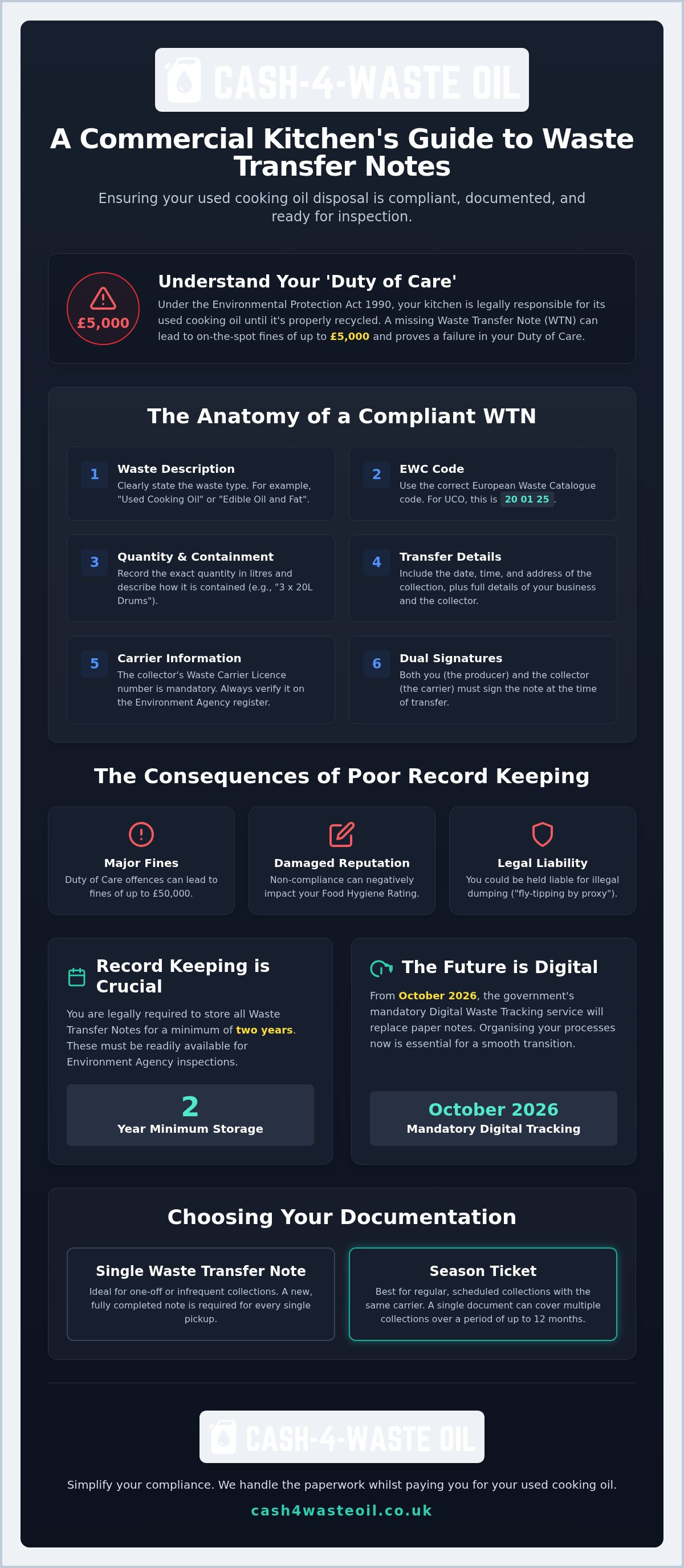
A valid WTN isn't just a receipt; it's a legal document with specific components. To meet the waste transfer note requirements UK, your documentation must contain six primary elements. These include a clear description of the waste, the appropriate classification code, the quantity produced, full business details for both parties, the collector's licence number, and a dual signature. Missing even one of these fields can render the entire document invalid during an audit.
For cooking oil, quantity must be recorded in litres. Precise figures are essential because they allow the Environment Agency to cross-reference your oil purchases with your waste output. If you buy 500 litres of fresh oil but only account for 50 litres of waste over a year, it raises immediate red flags regarding illegal disposal. Ensure your business addresses are complete and legible; a postcode alone is insufficient for compliance. If you want to skip the administrative burden, you can find a professional who offers used cooking oil collection and handles the documentation on your behalf.
Describing the Waste: EWC Codes for Cooking Oil
The European Waste Catalogue (EWC) uses a six-digit coding system to classify every type of waste. For used cooking oil (UCO), the correct code is 20 01 25. This specifically covers edible oil and fat. It's vital to distinguish this from 20 01 26, which covers other types of oils, or grease trap waste. Correct categorisation prevents your waste from being rejected at the recycling plant and ensures you're following the correct disposal pathway for vegetable-based products.
Carrier and Broker Details
Your document must include the collector's Waste Carrier Licence number. This proves they've been vetted by the Environment Agency and are authorised to transport your waste. You also need to state the exact place and date of the transfer. Don't forget your Standard Industrial Classification (SIC) code; most restaurants and cafes use 56101 or 56102. Including these details ensures your paperwork is bulletproof and traceable.
Containment and Safety Information
Describe how the oil is packaged. Are you handing over 20-litre drums, 120-litre blue barrels, or is it a bulk tank suction? You must also declare the waste as non-hazardous. Whilst used vegetable oil is generally safe, any processes the waste has been through, such as filtering, should be noted. This transparency helps the recycler manage the material efficiently and ensures the safety of everyone in the supply chain.
Single Notes vs. Season Tickets: Which is Better?
Choosing between a single transfer note and a season ticket depends entirely on your kitchen's output and collection frequency. A single waste transfer note is a one-off document used for irregular or ad-hoc collections. It's the standard choice if you only call for a pickup once your drums are full. Whilst this offers flexibility, it creates a significant administrative burden for busy chefs who have to sign and file a new document every few weeks.
For most established restaurants, a "Season Ticket" or annual note is the superior option. This single document covers multiple transfers of the same waste type over a set period. To satisfy the waste transfer note requirements UK, three elements must remain identical throughout the life of the ticket: the waste producer, the waste carrier, and the type of waste being collected. If you change your oil collector or move your business to a new unit, the season ticket becomes void and you must issue a new one immediately.
When to Use an Annual Waste Transfer Note
Annual notes are ideal for kitchens with a fixed, predictable schedule. If your oil is collected every Tuesday or once a fortnight, a season ticket removes the need for repetitive paperwork. These notes have a maximum legal duration of 12 months. You must renew them annually to remain compliant. Using an expired note is a common mistake that leads to "failure to produce" charges during Environment Agency inspections. It's a simple, pragmatic way to streamline your compliance whilst ensuring your records are always up to date.
Keeping the "Schedule" of Collections
A season ticket is not a standalone document; it must be supported by a "Schedule of Collections." Many business owners forget this critical step and find themselves vulnerable during audits. You must maintain a log that records the specific details of every individual pickup made under the annual note. This log acts as the granular proof that the transfers actually took place. Your schedule should include:
- The exact date and time of the transfer.
- The specific volume of oil collected in litres.
- The signature or digital confirmation from the driver.
We recommend using a digital spreadsheet or a dedicated compliance app for this log. Physical paper logs in a kitchen environment often become illegible due to grease or moisture damage. Digital records are easier to organise, back up, and produce instantly when an inspector arrives. By pairing a valid annual note with a meticulous collection log, you create a robust audit trail that protects your business from heavy fines.
Organising Your Records for Environment Agency Inspections
Local councils across London and the South East are becoming increasingly proactive with unannounced inspections. You cannot afford to be caught off guard when an officer walks through your kitchen door. To stay ahead, we recommend a "compliance folder" approach. This can be a physical binder kept in the manager's office or a dedicated digital folder. The goal is to ensure every document is accessible within seconds. If you can't produce the records immediately, you risk a "failure to produce" charge, regardless of how well you actually manage your waste.
Whilst physical folders are traditional, they are vulnerable to grease spills and heat damage in a busy kitchen. Digital storage is the superior choice for longevity and ease of access. By October 2026, the transition to mandatory digital tracking will make digital record-keeping the industry standard. Storing your notes in the cloud ensures they are backed up and searchable, which is essential for meeting the waste transfer note requirements UK during a high-pressure audit.
The 2-Year Retention Rule Explained
You are legally required to keep all waste transfer notes for a minimum of two years. This clock resets with every new note generated. If you use an annual season ticket, the two-year period starts from the date the ticket expires, not the date it was issued. Even if your business closes or you move to a new premises, these records must remain accessible for inspection. This ensures a transparent trail for the authorities to follow. For a broader look at staying safe and legal, check out our essential compliance checklist.
What Happens During a Waste Audit?
When an Environment Agency officer visits, they aren't just looking for signatures. They want to see a clear audit trail from your fryer to the final biodiesel feedstock. They will check that your volumes match your business size and that you've followed the waste hierarchy. This hierarchy requires you to prove you have taken steps to reduce waste, reuse where possible, and recycle the rest. Proving your commitment to recycling is easy when your WTNs clearly show your oil is being collected for repurposing. If you want to ensure your records are always perfect and your oil is handled by an Environment Agency registered carrier, book a collection with us today. We provide a fully compliant WTN with every pickup, giving you total peace of mind during any inspection.
How Cash 4 Waste Oil Simplifies Your Compliance
Managing a kitchen is demanding enough without the added stress of regulatory paperwork. Most business owners view documentation as a chore, but we see it as a service feature. At Cash 4 Waste Oil, we've designed a collection process that removes the "paperwork headache" entirely. We don't just take your oil; we ensure your business meets every one of the waste transfer note requirements UK at the point of collection. This proactive approach keeps your records spotless and your kitchen inspection-ready at all times.
Our service covers a wide area including London, Kent, Surrey, and across the Midlands. We provide a fully compliant Waste Transfer Note for every single pickup, so you never have to worry about missing records during an inspection. The best part? We pay cash on the spot for your used vegetable oil. This turns a mandatory compliance task into a profitable transaction, proving that environmental responsibility and commercial gain can go hand in hand. You get the peace of mind that comes with professional service and a direct financial benefit for your business.
Licensed Collection and Biodiesel Transformation
We take our role in the supply chain seriously. As an Environment Agency registered waste carrier, we ensure your waste is tracked and processed with total transparency. Choosing a licensed partner is the only way to protect your business from the "fly-tipping by proxy" risks discussed earlier in this guide. Beyond compliance, your waste plays a vital role in the circular economy. Our sustainable waste oil disposal process transforms your used kitchen grease into high-quality biodiesel feedstock. This reduces the UK's reliance on fossil fuels and gives your waste a second life as a renewable energy source.
Booking Your Free Compliant Collection
Arranging a collection in London, Birmingham, or the surrounding counties is straightforward. We operate with a no-nonsense approach: we arrive on time, we pay you per litre, and we hand over the necessary legal documentation. There's no need to chase collectors for missing notes or struggle with confusing online portals. Switching to a collector who understands the latest DEFRA cooking oil waste guidance ensures your kitchen stays ahead of the 2026 digital tracking mandate. Don't let compliance become a burden. Partner with a local expert who values your time and efficiency as much as you do.
Secure Your Kitchen’s Compliance for 2026 and Beyond
Mastering your Duty of Care doesn't have to be a source of constant stress. By understanding the specific waste transfer note requirements UK, you've already taken the biggest step towards protecting your business from Environment Agency fines. Whether you choose single notes for flexibility or season tickets for efficiency, the goal remains the same: a transparent, unbroken audit trail. As the industry moves towards mandatory digital tracking in October 2026, getting your record-keeping organised now will ensure a seamless transition later.
Compliance isn't just a legal hurdle; it's an opportunity to streamline your operations and even boost your bottom line. We make this process effortless by acting as your trusted, Environment Agency registered partner. We arrive, provide your digital or physical WTNs instantly, and pay you cash on the spot for every litre of used vegetable oil. You can get a compliant collection and cash for your waste oil today and focus on what you do best: running a successful kitchen. Let's work together to keep your business profitable, compliant, and environmentally responsible.
Frequently Asked Questions
What is the EWC code for used cooking oil in the UK?
The correct European Waste Catalogue (EWC) code for used cooking oil is 20 01 25. This specific classification covers edible oil and fat produced by kitchens. It's vital to use this code rather than 20 01 26, which is reserved for non-edible oils. Correct classification ensures your waste follows the right recycling pathway and remains a core part of the waste transfer note requirements UK for every collection.
How long must I keep waste transfer notes for my restaurant?
You are legally required to keep all waste transfer notes for at least two years. If your business handles hazardous waste, this retention period increases to three years. For annual season tickets, the two-year clock begins from the date the ticket expires. Keeping these records organised is essential, as Environment Agency officers can request to see them during unannounced inspections to verify your ongoing legal compliance.
Can I use an invoice instead of a waste transfer note?
No, a standard commercial invoice is not a substitute for a legal waste transfer note. Whilst an invoice proves a financial transaction occurred, it lacks the mandatory regulatory fields required by the Environment Agency. A valid WTN must include specific details such as EWC codes, SIC codes, and the waste carrier's licence number. Relying solely on invoices leaves your kitchen vulnerable to significant non-compliance fines during an audit.
Do I need a separate waste transfer note for every oil collection?
Not necessarily. You can use a single WTN for one-off collections or an annual "season ticket" for regular, scheduled pickups. A season ticket covers multiple transfers of the same waste type between the same two parties for up to 12 months. However, you must maintain a separate log or schedule of every individual collection date and volume to ensure the arrangement remains legally valid and transparent.
What happens if I cannot produce a waste transfer note during an inspection?
Failure to produce a valid note can result in an immediate fixed penalty notice or even criminal prosecution. Fines for "duty of care" offences can reach up to £50,000. Beyond the financial impact, missing documentation can damage your business reputation and lower your local authority hygiene rating. It is a serious administrative oversight that suggests your kitchen is not following mandatory environmental safety protocols or waste tracking laws.
Is a digital signature valid on a UK waste transfer note?
Yes, digital signatures are fully valid and increasingly encouraged by DEFRA. As the UK transitions to mandatory digital waste tracking in October 2026, electronic record-keeping is becoming the industry standard. Digital notes are easier to store, harder to lose, and simpler to produce instantly during a snap audit. Ensure your digital system captures the name and status of both the waste producer and the authorised carrier.
Does a waste transfer note cost money to produce?
There is no government fee for the document itself, but many waste carriers charge an "admin fee" or "compliance fee" to generate it. At Cash 4 Waste Oil, we provide a fully compliant WTN for free with every collection. We believe legal paperwork should be a seamless part of the service, not an extra expense that eats into your kitchen's weekly food budget or profits.
Who is responsible for filling out the waste transfer note?
Both the waste producer and the waste carrier share legal responsibility for the accuracy of the note. Whilst the collector usually prepares the document, you must check that all fields, including the waste transfer note requirements UK, are filled in correctly before signing. Both parties must sign the document and keep a copy to ensure the chain of custody is legally documented and traceable for two years.