Waste Transfer Notes for Pubs: The 2026 Compliance Guide
Did you know the Environment Agency now charges £118 per hour just to investigate a pub's waste compliance? For a busy landlord, a simple administrative slip-up with your used cooking oil can quickly turn into a financial headache. Managing waste transfer notes for pubs often feels like another layer of red tape that keeps you away from the front of house. You likely feel that the time spent chasing EWC codes and filing paper records is time that belongs in the kitchen.
We agree that your focus should stay on serving guests, not navigating complex environmental regulations. This guide promises to clear the confusion, showing you how to manage your documentation with total confidence. You will learn how to satisfy inspectors whilst actually making money from your waste oil. We will preview the latest 2026 digital tracking mandates, explain the essential EWC 20 01 25 classification, and outline a streamlined process that turns a disposal chore into a consistent cash payment. It's time to swap legal anxiety for total peace of mind and a better bottom line.
Key Takeaways
- Understand your permanent Duty of Care under the Environmental Protection Act 1990 and why it requires a clear audit trail for every oil collection.
- Learn how to accurately complete waste transfer notes for pubs using the specific EWC code 20 01 25 for used cooking oil.
- Discover how "Season Tickets" can reduce your administrative burden by covering multiple regular collections for up to 12 months.
- Find out how to stay compliant whilst earning cash on the spot by switching from general waste contractors to a specialist collector.
- Prepare for the 2026 digital tracking mandates and learn exactly how long you must legally retain your records to satisfy inspectors.
What are Waste Transfer Notes for Pubs?
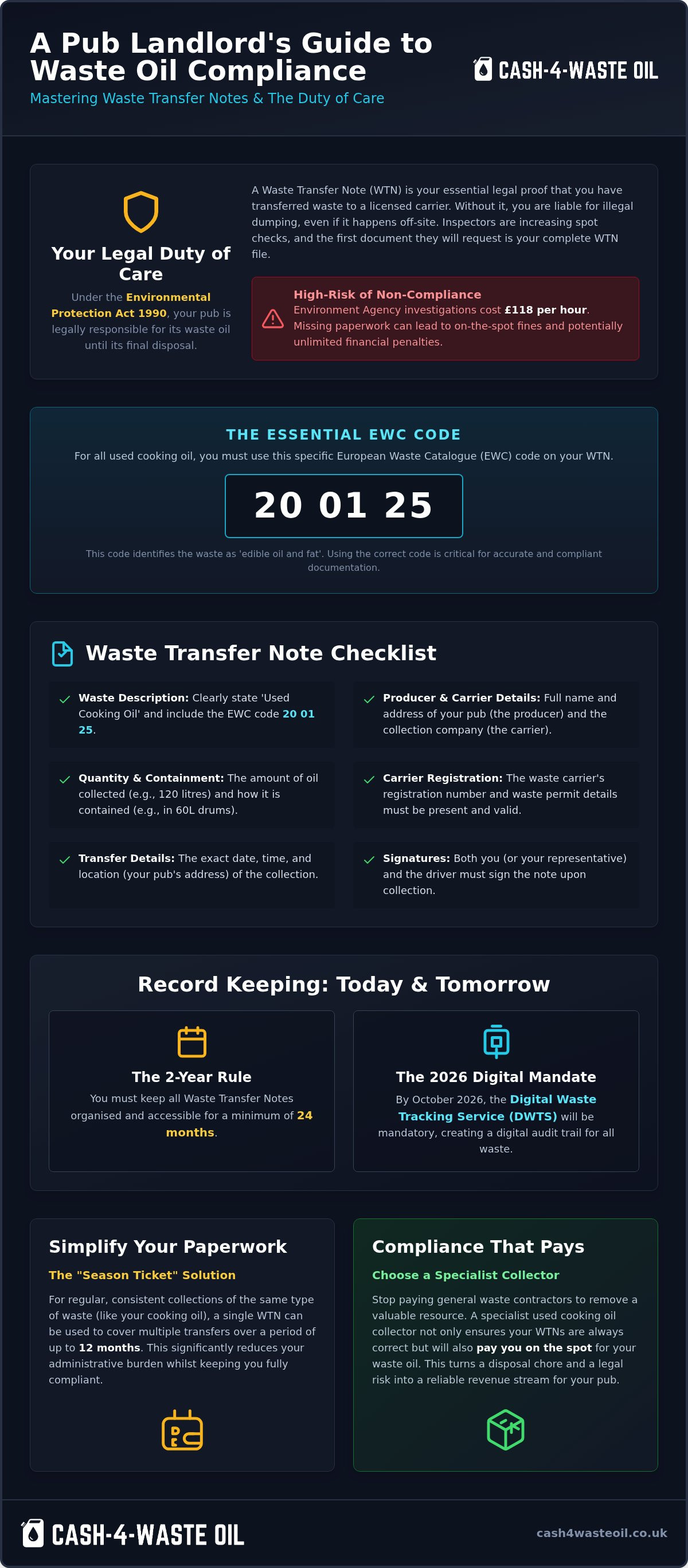
A Waste Transfer Note (WTN) is the legal receipt of a waste transfer between a waste producer and a licensed carrier. For your business, it's the primary document that proves you've handed over used cooking oil to a legitimate professional. Every single load of waste that leaves your premises must have one. These aren't just pieces of paper; they are the physical evidence of The Legal Duty of Care that every pub landlord holds. In 2026, staying on top of waste transfer notes for pubs is more critical than ever. It ensures a clear trail from your kitchen to the final processing centre, proving you aren't fly-tipping oil or pouring it down the drains.
Why Pub Landlords Cannot Ignore WTNs
Ignoring your paperwork is a high-risk strategy. If the Environment Agency or a local council inspector visits your site, the first thing they will ask for is your waste records. Failing to produce a valid WTN can lead to unlimited fines. Local authorities across London, Kent, and Surrey are currently increasing spot checks on hospitality fat-traps and oil storage areas. They want to see exactly where your waste is going. Having a correctly filed note protects your business. It proves you used a licensed, registered collector who handles waste responsibly. Without this proof, you're legally liable for what happens to that oil after it leaves your back door. It's a simple step that prevents massive legal exposure.
The Difference Between Hazardous and Non-Hazardous Waste
Confusion over waste categories often leads to administrative errors. Used cooking oil is classified as non-hazardous waste. This means it requires a standard WTN rather than a more complex Consignment Note. Consignment Notes are reserved for hazardous materials like chemicals, asbestos, or certain industrial solvents. Whilst used cooking oil is messy and environmentally damaging if spilled, it doesn't fall into the same high-risk legal bracket as toxic chemicals. Understanding this distinction is vital. It prevents your pub from wasting time on the wrong regulatory paperwork. By using the correct waste transfer notes for pubs, you ensure your compliance is accurate. A standard note for oil must contain:
- A description of the waste and its specific EWC code.
- The quantity of oil and how it is contained (e.g., drums or IBCs).
- The name and address of both the producer and the carrier.
- The date, time, and location of the transfer.
- The carrier's registration number and waste permit details.
Keeping these details accurate ensures your kitchen stays operational without unnecessary red tape or the threat of investigation fees.
The Legal Duty of Care: Why Your Pub Needs a WTN
Under Section 34 of the Environmental Protection Act 1990, every pub in the UK operates under a permanent "Duty of Care". This isn't a voluntary guideline; it's a strict legal obligation to ensure your waste is managed responsibly. You must verify that your waste oil is handled only by an Environment Agency registered carrier. Many landlords mistakenly believe their responsibility ends the moment the collection van pulls out of the car park. In reality, the producer of the waste remains legally liable for that oil until it reaches a fully licensed processing site. Your waste transfer notes for pubs serve as your only definitive proof that a legal transfer took place.
Without this documentation, you have no defence if your oil is later found dumped illegally. If an unlicensed collector pours your waste into a Kent hedgerow or down a Surrey drain, the authorities will trace the source back to your kitchen. The WTN acts as a legal shield, confirming you fulfilled your statutory duties by passing the material to a legitimate professional. It's the most important piece of paper in your kitchen office.
Environment Agency Inspections in 2026
Inspections are becoming increasingly data-driven and rigorous. When an officer visits a pub in Surrey or Kent, they aren't just looking at your grease traps; they're checking your audit trail. You must follow the "two-year rule", which requires you to keep every single WTN organised and accessible for at least 24 months. The landscape is shifting with the introduction of the Digital Waste Tracking Service (DWTS). By October 2026, receiving sites must use this digital system, and the Environment Agency will use this data to flag pubs that aren't reporting regular collections. If your records don't match the digital trail, you'll likely face a formal investigation.
The Consequences of Non-Compliance
The fallout from missing paperwork is swift and expensive. Inspectors can issue Fixed Penalty Notices (FPNs) on the spot for failing to produce documentation. However, the risks of using "cowboy" collectors go much deeper. If your oil contributes to the £18 million annual fatberg problem faced by companies like Thames Water, and you cannot prove a legal transfer, you face full prosecution. Beyond the fines, non-compliance seriously damages your pub's reputation. Environmental health officers often view poor waste management as a red flag for general kitchen hygiene, which can lead to a reduced star rating on your next inspection.
Choosing to work with an Environment Agency registered collector ensures your Duty of Care is fully met from the moment of collection, protecting both your licence and your local standing.
Essential Information: EWC Codes for Used Cooking Oil
Every waste transfer notes for pubs must feature a specific six-digit number known as a European Waste Catalogue (EWC) code. This code isn't just a filing reference; it's a legal requirement that identifies the exact nature of the waste being moved. For used cooking oil, the standard code is 20 01 25. This specifically designates edible oil and fat from commercial sources like your kitchen. Accuracy here is non-negotiable. If you misclassify your oil, the WTN becomes legally invalid. This often triggers an Environment Agency audit, as it suggests a lack of control over your waste management processes.
Alongside the code, the note must include a clear, written description. Simply writing "oil" isn't enough. Use specific terms like "Used vegetable cooking oil" to ensure there is no ambiguity during an inspection. In 2026, as digital tracking becomes the norm, these codes allow the Environment Agency to monitor waste volumes across the hospitality sector instantly. If your reported codes don't match the actual waste produced by a pub of your size, it could lead to a follow-up investigation.
Common EWC Codes for Pub Waste
Managing a busy cellar and kitchen means you handle various waste streams daily. Whilst 20 01 25 is your primary focus for oil collections, you should be familiar with other common codes to keep your records straight. This helps you organise your storage areas and ensure you're using the right carriers for the right materials. Common codes include:
- 20 01 25: Used cooking oil (edible oil and fat).
- 20 01 01: Paper and cardboard from deliveries.
- 20 01 02: Glass bottles and jars from the bar.
Keeping these codes separate ensures that your waste carriers are correctly licensed for the specific materials they are removing. Never let a carrier take oil under a general "municipal waste" code, as this invalidates your Duty of Care.
What Must Be Included on the Note
A compliant waste transfer notes for pubs requires more than just a code. It must provide a complete picture of the transaction to satisfy regulatory requirements. Ensure every note you sign contains these essential details:
- Producer Details: The full name and business address of your pub.
- Carrier Details: The name and official licence number of the collector.
- Waste Volume: The exact quantity of oil collected, measured in litres.
- Transfer Data: The specific date and time the oil left your premises.
Check these details before the collector leaves your site. It only takes a moment to verify the information, but it saves hours of administrative stress later. Insisting on accuracy at the point of collection turns a complex legal requirement into a simple, repeatable process that protects your business.
Organising Your Records: Storage and Season Tickets
Managing waste transfer notes for pubs doesn't have to be a daily paperwork battle. If your kitchen has a high turnover and requires weekly or fortnightly collections, you can simplify the process using a "Season Ticket". This is essentially an annual waste transfer note that covers multiple transfers of the same waste type for up to 12 months. It removes the need to generate a completely new document for every single visit, significantly reducing your administrative burden. It's a pragmatic solution for busy landlords who want to stay compliant without the clutter.
However, a Season Ticket isn't a shortcut to ignoring your records. You must still maintain a detailed schedule or log of every individual collection. This log must track the specific date of each transfer and the exact volume of oil removed. Inspectors will check this schedule against your annual note to ensure the volumes align with your business activity. Without this accompanying log, your Season Ticket is legally incomplete and won't protect you during an audit.
Digital vs Paper Waste Transfer Notes
Paper files are a liability in a high-pressure kitchen environment. Grease stains, heat, and misplaced folders often make physical records unreadable or impossible to find during a spot check. Switching to digital storage is the most sensible move for 2026. Digital notes offer instant searchability and secure cloud backups. When an inspector asks for proof of a collection from six months ago, you want to find it in seconds on a tablet, not dig through a dusty lever-arch file. To ensure your digital records meet Environment Agency standards, they must be clear, unalterable, and easily exportable for review. Most professional collectors now provide these automatically, saving you the hassle of scanning messy paper receipts.
The 2-Year Retention Rule
Why is 24 months the magic number for record keeping? Legally, you must retain every waste transfer note for a minimum of two years. This ensures that any retrospective investigation into local fly-tipping or regional sewer blockages can be cross-referenced against your kitchen's activity. Organising these documents into a simple, date-ordered filing system is an essential part of your commercial kitchen oil disposal strategy. It turns compliance from a stressful event into a background process that runs itself. If you want to automate your paperwork and ensure every record is stored safely, book your next collection with Cash 4 Waste Oil to receive your digital WTN immediately on-site.
Professional Oil Collection: Compliance That Pays You
Many landlords view waste management as a pure cost. General waste contractors often reinforce this by charging admin fees for documentation or software access. In contrast, using a specialist collector turns the entire process on its head. When you focus on waste transfer notes for pubs through a dedicated oil recycler, you aren't just ticking a compliance box. You're entering a circular economy where your waste has tangible value. It's the difference between paying for a service and being paid for a resource.
Cash 4 Waste Oil operates a "Cash on the Spot" model that rewards your efficiency. We arrive, measure your oil, and pay you per litre immediately. There's no waiting for monthly invoices or chasing rebates through a corporate portal. Crucially, we provide the mandatory WTN at the point of collection. You don't have to wait for an email that might get buried in your inbox; you receive the proof of transfer before our van leaves your premises. This immediate handover ensures your audit trail is always up to date without any extra admin work.
Turning a Legal Requirement into a Rebate
General waste companies often charge for notes, whilst specialists provide them as part of a get paid for used cooking oil London service. This rebate is a vital hidden income stream for modern pubs. To maximise this value, keep your fryer oil clean and stored in a secure, dry area. Regular collections prevent the oil from degrading, ensuring you get the best possible return. It's a rare scenario where doing the right thing legally actually puts money back into your till. By treating your oil as a byproduct rather than rubbish, you support the production of sustainable biodiesel whilst boosting your bottom line.
Booking Your Compliant Collection
Simplicity is the key to maintaining a busy kitchen. You shouldn't have to spend hours vetting collectors, but you must verify their Environment Agency registration. A legitimate carrier will always provide their licence details upon request. The Cash 4 Waste Oil process is built for the fast-paced hospitality sector: call us, we collect, you get paid, and the note is issued. We provide this reliable service across London, Kent, and Surrey, focusing exclusively on commercial kitchens. This local expertise means we understand the logistical challenges of pub deliveries and collections, providing a hassle-free experience that keeps you compliant and profitable.
Streamline Your Compliance and Boost Your Bottom Line
Navigating environmental regulations doesn't have to be a drain on your time or your budget. By mastering the use of EWC code 20 01 25 and maintaining a robust two-year filing system; you protect your licence and your professional reputation. Managing waste transfer notes for pubs becomes a simple; automated byproduct of choosing the right collection partner. You've seen how easy it is to swap paper clutter for digital security and turn a messy disposal task into a reliable revenue stream that supports the circular economy.
We are an Environment Agency registered collector dedicated to serving busy commercial kitchens across London; Kent; and Surrey. We pay cash on the spot for every litre collected and provide your mandatory documentation immediately on-site. There is no reason to pay for waste oil removal when your used oil has such high commercial value. Get a cash rebate and your Waste Transfer Note today; book your free collection. Your kitchen stays compliant; your records stay clean; and your business stays profitable. It is time to make your waste work for you.
Frequently Asked Questions
Do I need a separate waste transfer note for every oil collection?
You must have documentation for every transfer, but you don't necessarily need a unique piece of paper every time. If you have infrequent or ad-hoc collections, a single-use note is required for each visit. For those with a consistent schedule, a season ticket covers multiple transfers over a year. Regardless of the format, you must record the date and volume of every individual pickup to maintain a compliant audit trail.
How long must my pub keep waste transfer notes for used cooking oil?
You are legally required to retain all waste transfer notes for pubs for at least two years from the date of the transfer. This 24-month rule applies to both physical paper documents and digital files. Keeping these records organised is vital, as Environment Agency inspectors can request to see your full history during a spot check. If you cannot produce records for the past two years, your business faces significant fines and potential prosecution.
What is the EWC code for used cooking oil in a pub kitchen?
The correct European Waste Catalogue (EWC) code for used cooking oil from a commercial kitchen is 20 01 25. This code identifies the waste as edible oil and fat and is essential for the legal validity of your documentation. Using an incorrect code, such as those for general municipal waste, can trigger a regulatory audit. Always ensure this specific six-digit number is clearly printed on your note before you sign off on any collection.
Can I use a season ticket for my pub’s regular oil collections?
Yes, you can use a season ticket if you have regular collections of the same waste type by the same carrier. Also known as an annual waste transfer note, this single document covers all transfers for up to 12 months. It's a highly efficient way to manage waste transfer notes for pubs with high-volume kitchens. You must still keep a separate log of the dates and litre amounts for every individual collection to satisfy inspectors.
Is it illegal to dispose of used cooking oil without a waste transfer note?
It is illegal to hand over your used cooking oil to any carrier without receiving a valid waste transfer note. Doing so violates your statutory Duty of Care under the Environmental Protection Act 1990. Without this document, you have no legal proof that your waste was handled by a licensed professional. This oversight can lead to unlimited fines and leave your pub liable for any environmental damage caused by an unlicensed collector's illegal disposal.
Does the waste transfer note need to be a physical paper copy?
No, your records do not need to be physical paper copies; digital versions are fully recognised by the Environment Agency. In fact, digital notes are often more reliable in a kitchen environment as they don't get lost or damaged by grease and heat. As long as the digital record contains all the required information and is easily accessible for inspection, it meets all legal standards. Many professional collectors now issue these via email or mobile apps.
What should I do if my oil collector does not provide a waste transfer note?
You should refuse the collection immediately if a carrier cannot or will not provide a valid note. It's your legal responsibility as the waste producer to ensure the paperwork is completed correctly. Accepting a collection without a note leaves you with no evidence of compliance. If this happens, look for an Environment Agency registered collector who provides immediate, on-site documentation. Never risk your business's reputation and licence for the sake of a quick, undocumented pickup.
Can a pub get in trouble if the oil collector fly-tips the waste?
Yes, your pub can be prosecuted if your waste is fly-tipped by a carrier you hired. Under the Duty of Care, you are responsible for ensuring your waste is passed to a legitimate, licensed carrier. If you don't check their registration and keep a valid waste transfer note, the law treats you as partially responsible for the illegal dumping. Having a signed note from a registered professional is your only definitive legal protection against these serious charges.