Who Collects Used Cooking Oil? A Guide to Professional UK Services
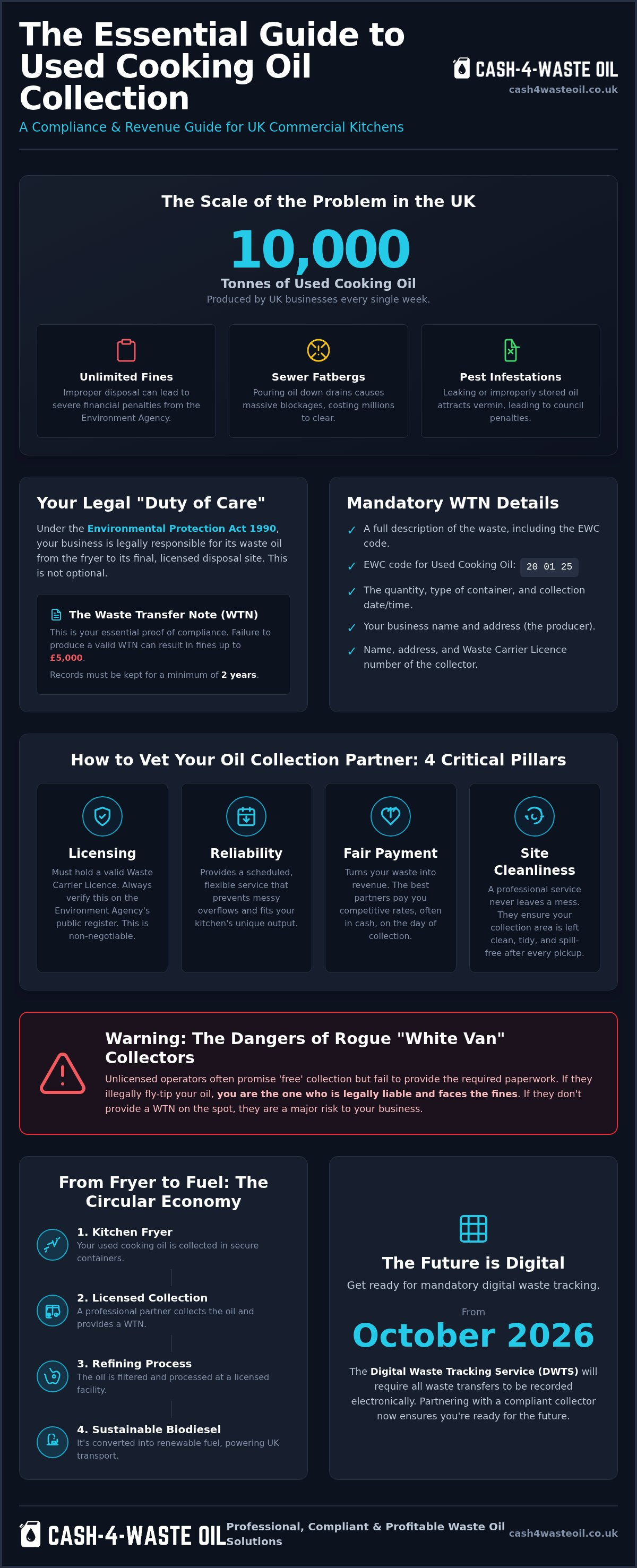
Did you know the UK produces over 10,000 tonnes of used cooking oil every week, yet many commercial kitchens still risk unlimited fines by letting it go to waste? Finding out exactly who collects used cooking oil shouldn't be a guessing game that leaves you vulnerable to rogue operators or messy, pest-attracting overflows. You need a reliable solution that's as fast-paced as your service, ensuring your back-of-house stays tidy whilst your business stays on the right side of the law.
We understand that managing a busy kitchen is demanding enough without the added stress of complex waste regulations. This guide shows you how to identify licensed waste oil collectors, stay ahead of the October 2026 Digital Waste Tracking mandate, and turn that greasy liability into immediate cash revenue. We'll walk through the legal essentials of Waste Transfer Notes, explain how to avoid the trap of rogue collectors, and outline the simple steps to ensure your kitchen remains clean, compliant, and profitable.
Key Takeaways
- Understand your legal "Duty of Care" and why a Waste Transfer Note is your essential proof of compliance against Environment Agency fines.
- Identify who collects used cooking oil by verifying an Environment Agency Waste Carrier Licence to ensure your kitchen waste is handled legally.
- Learn the four critical pillars of vetting a collection partner, focusing on licensing, reliability, immediate payment, and site cleanliness.
- Master the specific details required on every Waste Transfer Note, including the mandatory EWC code 20 01 25, to avoid costly non-compliance charges.
- Discover how to transform a messy disposal problem into a streamlined revenue stream with professional services that pay cash on the spot.
The Legal and Environmental Necessity of Professional Oil Collection
Professional waste oil collection is a strictly regulated logistical service. It isn't a casual chore you can delegate to just anyone. Under the Environmental Protection Act 1990, every UK business has a "Duty of Care" to manage their waste responsibly. This means you're legally responsible for your oil from the moment it leaves the fryer until it reaches a licensed disposal site. Understanding who collects used cooking oil and how they operate is the first step toward maintaining a compliant, safe kitchen.
Pouring oil down the sink is a fast track to financial disaster. It leads to the formation of fatbergs; massive, solid blockages in the sewer system that cost the UK millions to clear every year. The Environment Agency takes this very seriously and can issue unlimited fines for improper disposal. Beyond the fines, businesses often face non-compliance charges of £118 per hour for the time spent investigating the source of a blockage. Deciding who collects used cooking oil for your establishment directly impacts your bottom line and your legal safety.
Why You Cannot Treat Cooking Oil as General Waste
Used cooking oil (UCO) is specifically classified under the European Waste Catalogue (EWC) code 20 01 25. It's hazardous to the environment and cannot be thrown out with general rubbish. Storing it in leaking drums leads to council penalties for attracting pests or causing spills. By October 2026, the Digital Waste Tracking Service (DWTS) will make electronic recording mandatory. You're legally required to keep a Waste Transfer Note for two years; failing to produce these records can result in fines of up to £5,000.
The Environmental Journey: From Fryer to Fuel
When you partner with a professional service, your waste enters a circular economy. Yellow grease, also termed used cooking oil, is refined into sustainable biodiesel. This significantly reduces the hospitality sector's carbon footprint by providing a renewable alternative to fossil fuels. It's a smart business move that supports the UK transport industry. The biodiesel produced from your old oil powers HGVs and public transport across the country, turning a messy liability into a valuable resource.
Types of Used Cooking Oil Collectors in the UK
When deciding who collects used cooking oil for your restaurant, you'll find three main categories of service providers. Each has a different impact on your kitchen's efficiency and legal compliance. Some kitchens rely on massive national corporations, whilst others prefer the agility of local specialists. There's also the option of using your fresh oil supplier, though this often lacks the financial benefits of a dedicated waste partner. Choosing the right one depends on whether you value corporate scale or a more personal, "hassle-free" relationship.
National Corporations vs. Local Specialist Partners
National giants often handle thousands of clients, which can result in a rigid, "one-size-fits-all" approach. Whilst they offer stability, they frequently struggle with the logistical hurdles of city-centre locations. If your business is based in Soho or Camden, a local specialist partner usually provides much faster response times. They understand the specific traffic restrictions and narrow access points of London and the Midlands better than a distant call centre. A local partner offers a tailored, scheduled service that adapts to your kitchen's output, rather than forcing you into a corporate collection window that doesn't fit your needs. Knowing who collects used cooking oil in your specific postcode can save hours of logistical frustration.
The Danger of Unlicensed "Free" Collectors
The "white van" rogue collector is a common sight in major UK cities. These individuals often offer free collection but fail to provide the necessary documentation. According to UK government regulations on cooking oil, you're the one legally liable if your waste is fly-tipped or disposed of illegally. If a collector doesn't issue a Waste Transfer Note (WTN) on the spot, they're a liability, not a help.
Always check the Environment Agency public register before handing over your oil. A legitimate collector will be a registered waste carrier and will never shy away from showing their credentials. If you want to avoid the risks of rogue operators and ensure you're paid fairly, it's best to work with a licensed local collector who understands the specific needs of commercial kitchens in your area. This ensures full compliance whilst putting cash back into your business.
Essential Criteria: How to Vet Your Oil Collection Partner
Finding who collects used cooking oil is only half the battle; you must ensure they meet professional standards before they enter your premises. A high-quality partnership rests on four pillars: licensing, reliability, payment, and cleanliness. Without these, you're inviting logistical headaches and potential legal trouble into your business. You need a partner who understands the fast-paced nature of the hospitality industry and acts as a dependable ally rather than a burden.
A valid Waste Carrier Licence from the Environment Agency is the absolute minimum requirement. Don't take a collector's word for it. Ask to see their certificate or verify their registration number online. This protects you from rogue operators and ensures your waste is tracked legally. Beyond paperwork, look for a collector who values your kitchen's hygiene. Professional services provide clean, sanitised barrels and exhibit mess-free behaviour during the collection process. Spills attract pests and create slip hazards, so a tidy operator is a non-negotiable asset for any serious kitchen manager.
Financial Returns: Cash on the Spot vs. Rebates
The most efficient way to dispose of commercial fryer oil is a service that pays you for it. Many national firms use complex rebate schemes that take 30 to 60 days to process. This delay starves your kitchen of immediate liquid capital. Choosing "cash on the spot" improves your cash flow instantly. It turns a waste management task into a revenue-generating activity. You get paid per litre the moment the oil is collected, with no hidden administration fees or waiting periods. This transparency ensures you know exactly who collects used cooking oil and exactly what it's worth to your business.
Logistics and Storage Solutions
Your storage setup should match your kitchen's volume. Whilst high-volume takeaway shops often require weekly collections, smaller cafes might only need a pickup every fortnight. Most professionals provide 60-litre or 120-litre blue barrels, which are easy to manoeuvre and seal tightly to prevent odours. If you produce massive quantities, bulk tanks might be more appropriate for your site. For more advice on maintaining a tidy area, check out these used fryer oil collection tips. Ensuring you have the right container and a predictable schedule prevents the messy overflows that damage your reputation and attract unwanted attention from pests.
Navigating Compliance: Waste Transfer Notes and Legal Duties
A Waste Transfer Note (WTN) is your only legal protection against Environment Agency prosecution. If an inspector arrives at your kitchen, they won't just check your food hygiene ratings; they'll audit your waste trail. You're legally required to keep these notes for a minimum of two years. Without them, you have no proof that your waste was handled by a licensed carrier. This is why deciding who collects used cooking oil for your establishment is a decision that carries significant legal weight.
Navigating the legalities of kitchen waste can feel like a full-time job. However, the Environment Agency's audit process is straightforward: they want to see the paper trail. Deciding who collects used cooking oil from your site determines whether that trail is solid or non-existent. Handing oil to an unlicensed collector without receiving a WTN leaves you fully liable for any environmental damage or fly-tipping they commit.
The Anatomy of a Valid Waste Transfer Note
In England, a WTN must contain specific details to meet the standards of the Environmental Protection Act. If any of these fields are missing, the document is technically invalid. A compliant note must include:
- The name and address of both the waste producer and the carrier.
- The carrier's Environment Agency registration number.
- The European Waste Catalogue (EWC) code 20 01 25, which identifies the waste specifically as edible oil and fat.
- The date, time, and exact location of the transfer.
- Signatures from both the kitchen representative and the collector.
Cash 4 Waste Oil provides these legal documents instantly with every collection, ensuring you're never left without the necessary paperwork.
Preparing for an Environment Agency or Council Audit
Surprise inspections are stressful, but being prepared removes the anxiety. An inspector from the Environment Agency or your local council will look for a clear, chronological file of your disposal records. With the introduction of the Digital Waste Tracking Service in October 2026, the government is moving towards a digital-first enforcement model. This means your records must be impeccable. Failing to produce a WTN upon request can lead to fixed penalty notices or fines of up to £5,000. For a deeper look at the upcoming digital requirements, see our 2026 compliance guide.
Don't leave your business vulnerable to heavy fines or legal action. If you need a reliable partner who understands the importance of full compliance, book your licensed oil collection today and get your paperwork in order instantly.
Streamlining Your Kitchen Waste with Cash 4 Waste Oil
Choosing who collects used cooking oil for your business shouldn't involve navigating complex contracts or waiting weeks for a rebate. Cash 4 Waste Oil operates with a simple, results-oriented philosophy: we take the mess away and put money back into your pocket immediately. We serve as a trusted local partner for commercial kitchens across London, Kent, Surrey, and the Midlands, providing a professional alternative to the slow-moving national giants. Our goal is to handle the logistics so you can focus on running your kitchen without the burden of waste management hanging over your head.
We believe in a "no-nonsense" approach that values your time. You won't find any hidden administration fees or long-term commitments here. Instead, you get a reliable, scheduled service that adapts to your kitchen's specific output. By choosing a partner that pays cash on the spot, you turn a necessary chore into an immediate boost for your daily cash flow. It's a pragmatic solution for smart business owners who want to stay compliant whilst staying profitable.
Our "No-Nonsense" Collection Process
We've stripped away the administrative fluff to create a service that moves as fast as your kitchen does. You don't need to worry about complicated accounting or delayed bank transfers. Our process is designed for maximum efficiency:
- Step 1: Reach out via phone or our website to book a collection time that suits your schedule.
- Step 2: Our professional team arrives in a clean vehicle to collect your used oil from your storage area.
- Step 3: You receive an instant cash payment per litre and a legal Waste Transfer Note on the spot.
The service is completely free; we're the ones paying you. Our teams are trained to behave professionally, ensuring your site remains clean and your staff aren't interrupted during busy service hours. Because we're an Environment Agency registered waste carrier, you can rest easy knowing your compliance is handled perfectly every time.
Serving the Hospitality Heartlands
We have deep local expertise in the UK's busiest hospitality hubs. From the high-pressure environments of Soho and Camden to the thriving food scenes in Birmingham and the Midlands, we understand the logistical challenges you face. Narrow access roads, strict traffic windows, and high-volume output aren't obstacles for us; they're part of our daily routine. This local focus allows us to offer rapid response times for emergency collections when your storage reaches capacity unexpectedly.
Knowing who collects used cooking oil with this level of local agility can be the difference between a clean yard and a messy overflow. If you're ready to clear your storage area and boost your cash flow, learn more about how to get paid for used cooking oil in London. We provide the reliability of a national carrier with the personal, hassle-free touch of a local guide.
Secure Your Kitchen’s Compliance and Cash Flow Today
Managing commercial kitchen waste doesn't have to be a source of constant stress or legal risk. By identifying a professional partner who collects used cooking oil, you ensure your establishment meets all current Environment Agency requirements whilst maintaining a tidy, pest-free storage area. A valid Waste Transfer Note is your only essential legal safeguard against heavy fines; don't settle for rogue collectors who leave you vulnerable. Choosing a service that pays cash on the spot is a smart business move that provides immediate liquid capital instead of forcing you to wait for complex rebate vouchers.
We pride ourselves on being a dependable ally for the hospitality sector. As an Environment Agency Registered Carrier serving London, Kent, Surrey, and the Midlands, we provide full compliance and professional behaviour with every visit. We make the entire process seamless, transparent, and profitable for your business. Book your free waste oil collection and get paid cash today to turn your greasy liability into a clean, compliant revenue stream. Let's help you keep your kitchen running smoothly whilst doing something positive for the planet.
Frequently Asked Questions
Who collects used cooking oil from restaurants in London and the Midlands?
Cash 4 Waste Oil provides professional collection services for commercial kitchens across London and the Midlands. We specialise in helping restaurants, pubs, and takeaways manage their waste efficiently whilst staying fully compliant with UK law. As a registered waste carrier, we ensure your oil is handled responsibly from the moment it leaves your premises. Our local teams understand the specific logistical challenges of city centres, providing a reliable alternative to national corporations.
Is it legal to give my waste oil to anyone who asks for it?
No, it's illegal to hand over your oil to an unlicensed carrier. Under the Environmental Protection Act 1990, you have a "Duty of Care" to ensure your waste is disposed of by an authorised professional. If you give your oil to a rogue collector who fly-tips it, you remain legally liable and could face unlimited fines. Always verify that the person who collects used cooking oil from your site holds a valid Waste Carrier Licence.
How much cash can I expect to receive for my waste oil?
You receive a cash payment based on the volume of oil we collect from your site. We pay per litre on the spot, ensuring your kitchen benefits from immediate liquid capital rather than waiting for complex rebate schemes. The exact amount depends on the quantity and quality of the oil you produce. This transparent model rewards efficient kitchens and turns a messy waste disposal task into a predictable revenue stream for your business.
What is a Waste Transfer Note and why does my restaurant need one?
A Waste Transfer Note (WTN) is a mandatory legal document that tracks the transfer of waste from your business to a carrier. It's your proof of compliance during an Environment Agency or local council audit. You're legally required to keep these records for at least two years. Every note must include specific details like the EWC code 20 01 25. Without a valid WTN, your restaurant risks heavy fines for improper waste management.
Do you collect used cooking oil from domestic households?
No, we don't provide residential or domestic oil collection services. Our operations are strictly focused on commercial kitchens, including restaurants, hotels, schools, and industrial catering units. If you're a homeowner looking to dispose of small amounts of oil, you should contact your local council or visit a household waste recycling centre. We specialise in the high-volume needs of the hospitality sector, providing the specialised equipment and documentation required for commercial compliance.
Which areas of the UK does Cash 4 Waste Oil cover?
We provide comprehensive coverage across London, Kent, Surrey, and the Midlands. Our local expertise allows us to offer rapid response times and flexible collection schedules tailored to the needs of businesses in these regions. Whether you're operating a busy takeaway in Birmingham or a fine-dining establishment in the West End, our teams are equipped to handle your requirements. We focus on these heartlands to ensure we remain a dependable, local partner for every client.
What happens to the oil after it is collected from my kitchen?
Your used cooking oil is transported to a specialist facility where it's refined into high-quality biodiesel. This circular economy process transforms a waste product into a sustainable fuel source for the UK transport industry. By recycling your oil, you're significantly reducing your kitchen's carbon footprint and preventing the formation of fatbergs in the sewer system. It's a pragmatic way to support environmental sustainability whilst fulfilling your commercial and legal obligations as a business owner.
Do I need to sign a long-term contract for oil collection?
No, we don't require our clients to sign long-term, restrictive contracts. We believe in providing a hassle-free service that earns your loyalty through reliability and prompt payment. You can book collections as and when you need them or set up a regular schedule that fits your kitchen's workflow. This flexibility ensures you're never locked into a service that doesn't meet your needs, allowing you to manage your waste on your own terms.